
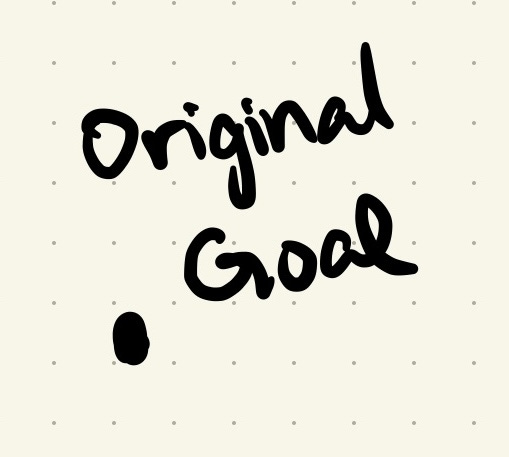
One of the main patterns that I’ve observed in many accounts of insight, wisdom, and growth is what I like to call the “journey.” Usually, one begins with a reasonable, understandable, single-pointed pursuit of a single goal or ideal. Let’s represent it thus:
However, soon one runs into obstacles, or disillusionment with that goal, and one turns their back on it completely, usually pursuing the exact opposite of it:
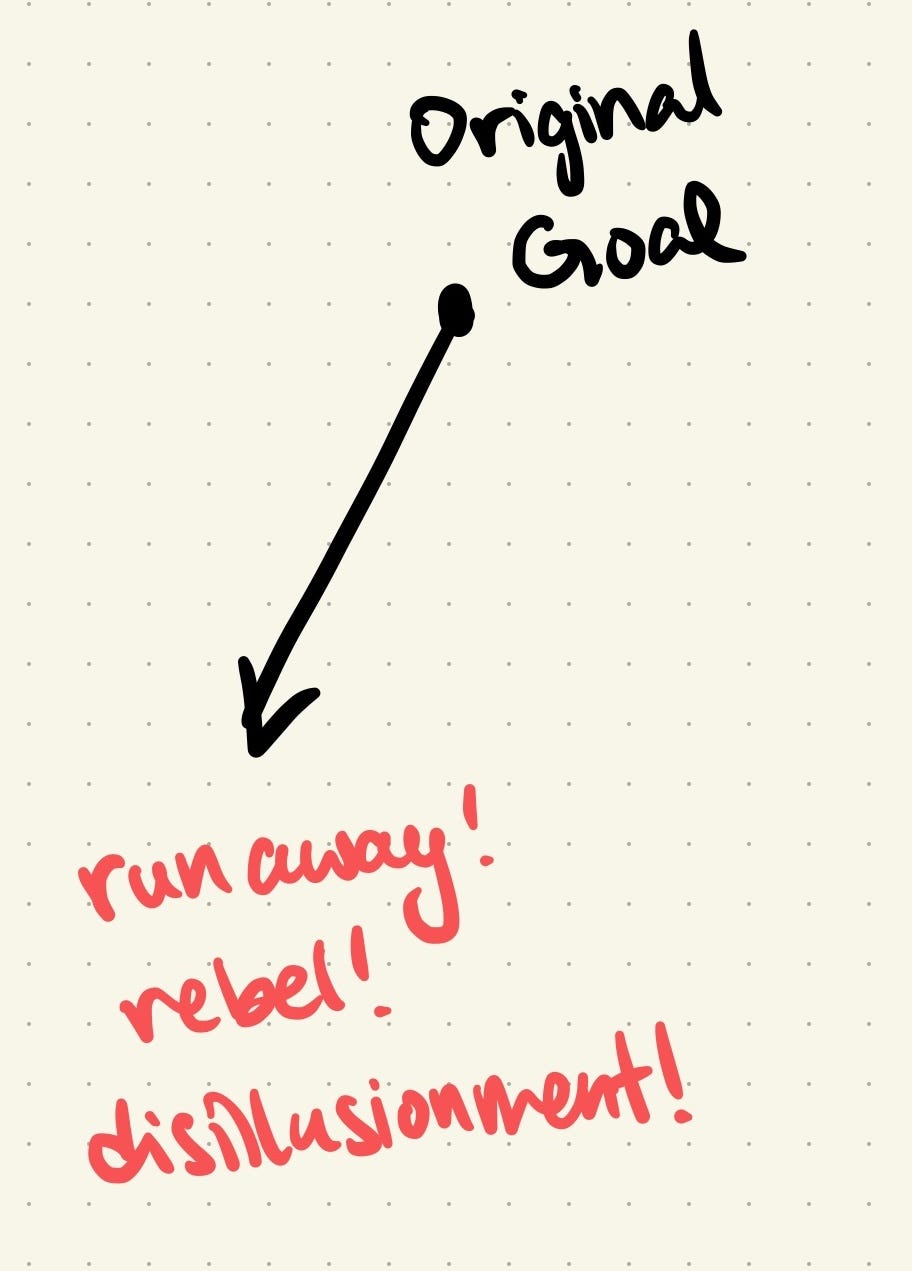
Of course, the opposite of stupid is not smart, and one often becomes disillusioned with their disillusionment and feels stuck.
At this point, many would argue for moderation, for a middle way, for balance. There is certainly a lot of truth to this, but more often than not one will feel trapped in an oscillating balance between the two, moving back and forth, stuck chasing that elusive Middle Way or Plato’s Golden Mean:
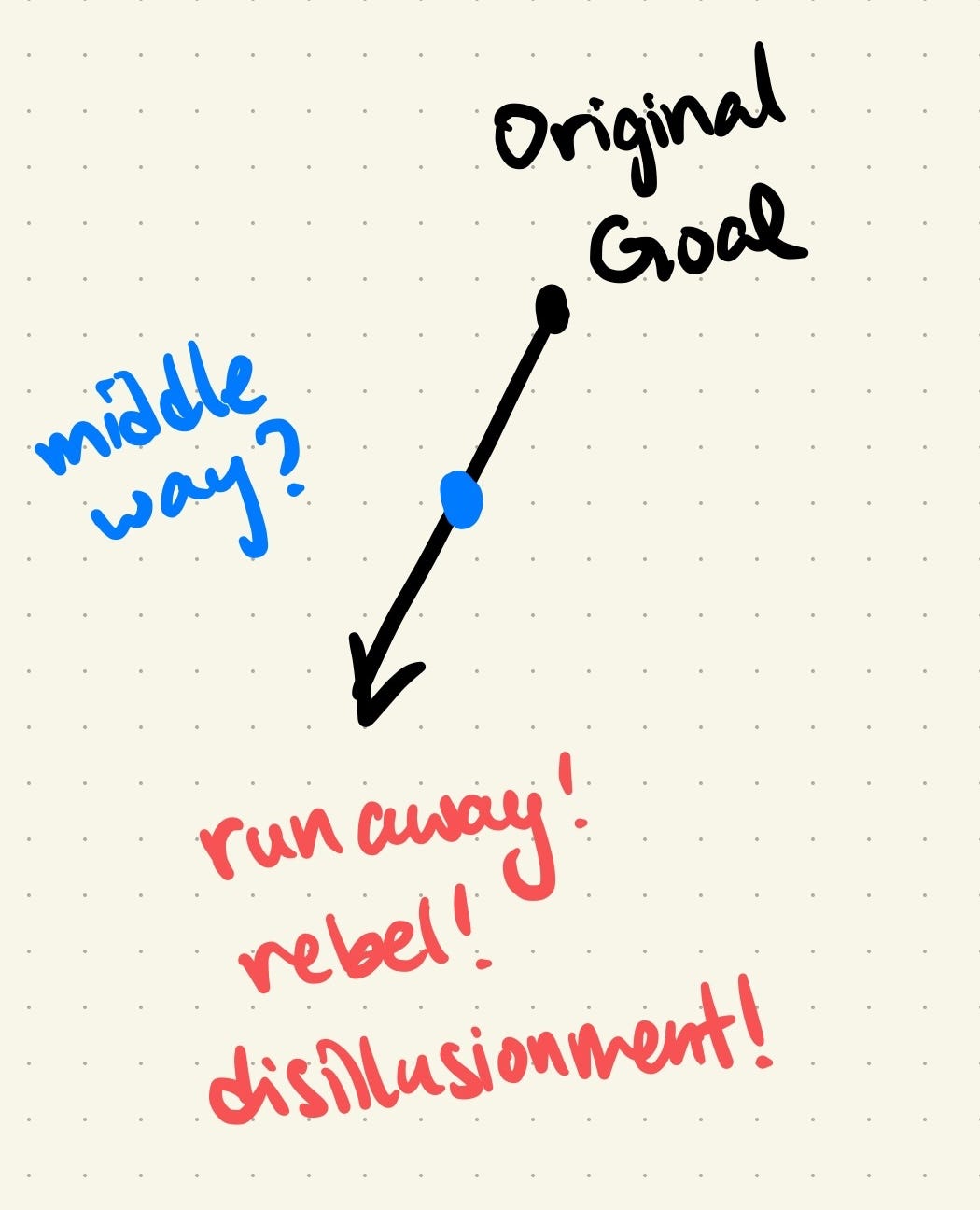
Instead, the breakthrough is realizing that the middle way is not about retreading old paths. Instead, the really really hard part is finding a third point of experience that extends space in a new dimension:
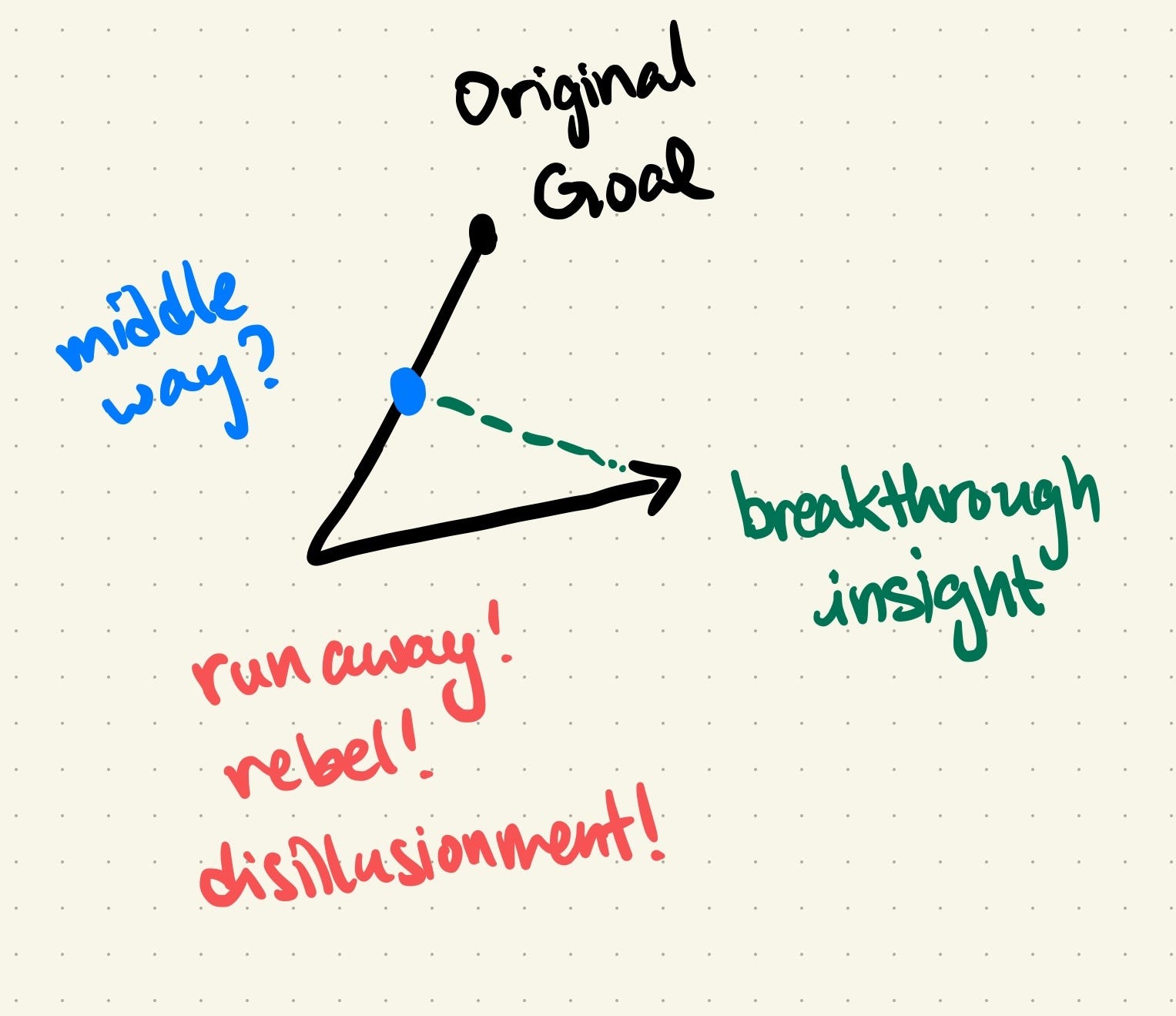
From this perspective, one sees that the confused middle way was simply a projection of the full path onto a lower-dimensional space. I can’t emphasize this enough — language, while a very powerful tool, for the most part works best with categories, and kind of caps out in expressiveness at 1-dimensional spectra with words like “middle” and “kind of”.
The journey to wisdom and beyond reasonable is oftentimes about finding and bootstrapping ourselves into new dimensions. Three points make a plane, and make for a much more interesting journey. In principle nothing stops us from going further, adding a fourth point of experience and a third dimension:
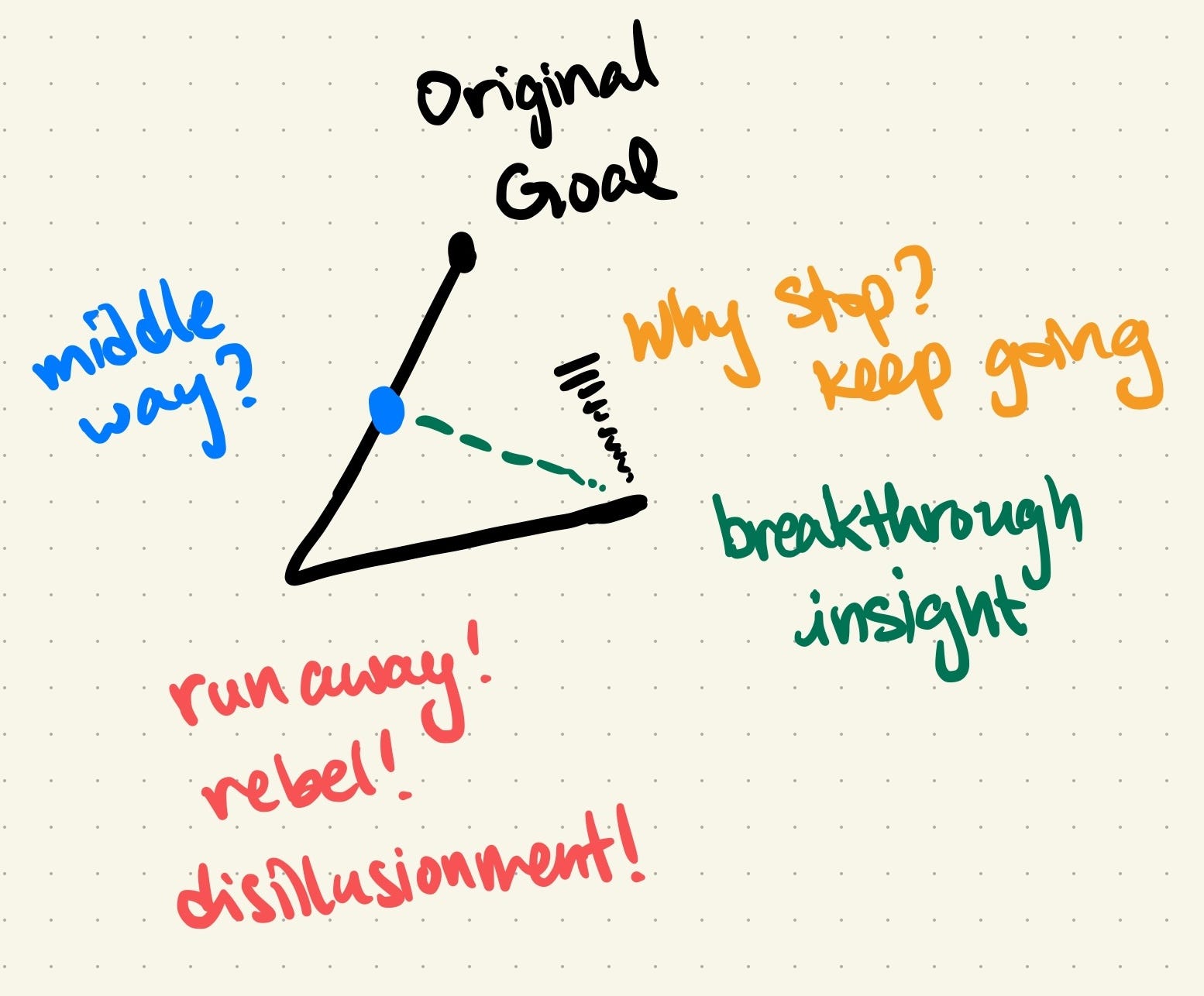
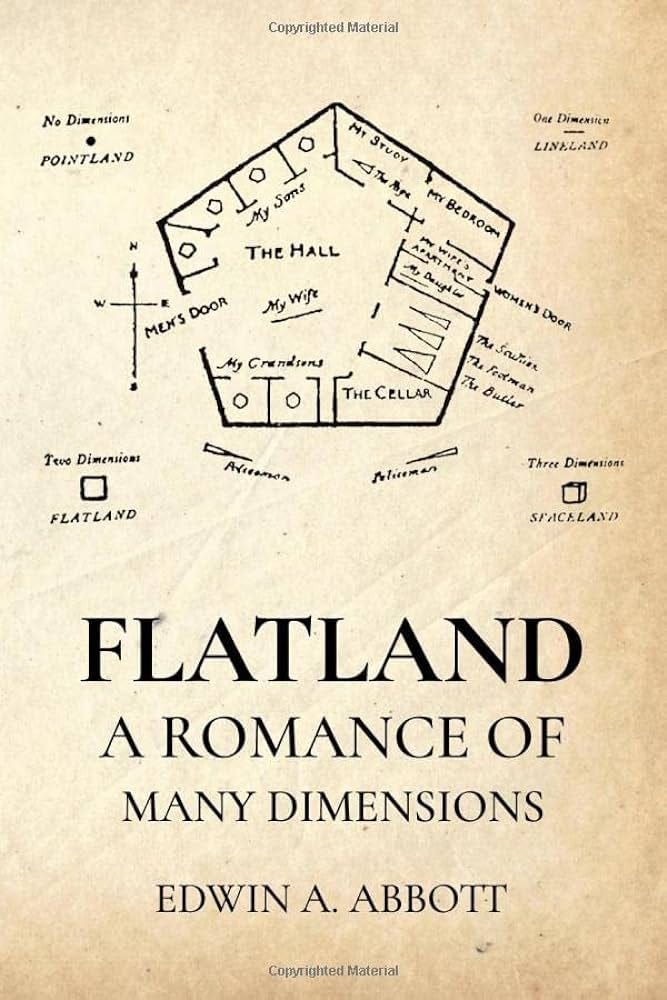
But 3D and above is getting rather complicated, quickly. And if breaking through to 2 dimensions is hard enough in daily life, 3D is likely to be much harder to conceive. Just read Flatland. It really can feel ineffable when you’re still trapped in lower dimensions.
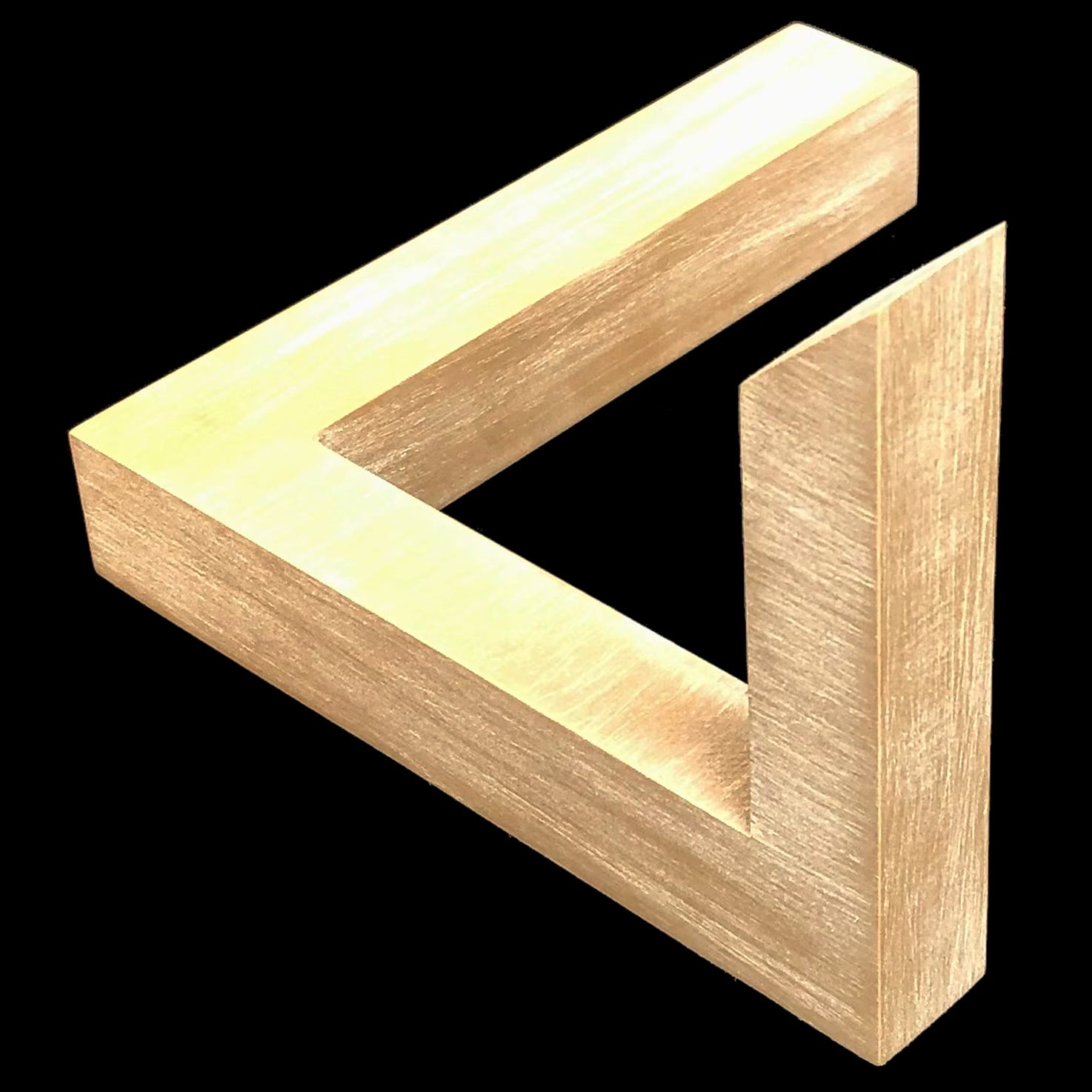
As a mnemonic I think of the Penrose triangle as sufficiently illustrating this journey into multidimensionality.
I am not sure if one can simplify the journey any more — simplify any more, and the journey is either “you’ve arrived already” or “the journey is straight ahead.” Almost surely, given the complexity of the world, one will need 3+ points of experience to really begin mapping out the nonlinear and multidimensional nature of the world. At best the journey above is just the beginning, and is just a crude, simplex approximation of the world and wisdom.
If the above seems obvious, great! But consider that even though it probably looks super obvious once you draw it down, upon closer reflection of human activity, in practice it really isn’t. You have people chasing after monism (e.g. “We are all One” or “this One secret/trick”) or finding aha moments in articulating dualism (e.g. “cosmic Good vs Evil”) or waxing poetic about the mystical ineffability of the middle way and non-dualism (these schools of thought content themselves with appreciating and recognizing the limits of dualism)… and discussion usually stops there. But step away from linguistic representations to a couple lines on paper… and it seems blindingly obvious. As noted elsewhere, responses to insights oftentimes “vary from enlightenment to boredom to bafflement.”
The interesting question is, if the above seems obvious, then why isn’t it more widely recognized, and importantly, practiced? Why are there so many thought errors associated with an excessive oversimplification and flattening of situations, squeezing out all dimensionality from an extremely high dimensional world? One could call this a variant of the map-territory (mis)correspondence, but it seems a bit more severe than that — a complete mismatch of geometry.
Why do we, the average, reasonable person nevertheless go on living in flat worlds in so many domains of life? What is limiting us? These questions of our limits are central to Beyond Reasonable.
As a starting but non-exhaustive list, some factors that limit us from living a fuller, multi-dimensional life likely include:
Limited mental capacity: people’s working capacity is juggling at most 3-4 ideas at once. Most likely, people reflexively want to work with even less.
Making sure we expand and fill our mental capacity to 3-4 concepts (representing 2-3 dimensions, respectively) is already quite challenging. I for one have trouble visualizing even 3-dimensional space. And if one does make it that far, there are likely other domains of life that require your bootstrapped attention, so there may be diminishing returns for going past 3-4 concepts at once.
Adding dimensions grows the number of situations we have to consider exponentially, further underscoring the mental cost and burden of doing so! The implication is that while individual situations can be articulated at a cost linear in dimensions, properly *contextualizing* the situation is much costlier.
So how do people get by with simpler 0-1 dimensional world views? Where does that simpler world view run into problems? We’ll cover this later, but most of “merely reasonable” thought is oriented towards facing local problems in front of us. Highly effective locally, but does not extrapolate well.
Limits of time and reality: Simply put, many people aren’t afforded time to think beyond 0-1 dimensions. If 0-1 dimensional thinking solves the problem at hand, then why go higher?
Limits of discursive, linguistic thinking: as noted earlier, language is not great at representing space. Discretizing space (into categories) is already huge progress, and considering a continuous spectrum in 1 dimension oftentimes maxes the expressiveness of everyday language.
Limits of experience: The easiest way to see new dimensions is probably to experience them. Most likely, if we are too early in our journey, we’ll only have 1-2 landmarks to focus on. We can’t hope to really grasp wisdom and multidimensionality until we go out and experience and find those new dimensions.
If you know your (or someone else’s) worldview only has a couple main reference points, you should have a hunch that it is too limited.
Wisdom can not be rushed. It must be experienced.
I believe that any “reasonably beyond reasonable” way of being should take the above limitations into account, especially limitations of intrinsic mental computational complexity as well as lived, real-world constraints, contexts, and problems.
In this view, if someone makes it to a 3-4 pointed consideration or analysis of a problem, they’ve already made huge strides in their framing of the problem, and even that is already hard enough and requires a good amount of work. In short, I think it’s reasonably beyond reasonable standard to hold ourselves accountable to, without overburdening ourselves in an unproductive way. People will likely come with fewer points, which is ok and maybe even interesting, but as a crude filter you’ll know it is too simple and that the serious work of integrating the 1-2 points within a higher dimensional space has yet to be done.
Your journey beyond reasonable begins with 3.
When facing an unstructured problem that you can’t solve reflexively, try to lay it out (“embed it”) in 2-3 dimensional space. If you can’t, you know you need more experience/data points. If someone *else* comes to you with a simpler solution that lives in 0-1 dimensions, politely tell them that it’s a good start, but please come back after you’ve done a bit more interesting work.
Side note 1: In machine learning parlance, I suspect that 3-4 is a good rule-of-thumb human hyperparameter for how much effort to put into fleshing out a problem. 3-4 might not seem like a lot, but in my experience we rarely reach even this seemingly modest amount of mental capacity. Thus, a lot of Beyond Reasonable will be associated with techniques for increasing our mental capacity and mental abundance.
Additionally, although it would be nice to increase it and develop a stronger mental model, ie a stronger learner with more than 3-4 considerations, in a complex and nebulous world there is a very good chance that one’s mental resources are better directed towards creating different weak learners that capture completely different perspectives and aspects of life.
Side note 2: In Peirce’s Categories, he proposed a reduction hypothesis that triadic relations are the fundamental irreducible unit in representing ideas and meaning. More support for the notion that the world of relationships really gets interesting once we get to 3!
No posts
Comments
Nothing yet. Say the first thing.
Sign in to join the conversation.