
This spring, I was asked to present to families and teachers in Colorado’s largest school district on gifted underachievement, and I’ll be presenting on the same topic at several conferences and schools this fall. Gifted underachievement has become a central focus of my education consulting practice and is one of the most frequent reasons families seek my support.
Not only is underachievement an emotionally charged, negative term, but it’s also notoriously difficult to define.1 It implies a reduced level of performance, but reduced performance relative to what, exactly? And by whose definition is someone actually an underachiever?
Today and next week, I’m sharing some of the critical information I’ve shared with families and school districts to help you understand the perplexing problem of gifted underachievement.
This week I’m covering:
What gifted underachievement actually is and how commonly it occurs
The difference between an underachiever and a selective consumer
For paid subscribers, I’m also including:
Warning signs of underachievement by age and developmental stage so you can spot it early and help prevent it
Then next week, I’ll cover:
What research has found about the causes of underachievement
Strategies to combat underachievement, even after it has begun
The two-page handout on underachievement I share with families and teachers, which you are welcome to share with your child’s teachers

Whether you were at some point told by a teacher that you weren’t “living up to your potential,” or you are the parent of a bright child who seems unmotivated by school—you’re in good company. In my practice working with parents and gifted adults, I hear concerns about achievement weekly.
Parents are often frustrated when a child who previously loved learning disengages from schoolwork and starts receiving poor grades. Gifted adults often grieve that they didn’t achieve as much as they hoped because no one ever mentored or guided them, or because life got in the way. When schools and workplaces routinely fail to meet the needs of gifted people, underachievement is often the result.

Yet other times, achievement concerns arise because gifted people are expected to achieve greatness, and anything less than that feels like a failure. A gifted adult may share that they are privately ashamed of their lack of career accomplishments, or a gifted young adult may be distraught that they weren’t the class valedictorian. But digging deeper, I frequently find that these were never really the goals they cared most about anyway—they were simply the expectations others placed on them.
In these cases, unrealistic expectations can create a perception of underachievement when, in reality, there is none. This is why it’s critical to first explain what gifted underachievement actually is, and what it is not.
Gifted underachievement is challenging to define, but is most frequently understood as “a discrepancy between a person’s demonstrated ability and their actual performance that persists over time.”2
Rather than a single poor grade or lackluster job interview, it is a pattern of poor performance that repeats over time and is significantly below an individual’s previously demonstrated level of performance or capability. True underachievement has nothing to do with what we believe smart people should or could do with their lives; it must be relative to an individual’s own proven capabilities.
To illustrate: the child who consistently earns A’s without trying, then earns C’s and D’s because they are no longer turning in work, is likely underachieving. In contrast, a gifted child who has always worked hard and achieved B grades is probably performing at their true ability level. Just because a person is identified as gifted does not mean they will suddenly earn A grades, or that anything less than perfection indicates underachievement.
Critically, though underachievement is an individual issue, it does not mean that underachievement is the fault of a given person. As I’ll cover more in part two, underachievement is multifaceted and complex, and can be caused by everything from undiagnosed learning disabilities to mental health concerns to inappropriate school or home environments.
The statistics on underachievement are alarming. A large systematic review of 33 studies on gifted underachievement conducted between 2010 and 2024 found that between 9 and 50% of identified gifted students underachieve, depending on how researchers defined the term.3
That same systematic review found that gifted underachievement intensifies as children age, and becomes two to three times more common in middle and high school than in elementary school. Gifted boys are more likely than gifted girls to underachieve overall, and gifted girls are more likely to underachieve in math.4
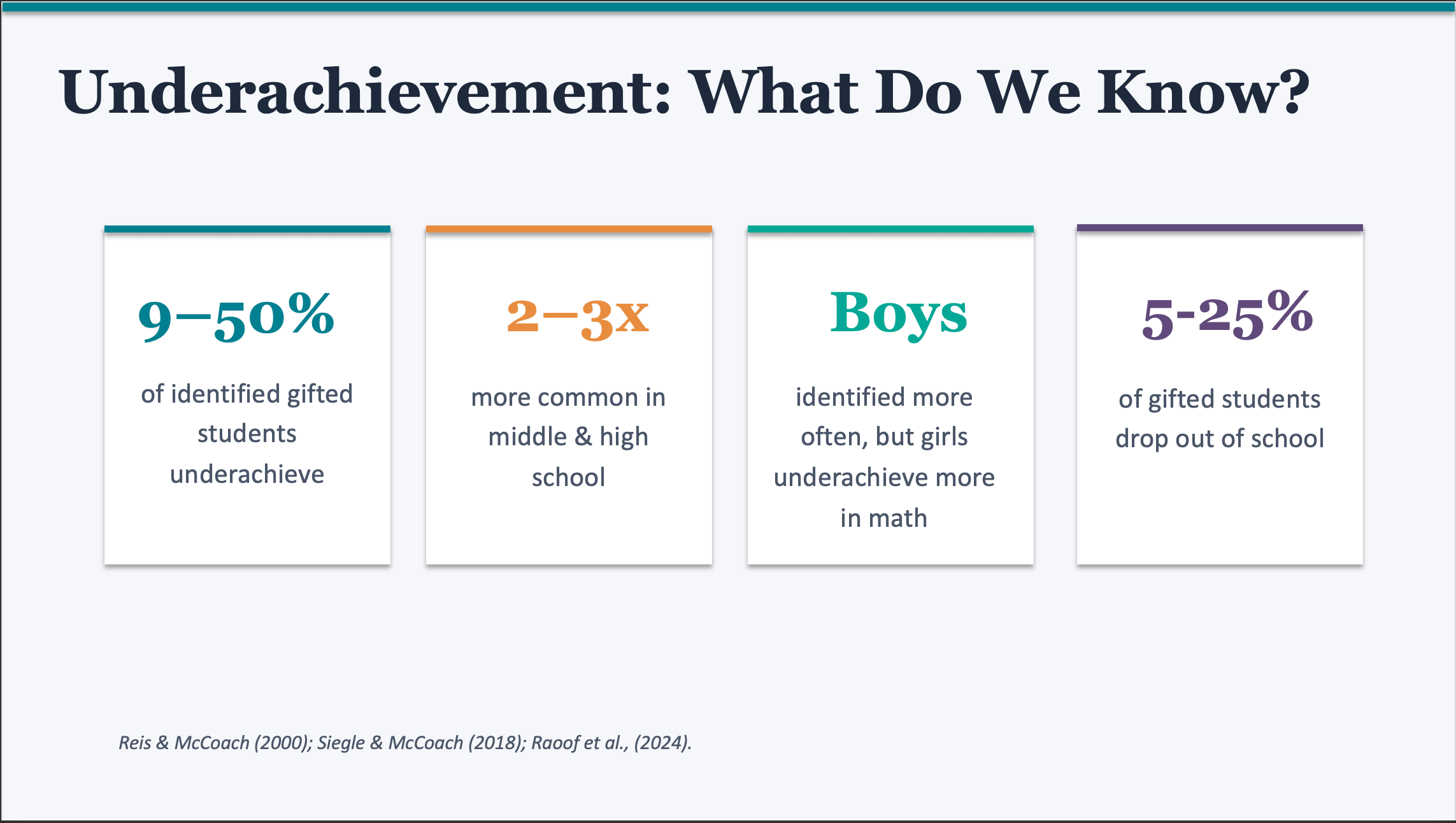
Stunningly, estimates suggest that as many as 25% of gifted students may drop out of school altogether before graduating high school.5 For reference, the percentage of all eligible students ages 16-24 who did not graduate with a high school credential was roughly 5.3% as recently as 2022.6 Other research suggests that gifted students may drop out of school at similar rates to the general population, but because population-level achievement data doesn’t parse students specifically by gifted identification, we can’t say for sure. 7
✨ If you’re a sensitive, ambitious, bright adult in need of career support, consider joining us for the CURIOUS Career Cohort, beginning Sept. 2nd. Learn more here. ✨
I’ve written previously about the myth of potential and how being gifted doesn’t obligate you to achieve. But for many of us, it’s hard to shake the belief that when you are smart, competent, and a natural at many things, you should do something magnificent with your life.
Giftedness is often conflated with high grades, monetary success, and prestige, but as I outlined in this article, being gifted is not the same as being a high achiever:
Giftedness is a neurobiological difference characterized by advanced reasoning, intense curiosity, strong pattern recognition, and heightened sensory perception. While it’s true that gifted children have an enormous capacity to succeed in the right environments, not every gifted child will achieve at high levels.
High achievers frequently enjoy school, follow the rules, successfully complete graduation requirements, climb the career ladder, and as a result, live conventionally successful lives. Some are intrinsically motivated to achieve, and many work very hard to do so. Others succeed at a high level because of factors such as socioeconomic advantage or enormous social pressure to succeed. Some high achievers may also be gifted, while others may not be.
When I hear someone say, “Everyone said I was so smart. Why haven’t I done anything with my life?” it suggests to me that somewhere along the way, giftedness became conflated with high achievement. Gifted people certainly can be high achievers, but not all high achievers are gifted, nor will all gifted people achieve extraordinary things.
Research suggests that a person’s life outcomes are heavily influenced by many factors beyond intelligence, such as their life circumstances, marital status, and personality traits.8 As you’ll see, gifted underachievement is similarly influenced by numerous variables, many of which are outside an individual’s control.
The late, brilliant Dr. Jim Delisle, who spent much of his career studying underachievement, offers a helpful shift in perspective. In Dr. Delisle’s view:
An underachiever is a person who is flawed, broken, or lazy.
A selective consumer is a person who makes reasonable judgments about which work and efforts are worth their time.
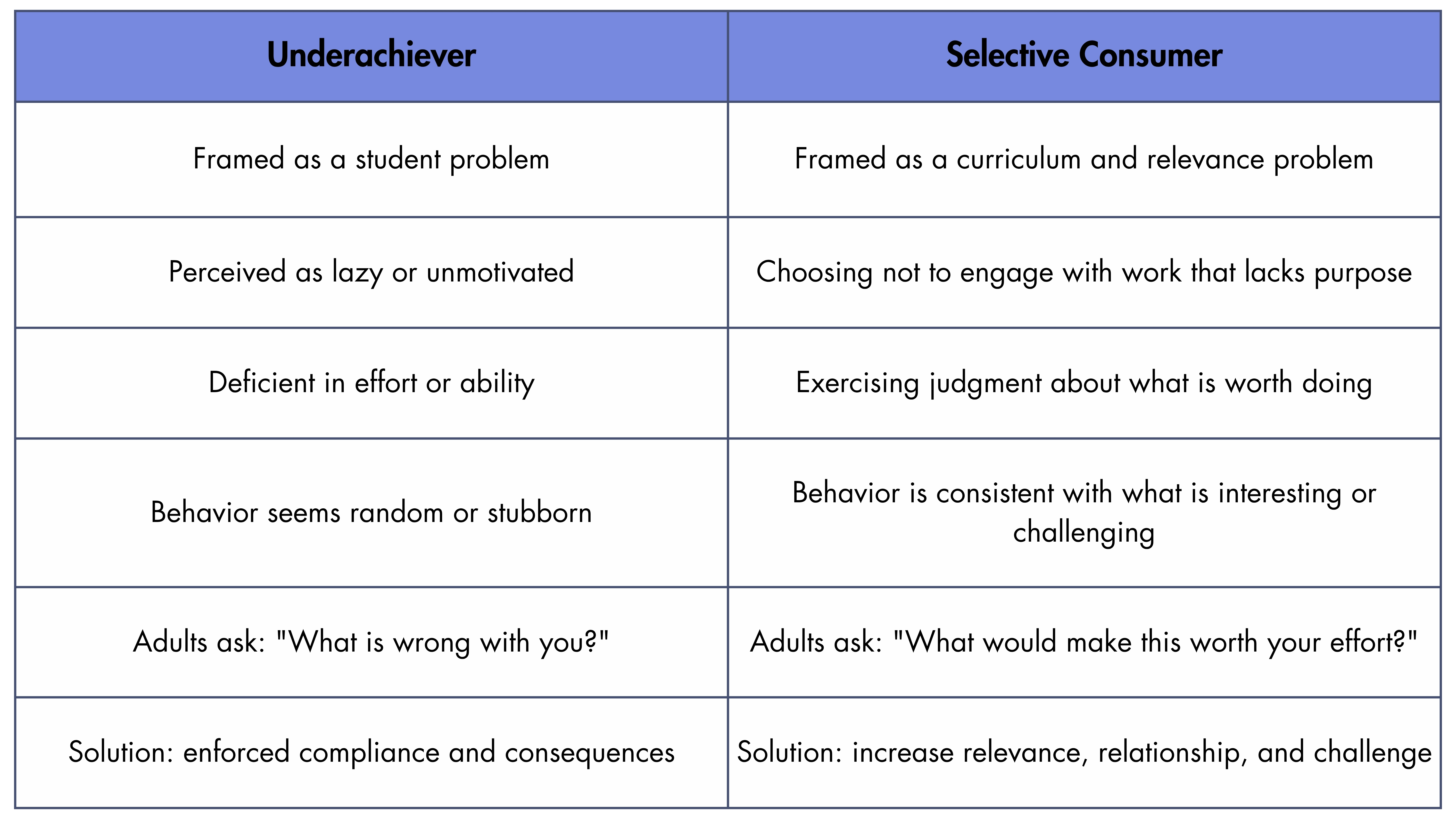
This is a beautiful way of seeing underachievement as the rational consequence of a person’s experience in a given environment—an outcome that can be changed—rather than a personal problem or individual behavioral flaw.
For children and teens in particular, achievement is often influenced by the attitudes and perceptions adults have about them. When children are placed in environments where giftedness is understood as a neurobiological difference rather than a measure of performance, and adults take the time to build relationships and make school worth the child’s effort, we see much higher levels of achievement.
A large body of research has found consistent warning signs and indicators of potential underachievement, though these vary by age and developmental stage.
If you are concerned that you or your child are exhibiting symptoms of underachievement, or you want to make sure you know what to look for to prevent it, you’ll want to take a look at the following chart:
Comments
Nothing yet. Say the first thing.
Sign in to join the conversation.