
Last week, I shared the first of a two-part series outlining the perplexing issue of gifted underachievement. If you missed it, here is part one.
In my prior article, I shared what underachievement is and how commonly it occurs, the difference between underachievers and selective consumers, and warning signs of underachievement by age and developmental stage.
Today’s article dives into why gifted people often underachieve, even when many people assume they've been handed a ticket to success.
I’m covering:
What research has found about the causes of underachievement
And for paid subscribers, I’m including:
16 evidence-based strategies to combat underachievement, even after it has begun
The two-page handout on underachievement I share with families and teachers, which you are welcome to share with your child’s teachers

With underachievement, it’s tempting to point to a single cause—you just need to try harder!—but in reality, underachievement is a complex, multifaceted issue. The good news is that even understanding a handful of the contributing factors can go a long way towards supporting gifted people and reversing patterns of underachievement.
A large systematic review of 33 studies on gifted underachievement found a consistent pattern of contributing factors, which researchers categorized as internal/person-based factors (specific to an individual) and external factors (related to a person’s environment or circumstances).1
These factors are summarized in the table below:
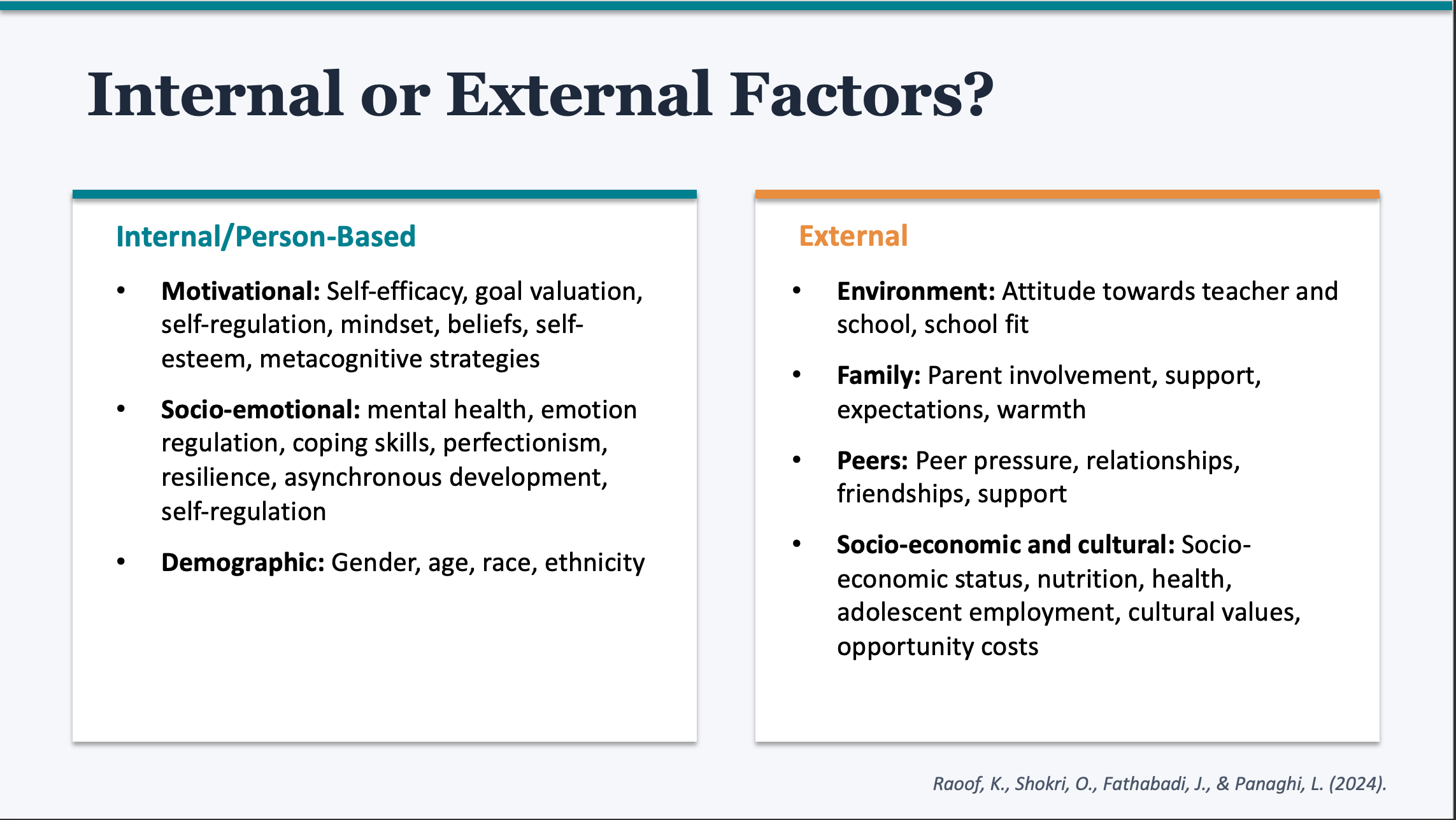
While many factors that lead to underachievement are specific to an individual, they are not always within the individual’s control. Internal factors researchers have identified as contributing to underachievement include:
Motivational factors: Motivation is multifaceted and encompasses facets like self-efficacy, mindset, metacognitive strategies, goal valuation, and self-esteem. When being smart is a child’s entire identity, it can be difficult to take risks, as failure threatens that identity. Underachievement is thus often a response to fear of failure, poor self-concept, and problematic self-beliefs.
Socio-emotional factors: Underachievement can be influenced by traits such as perfectionism, asynchronous development, mental health concerns, ineffective coping skills, and difficulty regulating intense emotions.
Demographic Factors: A person’s race, gender, ethnicity, disability status, and geographic location have all been shown to influence underachievement. Boys, individuals with disabilities, and those from minoritized racial groups all face a higher likelihood of underachievement. 2

While many individual factors contribute to underachievement, the way these factors interact with the environment increases or decreases the likelihood of underachievement. Environmental contributors include:
School environment: When curriculum is inadequate—whether because it is too easy, too slow, or doesn’t match a student’s way of learning—it can cause gifted children to disengage. The absence of meaningful challenge can also deprive children of a chance to learn the academic skills needed for higher levels of study and to develop protective factors such as self-confidence.
Family dynamics: Family dynamics that can contribute to underachievement include parents overemphasizing the importance of grades or threatening consequences for poor performance, comparing siblings’ abilities, or becoming overinvolved in schoolwork. All of these can contribute to a child developing low self-efficacy, a lack of intrinsic motivation to achieve, and resentment towards parents.
Peer dynamics: Desire for social belonging can override academic motivation. Particularly in middle school, many bright students underperform to fit in with peers.
Socio-economic and cultural factors: Cultural stigma surrounding giftedness can lead students to downplay their abilities to conform to cultural norms or expectations. Conversely, many children of immigrant families feel enormous pressure to succeed to prove that their families’ sacrifices were worth it. Unfortunately, the stress of this obligation often backfires, leading to long-term underachievement.
It should be noted that in adulthood, a fair number of gifted people engage in what I call selective achievement. Much like the concept of selective consumption in children, this is a form of deliberate, intentional non-striving in some areas and conscious striving in others.
Gifted adults engaged in selective achievement may intentionally choose to take less-demanding jobs, follow non-traditional paths, or opt out of traditional expectations such as marriage, child-rearing, or earning a consistent income. This may look to outsiders like underachievement—but can actually be a conscious, values-aligned process.

Many gifted adults choose alternative paths because they prefer to have time to make art, engage with their hobbies, or support their communities; they don’t see the value in traditional economic systems; they wish to have time to care for family members or raise children; or they may simply want to live their lives in ways society may not value. Non-conformist behavior is quite common among gifted adults, even among those who must still sometimes comply with traditional systems.
Selective achievement can be quite positive, as it implies that adults are making empowered decisions about what they do and do not wish to achieve, given limited time and resources. Refusing to comply with others’ expectations in order to live a self-directed life is often the only way gifted adults can live in alignment with their values.
✨ Want to learn about giftedness in a small, confidential setting while meeting and getting support from peers? Register here for our upcoming community groups for gifted adults and caregivers of gifted children! ✨
For paid subscribers, here are 16 evidence-based strategies to combat underachievement. These are helpful both for preventing underachievement and for addressing it even after it has begun. While these are geared towards parents, many of these strategies also apply to gifted adults.
I’m also including the two-page handout I give to families and teachers, which clarifies myths about underachievement and provides strategies you can use to help children and teens get back on track. You are welcome to share this handout with your child’s teachers or fellow parents.
Comments
Nothing yet. Say the first thing.
Sign in to join the conversation.