
The definition of insanity is trying the same thing multiple times and expecting different results. Usually, when people say that, they mean trying the same thing, at most, three or four times. Like pushing a pull door, pushing it again, then finally catching on. Fool me once, after all. But what do you call it when someone tries the same thing 64 times and expects a different result? Lunacy? Derangement? A collective hallucination? Nothing quite seems strong enough.
If you hadn’t already clocked it, I’m referring to England’s Groundhog Day-esque relationship with Zak Crawley. In cricketing terms, no team has ever even attempted this particular brand of insanity as often as England have with Zak Crawley—especially not with such subpar results—so we’ve never had cause to invent a term for it. BazBall without brains?
At this point, when Zak Crawley walks out to open the batting for England, I am confident that I could pause live play, put on a random replay of one of his 117 previous Test innings, and not miss anything of consequence. In fact, so predictable is Mr Crawley that there’s a decent chance that replay would align quite neatly with live play in the form of Crawley being dismissed in one of his two favourite fashions: in the first over, or after scoring a breezy 70.
By now, you almost certainly know the stat: no top-order batter in history has played as many Tests as Zak Crawley with a worse average than his 31.18. In a sensible world, that would be sufficiently damning, and I could clock off early and end the article here. We do not live in a sensible world.
To be fair, that stat can be slightly misleading, given there have only been 107 top-five batters who have played 63 or more Tests in history. It’s a bit like being the slowest 100 metre sprinter in the Olympic finals; to even get to that stage, you have to be doing a lot of things right.
To emphasise this point, Arjuna Ranatunga has the fourth-worst average ever (min. 60 Tests) among top five batters. Do you think Arjuna Ranatunga is the fourth-worst Test batter ever? Probably not. John Wright, who has a strong claim to being one of New Zealand’s greatest openers, has the 11th-worst average by this mark.
There is also the fact that Test batting currently is the most difficult it has been since the 1950s. Four of the top-six worst averages (min. 60 Tests, batting 1-5) in Test history come from players who have played in the last two years: Crawley, Kraigg Brathwaite, Kusal Mendis, and KL Rahul. The point being, just quoting that Crawley has the worst average of specialist top-five batters in history can be misleading. It doesn’t necessarily give you the full picture.
So, here are some stats that I think demonstrate the totality of Crawley’s struggles more clearly.
Since Zak Crawley debuted in November 2019, no one has been dismissed for 9 or fewer runs more often than him. That is not just among top-order batters. That includes everyone, right down to number 11.
In this period, Crawley has been dismissed for single figures a whopping 47 times. His nearest neighbours are Jasprit Bumrah (38) and Tim Southee (36), with two more BazBallers rounding out the top five in Stokes (35) and Pope (34). Fair to say it is not a great sign when Crawley’s nearest neighbours by this metric are two tail-enders, who he still clears comfortably. The non-English top-order batter who has been dismissed for single digits the next most often in this period is Kraigg Braithwaite (31).
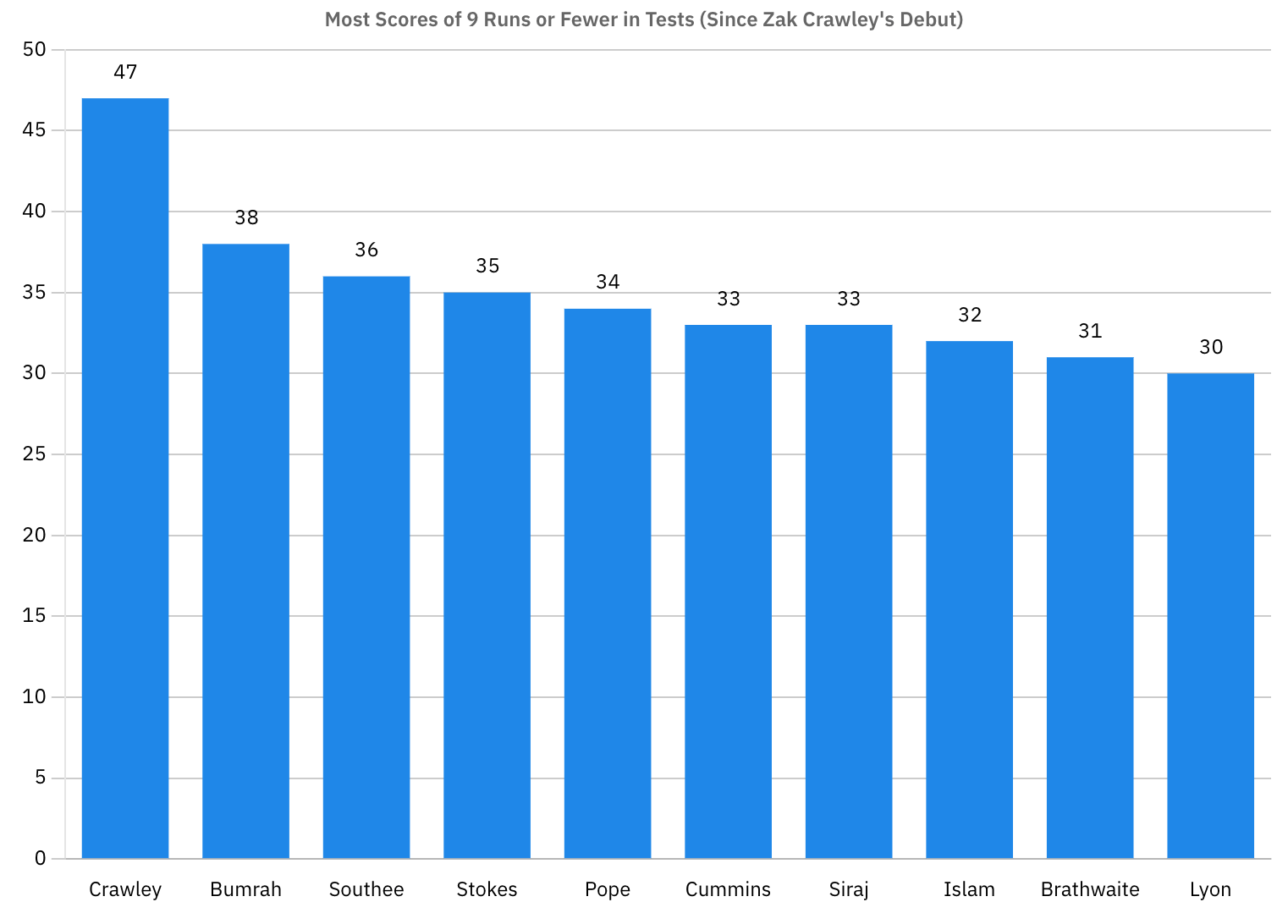
Six of the top ten are specialist bowlers. Stokes is an all-rounder. Brathwaite and Pope have both been dropped by their respective teams. And then there was Crawley. Among specialist Test batters who don’t play for England and who are not currently dropped from their teams, Tom Latham (26) has the next most dismissals for single digits in this period, nearly half as many as Crawley.
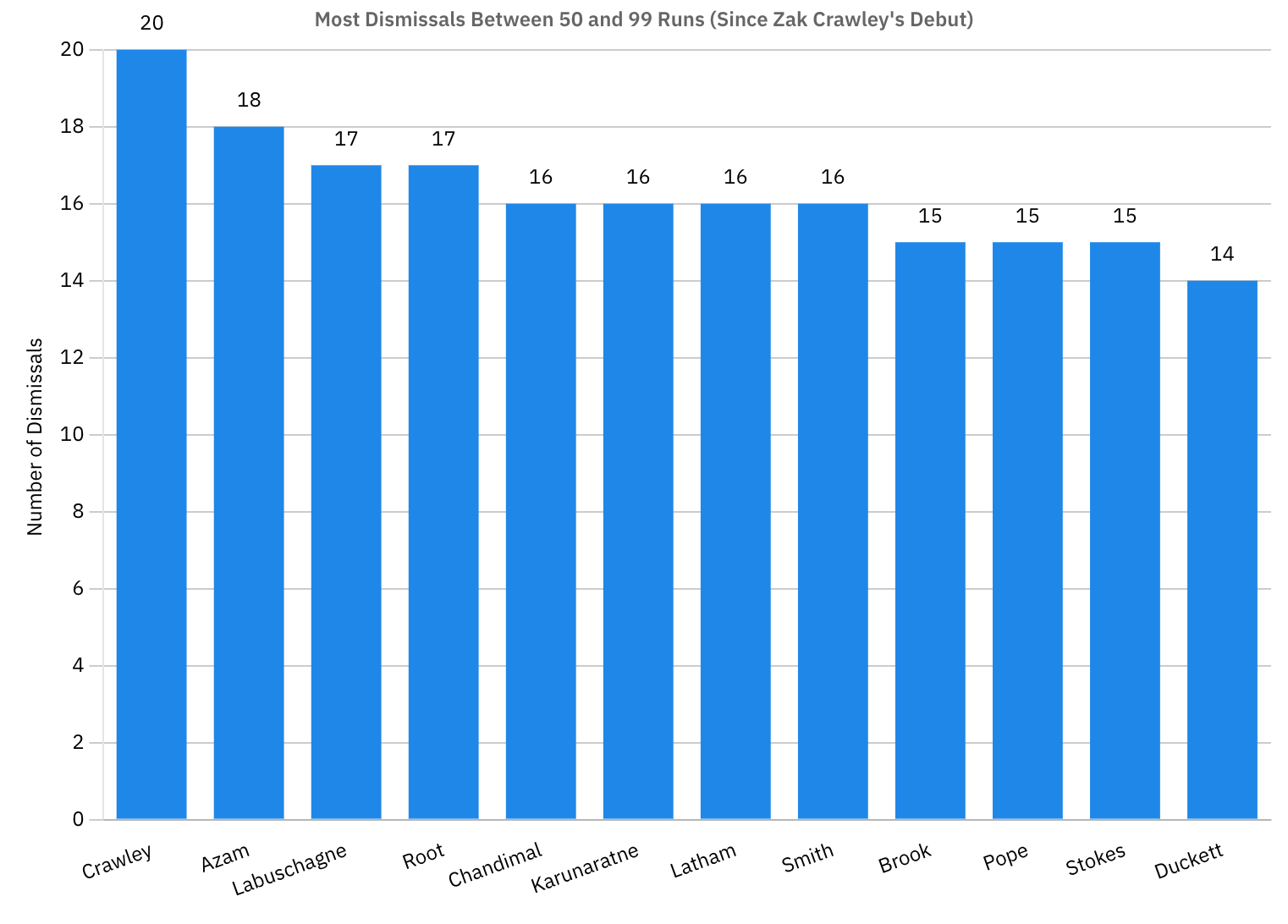
The kicker to this stat is that, in this same period, Crawley is also the batter who has been dismissed the most often between 50 and 99.
Crawley has been dismissed between 50 and 99 on 20 occasions in this period. The next most is Babar Azam with 18 such dismissals, followed by Marnus and Joe Root with 17 apiece.
Perhaps equally remarkable is the fact that English batters comprise half of the top-12 by this metric since November 2019. While this isn’t inherently a bad thing (scoring 50 is still valuable, and there are some great players on this list like Smith and Root), in conjunction, it sends a screaming neon signal that this team is abysmal at converting their starts; something that was likely already obvious from the eye test.
One player is a coincidence. While some of this is due to the sheer volume of cricket England plays, your entire top six struggling to convert starts is a trend, and Crawley is quite the trend-setter.
Although, while it is technically true that Crawley has the most scores between 50 and 99 in this timeframe, that isn’t quite specific enough to diagnose his issue.
Crawley’s partner, Ben Duckett, has been dismissed the most between 80 and 99 in this period, getting out seven times. Crawley isn’t even in the top-20.
Equally, Harry Brook leads the way for dismissals between 50 and 59 with 8. Crawley has the 17th most.
For dismissals between 60 and 69, Alex Carey leads the way with six, though Crawley is finally at the races in equal second with five.
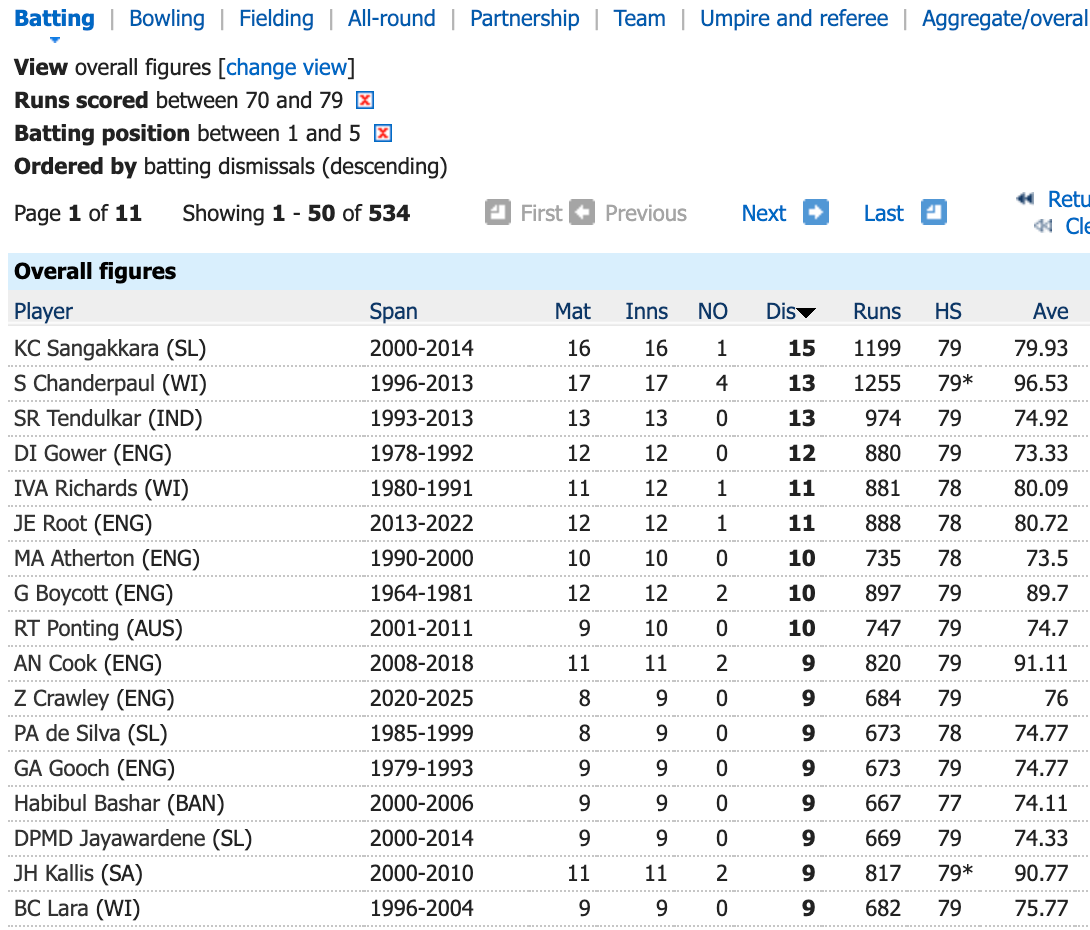
However, since his debut, Zak Crawley has been the best batter in the world at two incredibly specific skills: being dismissed for less than 10, and being dismissed in the 70s. Since debuting, Crawley has been out for between 70 and 79 runs nine times. The next-most is Virat Kohli with just six. I was not exaggerating earlier when I said the two types of innings Crawley plays are being dismissed in the first over and scoring a breezy 70.
In fact, forget ‘since his debut.’ Among all top-five batters in Test cricket history, Crawley has the equal-5th most dismissals in the 70s. The names above him—Sangakkara, Ponting, Viv, Sachin, Cook, Chanderpaul, etc.—are all-time greats who achieved this through sheer longevity. Everyone ranked above Crawley played at least 180 Test innings, with most well clear of 200. Crawley has played just 117 innings for his nine dismissals in the 70s.
Here’s another way of looking at that. Over the past 5 years in Test cricket, Zak Crawley has the 3rd most scores of 60+. For scores of 75+, he starts to drop back, but is still 8th. But just five runs later at scores of 80+? Crawley drops off a cliff to have the 28th most.
Remarkably, it took until 2025, six years into his career, with his 84 against India at Manchester and his 85 in Adelaide recently, for Crawley to be dismissed in the 80s. He has never been dismissed for between 86 and 120 in Test cricket.
If you ever feel like you’re watching him score the same breezy 70 on repeat, you are. For Crawley, it’s not the nervous nineties, it’s the silly seventies.
Inversely, there are seven openers who have scored more hundreds than Zak Crawley (4) in this period, and four others who have scored as many. All of these players have scored their hundreds in fewer innings than Crawley and at better averages.
This ties neatly into the fact that Zak Crawley is rapidly climbing up the list of the worst 50/100 conversion rates in Test history. Right now, his mark of converting just 19.23% of his fifties into hundreds is the 60th worst in Test history (minimum 2,000 runs).
However, for context, the vast majority of players with worse conversion rates are either wicketkeepers, all-rounders, or bowlers. The specialist batters with worse conversion rates than Crawley are:
Sherwin Campbell
Stephen Fleming
Mark Richardson
Jonty Rodes
Martin Guptill
Mark Ramprakash
Ken Rutherford
Temba Bavuma
Habibul Bashar
Alistair Campbell
Arjuna Ranatunga
Ajit Wadekar
Ramiz Raja
As a long-suffering Black Caps fan, Martin Guptill is the player that Crawley most reminds me of. Like Crawley, he passed the eye test with flying colours, looking like he should score 200 every time he hit a crisp drive. Like Crawley, he posted his highest Test score at home within a year of his Test debut, which flattered to deceive (Guptill’s 189 against Bangladesh, Crawley’s 267 against Pakistan). Like Crawley, he was a tall, nominally aggressive (though his Test SR of 46 said otherwise) right-handed opening batter, and often paired with a short, punchy bloke named McCullum. Like Crawley, he was capable of being destructive and hitting the world’s best bowlers off their length on his day (which rarely came). Like Crawley, he had backers in the right places; in Guptill’s case, Martin Crowe, in Crawley’s case, Stokes and McCullum. Like Crawley, he played far more Tests (47) than his record (avg: 29) justified. And, like Crawley, there was always an excuse not to drop him. Until there finally wasn’t.
Among specialist batters, only Fleming, Bavuma, and Ranatunga have scored more runs with a worse conversion rate than Zak Crawley. They also all averaged above 35, and 40 in Fleming’s case. In fact, I wrote this piece about Stephen Fleming a few months back, but much of what I wrote about his conversion rate also applies to Crawley.
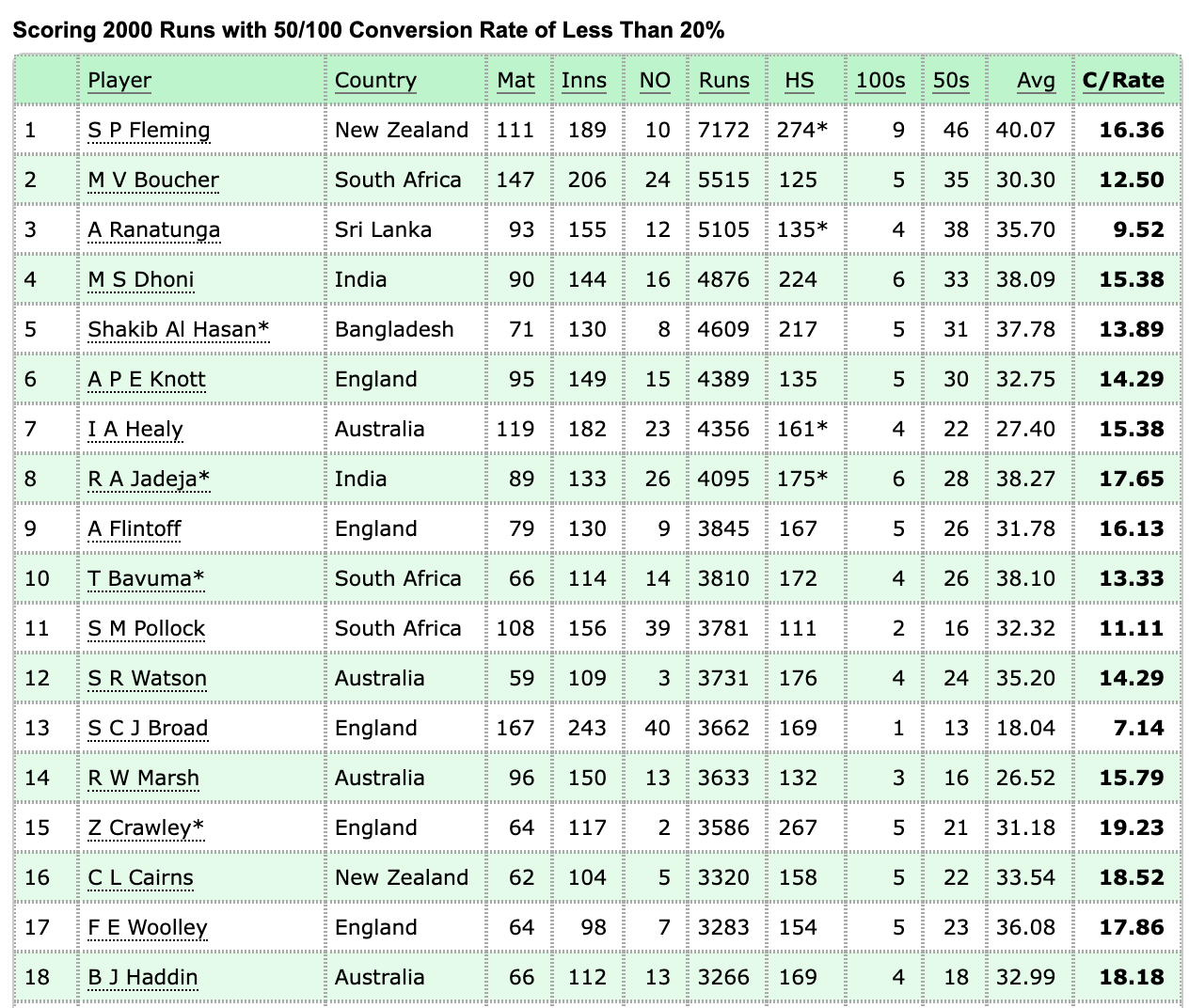
As you can see, Crawley’s record is far more similar to that of a wicketkeeper batter (Boucher, Dhoni, Knott, Healy et. al.) or a bowling allrounder (Pollock, Flintoff, Jadeja, Cairns et. al.) than to that of a full-time specialist top-order Test batter.
The thing is, this shouldn’t even be a surprise, as Crawley has almost perfectly translated his first-class conversion rate of 20.33% (12 hundreds out of 59 50+ scores) to the Test arena. Once again, it would have been the definition of insanity to expect Crawley to improve his conversion rate at the top level; not many batters even manage to replicate it without a slight dropoff.
Do you ever feel like there are two Zak Crawleys? You would be correct. There is the Zak Crawley who comes out only when England win the toss at home. This Crawley strikes faster than David Warner and averages more than Andrew Strauss. Then there is the Crawley who shows up in all other situations, who averages about the same as Tim Bresnan.
Let me explain.
Perusing the above list of batters who struggled to convert their stats, you will notice that these are not exclusively bad or untalented players. Rather, they are players who require conditions to be perfectly in their favour. Arjuna Ranatunga averaged 40 at home and 30 away. Stephen Fleming averaged 65 in Asia but only 33 in New Zealand. Temba Bavuma averages 44 in South Africa and 31 away. So it is with Crawley.
Perhaps nothing demonstrates that Crawley needs everything to be in his favour more than the comparison between his home and away stats after winning/losing the toss.
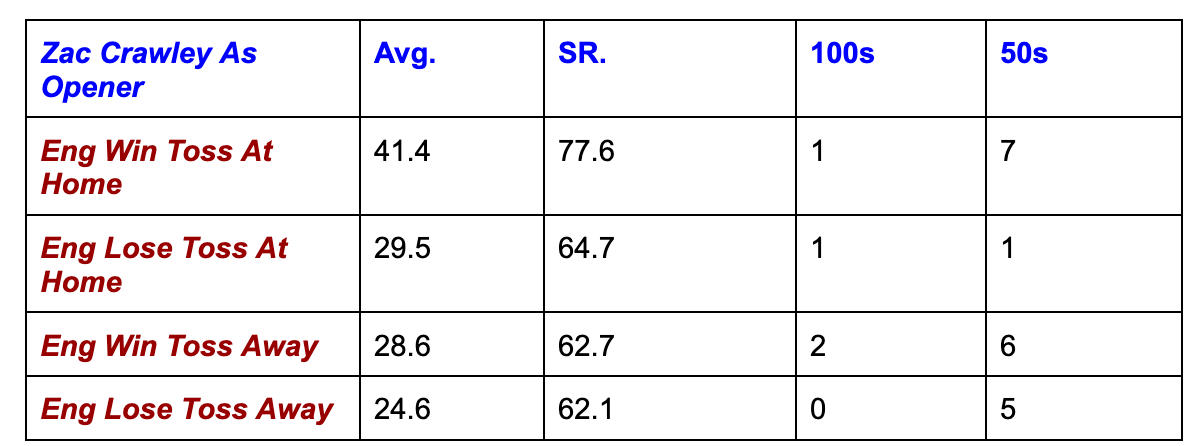
When conditions are at their most favourable—at home with England winning the toss—Crawley has a fantastic record, averaging 41.4 and pummelling the ball at 78, which would be the fifth highest Test batting strike rate ever. This is the version of Crawley that England are hoping to get all the time. Except, it doesn’t work like that. The less favourable conditions become, the worse Crawley’s record gets, reaching its nadir in the most unfavourable of conditions, when England lose the toss away from home.
In fact, taking this one step further, when England lose the toss away from home and are asked to bat first, Crawley averages 11.5. When England wins the toss at home and chooses to bowl first, Crawley averages 44.4.
Additionally, however bad you think Zak Crawley is in the first innings, he is even worse in the second. In the first two innings of Tests, Crawley averages 32.8 and strikes at 69.6; still not great numbers, but above his career marks, at least. In the third and fourth innings, he averages just 27.7 and strikes at 63. Among the 17 openers to have scored 500+ runs in the third and fourth innings in this period, only Kraigg Brathwaite and Dean Elgar have worse averages.
The stark contrast between Crawley’s record when winning and losing the toss at home is what really stands out to me. Crawley’s away record is more or less equally poor regardless of the coin flip. When playing at home, it is the difference between him being perhaps the most destructive opener since Sehwag or not of Test standard. It’s never a good sign when you’re relying on a coin flip to ensure a member of your XI is Test standard.
70-year-old grizzled Australian cricket coaches from Perth to Hobart will have been having a field day with this English team. I’ve been coached by plenty of these types over my time, and they all love to repeat the same line (often, with increasing frustration): “you can’t get out if you hit the ball along the ground.” The only thing they like more is talking about 1%-ers.
Well, did anyone tell England?
Another unwanted stat where Crawley leads the way is the number of times he has been dismissed caught. Since his debut, Crawley has been dismissed caught 75 times, with only Joe Root able to match that figure. However, Root averages 42 in the innings where he is dismissed caught, compared to just 22 for Crawley. Stokes is in third place, but a long way back on 66.
Now, initially, I thought this might not have been that big of a deal. After all, you would expect openers to edge the new ball behind and be caught more often. However, even among other openers, Crawley’s numbers stick out like a sore thumb. When opening in this period, Crawley has been dismissed caught 67 times. The next-most is Tom Latham with just 48. Since his debut, Crawley has been dismissed caught 39.5% more than the next-worst opener; not than the average opener, but the next-worst. Again, some of this is due to the sheer volume of cricket England plays, but it is telling that Crawley’s partner Duckett has only been dismissed caught 44 times.
Leading into the Ashes, we heard a lot about how Crawley is supposed to be good specifically against India and Australia. However, among the 22 openers who have scored 200+ runs against these two opponents since November 2019, Crawley is almost exactly in the middle of the pack: 9 players have better averages than his (34.76), while 12 are worse. The kindest thing you can say about him is that he is average.
Aside from this, England’s justifications for Crawley’s continued selection seem to more closely resemble a game of Guess Who? Crawley is tall and lanky and right-handed, while Duckett is short and punchy and left-handed. On paper, it makes sense as a complementary partnership. But, by that same logic, Bryden Carse is also a tall, aggressive right-hander. Carses’s first class numbers (27 average and a 58 SR) aren’t that far off Crawley’s (32 average at a 63 strike rate). Should he move up one spot from his MCG innings and open for England? Of course not, but I’m not sure that suggestion is markedly more ridiculous than continuing to pick Crawley.
Now, as a Black Caps fan, I’m writing all this in spite of myself, as I have a vested interest in England continuing to pick Crawley for at least their next three Tests, which just so happen to be against us. However, as a fan of high-quality Test cricket, I have simply had enough.
Too often in the world today, actions have no consequences. Surely, at long last, there must be consequences for the man with the worst top-order batting average in history (min. 60 Tests), who has been dismissed for single figures more than any other Test cricketer since his debut, who is being dismissed caught ~40% more often than the next worst opener, who has a mental block in he 70s, and who has the 14th worst conversion rate among specialist batters in Test history.
This crazy Crawley calamity can’t continue.
Keen to keep reading about cricket? Same! If you liked this article, you might also enjoy:
Comments
Nothing yet. Say the first thing.
Sign in to join the conversation.