
Before this article is over, I will have shown you that Beau Webster is currently achieving a statistical feat never before seen in Test cricket, all while comparing him favourably to Ian Botham and Keith Miller. Have I lost it? Without a doubt. But not in this case.
First, though, let me set the scene.
The way we judge Test all-rounders is fundamentally broken. Perhaps it always has been. The expectations are, frankly, unreasonable.
If you’re a fan of Jarrod Kimber’s work—and I’m pretty confident that particular Venn Diagram is a circle—you’ll be familiar with his theory of the Pringle-Botham continuum. If not, here’s your assigned reading for the day. To play to my New Zealand audience, you could just as easily call this the (Dipak) Patel-Cairns continuum, or the Marsh-Miller continuum, if you’re Australian, or even the Binny-Dev continuum, if you’re Indian. You get the picture.
TL;DR: The talent difference between a great Test all-rounder (Botham/Cairns/Miller) and one who is regarded as a bit of a joke (Derek Pringle/Dipak Patel/Mitch Marsh) is often razor-thin. For all-rounders, the margin for error between greatness and mediocrity is slimmer than for any other cricketing pursuit. Herein lies the inherent unfairness of being a Test all-rounder.
For people to think you’re even decent—not great, just decent—as a Test all-rounder, you’ve probably got to average at least 30 with the bat and less than 35 with the ball. I don’t think the average cricket fan grasps just how haltingly rare it is to find such a player. In Test history, there have only been 58 players to average 30+ with the bat and 35 or less with the ball (minimum 10 wickets and 400 runs). That is equivalent to just 0.017% of all Test cricketers. In the grand scheme of Test cricket, those 58 all-rounders may as well be a rounding error. Even then, there’s a non-zero chance that people still might not really rate you; ask someone like Hamilton Masakadza or Wiaan Mulder.
To put that into context, there have been 941 top-order batters (positions 1-6) in Test history who have played more than 10 Tests while averaging less than 30. You are more than 16x as likely to accidentally find a shit batter than to intentionally find a decent all-rounder.
Up the minimum criteria to 50+ wickets and 1,000+ runs while averaging over 30 with the bat and under 35 with the ball, and there are just 16 players who qualify, or .005% of all Test cricketers. Even making it onto this unbelievably exclusive list leaves no guarantee that people will rate you as a Test cricketer: ask Shane Watson. Hell, it isn’t even a guarantee that you’ll be widely remembered.
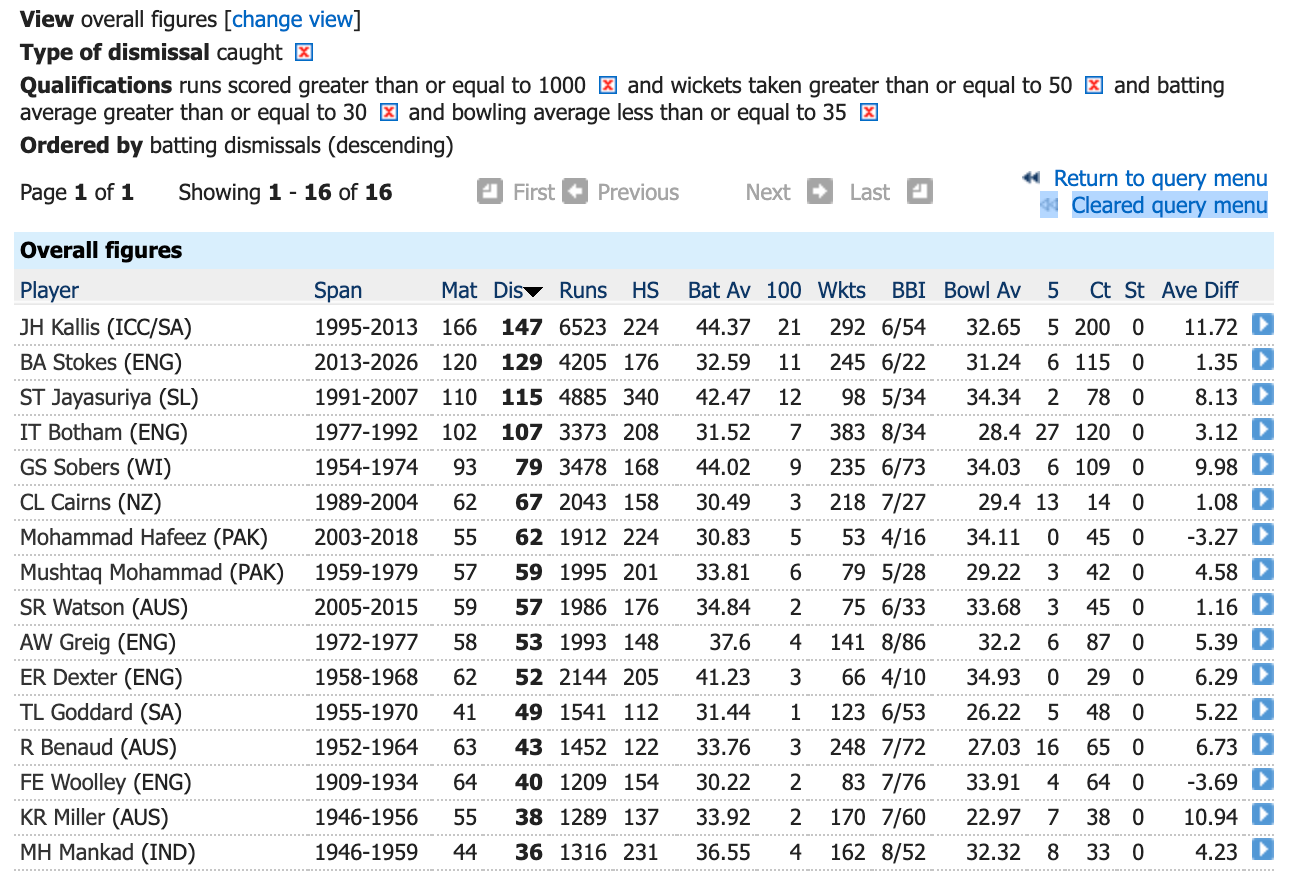
Only two players—Chris Cairns and Ian Botham—have 2,000+ runs and 200+ wickets while averaging more than 30 with the bat and less than 30 with the ball. And yes, I have very much shoehorned that stat in to make Cairns look as good as possible. This is still a New Zealand cricket blog, after all.
If we add some more leeway and really stretch the definition of an all-rounder, there have still only been 126 Test cricketers who average less than 40 with the ball and more than 25 with the bat (min. 10 wickets and 400 runs); or 0.38% of all Test cricketers. You can do something that fewer than 0.5% of players have ever achieved, and still end up as a punchline like JP Duminy. Or, worse still, get pigeon-holed as a bits and pieces player and never find a consistent role, like Moeen Ali.
To be considered a ‘great’ batting all-rounder, you’d want to be averaging at least 35 with the bat and less than 35 with the ball. There have, fittingly, only ever been 35 members of this club. Just 16 Test cricketers have ever averaged over 40 with the bat and less than 35 with the ball.
To be considered a great bowling all-rounder, you’d want to be averaging less than 30 with the ball and more than 30 with the bat. This feat is even rarer again: there have only been 25 such Test cricketers, and only 9 who average less than 25 with the ball and more than 30 with the bat.
Only five cricketers—Doug Walters, Darren Lehmann, Charles McCarthy, Aubrey Faulkner, and Beau Webster—have averaged 40+ with the bat and less than 30 with the ball. Of these, only Aubrey Faulkner took more than 50 Test wickets (82). Faulkner is the only man to average more than 40 with the bat and less than 30 with the ball (min. 1000 runs and 50 wickets) in Test cricket, yet he rarely gets brought up in conversations for the greatest all-rounder. And yes, you can thank my long-time reading of Jarrod Kimber’s work for this stat, too.
Only five others—those who I would argue are the most balanced, or ‘all-rounder-iest’ all-rounders—have averaged 35+ with the bat and less than 25 with the ball. This is an unbelievably elite list: Allan Steel, who played for England in the 1880s; Keith Miller; Imran Khan; Ravindra Jadeja; and…Beau Webster.
Are you sitting down? Because, if you haven’t already guessed, all of that has been a rather long (though hopefully insightful) run-up to my next point, like Shoaib Akhtar charging in from the boundary rope.
Here is the complete list of Test cricketers who average 40+ with the bat and less than 25 with the ball (min. 400 runs and 10 wickets):
Beau Webster.
End of list.
Thanks for coming, everyone, but he’s clocked Test cricket. Pack it up.

He’s still going to be dropped again for Australia’s next Test, isn’t he?
Expand the minimum qualifying mark to just five Test wickets and 200 Test runs at these averages, and you can add Corbin Bosch and Basil Butcher to the list. No matter how you slice them, the numbers Beau Webster is putting up in Test cricket are so rare and valuable that he’ll want to be careful Trump doesn’t kidnap him and claim them as his own (oooooo political).
Now, I’m fully aware this is mostly just a bit of fun with small sample sizes—Webster’s 71* in Sydney vaulted his Test batting average from 34.6 to 41 in one fell swoop, for example. If he is dismissed for less than 28 the next time he bats, his average will drop back below 40. Equally, his bowling has been fairly low-usage, averaging just 6.1 overs per innings. If he plays enough, the overwhelming likelihood is that Webster’s numbers will revert to the mean. In that sense, it’s a bit like Adam Voges having the third-highest batting average ever. That is the mature, measured take that I would usually try to offer. If I put my sensible hat on, Beau Webster clearly isn’t the greatest Test all-rounder ever, no matter what the numbers say.
Even still, do you know how hard it is to hit the ground running in Test cricket? 1,759 Test cricketers—54% of those to have played the sport—have ended their careers having played eight or fewer Tests.
So, bugger all that sensible stuff. Any time you’re doing something that no one has ever done in Test history before—even if only briefly—it is worthy of celebration and hyperbole. When the rules of what is statistically possible in Test cricket are being rewritten, I think you’re allowed to get a little carried away. So, let’s do that instead.
When I first came across this stat that Webster, currently, is the only person to average 40+ with the bat and sub-25 with the ball, I wondered if you could therefore mount the argument that he has had the best start to a Test career on both sides of the ball ever.
I soon learned that the answer is no, not quite, as that particular title almost certainly belongs to Ian Botham. However, when you see the sort of elite company Webster is keeping, you’ll understand that it wasn’t a silly question.
Right now, Webster has played 8 Tests, scored 452 runs at 41.1 and taken 11 wickets at 24.5. Here is how that compares to other legendary all-rounders after their first eight Tests (a common metric which we universally recognise, of course).
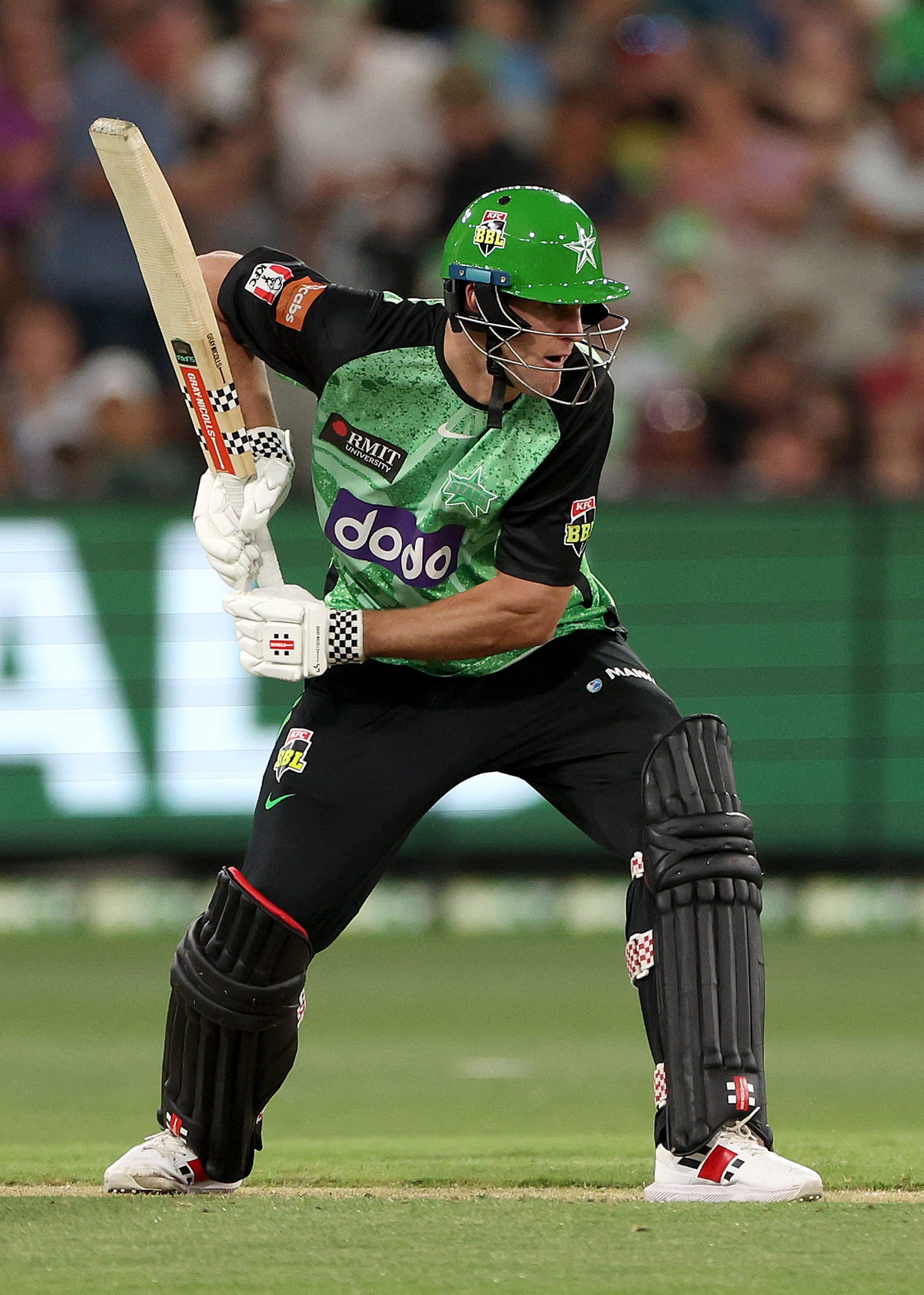
As alluded to, Ian Botham had a fantastic start to his Test career, before tailing off as he aged (and started to have more fun drinking and being famous). Across Botham’s first 8 Tests, he took a staggering 40 wickets at 18 and scored 499 runs at 49.9 with three hundreds. If there has ever been a better start to a Test career on both sides of the ball, I haven’t found it.
Keith Miller’s Test record is one of the closest to Webster’s so far, statistically, as one of only five players to average more than 35 with the bat and less than 25 with the ball. Across his first 8 Tests, he was imperious, scoring 489 runs at 61.1 and taking 23 wickets at 18.52.
Many consider Jacques Kallis to be the greatest all-rounder ever (give me Sobers or Imran, but it’s close), or even the greatest cricketer ever, if you listen to Ricky Ponting. Across the first 8 Tests of his career, Kallis scored 249 runs at 24.6 and took 7 wickets at 29.6.
Imran Khan has the second-greatest peak in Test history, and is probably the only player with a credible argument to have a peak on par with Bradman, averaging 51.3 with the bat (2,516 runs; 5 hundreds) and 19.2 with the ball (218 wickets) between 1982-1992. Across his first 8 Tests, he scored 255 runs at 23.2 and took 20 wickets at 42.5.
You don’t need me to tell you how good Gary Sobers was. If you do, you must be lost. Across his first 8 Tests, he scored 350 runs at 35 and took 12 wickets at 25.7.
Kapil Dev started his career like a house on fire with the bat, scoring 426 runs at 47.33 across his first 8 Tests, but was only mediocre with the ball initially, taking 23 wickets at 38.6.
How about some more modern examples? Across his first 8 Tests, Ben Stokes scored 401 runs at 28.6 and took 23 wickets at 40.8. Jadeja’s first 8 Tests yielded just 187 runs at 20.8 with the bat, but 36 wickets at 26.3 with the ball.
To complete the trifecta of famous English all-rounders, Andrew Flintoff was barely international standard across his first 8 Tests, scoring 205 runs at 17 with the bat and taking just 6 wickets at 56 with the ball.
Chris Cairns had a similarly slow start to his career; remember that he debuted at just 19, scoring 229 runs at 22.8 with the bat and taking 25 wickets at 39.6.
Darren Lehmann is arguably the closest parallel to Beau Webster, as a middle-order batter who can bowl both part-time seam and spin, and who isn’t a regular member of the XI despite outstanding numbers. Across Lehmann’s first 8 Tests, spaced between 1998 and 2002, he scored 325 runs at 29.5 and took just two wickets.
Doug Walters is another with a broadly similar record to Webster, as another middle-order Australian batter and more of an occasional bowler. He had a ridiculous start to his Test career, scoring 831 runs (!) at 83.1 and taking 11 wickets at 33.5.
Tong Greig is another who managed to start his Test career on the right foot, scoring 514 runs at 42.8 and taking 18 wickets at 28 across his first 8 Tests.
Look, I could quite happily sit here listing all-rounders’ stats after eight Tests all week, but restraint is the better part of valour, and I’m sure you’re getting the broader picture by now.
So, what does this all mean? Largely, it’s just a bit of fun with stats and small sample sizes, and an attempt to give Webster the plaudits he so richly deserves, and which the Australian selectors have largely deprived him of this summer. Maybe, next time you’re at the pub or the nets, you can slip into a conversation that Webster has had a better start to his Test career than Sobers, Imran, or Kallis. If you’re feeling cheeky, floor them with the stat that he’s the only player to average more than 40 with the bat and less than 25 with the ball (but get in quick while that is still true).
However, there is no denying that Beau Webster has taken to Test cricket like a duck to water, and boasts one of the best statistical starts to his Test career over his first eight games of any all-rounder, perhaps only behind Ian Botham, Keith Miller, Doug Walters, and that one person I forgot to list who you will correct me on in the comments. Any time that is the sort of company you’re keeping, you know you’re doing quite a few things right.
Shit, sorry. I let my sensible hat slip back on again. Let’s try that again with a bit more gusto. What does this all mean? Two words: Slug Supremacy. He’s gonna be better than Sobers and Kallis combined by the time it’s all said and done.
Thanks for reading! Like my work? Please consider supporting me via a paid subscription or Buy Me A Coffee. For more info on how your support helps me produce this work and what your contributions go towards, see my About Page!
Like my work, but not that much? Fair enough! If you still want to support me, the best thing you can do is share this article far and wide: whether that’s with friends and family, teammates at your local club, on Reddit, or in your obscure cricketing Discord server, I cannot emphasise enough how helpful every single share is.
Just keen to keep reading about cricket? Same! If you liked this article, you might also enjoy:
Comments
Nothing yet. Say the first thing.
Sign in to join the conversation.