
Ever since the current ICC Future Tours Program was released in 2022, I have had the Black Caps’ schedule for the next 9 months circled, bolded, and highlighted. At first, I had to double-take—surely I was reading the wrong column, and this was actually England’s schedule?
Why? Because from the start of the historic 4-day Test against Ireland tonight, marking the first Test meeting between the two sides, until March 2027, when the side travels to Pakistan for two Tests, the Black Caps will play a bumper 14 Tests in just over 9 months, with series against:
Ireland x1 (A)
England x3 (A)
India x2 (H)
Australia x4 (A)
Sri Lanka x2 (H)
Pakistan x2 (A)
No team will play more Tests than New Zealand in this timeframe (Australia will play as many compressed into an even shorter window), nor does any other team play all of the Big Three in this timeframe. If you turn on a random game of Test cricket between tomorrow and next March, you’re more likely to see New Zealand in action than any other side. If you’re a casual fan of one of the Big Three sides, you’ll be watching New Zealand this summer—lucky you.
For the first, and almost certainly last, time, New Zealand are poised to be Test cricket’s protagonists, even if only briefly, and I intend to luxuriate in every second of it.
While 14 Tests in 9 months might not sound out of the ordinary for fans of some teams (England have played exactly 14 Tests in a calendar year 10 times, and more than 14 in a year a further eight times), by New Zealand standards, this is a veritable smorgasbord of Test cricket.
In the 96 years New Zealand have been participating in Test cricket, only once before have the Black Caps played so many Tests in such a short timeframe. To put this upcoming run in context, since the second Test against Australia back in March 2024, the Black Caps have played just 14 Tests in 26 months, including a paltry five last year. Now, in just 9 months, they will match that 14-Test total. Like London buses, you wait, and wait, then they all come along at once.
If, like me, you’re a New Zealand Test cricket fan, life has quite literally never been so good. This is not hyperbole. The most Tests New Zealand have ever played in a calendar year is 14, in 2008. There have been a couple of rare instances where the Black Caps have enjoyed similarly packed Test schedules, but none that outright beat this upcoming run:
Between Boxing Day 1998 and 1999, the team played 14 Tests.
From March 10, 2005, to March 26, 2006, they played 13 Tests.
Most recently, from July 2016 to March 2017, the team also played 14 Tests, the closest match to this upcoming run.
Except, with the greatest will in the world, that 2016/17 run kicked off with two Tests in Zimbabwe, and included four home Tests against Bangladesh and Pakistan, which New Zealand won by 7 wickets, 8 wickets, 9 wickets, and 138 runs. So, the biggest difference is, this time, we’re not just playing a lot of Tests, but a lot of marquee Tests, highlighted by back-to-back-to-back series against the so-called Big Three.
Only twice previously have the Black Caps played the Big Three in consecutive series. It happened between 1974 and 1976, although calling these ‘consecutive series’ is perhaps a stretch, given they played Australia in March 1974 (1-1 draw), England in Feb 1975 (1-0 England), and India in Feb 1976 (1-1 draw), though technically there were no other Test series in between. More recently, it happened in 2019/20 in the lead-up to the Black Caps’ historic WTC triumph, when they beat England 1-0, lost to Australia 3-0, and beat India 2-0.
It will also be the first time since beating England 2-1 in 1999 that the Black Caps will feature in a 4-Test series, only the 14th time in history they will play in a series of at least 4 Tests, and the first time ever playing a 4-Test series against Australia. However you slice the numbers, this is set to be a historic run of Tests for the Black Caps with several fascinating storylines, so let’s dig into them.
New Zealand squad for Ireland and England: Tom Latham (c), Tom Blundell (wk), Devon Conway, Zak Foulkes, Dean Foxcroft, Matt Henry, Kyle Jamieson, Daryl Mitchell, Henry Nicholls, Will O’Rourke, Glenn Phillips, Rachin Ravindra, Nathan Smith, Blair Tickner, Kane Williamson, Ben Sears (Travelling 16th Man for England Squad), Will Young*, Kristian Clarke*, Michael Rae*
*Ireland Test only.
As much as I’d like to start with the positives, and there are plenty which we’ll get to shortly, it’s impossible not to look at this squad and wonder about the age profile. When the first Test against England starts in a few weeks, the likely XI will be:
Tom Latham (34)
Devon Conway (34, turning 35 in July)
Kane Williamson (35, turning 36 in August)
Rachin Ravindra (26)
Daryl Mitchell (35)
Tom Blundell (35, turning 36 in September)
Glenn Phillips (29)
Nathan Smith (27)
Kyle Jamieson (31)
Matt Henry (34)
Will O’Rourke (24)
Average Age: 31.27
Median Age: 34

Just one member of our likely top six will be younger than 34, and their potential replacements in Henry Nicholls (34) and Will Young (33) are no spring chickens either.
In July last year, when previewing the New Zealand Test squad selected to tour Zimbabwe, I wrote the following:
“I desperately hope I’m wrong, but I can’t stop seeing visions of several of Latham (33), Conway (34), Williamson (34), Nicholls (33), Young (32), Blundell (34), and Mitchell (34) all losing form at once in the middle of our mega run of 14 Tests in 10 months between June 2026 and March 2027…I hope I’m being too pessimistic (wouldn’t be the first time), but the last thing the Black Caps would want is for several of our older batters to lose form simultaneously during this marquee run. If so, we’d be stuck between a rock and a hard place, forced into a position where we either have to persist with ageing, out-of-form batters against elite opposition or throw unproven youngsters into the deep end of Test cricket against Archer, Bumrah, Cummins et al.”
At least I was wrong about having to face Archer!
Well, in lieu of blooding potential youngsters against Zimbabwe and the West Indies last year (barring Mitchell Hay’s sole Test), the Black Caps are now in the position of crossing their fingers and hoping their ageing batting line-up is still good enough to go around one more time. I sincerely hope the missed opportunity to blood youngsters against Zimbabwe and the West Indies doesn’t come back to haunt us, in a similar way that failing to pick Lockie Ferguson in a non-WTC Test against England in 2019, and then throwing him into the fire on debut in Perth weeks later, where he broke down after 11 overs, cost us.
To me, it feels like this approach will either be a rousing success, as a settled, experienced batting line-up that has seen and done it all before navigates a high-intensity period of Test cricket, or otherwise, a catastrophic failure, as several ageing batters lose form simultaneously in conditions where they have historically struggled, with only promising but completely raw replacements waiting in the wings. It’s hard to see a middle ground, but now that we have put all of our eggs in this basket, there’s not much to be done except get behind the team and hope for the former result.
On to the team itself, and let’s start at the top of the order, where, barring disaster, Tom Latham and Devon Conway will open the innings. As with many Kiwi batters throughout this run, this is likely to be a legacy-defining stretch for Latham and Conway, either for better or for worse.
While I am personally a long-time, card-carrying member of the Tom Latham fan club, there is no hiding from the fact that both his away Test record and his record against the so-called Big Three are subpar, to be very generous.
Away from home, Latham averages just 35.53 in Test cricket—below his career mark of 39, but perfectly respectable for an opener in this era, given that the average opener averages 30.56 away from home in Test cricket since 2014, when Latham debuted. However, against England, Australia, and India, Latham averages just 29.73 with only one hundred, which drops further to 28.11 for Tests in Australia, England, and India.
For such a talented batter who has a genuine argument to be New Zealand’s best-ever opener, there is no nice way to massage these numbers: Latham has significantly and consistently underachieved against the Big Three. The good news? There’s no time like the present to rectify that, and after a leaner recent run, Latham appeared to be back in form against the West Indies last year, scoring three hundreds in the series, including scores of 137 and 101 in his most recent Test outing. Obviously, this run of Tests will be a significant step-up in difficulty compared to those West Indies Tests.
However, if Latham does need any extra motivation, he and Williamson both have the opportunity to surpass Tim Southee as New Zealand’s most successful Test cricketer in terms of wins throughout this series. Currently, Southee sits in first on that list with 47 Test wins, with Latham and Williamson hot on his tail with 46. Barring an utterly catastrophic run, both men should secure the two Test victories they need to move to first place at some point during this 14-Test run (though hopefully sooner rather than later).
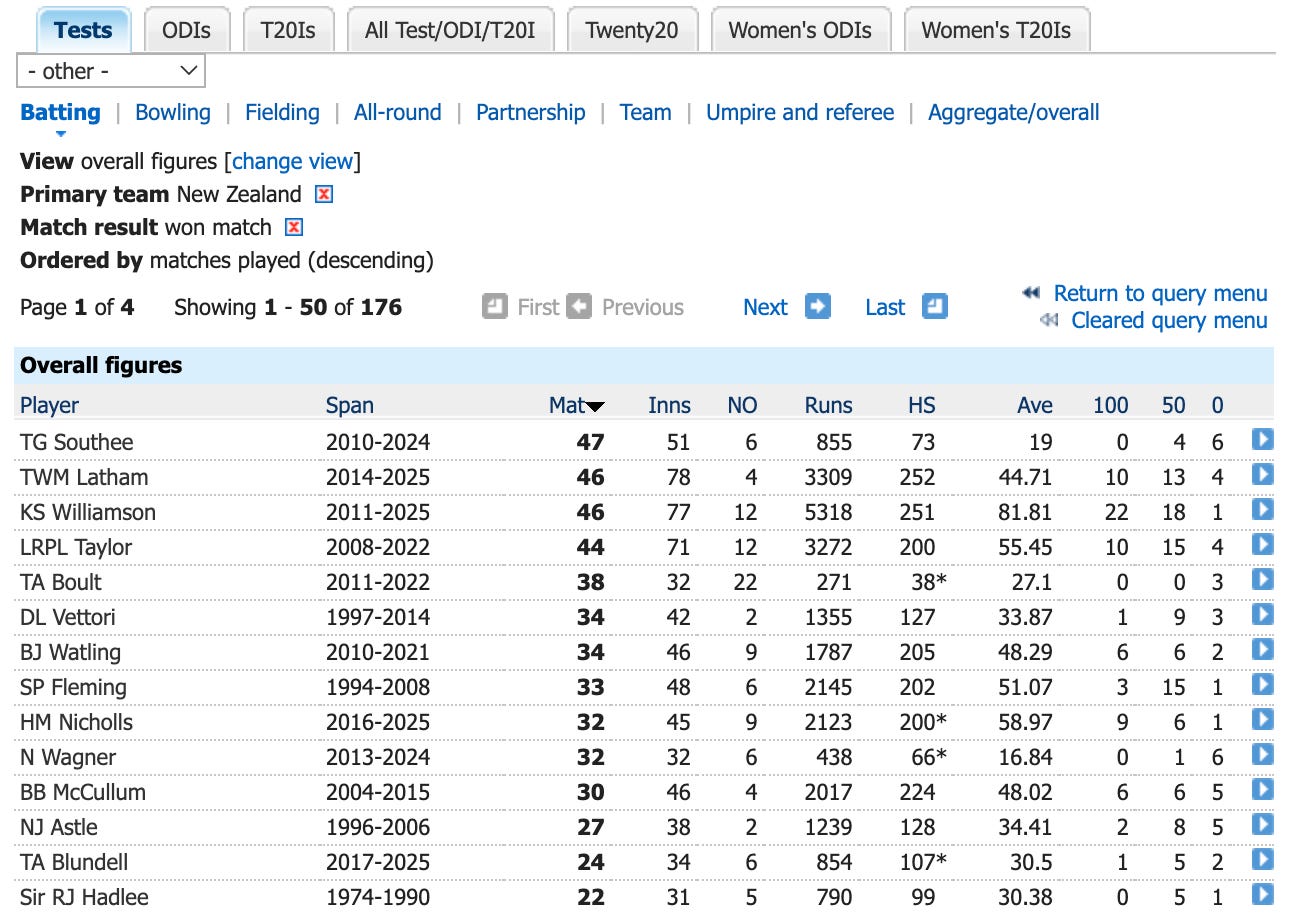
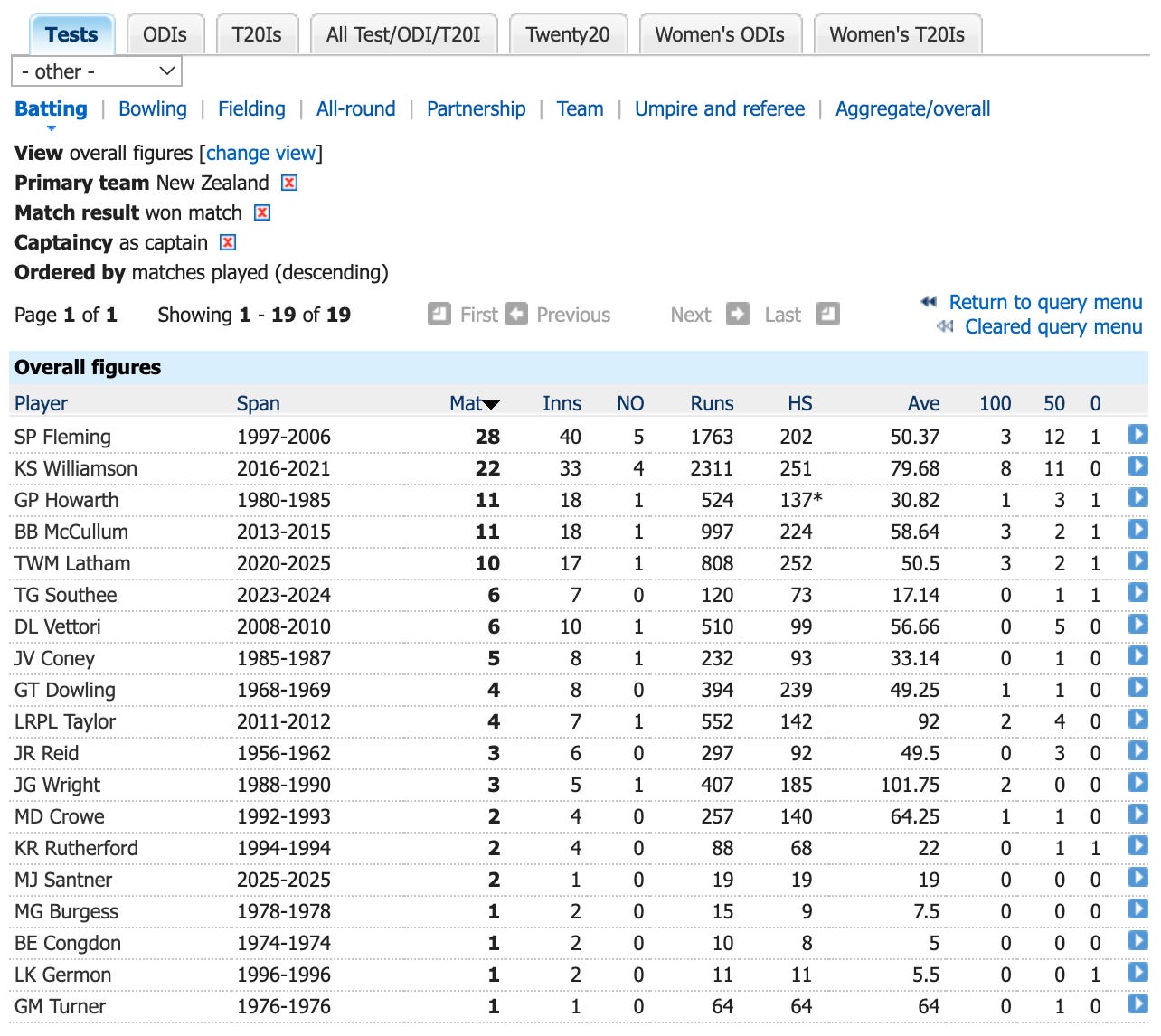
Two more wins would also see Latham overtake McCullum and Howarth (11 wins apiece) and move into third place on the list of most wins as New Zealand Test captain, behind only Williamson (22 wins) and Fleming (28 wins). It’s worth remembering those two stats the next time you hear someone question Latham’s value to this side.
It’s a slightly different story for Conway, who hasn’t yet faced Australia in Test cricket, and who performed strongly in England last time, scoring that memorable debut 200 at Lord’s. Accordingly, it’s less a case of Conway proving his mettle away from home or against the Big Three, like Latham, and more a case of proving he still has it.
After starting his Test career with a hiss and a roar, averaging 54.1 across his first 11 Tests in 2021 and 2022, Conway went through a protracted run of poor form in 2023 and 2024, averaging just 26 from 16 Tests and coming perilously close to being dropped altogether.
On paper, Conway bounced back with a vengeance in 2025, averaging 87.1 and scoring three hundreds and two fifties in nine innings, with his two most recent Test digs being scores of 227 and 100. However, that comes with a rather big caveat that those runs were scored against Zimbabwe and the West Indies. Test runs are Test runs, and they all count the same at the end of the day, but the question now becomes whether Conway can rediscover his best form against the top teams, or if he’ll revert back to the 2023-24 model?
If so, the good news at least is that New Zealand has two young openers waiting in the wings in Rhys Mariu and Curtis Heaphy who have been banging the door down to get their opportunities, though let’s hope Conway and Latham make them wait a bit longer still.
Between injuries, New Zealand’s sparse schedule, and his abrupt T20I retirement, it has been a strange few years for Kane Williamson. Since the start of 2024, Williamson has played just 12 Tests, while still averaging an elite 57. In this same period, Joe Root has played 28 Tests.
Across all formats, Williamson has made just 28 international appearances for New Zealand since 2024, compared to 80 for Daryl Mitchell. However you slice the numbers, watching Kane in international cricket has become increasingly rare, so it’s worth savouring watching this genuine legend in action for however much longer it lasts, as retirement rumours continue to swirl.
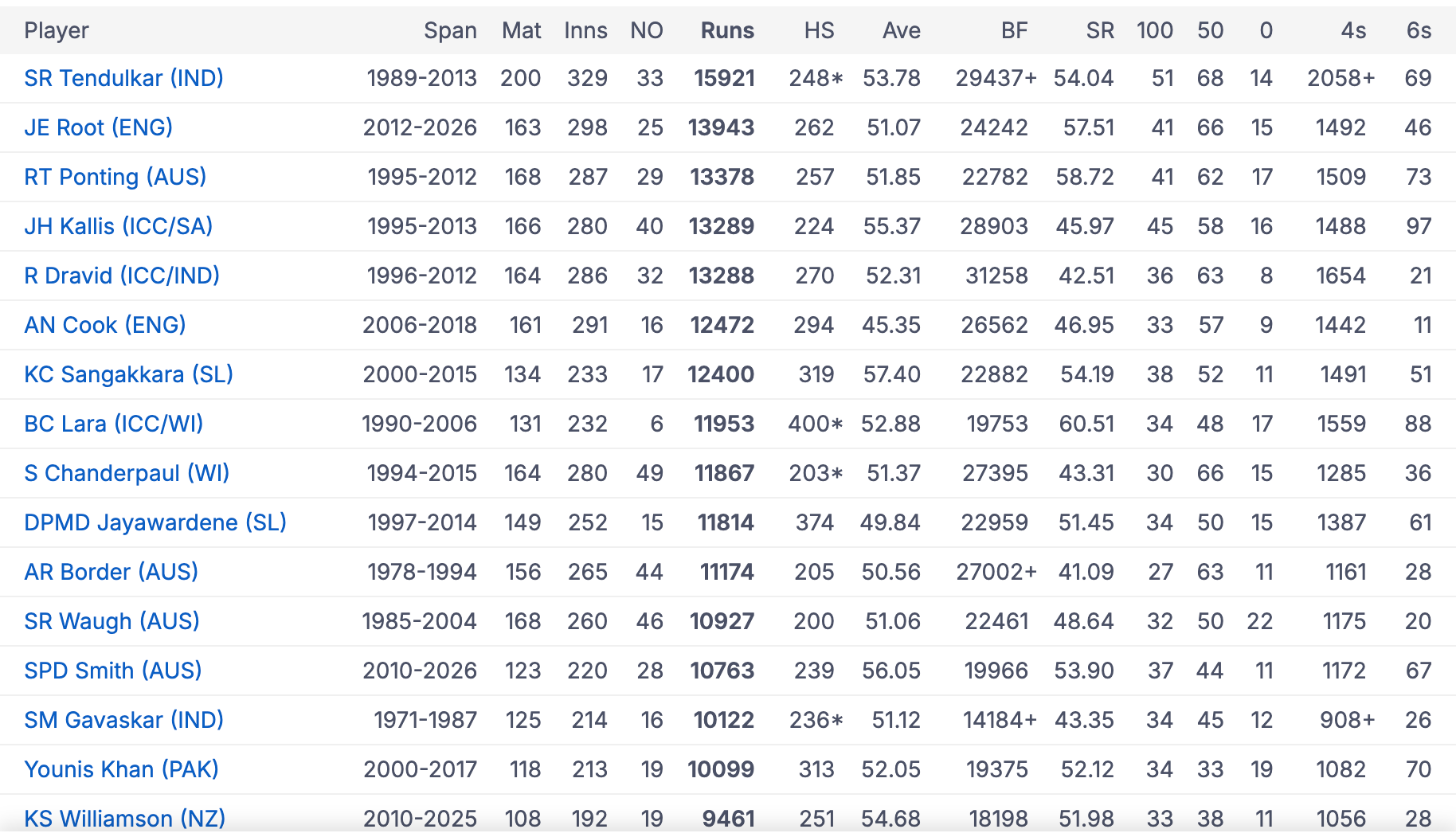
For many Black Caps fans, the biggest number when watching Williamson bat across these series will be 539—the number of Test runs he needs to reach 10,000. You can all but guarantee that number will be the furthest thing from Williamson’s mind, given he’s never paid too much mind to individual milestones, but for many fans, myself included, seeing Williamson become the first New Zealander to enter the exclusive, 15-man (at present) 10,000-run club would be a real treat, and a just reward for his years of excellence.
To do that, of course, Williamson will need to score runs against the Big Three, where, like Latham, he has traditionally underperformed. Against Australia, England, and India in Test cricket, Williamson has averaged 39.44 with 9 hundreds—solid numbers for almost anyone else, but disappointing by his high standards—while in Australia, England, and India, that drops to 35.3, with 4 hundreds. Again, these aren’t terrible numbers, but they are well below par by Williamson’s high standards.
Accordingly, in the eyes of many neutrals at least, this run could be truly legacy-defining for Williamson. For me, Kane’s legacy is already well and truly secured, and was years ago, realistically. He could score 20 consecutive ducks across these tours and still go down as New Zealand’s greatest batter and as an all-time Test great. However, given the sheer volume of discourse and criticism online about Williamson’s subpar record against the Big Three, he has a chance to finally shut the doubters up and patch any slight holes remaining in his Test record if he can perform strongly across these upcoming series.
Rachin Ravindra has done pretty much everything asked of him so far in Test cricket. He’s blocked out a draw as a 21-year-old batting at 8 in India with his 18* (91) back in 2021. He’s taken Test wickets, including that of Shubman Gill. After 20 Tests, he’s averaging 47.68, which is the second-best Test average for a New Zealander (min. 1,000 runs), behind only Williamson.
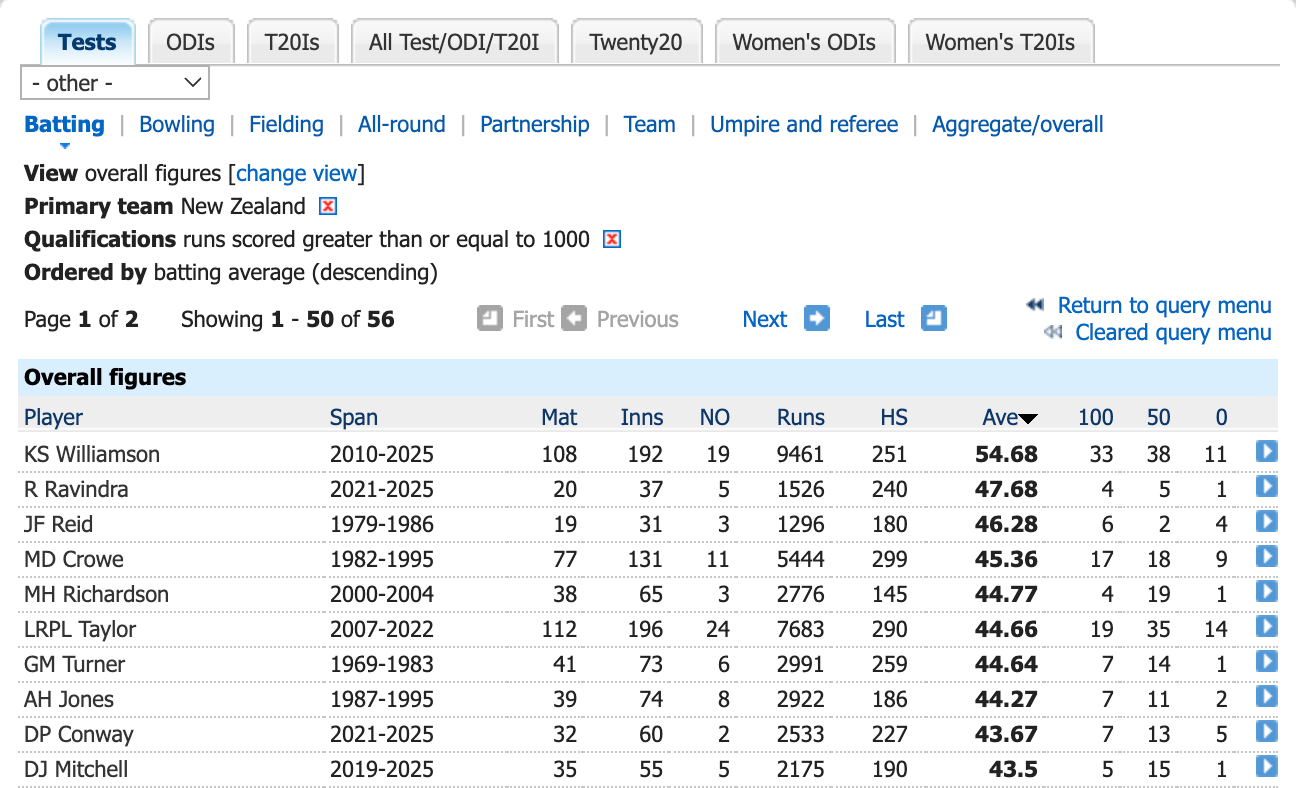
Last year in Test cricket, he averaged a ridiculous 117, striking at 97. You would put very short odds on Ravindra one day captaining his country.
So, the only criticism you can really have of Ravindra—and this isn’t really his fault—is who he has scored his runs against. Of Ravindra’s four Test hundreds so far, one came against a South Africa D team, one against Zimbabwe, and one against the West Indies at home, leaving only his 134 at Bengaluru as a stand-out, match-defining knock against a quality attack. Again, this isn’t Ravindra’s fault—he can only play what’s in front of him, and he’s done exactly what he’s supposed to do by scoring bulk runs against weaker attacks.
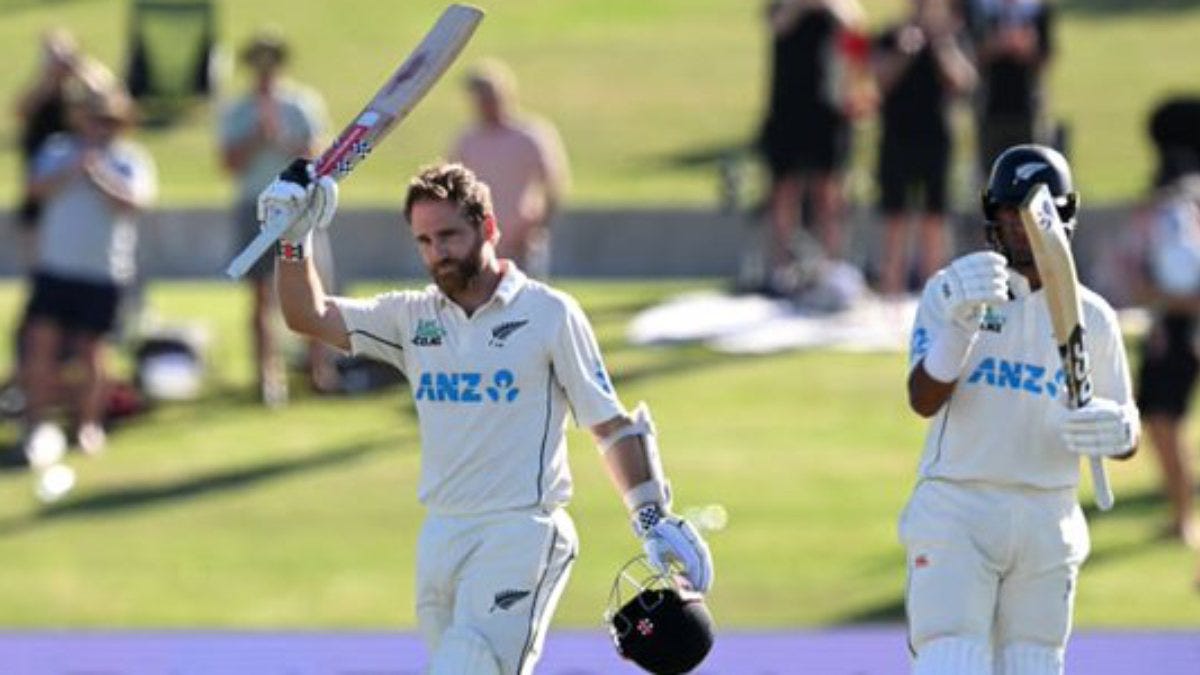
But in order for Ravindra to take the next step in his Test career, he will want to announce himself on larger stages and start putting match-defining numbers on the board against the bigger teams, too. There aren’t many better places to make a statement like that than the first Test of an English summer at Lord’s. Just saying. Because if there is a slight criticism of Ravindra’s Test career so far, it’s his propensity for ‘wasting’ pretty starts. The last time Ravindra played England in late 2024, he scored 24, 34, 3, 6, 18, 44—getting started four times out of six, but failing to go big even once, often losing concentration and appearing to get himself out. If Ravindra is to take the next step towards greatness during this run of Tests, converting those starts will be his biggest work-on.
The last time New Zealand toured England in 2022, Daryl Mitchell and Tom Blundell both had ridiculous series, with Mitchell scoring 538 runs at 107.6 with three hundreds, and Blundell contributing 383 runs at 76.6 with one hundred.
However, since then, it has been a slightly leaner period for Mitchell and Blundell. After starting his Test career like a house on fire, averaging 61.4 from his first 13 Tests between 2019 and 2022, Mitchell has come back down to earth somewhat, averaging 35.5 in the 22 Tests since, with just one hundred. Mitchell’s last Test hundred came against Sri Lanka in March 2023, so it has now been a long time between drinks. Mitchell certainly hasn’t been terrible in this time, chipping in with ten 50s and getting regular starts, but New Zealand fans will be hoping that a return to England sees Mitchell return to that imperious form of 2022.
It has been a similar story for Tom Blundell in recent years, although his struggles have been even more pronounced than Mitchell’s. Since the start of 2024, Blundell is averaging just 21.8 with the bat from 16 Tests, with his sole hundred in this period coming in the deadest of match situations against England, when New Zealand were 5/106 chasing over 500 in the 4th innings. With Mitchell Hay shining with a 50 on debut against the West Indies last December and Blundell nearing 36, he will surely have to show signs of a return to the 2022 model against England to retain his place for the home series against India.
While Glenn Phillips will miss the Ireland Test with IPL duties—likely paving the way for a debut for Dean Foxcroft in the spinning all-rounder role at number 7—when he does return to the XI for the England series, there are still some question marks over his role.
Note that I said role, and not talent, as that has never been in question. However, Phillips is 29 and has been in the Test setup for 6 years now, meaning he is no longer the exciting youngster who just burst onto the scene. Yet, in his 17 Tests, Phillips is averaging 32.2, still doesn’t have a hundred to his name, and it still feels like he hasn’t quite ‘announced’ himself in the Test arena.
To be clear, I’m not solely blaming Phillips for this, as he has spent the vast majority of his career batting at 7, consistently running out of partners or not batting at all, and bowling a bit of spin, which I believe is a waste of his talents and first-class average of 40. I am blaming the selectors, however, for still not giving him a proper opportunity up the order—given Mitchell and Blundell’s form struggles, there’s no reason Phillips couldn’t have been batting 5 with Mitchell at 6 and Blundell 7 in recent years, particularly in the series against the West Indies.
Given the current age profile of the side, Phillips at 29 stands out as a vital cog in our future batting line-up when, god forbid, Latham, Conway, Mitchell, and Williamson are all gone. So, my biggest question over this run of series is, will Phillips continue to be used as a bit-part Test all-rounder? Or is it finally time for the coach and selectors to start trusting him with a bigger role with the bat?
Nathan Smith has been solid but unspectacular in his four Test opportunities so far—averaging 25 with the bat and 39 with the ball—however, with no specialist spinner in the squad, I expect Smith will get more opportunities to impress at number 8 throughout this tour.
If anything, playing in England may help Smith, as he has been outstanding in his recent County stints, scoring 214 runs at 30 and taking 27 wickets at 21 for Worcestershire in 2024, and following that up with 14 wickets at 28 and 72 runs at 24 for Surrey in 2025.
Combine that with strong recent domestic returns in New Zealand—Smith averaged 48 with the bat and 20 with the ball from 3 appearances in the 2025/26 Plunket Shield—and it’s easy to see why the selectors are persisting with Smith and his all-round potential.
Then again, with plenty of other pace options in the squad—namely Foulkes and Tickner, though Sears is also a travelling reserve—Smith will need to start converting that potential into performances fairly quickly to retain his place long-term.
I don’t really want to jinx anything by writing too much about these two. For now, I am just thrilled that both are fit again, touch wood, and utterly salivating at the prospect of these two giants bowling in tandem. Batters beware.
With Henry locked in with the new ball from one end, it will be interesting to see which of Jamieson and O’Rourke partners him, and who ends up bowling first change. It will also be something of a homecoming for O’Rourke, who was born in London.
What more can I say about Matt Henry? He is undoubtedly one of the best new-ball bowlers in the world currently, taking 68 Test wickets at just 16.3 since the start of 2024. There’s not really a lot more I can add to that; the numbers speak for themselves.
In the past, Henry has struggled somewhat bowling in England, averaging 40.5 from his 4 previous Tests. However, that comes with the caveat that two of those Tests came in 2015, one in 2021, and one in 2022, and we know that Henry is a far different, more well-rounded Test bowler these days. There is absolutely no logical reason that an accurate new-ball bowler who relies on swing and seam movement like Henry shouldn’t absolutely feast in English conditions with the Dukes ball, so fingers crossed he can put that record right on this tour.
After taking a bit of a break to refresh recently, I am planning to cover each of these series closely on here. If you are still reading this far into the article, I’d love to hear your thoughts in the comments on what exactly you’d like that coverage to look like and what sort of content you get the most value out of from me. Do you want shorter daily recaps? Match summaries? More detailed analyses of key moments? Honing in on technical details? Humour? Ramblings? Something else entirely? I would love your feedback in the comments to help shape how I plan to cover these series.
Thanks for reading! Like my work? Please consider supporting me via a paid subscription or Buy Me A Coffee. For more info on how your support helps me produce this work and what your contributions go towards, see my About Page!
Just keen to keep reading about cricket? Same! If you liked this article, you might also enjoy:
Comments
Nothing yet. Say the first thing.
Sign in to join the conversation.