
Chris Martin is one of only 87 bowlers to have taken 200 or more Test wickets, placing him inside the top 4.5% of all bowlers who have taken at least one Test wicket. In fact, that is underselling Martin, as only 68 players have taken at least as many Test wickets as Martin’s 233. That, quite literally, isn’t something that happens every day. Clarrie Grimmett was the first Test bowler to reach 200 Test wickets back in 1930, meaning we’ve averaged fewer than one bowler per year reaching the milestone ever since. In an era where we’ve seen Anderson and Warne and Murali blast past 700 Test wickets, it’s easy to underestimate just how many 200 really is, but we’re talking about rarified air.
And yet, I’m almost certain that Chris Martin is the only one of those 68 bowlers who isn’t even the most famous person with his own name—that’d be the Coldplay singer. Actually, he’s probably not even the second or third most famous Chris Martin: there’s also a current baseball player for the Texas Rangers and a footballer for Bristol Rovers (and formerly Scotland) who share the same name.
Honestly, Christopher Stewart Martin might not even be in the top-10 most famous Chris Martins, as the Wikipedia disambiguation also includes three former NFL players, a motorcyclist, a rower, a paralympic gold medallist, a boxing trainer, and a rugby union fullback who won four caps for England in the 80s. And those are just the sportspeople—there’s also the Canadian actor from The L Word and Vampire Diaries, the Scottish actor from River City, the English comedian who currently writes for The Late Late Show, and the former politician who served as Principal Private Secretary to the Prime Minister during David Cameron’s term from 2011-2015. Hell, to a certain section of the public, he might not even be the most famous Chris Martin associated with cricket: there’s also Christopher Martin-Jenkins, longtime Test Match Special commentator and former MCC president.
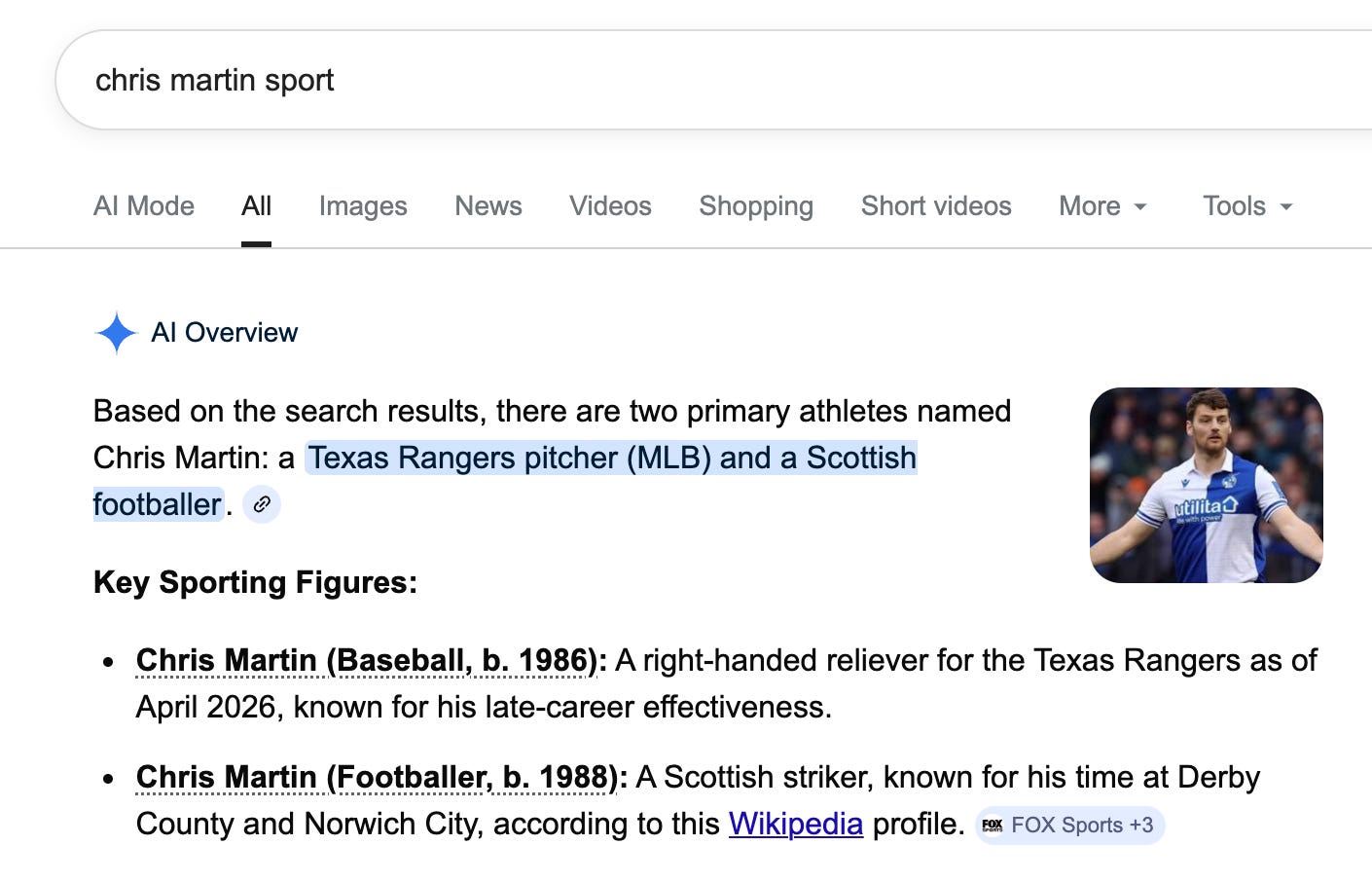
So, I guess what I’m saying is that Chris Martin (New Zealand Cricketer), who, again, took 233 Test wickets, 599 first-class wickets, and has played the 15th-most Tests for New Zealand, is approximately the 16th-most famous Chris Martin overall, about the 10th-most famous Chris Martin associated with sports, and, for some, maybe even the 2nd-most famous Chris Martin associated with cricket.
That’s not really fair. I know if I took even a single Test wicket, I’d want my name to come up first in the search results. The overwhelming majority of the other 67 players to take 233+ Test wickets are famous, revered names who went on to have careers in other areas of the game, whether coaching, commentary, or administration. You could pull a name out of a hat and be almost assured you’d have seen their face on a cricket broadcast within the past year—it’s basically a who’s who of IPL assistant coaches and mentors.
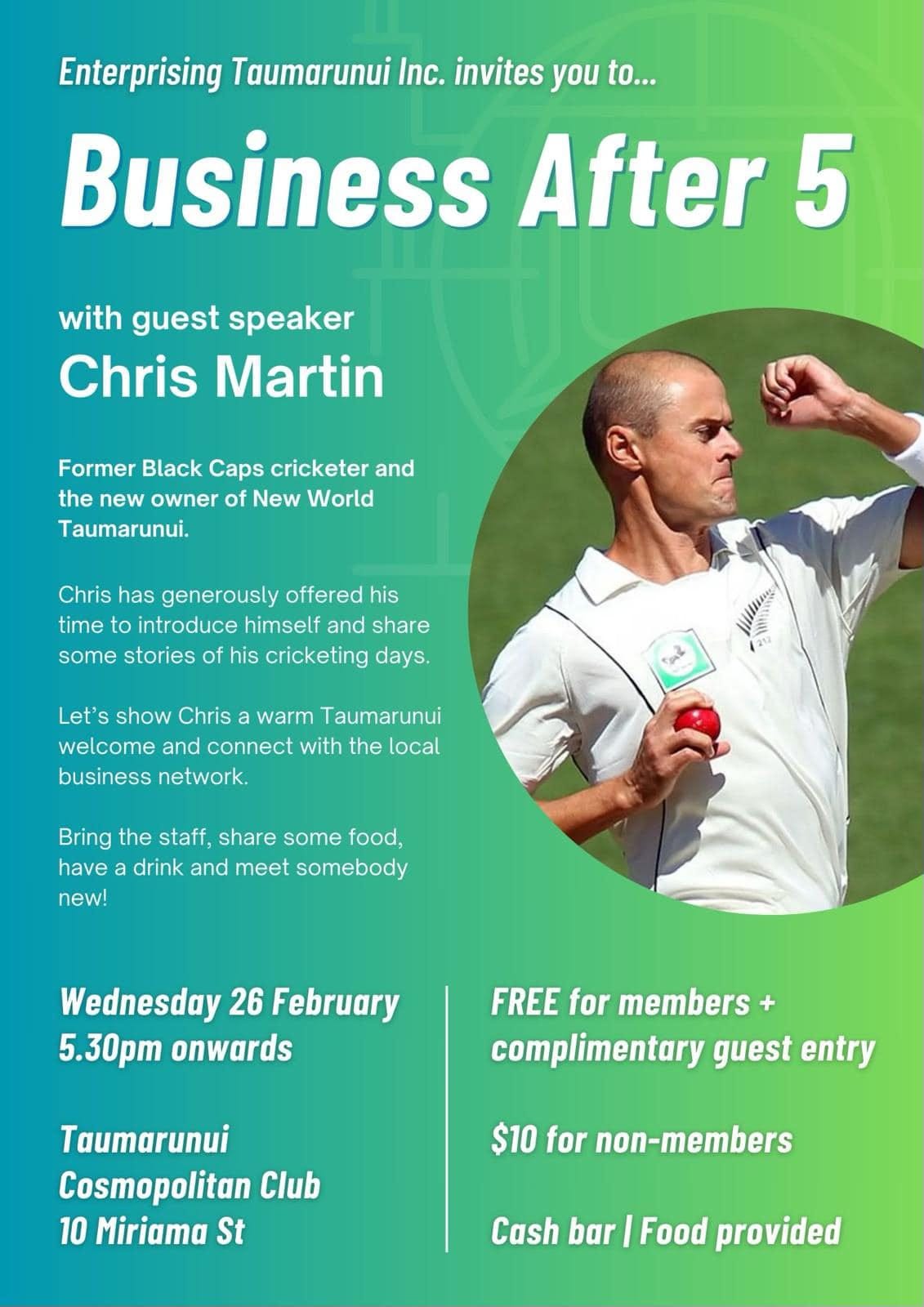
These days, Chris Martin owns a New World supermarket in Taumarunui, a small town in the middle of the North Island with a population of about 4,930.
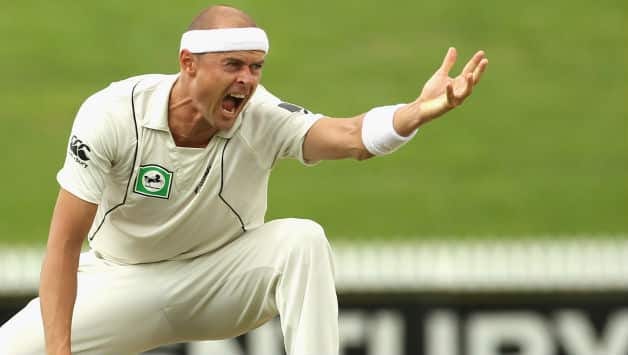
In an odd way, it almost makes Martin the platonic ideal of a Black Caps cricketer. As mentioned, Martin has the 15th-most Test caps for New Zealand and is one of only 177 cricketers to play at least 70 Tests, plus the 10th-most first-class wickets by a New Zealand bowler, and the 6th-most Test wickets for New Zealand. Yet, he still managed to fly under the radar, arguably even in New Zealand. For a long time, and perhaps even still, Martin was better known for what he couldn’t do with the bat than the many things that he could do with the ball.
Perhaps part of his mixed legacy is that he was a Test-specialist (averaging 45 in his 20 ODIs!) in an era where that became increasingly rare, while he wasn’t the most athletic fielder or the sexiest bowler even when he was taking wickets—he wouldn’t bounce people out like Wagner, or hoop the ball like Boult, or blast people out with raw pace like Bond. More still is the fact that Martin was quickly overshadowed by what came after him: New Zealand’s greatest ever pace triumvirate of Boult/Southee/Wagner came along and rightly hogged the spotlight.
And yet, I repeat: of the 1,946 bowlers to have taken a Test wicket, only 68 managed to take at least as many as Martin. He took more Test wickets than Mohammad Shami or Vernon Philander or Jeff Thompson or Shoaib Akhtar or Andrew Flintoff or Andy Roberts, though you’d scarcely know it. Chris Martin took 233 Test wickets, Jasprit Bumrah currently has 234, and Gary Sobers took 235—but how often have you ever heard those three names mentioned in the same sentence? When Alec Bedser retired from Test cricket in 1955, he held the world record for the most Test wickets at 236—just three more than Martin’s career tally—for 9 years and 186 days, until Brian Statham finally surpassed him. Are you starting to see what I’m getting at? 233 is a lot of wickets.
Underrated and under-discussed no more, I think it’s high time we re-evaluate Chris Martin’s Test legacy, not merely as the punchline of a batter that he is often remembered as, but also as the highly skilled 200+ Test wicket taker who led New Zealand’s attack for over a decade.
There’s No Shame In Being the Worst of the Best
Let’s be clear, I’m not trying to argue that Chris Martin is secretly a top-50 Test bowler of all time hiding in plain sight. However, he is most assuredly a New Zealand Test great and arguably within the 100 greatest Test bowlers ever. Yet, you wouldn’t always know it from the tenor of discussions around his legacy, if such discussions even exist. Not only is Martin’s name rarely brought up in conversations internationally—at least, not for his bowling prowess—but even in New Zealand, he is overshadowed by the Hadlees, Vettoris, Bonds, Boults, and Southees of the world. I would like to change that.
In the NFL and MLB, fans have a concept called the ‘Hall of Very Good’, honouring, you guessed it, those players who were very, very good, but fall just short of being elite Hall of Famers. In a cricketing context, this is precisely where I believe Martin fits: a very, very good Test cricketer who falls short of being an all-time great. Just to be clear, there is absolutely zero shame in this whatsoever.
Now, first, to understand Martin’s greatness, or very goodness, as it were, it is worth acknowledging his limitations. Of the 68 bowlers to take at least 233 Test wickets, only Danish Kaneria, Daniel Vettori, and Gary Sobers took their wickets at a higher average than Martin’s 33.81. By economy, only Mitchell Starc and Mitchell Johnson took their wickets at a higher rate than Martin’s 3.37. There is no doubt these numbers, which don’t exactly pop off the page, are part of what has held back Martin’s legacy.
To which I respond, as sarcastically as possible, “Oh no.” Yes, Martin may have one of the worst averages of those to have taken at least as many Test wickets as him, but that’s a bit like being the slowest runner in the 100m Olympic final: to even get to that position, you have to be so freakishly, absurdly talented that it beggars belief. There really is little shame in being the worst of the best, nor can Martin’s legacy be solely understood through his raw stats.
However, if we sort this group of elite wicket-takers by bowling strike rate, Martin ranks a more respectable 45th of 68, with his career mark of 60.1 almost identical to Tim Southee’s career strike rate of 60. And, ultimately, wickets, not economy, were what New Zealand needed the most out of Martin during that era, even granting that he was slightly miscast as a strike bowler.
By rights, Martin really never should have led New Zealand’s Test attack, let alone for a decade. During Martin’s era, that spot was always supposed to be reserved for Shane Bond. However, sadly, the two only played 10 Tests together, and never more than four in a calendar year, in 2006. However, from the glimpses we got in those 10 games, New Zealand won 6, drew 2, and lost 2 for a win/loss ratio of 3, which is a hell of a lot better than their overall record during the 2000s of 23 wins, 25 draws, and 32 losses, for a win/loss ratio of 0.71. In these 10 Tests, Martin took 29 wickets at 31.7, knocking about two runs off his career average, while Bond took 52 at 21.3, also below his career average.
It seems clear that this new ball partnership, which came up through the ranks together, playing for Canterbury U20s as far back as 1995, complemented each other beautifully, with Bond leading the attack, and Martin backing him up; the Ntini to Bond’s Pollock, the Gillespie to Bond’s McGrath, the Chatfield to Bond’s Hadlee.
On paper, that was how the attack of this era was supposed to work: Bond leads as the main strike bowler delivering short, sharp spells, Martin backs him up as the high-effort workhorse who bowls longer spells to allow Bond to rest, Vettori keeps things tight and chips in with wickets, Oram bangs it in and bowls the all-rounder overs, and James Franklin offers some left-arm variety. Oh, and somewhere in all that, the guy who took 692 first-class wickets at 24, Andre Adams, probably should have played more than the one Test, but I’ll have to park that for another article, or else we’ll be here all day.
Pace, height, effort, spin, left and right arm variety: on paper, this should have been a fantastically balanced Test attack. In reality, that exact attack played two Tests together against Sri Lanka in 2006, and that was it. This is the role that Martin was born to play in Test cricket—a very skilled new ball bowler, but as the second option, not the outright leader of the attack. However, injuries and New Zealand’s poor depth during this era pushed Martin further into the spotlight, often forcing him to play multiple roles within the same attack: the strike bowler, the workhorse, and the container all in one; a fast bowling chameleon for every tricky situation New Zealand found themselves in, and boy did they find themselves in plenty. It is hard enough taking Test wickets even if you have crystal clear role definition, so I can only imagine how difficult it was trying to take wickets as a fast bowling swiss army knife. For NBA fans, it’s a bit like having a great second option who’s not quite good enough to be the first option, but your team’s superstar is always injured (*cough* Embiid *cough*), so they have little other choice but to step up and fill the void as best they can.
To illustrate this point, in the 49 Tests where Martin took the brand new ball—bowling the first over of the innings—he took 153 wickets at an average of 34.45 and a strike rate of 62.1, both above his career numbers. In the 19 Tests where Martin bowled the second over of the innings, he took 53 wickets at an average of 31.62 and a strike rate of 54.9—identical to Trent Boult’s career strike rate. Clearly, this is the role that Martin was best suited to in Test cricket, but Bond’s constant injuries and the lack of other options until Tim Southee came of age in 2012 meant Martin was consistently thrust into the role of leading New Zealand’s attack.
Ready or Not, Lead the Attack
And lead New Zealand’s attack he did. Despite Martin’s average and strike rate both climbing when he bowled the first over, this was also the role in which Martin took 9 of his 10 Test 5-wicket hauls, as well as his 10-wicket match. Often, Martin had to bowl more aggressively in search of wickets when he led the attack, simply because someone had to take them, and few other bowlers were taking wickets for New Zealand during that era. When Bond wasn’t playing, the next-best bowler in those New Zealand teams was undoubtedly Daniel Vettori. However, for all of his many skills, with Vettori’s career strike rate of 78.4, he wasn’t exactly one to blast teams out, and someone had to at least try. For whatever else you think of Martin, you could never accuse him of not trying.
Before reaching that point, the powers that be had their eyes on Martin from a young age, with his first professional appearance that I can track down coming for a New Zealand Academy side back in 1994, when Martin was still 19. But it wasn’t until 1998 that Martin really started to break through, making his debut for Canterbury that February and claiming Mark Jefferson, who I’m sure you all remember, as his maiden first-class scalp. A week later, Martin got his first taste of international-adjacent cricket, suiting up for Canterbury against a touring Zimbabwean side that featured the Flower brothers, Heath Streak, and Alistair Campbell. But it was a few months later, in August 1998, playing for the New Zealand Academy against an Australian Cricket Academy side in Brisbane, when Martin really caught the eye and showed what he was capable of.
Bowling to an Australian Cricket Academy side featuring familiar names like Marcus North, James Hopes, and Graham Manou, Martin dominated, first with match figures of 5/33 and 3/70, followed by the eye-popping figures of 8/43 and 3/33. Martin followed this up by taking 22 wickets at 23 and 23 wickets at 29 across the next two first-class seasons, leaving Martin poised to make his Test debut at Bloemfontein in 2000, during which he claimed Gary Kirsten as his maiden Test wicket—not a bad scalp at all. From there, Martin’s love affair with South Africa never relented. Not only did Martin also play his final Test in SA, but it was the only country—including New Zealand—in which he averaged under 30 with the ball (29.1). Overall, Martin took 55 wickets at 26.7 and a strike rate of 49.1 against the great South African team of the 2000s.
More broadly, during Martin’s career span of 2000-2013, he took 233 wickets; more than double the next most successful New Zealand seamer, Tim Southee, who took 101. Globally, during this span, Martin took the 15th-most Test wickets. You can combine the 2nd and 3rd most successful New Zealand seamers during that period—Southee and Bond—and still only get 188 wickets, 45 shy of Martin’s tally. Add in Kyle Mills, who played 19 Tests and took 44 wickets in this era, and you’re still one shy of Martin’s tally. In fact, to take this a step further, if you combine Vettori and Martin’s wicket tallies during this period—501—you could take the next six most successful New Zealand bowlers—Southee, Bond, Tuffey, O’Brien, Franklin, and Boult—and still only have 492 wickets in this period. For the better part of a decade, Chris Martin and Daniel Vettori were effectively a two-man Test bowling attack.
That’s just the wickets, but Martin was also a workhorse. During this same period, Martin bowled 2337.4 overs. The next three most successful New Zealand seamers—Southee, Bond, and Franklin—only bowled 28 more overs combined. Or, to put it another way still, across Martin’s career, he played 71 Tests, and the next most-capped New Zealand seam bowler in this period was James Franklin with 31. Martin was, almost literally, doing the work of three men to hold New Zealand’s seam attack together.
Across these 71 Tests, Martin played in 17 wins, 18 draws, and 36 losses. 17 wins may not sound like that many, but in a New Zealand context, that puts Martin 15th-equal alongside Matt Henry, Mitchell Santner, Devon Conway, and Jeremy Coney. Perhaps more notably, Martin’s 17 Test wins are more than the 16 that the great Martin Crowe managed. And in these wins, Martin was utterly dominant, taking 83 wickets at 21 with a strike rate of 40. In draws and losses, Martin averaged over 40 with the ball, but when New Zealand did win, which was a rare enough feat in that era, Martin almost invariably played a starring role.
Of these wins, the highlight was undoubtedly Martin’s 10-wicket match against South Africa in 2004, helping New Zealand secure only their 4th Test win over South Africa at the time (we’ve only added 3 more in the intervening 22 years). A 10-wicket haul was probably the furthest thing from Martin’s mind when South Africa made their way to 0/177 in 58 overs courtesy of Gibbs and Smith. However, Martin finally trapped Smith LBW, with Cairns snaring Gibbs the very next ball to start the collapse. From there, Martin tore through South Africa’s middle order, with Roudolph, Kirsten, Kallis, and Boucher all falling with the score between 236 and 245—all but Kirsten dismissed by Martin—before also adding the scalps of McKenzie and Ntini to dismiss South Africa for 296 and finish with figures of 6/76 from 31 overs.
Big centuries from Scott Styris and Chris Cairns then set up a commanding New Zealand lead, before Martin picked up where he left off, dismissing Graeme Smith first ball. However, successive partnerships between Gibbs, Rudolph, and Kallis saw South Africa to 2/249 after Tea on Day 4, attempting to hang on for a draw. But after McMillian and Oram prized out the wickets of Gibbs and Kallis, Martin again tore through South Africa’s middle order, dismissing Kirsten and McKenzie in consecutive balls, and adding Boucher and Pollock a few overs later, finishing with figures of 5/105 and match figures of 11/181 to set up a comfortable 51-run chase for New Zealand.
Overall in Test cricket, Chris Martin bowled 295 balls to Graeme Smith, taking 8/187 for an average of just 23.4 (for Smith). Against his opening partner Gibbs, it was 4/92 (141), for an average of 23. Against Kallis, it was 4/158 (319) for an average of 39.5. Against AB De Villiers: 102/3 (140) balls for an average of 34. And I’ve saved the best for last, because against Mark Boucher it was: 5/28 (87), with Boucher averaging just 5.6. I don’t know that I can fully articulate why, but as I said, boy, did Martin enjoy playing against South Africa
But it’s not just Martin’s Test achievements that are worth reflecting on; taking 599 first-class wickets is also no joke. That means that Martin has either the 8th or 10th most first-class wickets by a New Zealander, depending on whether you choose to count Clarrie Grimmett (born in Dunedin but represented Australia) and Sydney Smith, who was born in the West Indies and represented them, but also represented New Zealand after moving here in 1915 and living out his life here. However, even this buries the lede somewhat, as the majority of the players above Martin on that list took a significant portion of their wickets overseas:
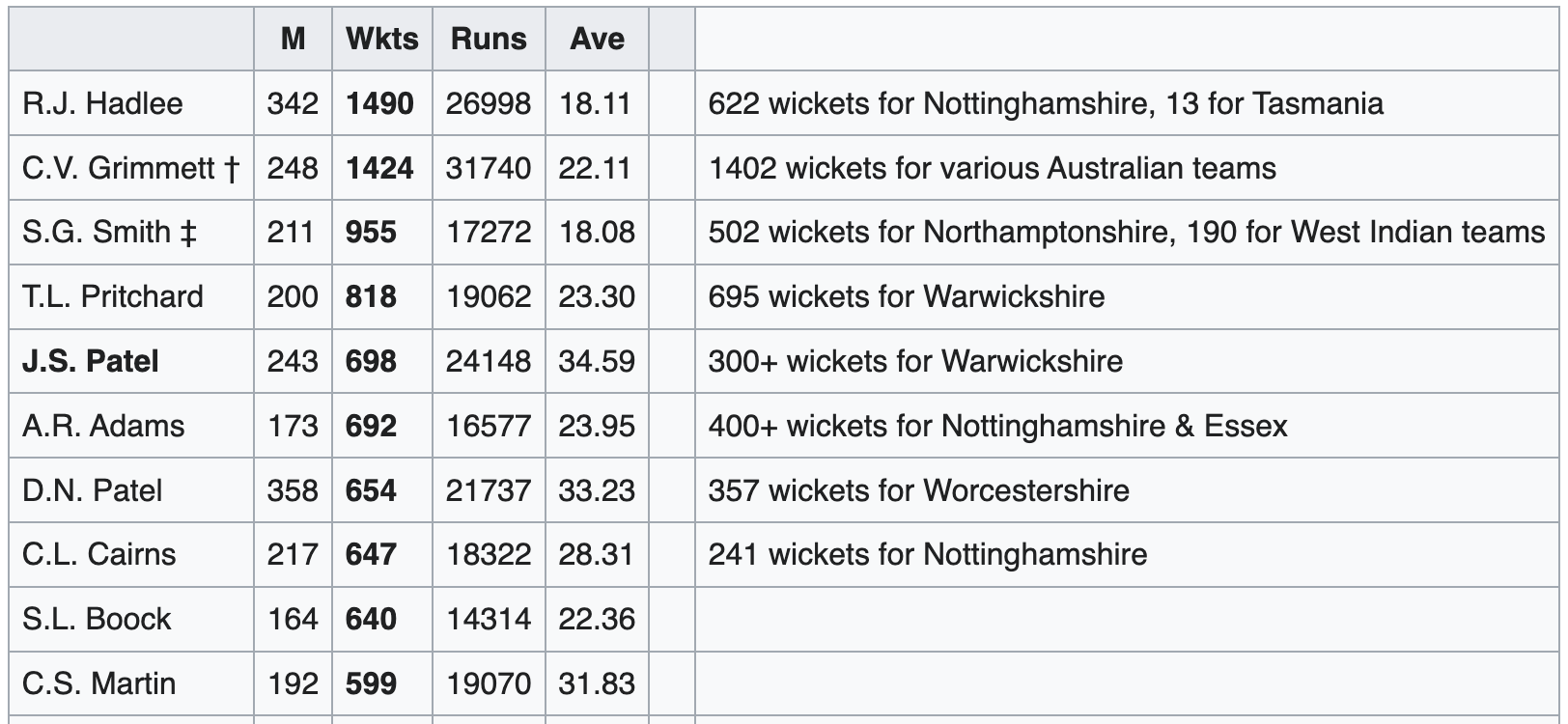
If you only count wickets taken for New Zealand or in New Zealand first-class cricket, Martin would rank third all-time behind only Sir Richard and Stephen Boock. Backing this up, Martin has the equal second most Windsor Cup wins—awarded to the best bowler in a season for performances in New Zealand first-class cricket—tied on 5 with Tim Southee, though still miles behind Hadlee’s 13.
The Advanced Stats
It is also worth contextualising Martin’s raw numbers compared to the era during which he played. As the decade with the second-highest batting average on record, the 2000s were the most batting-friendly era in Test cricket since the 1940s. Between 2000 and 2013, top-6 batters in Test cricket averaged 39.51, while opening bowlers averaged 31.32. By comparison, in the subsequent era from 2014-present, the average for top-6 batters has dropped by more than 3 runs to 36.4, while the average opening bowler now averages 27.68. There are many reasons for this, which I have discussed previously—from the WTC encouraging more ‘result’ pitches, to the proliferation of the wobble ball, to the reinforced Kookaburra seam.
All that to say that Martin’s Test average of 33.81 doesn’t quite tell the full story—in the modern era, you can all but guarantee that Martin would have been deadly with the wobble ball, and that average would probably look more similar to Tim Southee’s at around 30. In fact, there were already signs of this turnaround occurring, as Martin had three of his four best years by average in the final three years of his Test career, which is most atypical for a fast bowler, especially one who was 36-38 at the time. Yet, in 2011 Martin averaged 29.5, followed by 28.9 in 2012 and 21 in his final Test in 2013. Overall, across the final three years of his career as a 36+ year old, Martin took 43 wickets at 28.6, arguably peaking in his late 30s.
Match factor statistics, which are created by the team at and explained in more detail in their article here, reinforce this point and further muddy the waters of Martin’s legacy. Martin’s raw match factor, which measures how a player performed relative to players in the same role in the Tests they played, is 0.91, indicating he performed 9% worse than other pace bowlers in the matches he played. However, if you measure Martin’s match factor relative to his teammates, rather than his teammates and opposition, his match factor climbs to 1.04, indicating he was 4% better than other New Zealand seamers in the matches he played. Likewise, his strike factor was 1.09, indicating he had a 9% better strike rate than other New Zealand seamers in the games he played. Of the seamers that Martin played with regularly (so, excluding Bond), only Iain O’Brien, who, I promise, will get his own article someday soon, had a better strike factor relative to his teammates at 1.2.
During this era, Vettori also had a match factor 27% better than his teammates and an economy factor 29% better than his teammates, but had a slightly negative strike rate factor. This knowledge that Vettori would almost inevitably tie up an end allowed Martin to sacrifice his economy and average in search of wickets, making the two such a complementary pair for so long.
While we’re doing this—you guessed it—Martin does indeed have the worst match factor on record with the bat (minimum 100 runs) at 0.09, meaning he was a frankly ridiculous 91% worse than all other batters in Tests he played. Ok, we’ve had our fun, now back to how good of a bowler he was.
These numbers are also partially what makes Martin’s legacy so difficult to evaluate: how do you accurately rate a guy that advanced analytics show was a slight negative relative to the opposition bowlers, but simultaneously a positive relative to the other bowlers in his team, who has a relatively high bowling average but also played during an extremely batting-friendly era, but who also took 233 Test wickets and has played the 15th-most Tests for New Zealand, who averaged 31 at home and 38 away, and was mainly forced into a role that didn’t fully suit him? It’s almost no wonder that for the longest time, people have put this task in the ‘too hard’ basket and instead just poke some lighthearted fun at Martin’s batting.
Or, another way of visualising it. Here are all the bowlers who bowled at least 3,000 balls in Test cricket from 2000-2013, and there’s Chris Martin, almost bang in the middle:
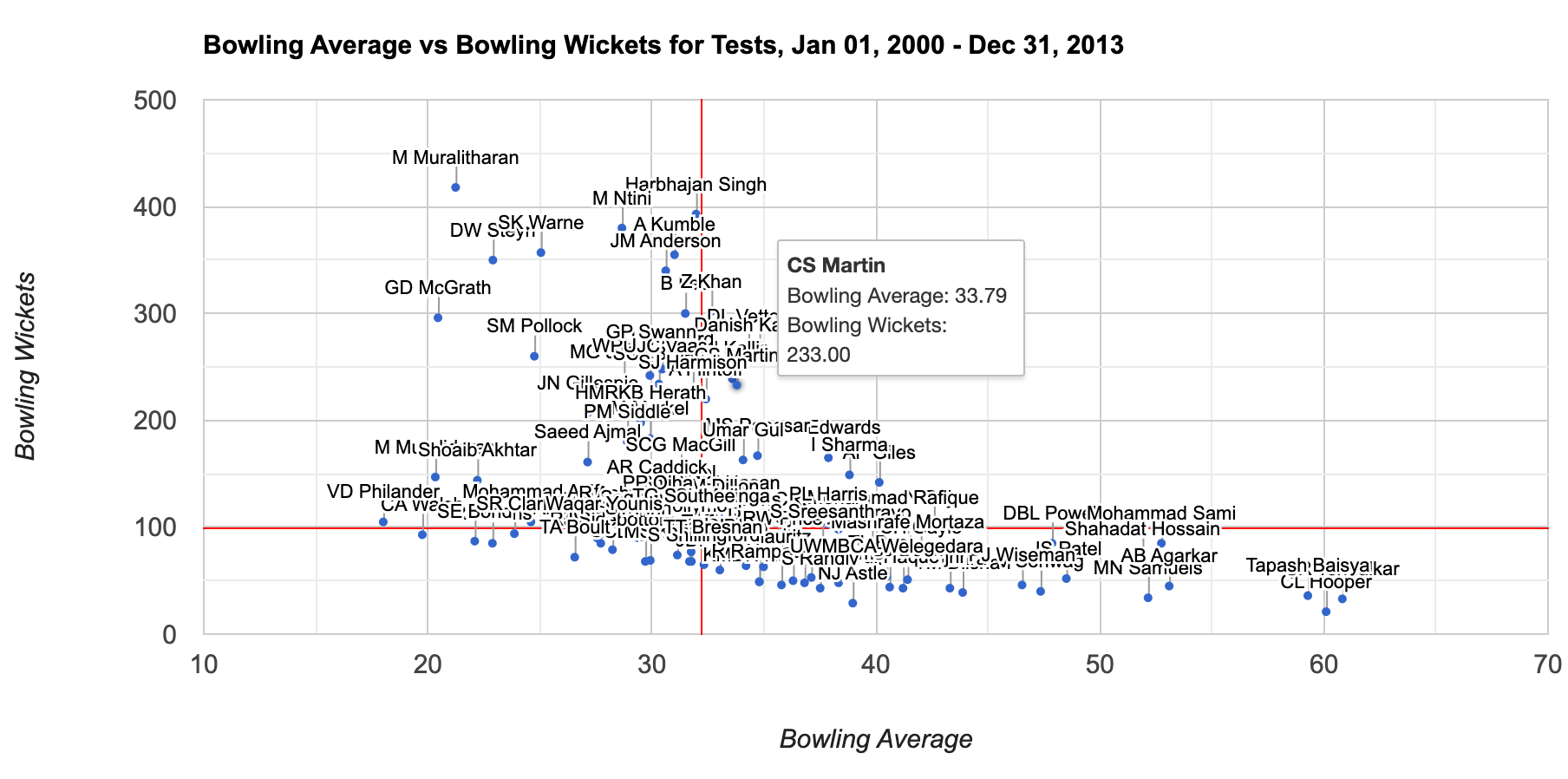
Sure, he’s far from the first name your eyes jump to, but just look at all the bowlers below him, too.
So yes, you can look at Martin’s raw numbers and fairly wonder if his average is really elite, or if his economy is a bit high, but equally, I would argue that few other bowlers have taken 200+ Test wickets with as little support as Martin. Wasim had Waqar. The West Indies greats hunted in packs. McGrath had Warne, Gillespie, and Lee. Anderson had Broad. Pollock had Ntini. Steyn had Morkle. Ashwin had Jadeja. Boult had Southee. Bedi was part of India’s spin quartet. Lillie had Thompson. Murali had Vaas. Hell, even Hadlee had Chatfield.
Yes, Martin had Vettori (or, more accurately, Vettori had Martin), but in terms of fellow seamers? For the majority of his career, Martin was partnered with either Shane Bond, held together by sticky tape, a still-teenager Tim Southee, or a rotating cast of Franklin, Tuffey, O’Brien, Oram, Bracewell, Mills, Butler, or Gillespie.
Closest Comparisons and Martin’s Legacy
Ultimately, the best way to determine Martin’s legacy is to look at his closest comparisons.
If we examine other bowlers who have 200+ Test wickets at an average greater than 30 and a strike rate greater than 59, you get Javagal Srinath, Steve Harmison, Andrew Flintoff, and Peter Siddle. This feels like appropriate company for Martin; fellow greats for their respective countries, but not in the echelon of all-time Test greats. Or, in other words, fellow members of the Hall of Very Good. Except, Martin never had the highlight Ashes moments—Siddle’s hat-trick, Harmison’s Lord’s 5-for in 2005, or even the first ball of 06/07, and Flintoff’s 2005 and 09 heroics—to cement his legacy, nor did he have a billion fans cheering him on like Srinath.
Extend that below 200 wickets, and you could add Geoff Lawson, Danny Morrison, Jerome Taylor, Andre Nel, and Michael Kasprowicz as players with roughly similar raw numbers to Martin, though none played anywhere near as many Tests, while above 300 wickets, you can add Tim Southee, Zaheer Khan, and Ishant Sharma.
In fact, Khan, Sharma, and Harmison have very, very similar raw numbers to Martin, with Harmison probably being the closest comparison in terms of conditions and career span:
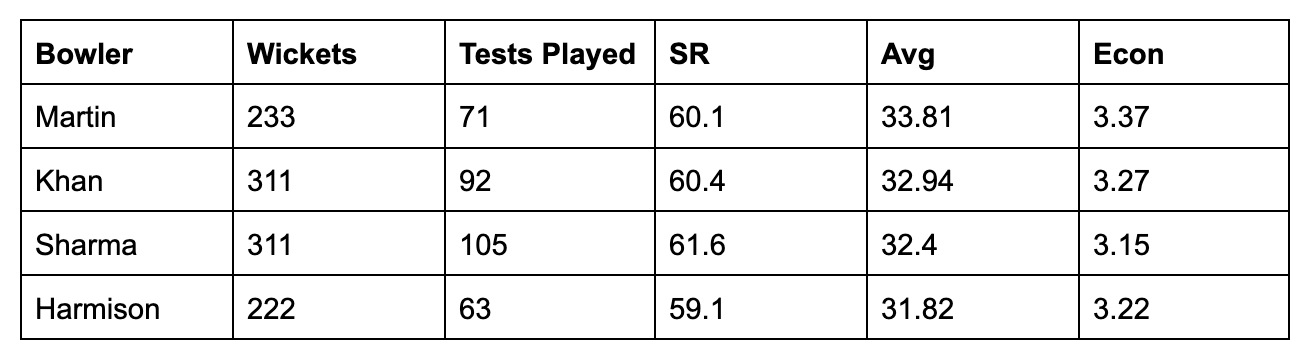
It is no coincidence that Martin, Harmison, and Khan all played the majority of their careers in the 2000s, nor that Sharma debuted in 2007.
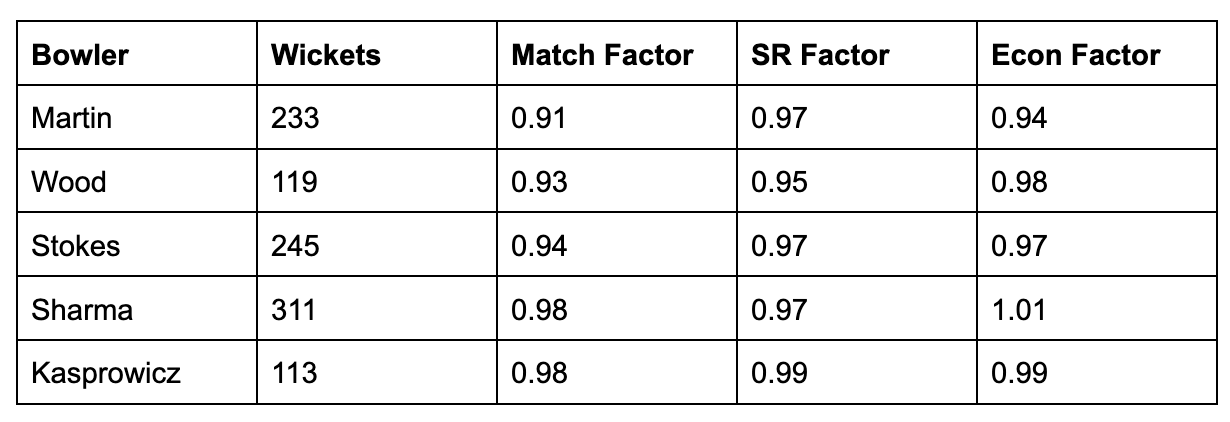
Or, going off the advanced numbers, the bowlers most similar to Martin, in that they all have just slightly negative match factor values relative to their teammates and opponents, are Ben Stokes, Mark Wood, Ishant Sharma, and Michael Kasprowicz:
Then again, if we look at those numbers only relative to teammates, rather than teammates and opposition, the players most similar to Martin would be Tim Southee, Steve Harmison, Matthew Hoggard, Mohammad Shami, Geoff Lawson, Makhaya Ntini, and Michael Holding—though that last one is quite clearly just the result of playing in such a stacked West Indies attack, as Holding’s numbers climb precipitously when compared to teammates and opposition.
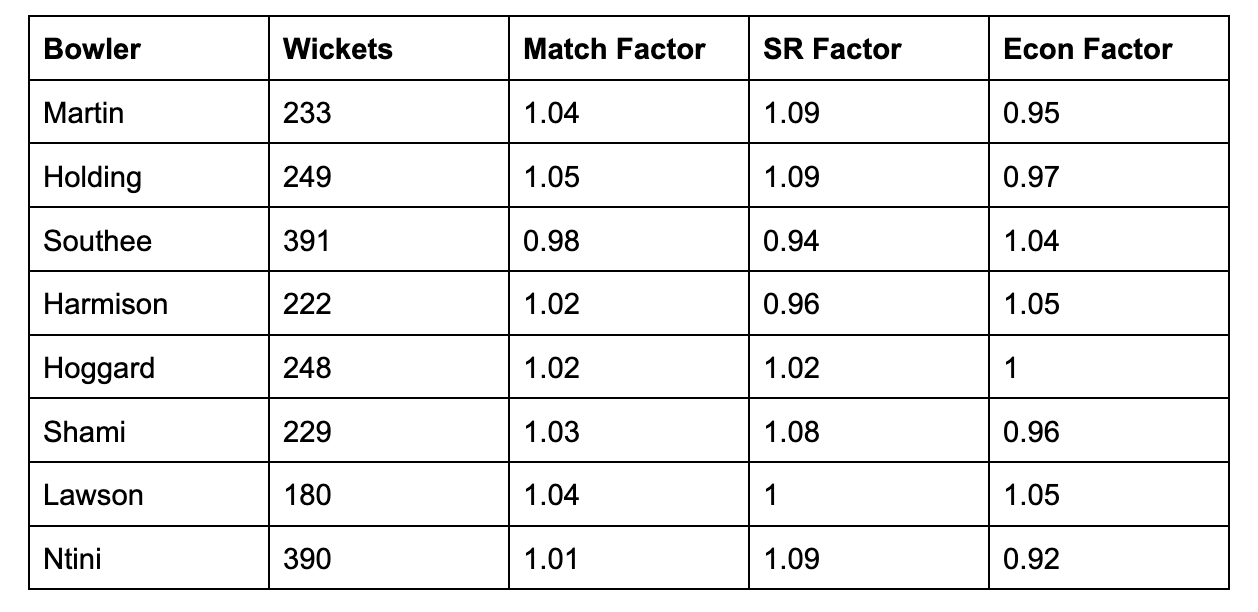
So……does that clear things up? I’m still not sure I have a clear, succinct answer for what Chris Martin’s Test legacy should be, other than that he sits comfortably somewhere in the Hall of Very Good, right in the cross-section of being better than Kasprowicz and Nel, not quite as good as Ishant Sharma and Zaheer Khan and roughly the same as Harmison and Shami—whatever that means to you.
Alternately, in New Zealand terms, Martin sits somewhere on the spectrum from Danny Morrison to Tim Southee—though much closer to the Southee end than I think many would expect. In fact, the more I have researched this piece and dug into their numbers, the more I’m convinced that if you swapped their careers and allowed Martin to bowl alongside Boult and Wagner in the wobble ball era, his record would much more closely resemble Southee’s, and he would likely be remembered in a similar tier of greatness, rather than just very goodness.
Or, to be really cheeky with the numbers, Chris Martin was almost exactly as good as Michael Holding*, and you can quote me on that.
I guess all I’m asking is: the next time you feel the urge to poke fun at Martin’s batting—and please, don’t let me stop you—maybe just add the caveat that he was also a Very Good Test bowler who didn’t take 233 wickets by accident.
*Relative to the other bowlers in their teams, which is definitely an apples-to-apples comparison.
Thanks for reading! Like my work? Please consider supporting me via a paid subscription or Buy Me A Coffee. For more info on how your support helps me produce this work and what your contributions go towards, see my About Page!
Just keen to keep reading about cricket? Same! If you liked this article, you might also enjoy:
Comments
Nothing yet. Say the first thing.
Sign in to join the conversation.