
It is 1958. Brendon McCullum’s dad is only two years old. England has just lost the Ashes 4-0 in Australia. New Zealand bowls England out for 221, collapses to 54/6, and loses the first Test.
It is 1983. Brendon McCullum is only one. England has just lost the Ashes 2-1 in Australia. New Zealand bowls England out for 209, collapses to 41/5, and loses the first Test.
It is 2022. The term BazBall means nothing yet. England has just lost the Ashes 4-0 in Australia. New Zealand wins the toss at Lord’s, falls to 36/6, bowls England out for 141, and loses the first Test.
It is 2026. The term BazBall is already on its 4th reset. England has just lost the Ashes 3-1 in Australia. New Zealand wins the toss at Lord’s, bowls England out for 140, falls to 30/6, and loses the first Test.
It is 2089. MechaMcCullum is now England’s longest-serving coach. BazBall is on reset number 128. England has just lost the Ashes 5-0 in Australia. New Zealand wins the toss at Lord’s, falls to 28/6, bowls England out for 142, and loses the first Test.
As a Black Caps supporter, why do I feel like I’ve seen that Test before?
Watching the Black Caps wilt from a commanding day one position, having won the toss and reduced England to 118/9, to an ultimately comfortable 115-run defeat, I couldn’t help but be overcome by a crushing sense of familiarity and inevitability. Here we go again…
I may not have seen that exact Test before, but I have absolutely seen that sort of Test performance from New Zealand many times previously. I’ve lost count of how many times I’ve fallen asleep after the first session or two of an away Test with New Zealand in a promising position, only to wake up and have those dreams immediately dashed. Even so, rarely has the whiplash been more extreme than calling it a night with England 108/7 and then waking up to find New Zealand had collapsed to 30/6.
Forget the pitch for a second. Forget Matt Henry’s injury. Forget the dropped catches. We’ll cover all those points in due course, but one thing is worth emphasising above all else here: New Zealand had England 118/9 on day one of this Test and still lost by 115 runs.
I can understand losing on what was ultimately a lottery of a pitch, but to lose by 115 runs in a match where no batter faced 100 balls and only one team passed 200 should scarcely be possible. It’s almost impressive, in a staggering sort of way.
How did New Zealand manage it? Let’s dig into it.
I would prefer to spend the majority of this article analysing the cricket itself, rather than the pitch, which has already been roundly discussed and criticised elsewhere. However, it clearly had a massive bearing on this result, even if it wasn’t the only decisive factor, so it’s worth addressing upfront.
With only 996 balls bowled at Lord’s, this became just the 25th completed Test in history to last fewer than 1,000 balls. 1,826 Tests have had a result in history, so this means that just 1.37% of completed Tests have finished in fewer than 1,000 balls.
Perhaps more remarkably, in terms of Tests where all 40 wickets have fallen, this was the third-shortest in history by balls bowled. The other two instances occurred in Leeds in 1907, when just 976 balls were bowled, and at Lord’s in 1888, when just 792 balls were bowled. In modern history, the next-closest example was between the West Indies and Australia in Kingston in 2025, when just 1,045 balls were bowled. There have been 348 Tests where all 40 wickets have fallen, so it occurs only 0.86% of the time that all 40 wickets fall in under 1,000 balls in a Test. It’s quite literally a once-in-a-century event in Test cricket.
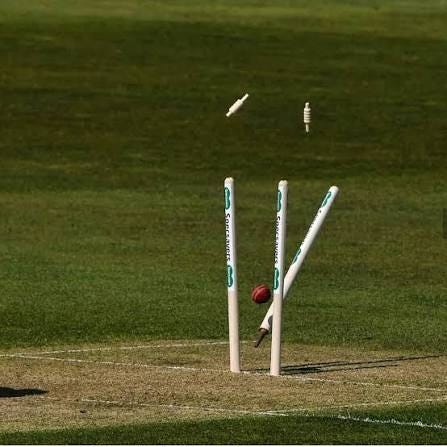
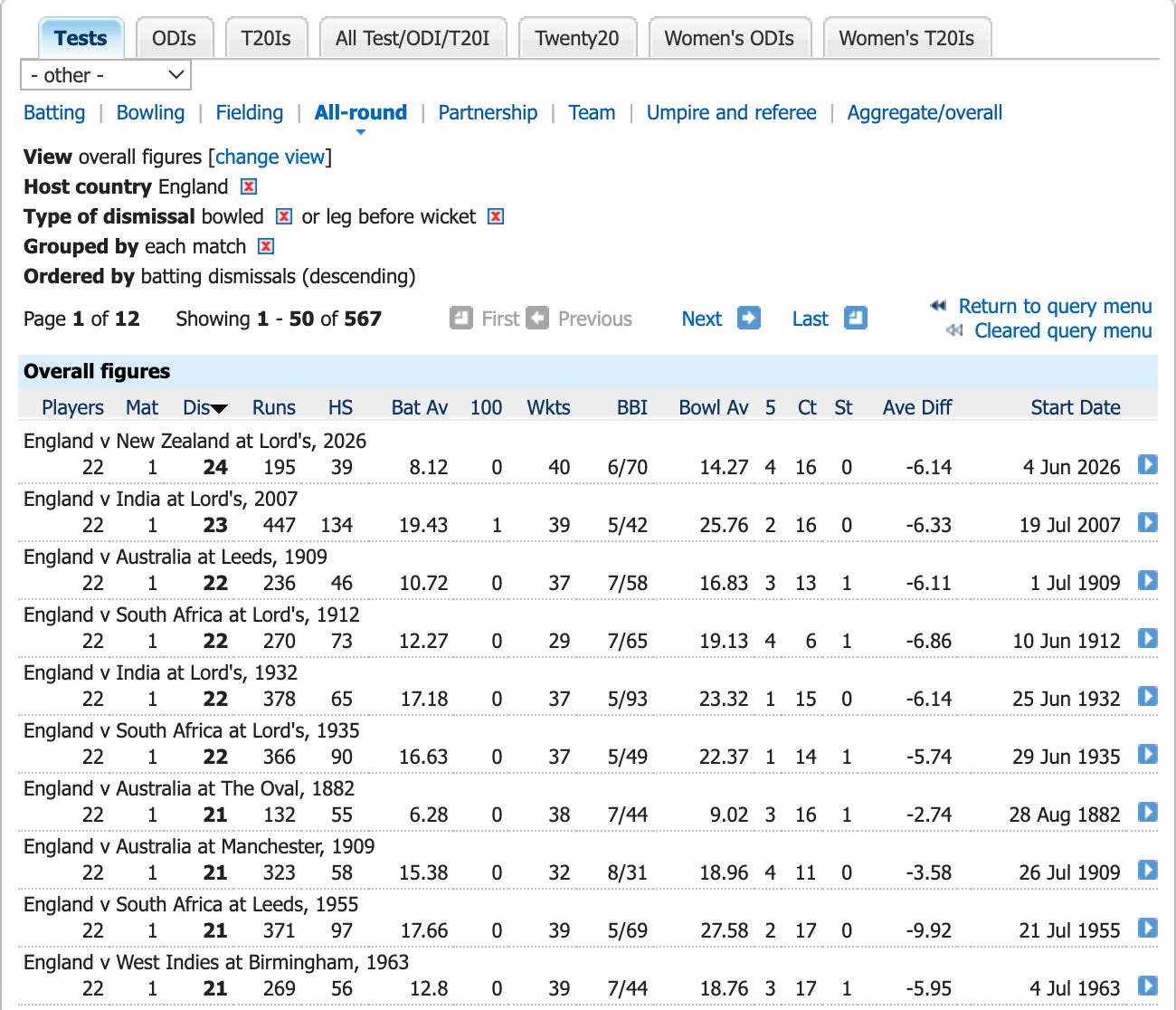
However, I believe the stat that underscores this pitch’s difficulty the most clearly is that, in the entire history of Test cricket in England, this match produced the most combined bowled and LBW dismissals, with 24. We’ve been playing Test cricket in England for so long that, whenever you set a new record or do something for the first time like this, it is notable. The previous record was 23 combined bowled and LBW dismissals at Lord’s between England and India in 2007. Of the 18 instances where there have been at least 20 combined bowled and LBW dismissals in a Test in England, only 4 have come since 1990.
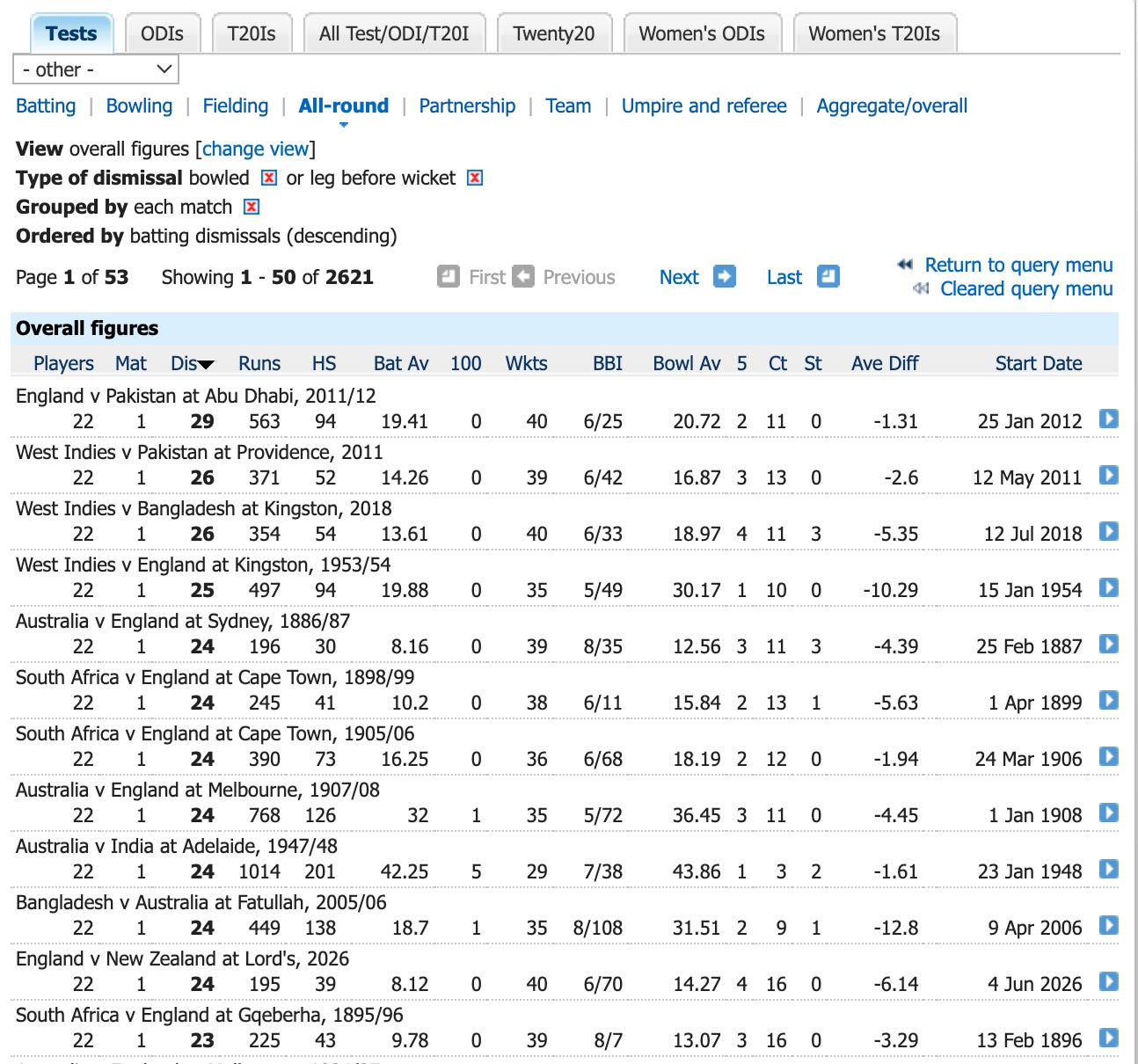
All time, the record for bowled and LBW dismissals in a Test is 29, between England and Pakistan at Abu Dhabi in 2011. However, even through that lens, this match still ranks equal 4th.
Basically, we just witnessed all-time historical levels of bowlers hitting the stumps for a Test in England. And that certainly aligns with the eye test from watching this match. How often can you ever remember seeing not one, not two, but three batters leave the ball and be bowled in the same Test? I certainly can’t recall ever seeing that before.
When Jamie Smith left his ball in the first innings, and Kyle Jamieson sent his stumps cartwheeling, the commentators initially criticised Smith for a poor leave. On first viewing, that might have seemed fair enough, but by the time it was happening to Daryl Mitchell and Nathan Smith as well, we should have known something was up. Fool me once, and all that.
Trust me, go back and look at where each of those dismissals pitched. On a normal pitch, all three would have been regulation leaves that go uncommented on, and which you’ve forgotten as soon as they’re played. On a spicy pitch, they were probably all tight leaves that you just about get away with. Everyone behind the stumps makes a lot of noise, but you likely survive. At worst, maybe one out of three jags back to bowl you. On this pitch, however you’d like to describe it, all three jagged back violently and made otherwise high-quality Test players look rather foolish.
Now, it’s fair to argue that on a pitch with this much movement, leaving the ball even on a 5th or 6th stump line is dangerous, and you should ideally try to play as many balls as possible, as late as possible; however, that is an entirely separate criticism from just labelling these as bad leaves.
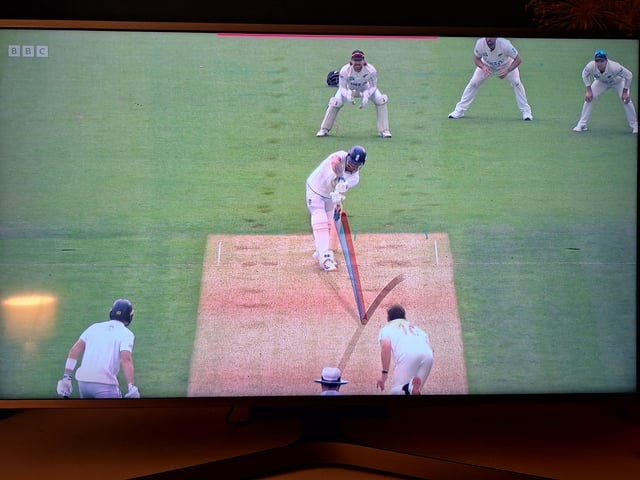
The same goes for Ben Stokes’ second-innings dismissal, which I heard some describe as Stokes simply ‘missing a straight one’. If you were guilty of that criticism, I’d urge you to go back and watch the dismissal closely. Stokes is playing the original line of the ball perfectly. If it doesn’t deviate, he would have middled a regulation forward defence. As it was, the ball straightened, beat Stokes’ outside edge, and he lost his off stump. I don’t know how any batter is supposed to play that.
In fact, forget all the stats and analysis; in hindsight, we should have known something was severely afoot when Ben Duckett decided to leave more balls in the first half hour of the Test than he has in the rest of his career combined, while on the rare occasions he did lay bat on ball, it sounded more like the echo of a shot he played with a cork bat three weeks ago than the crisp, willowy ping we’re used to hearing from Duckett against the new ball.
However, focusing exclusively on the pitch would imply this result was out of New Zealand’s hands, which would be letting the team off far too easily.
Again, having won the toss and reduced England to 118/9, the Black Caps had ample opportunities to win this match, or at least deliver a far tighter, more competitive finish than what eventuated.
The most obvious criticism should be of the Black Caps’ shoddy catching, with the focus squarely on Rachin Ravindra and Devon Conway, who dropped two chances apiece. It is that first drop, when Harry Brook was on 9*, and England were 44/4, that ultimately proved the most costly, with Brook going on to score 56. In a low-scoring Test, there is no doubt that those extra 47 runs were crucial.
Remember when I said I felt like I’d seen this Test before? Well, continuing to drop Harry Brook, after New Zealand dropped him 5 times on the way to his 171 in Christchurch in 2024, certainly didn’t help with that sense of déjà vu.
To give Conway some credit, his first drop was at least travelling, after Brook smashed a hard cut to him at backward point, and it spilled through his hands, but you can make no such excuses for Ravindra, who dropped Brook again when he was on 44* off a regulation chance at deep midwicket.
It was a similar story in the second innings, with Conway again dropping a catch at backward point, this time off Bethell, although that one at least didn’t prove as costly, as he only added another 6 runs before Matt Henry bowled him with a ball that inverted the laws of physics and bounced negative 10 inches.
However, Ravindra’s second-innings drop of Duckett in the 5th over, which was again a regulation chance, having been spooned straight to him at a shortish midwicket, proved immensely costly. Duckett added another 21 runs from that point, and perhaps more importantly, England’s opening partnership added another 38 runs before Duckett was eventually dismissed.
It has become a rather frustrating and unwanted habit for Ravindra, who, for all his immense skills with the bat and ball, has proven to be a fairly sloppy fielder so far in his international career. I almost think that people just assume that Ravindra is a good fielder because he’s young, athletic, and otherwise an excellent cricketer, but I’m not convinced the evidence bears that out so far.
There was also the moment in the second innings when Gay was on 20* and edged a ball off Henry at a perfect catching height between first and second slip, with neither Mitchell nor Latham even getting a hand on it. From there, Gay added another 37.
Things are never quite this simple, as actions have cascading consequences in Test cricket—butterfly effect, and all that—but if New Zealand had taken all four of these chances when they were first offered, they could have saved:
47 runs if Conway had caught Brook when he was on 9.
6 runs if Conway had caught Bethell when he was on 8.
21 runs if Ravindra had caught Duckett when he was on 12.
37 runs if Mitchell or Latham had caught Gay when he was on 20.
The savvy mathematicians among you will realise that 47 + 6 + 21 + 37 = 111.
New Zealand lost this Test by 115 runs.
Don’t tell me we didn’t have our chances.
Even given the pitch and the dropped catches, New Zealand still had chances to win this game, but managed to let their foot off England’s throats at inopportune times.
In the first innings, with England at 118/9, the Black Caps somehow allowed Tongue and Bashir to put on 22 (37) on this pitch, which was the second-highest partnership of England’s first innings.
I know that dismissing the tail is often easier said than done, but on a pitch like this, New Zealand simply had to find a way to curtail that final partnership.
It was a similar story in the second innings, when, after taking 4 wickets in 17 balls to consign England to 6/127 and get themselves right back into the game, the Black Caps managed to allow Jamie Smith, Ollie Robinson, Gus Atkinson, and the rest of the English tail to add another 99 runs.
I must sound like a broken record by now, but between letting the English tail wag twice and dropping so many opportunities, New Zealand had every opportunity to put themselves in a winning position in this Test, and have no one but themselves to blame for failing to do so.
Tom Blundell conceded 20 byes in this match—6 in the first innings, and 14 in the second.
Now, granted, it was a difficult pitch to keep on with the ball seaming all over the place, but, given Jamie Smith only conceded 1 bye for the match, I’m not sure that excuse fully holds up.
20 byes is quite obviously too many in any Test under basically any circumstances, but it is even more inexcusable in a Test decided by 115 runs, during which time Blundell only had to spend 574 balls, or just over 95 overs, keeping.
With the pressure already mounting on Tom Blundell’s place in the side between his age—he’ll be 36 in September—poor recent form outside of his hundred in Ireland, and the fact that Mitchell Hay is waiting in the wings and performed well on debut, he can ill afford to let his standards drop with the gloves as they have with the bat in recent years.
Blundell’s typically excellent keeping has been the main reason he has stayed in the side throughout his extended form dip with the bat. Still, there is no hiding from the fact that this was a poor showing with the gloves, and one he will want to bounce back from quickly.
Ironically enough, for all the talk about how England might approach this series and BazBall more generally post-Ashes, this was probably the perfect pitch to go full BazBall on, in hindsight.
Only 9 batters managed to pass 25 on this pitch. Of those, 7 scored at a strike rate of 70 or higher, with the exceptions being Gay, who still scored at a brisk 60, and Conway, who really dug in and struck at 45.
In that way, it was the quintessential ‘get them before they get you’ pitch. I know it’s a bad cliché at this point, but this really was a case where there’s going to be ‘one with your name on it’ if you hang around at the crease for any period of time, so you might as well play a few shots and try to score some runs while you’re out there.
There really was little value in trying to play yourself in and get set, like a traditional Test innings, as there was simply no way to be set on this pitch, as innings like Bethell’s 6 (22), Blundell’s 4 (21), Root’s 8 (19) and Ravindra’s 8 (21) exemplified throughout the game.
Outside of that, I’m loath to criticise any of the batters too much on such a tricky pitch, though I am keenly aware that, regardless of the pitch, this will still go down as two more notches in the failure column for Williamson and Latham in England. Collectively, Latham, Williamson, Ravindra, Mitchell, and Blundell contributed just 49 runs in this Test in 10 innings with 4 ducks. Kyle Jamieson contributed 44 runs for the match.
Someone remind me, is it a good sign when your number 9 nearly outscores the majority of your top 6 in a match?
While this was not a good overall performance, there were still some significant positives that New Zealand can take from this game for the rest of the series.
The primary among these are surely Nathan Smith’s continued form and Kyle Jamieson’s successful return, while it was also good to see Will O’Rourke get through his return unscathed. I also thought Glenn Phillips batted nicely in both innings, and Conway batted about as well as anyone throughout the Test in his second innings.
Let’s start with Smith, who backed up an outstanding performance in Ireland with 9 wickets for the match, including getting himself on the honours board with 6/70 in the second innings. I don’t have the hard data to prove it, but I am almost certain that Smith has added an extra yard of pace over the past 12-18 months, and he looks a much more threatening bowler for it. Previously, I remembered him spending most of his time delivering balls between about 130-135kph, whereas in this Test, it seemed like he was hovering more around 133-138kph on average and even threatening 140kph at times. While an extra ~3kph on average might not sound like a lot, at the highest level, it can make a monumental difference. There is precedent for this, with Tim Southee undergoing a similar transformation in pace at a similar age.
In my pre-series preview, I said of Smith:
With plenty of other pace options in the squad—namely Foulkes and Tickner, though Sears is also a travelling reserve—Smith will need to start converting that potential into performances fairly quickly to retain his place long-term.
Well, he has certainly ticked that box and should now enjoy an extended run in the side, fitness permitting, having cemented his place with this performance.
In the case of Jamieson and O’Rourke, I would have just been happy if both got through the Test unscathed, so the fact that Jamieson looked like he was picking up exactly where he left off with his first-innings 5/62 and 38* with the bat was a real bonus.
While O’Rourke’s return wasn’t quite as eye-catching in terms of wickets, he was still very steady with four wickets for the match, bowled with good pace, and was New Zealand’s most economical bowler. In both cases, you’d have to call that a successful return from long injury layoffs.
It was also a good match for Glenn Phillips with the bat, and one that underscored exactly why I will continue to beat the drum that PHILLIPS MUST BAT HIGHER THAN 7 IN THIS NEW ZEALAND ORDER. In both innings, Phillips counterattacked nicely, scoring 34 and 44*, but in both cases, he quickly ran out of partners. It is becoming a familiar story for Phillips, who has accumulated 6 not outs in 31 Test innings so far, along with many more instances where he has been the last man out chasing quick runs. The simple fact is, we still haven’t really seen what Glenn Phillips is capable of as a Test batter, because we haven’t yet given him the opportunity to be a pure Test batter, instead shoehorning him into the allrounder role at 7 (where he has performed admirably). With Mitchell and Blundell’s recent form being on the slide, I see no reason why Phillips couldn’t move up one or even two spots in the order to 5 or 6 to allow him the opportunity to show what he’s capable of as a batter at this level, rather than constantly having to bat with the tail.
Finally, while it was always likely to be a vain effort, I thought that Devon Conway’s second-innings 41 (91) was an outstanding effort on this pitch, and a timely reminder of his enduring class. Conway clearly made a conscious effort to play the ball:
a) As late as possible.
b) As straight as possible.
c) With the softest hands possible.
These decisions were probably most evident in the pair of on-drives that Conway hit for 3. On a normal pitch, I’m fairly certain Conway would have hit both shots significantly harder with a fuller extension of his arms and watched them clatter into the boundary without too much trouble. However, on this pitch, Conway made a clear effort to play within himself, keep his hands close to his body, and let the ball come to him, resulting in these driven threes. Given he survived for more balls than anyone except Gay, who faced 95 in England’s second innings, I’d say that was a pretty good tactic on this pitch. Again, it was ultimately a futile effort in the context of this match, but I think that is the best I’ve seen Conway bat against a top attack in a long time, so hopefully that can translate through to the rest of the series.
Speaking of which, New Zealand will now have until next Wednesday to regroup and go again at The Oval. What are the bets on the groundskeepers overcorrecting and producing a road now?
Thanks for reading! Like my work? Please consider supporting me via a paid subscription or Buy Me A Coffee. For more info on how your support helps me produce this work and what your contributions go towards, see my About Page!
Just keen to keep reading about cricket? Same! If you liked this article, you might also enjoy:
Comments
Nothing yet. Say the first thing.
Sign in to join the conversation.