
Did you know that the T20 World Cup starts in two days?
Of course you did. Just testing. It definitely didn’t sneak up on me…
For those keeping track, this will be the 6th official ICC tournament held since the start of 2025, following the Champions Trophy, WTC Final, Women’s ODI World Cup, Men’s Under-19 ODI World Cup (ongoing), and the Women’s Under-19 T20I World Cup.
Don’t worry, though, because we also have a Women’s T20 World Cup taking place in England in June this year, so you’ll only have to wait two months between one ICC tournament concluding and the next commencing.
I wonder, is there a sports administrator anywhere on the globe who understands the phrase: “too much of a good thing”? In the immortal words of Lemmy Kilmister: “OVERKILL, OVERKILL, OVERKILL.”
Anyway, let’s make the most of it and preview the Black Caps’ chances for this tournament, while there’s still time left between tournaments to write these previews.
Let’s start with the positives first. If you’d told me pre-tour that New Zealand would win three of their eight white-ball fixtures in India, I’d have likely called that an above-par outcome, particularly given the understrength ODI squad we sent over. Unfortunately, with the T20 World Cup looming, I’d have hoped that two of those wins came in the shortest format.
In that sense, we learned little from this recently concluded T20 series, which India won 4-1. If New Zealand met India in a World Cup knockout match tomorrow (and didn’t decide to forfeit…), you’d probably give us a ~20% chance of winning. Maybe 25%, if you were being generous. We’re definitely good enough to have a chance of winning in such a volatile format, but India would be the overwhelming favourites, particularly at home. And so it played out.
Accordingly, it would be unfair to say New Zealand learned nothing from this series. It’s a bit more nuanced than that, as every new answer threw up several additional questions.
The good news is that a fair chunk of New Zealand’s best T20I XI picks itself. The bad news is that those remaining spots may cause the selectors some pretty significant headaches.
Barring disaster or a temporary bout of lunacy from the selectors, the following names will line up for the Black Caps’ opening game against Afghanistan on Feb 8th:
Tim Seifert (wk)
Finn Allen
xxxxx
Glenn Phillips
Daryl Mitchell
xxxx
xxxxx
Mitchell Santner ©
Matt Henry
Jacob Duffy
xxxx
The batting order might vary slightly, but if those seven aren’t in our best XI, something has gone seriously wrong. Let’s analyse them player-by-player.
Among teams competing at this World Cup, Tim Seifert has the eighth-best T20I batting average since the start of 2025, while also striking at 165.
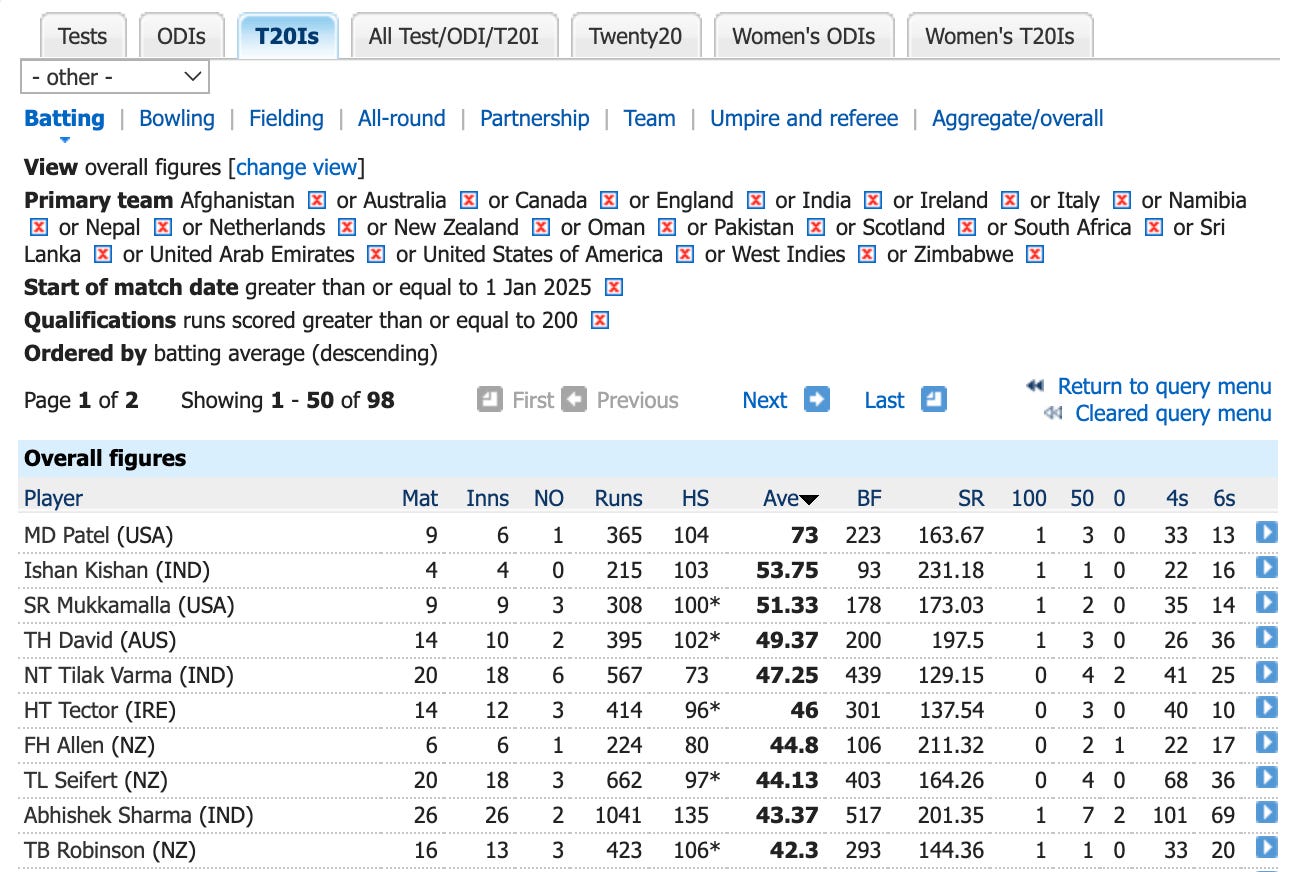
Among opening batters, only Canada’s Yuvraj Samra, Afghanistan’s Ibrahim Zadran, and Seifert’s likely opening partner, Finn Allen, have better T20I averages in this period.
For New Zealand specifically, Seifert has scored 150 more T20I runs than the next most successful batter (Mark Chapman) over the past two years, and tuned up for the World Cup by hitting 62 (36) in our sole victory over India in the recent series.
Given he is also our wicketkeeper, Tim Seifert should be the second name written on the team list currently, only behind captain Mitchell Santner. If New Zealand progress deep into this tournament, I predict Seifert will be our leading run-scorer.
No opening batter in T20 internationals—not even Abhishek Sharma—strikes faster than Finn Allen (211.32) since the start of 2025.
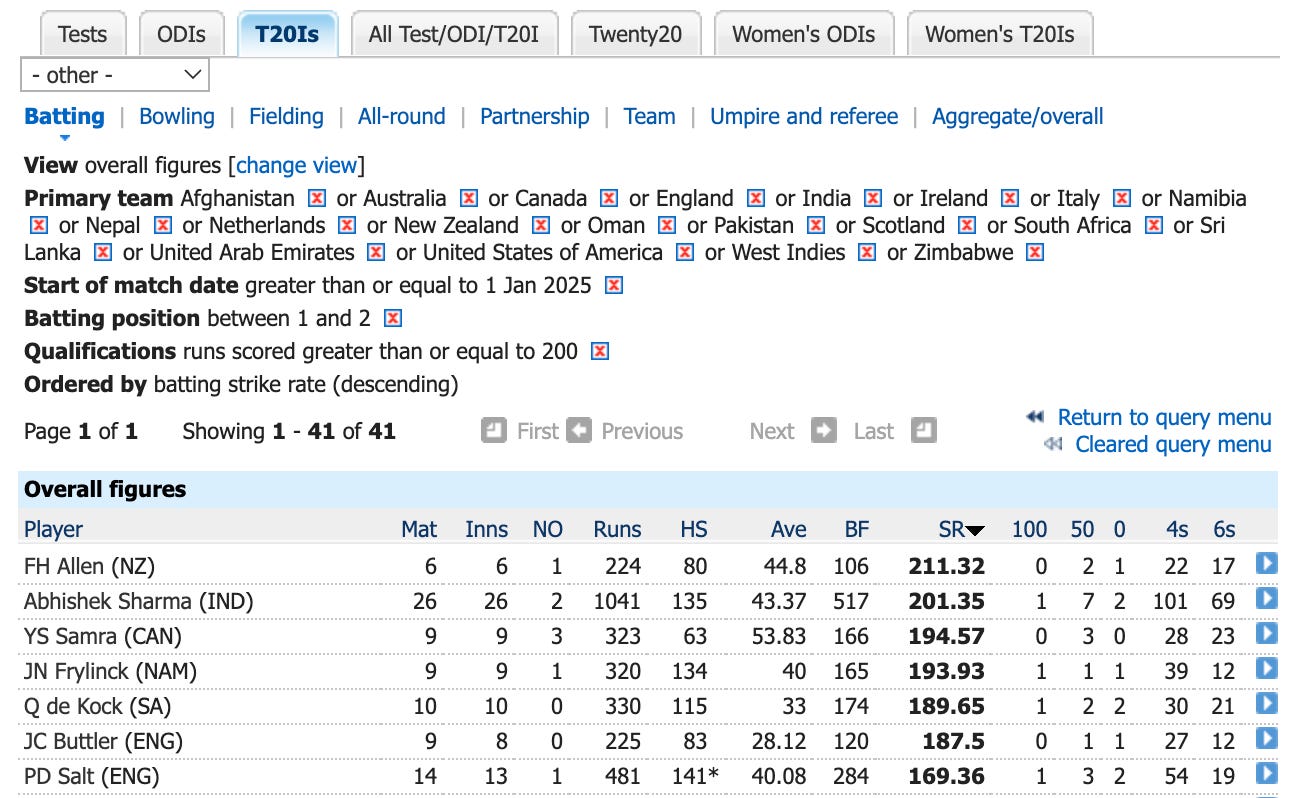
That should be plenty to justify his selection alone, but if it wasn’t, Allen has tuned up for the World Cup by smashing 80 (38) in his sole appearance against India, while also coming off a title-winning season for the Perth Scorchers, where he smashed 466 runs at 42 while striking at 184.
Remember, shortly before that, Allen also bashed a record-setting 151 (51) in Major League Cricket, and therefore enters this tournament in career-best form.
In conjunction, Seifert and Allen should form one of the most intimidating, destructive opening partnerships in the tournament. Since the start of 2025, only the Indian, English, and Canadian opening batters have struck faster than New Zealand’s pair:
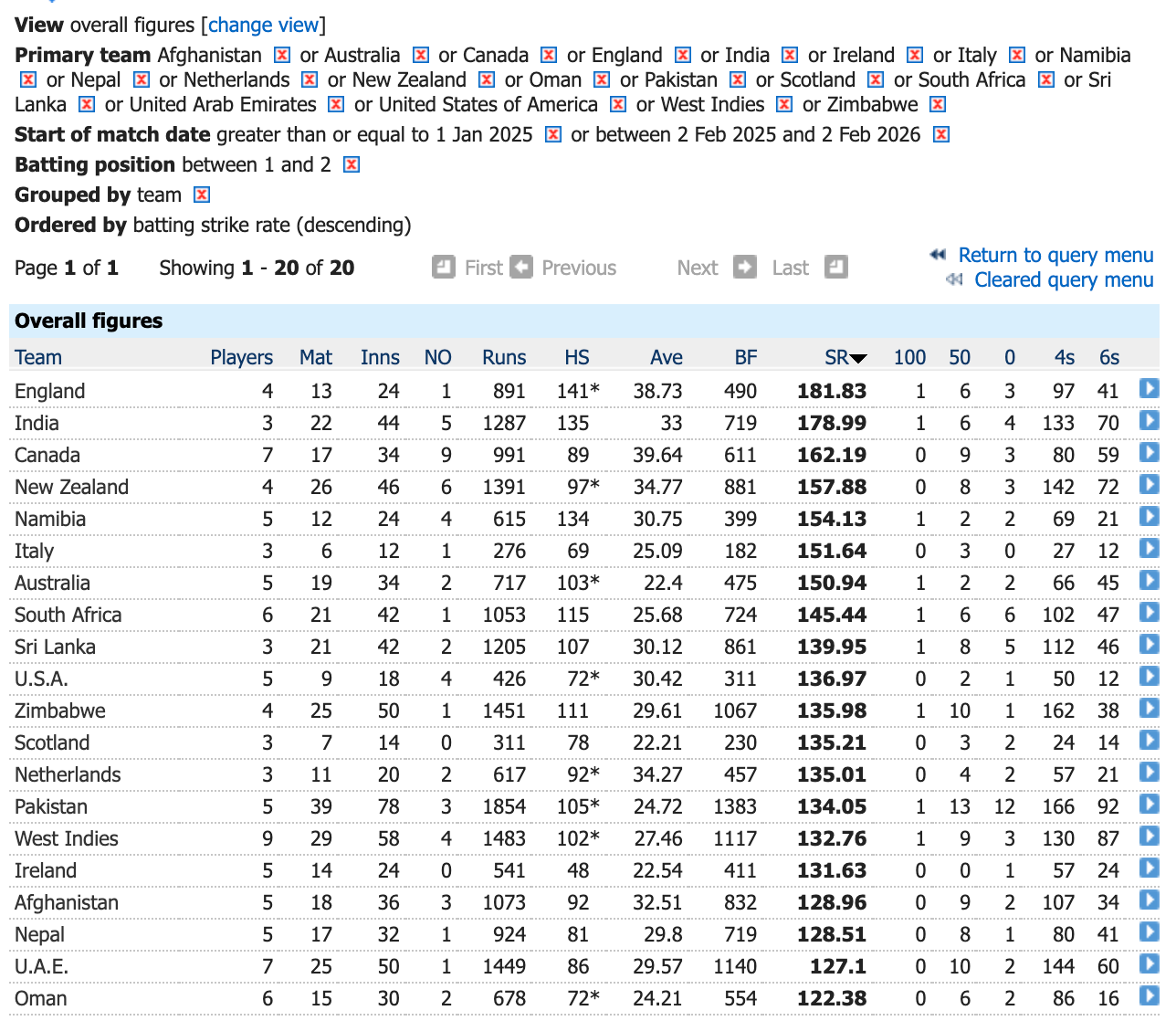
As such, if New Zealand are to go far in this tournament, a lot will rest on Seifert and Allen getting the side off to consistently fast starts. The simple fact is, if one of these two doesn’t come off, I fear New Zealand lack the batting firepower to keep pace with the other contenders.
I’m addressing Santner here because I want to get my hottest take out of the way early: Mitchell Santner should bat at three for New Zealand in the T20 World Cup.
This is not the same Mitchell Santner you have gotten used to seeing with the bat; the version who was capable, but hardly destructive. No, Santner has levelled up significantly as a batter over the past two years, and nothing demonstrates this more clearly than the following graph:
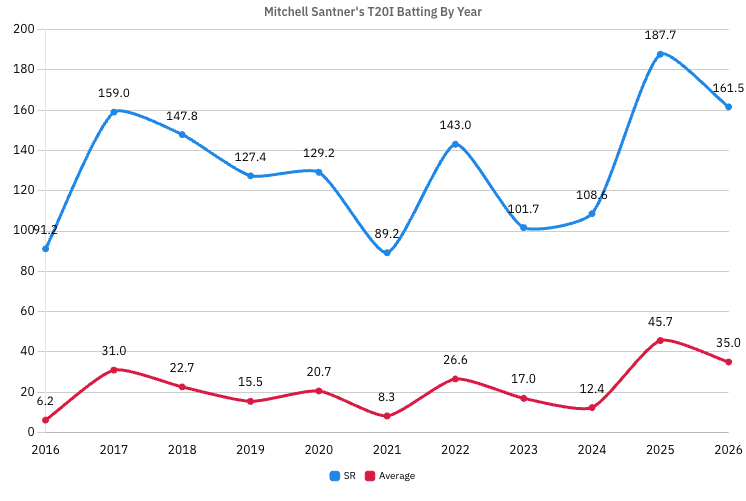
2025 and 2026 (so far) have seen Santner deliver the highest T20I averages and strike rates of his career, as he averaged 45.7 last year and struck at 187. That isn’t just good by Santner’s standards; it is elite globally. Since the start of 2025, Santner has the 9th-best strike rate and the 13th-best average in T20I cricket among teams that have qualified for this World Cup. For a guy whose primary skill is bowling, those are outstanding returns. I can’t prove it, but I am certain a good portion of this progression is attributable to Santner’s time at CSK in recent years.
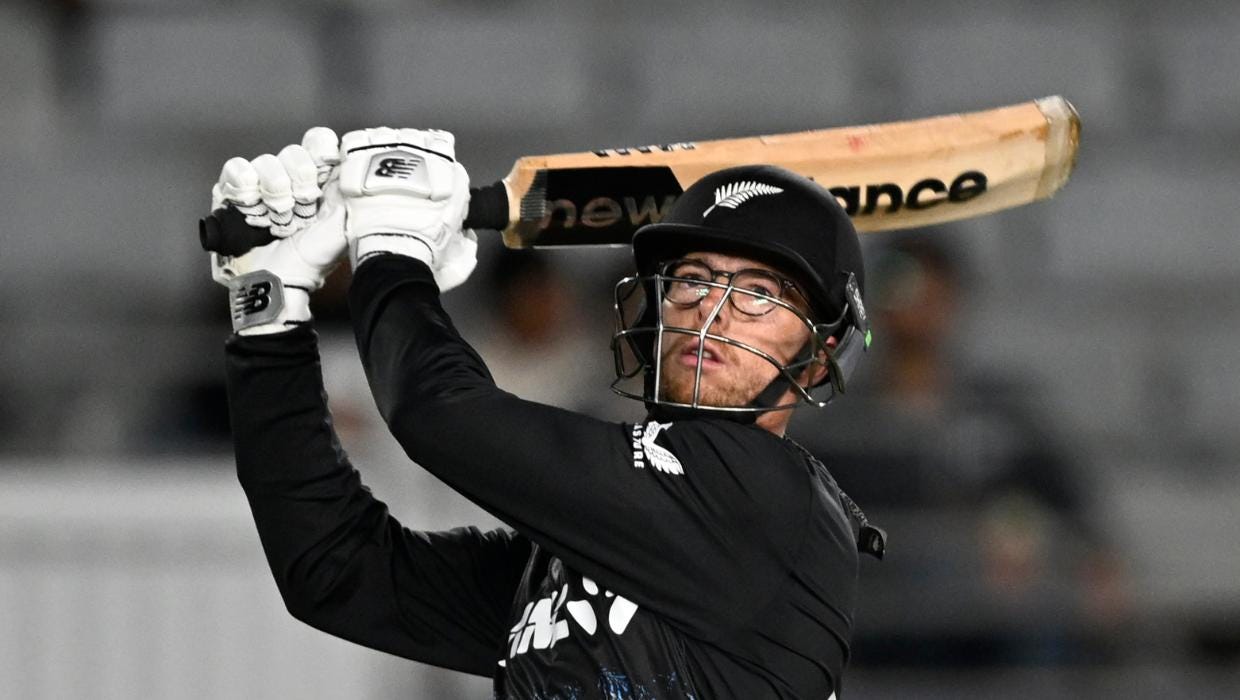
Here’s a stat that really drives home Santner’s current batting purple patch: we are just over a month into 2026, and he has already hit more boundaries (21) than in any other year of his T20I career. His previous record was 20, set in 2025, and before that, it was 17, set in 2022.
Let me repeat that, in just over a month, Santner has hit more fours and sixes than in any other year of his long T20I career.
New Zealand must take advantage of Santner’s current batting form, and I believe the best way to do that is to use him at three, where Rachin Ravindra has so far failed to cement a place, averaging just 19 across 43 T20Is now.
If it were up to me, I would send Santner in at three if New Zealand lost a wicket in the first four overs (as is highly likely with Finn Allen in the side), essentially as a pinch hitter to maximise the powerplay. If Allen and Seifert make it through the first four overs unscathed, I’d send Ravindra or Phillips in at three as normal and save Santner’s hitting for the death.
No one has scored more T20I runs in the last five years for New Zealand than Glenn Phillips. When he is in form, Phillips is our best T20 batter, bar none.
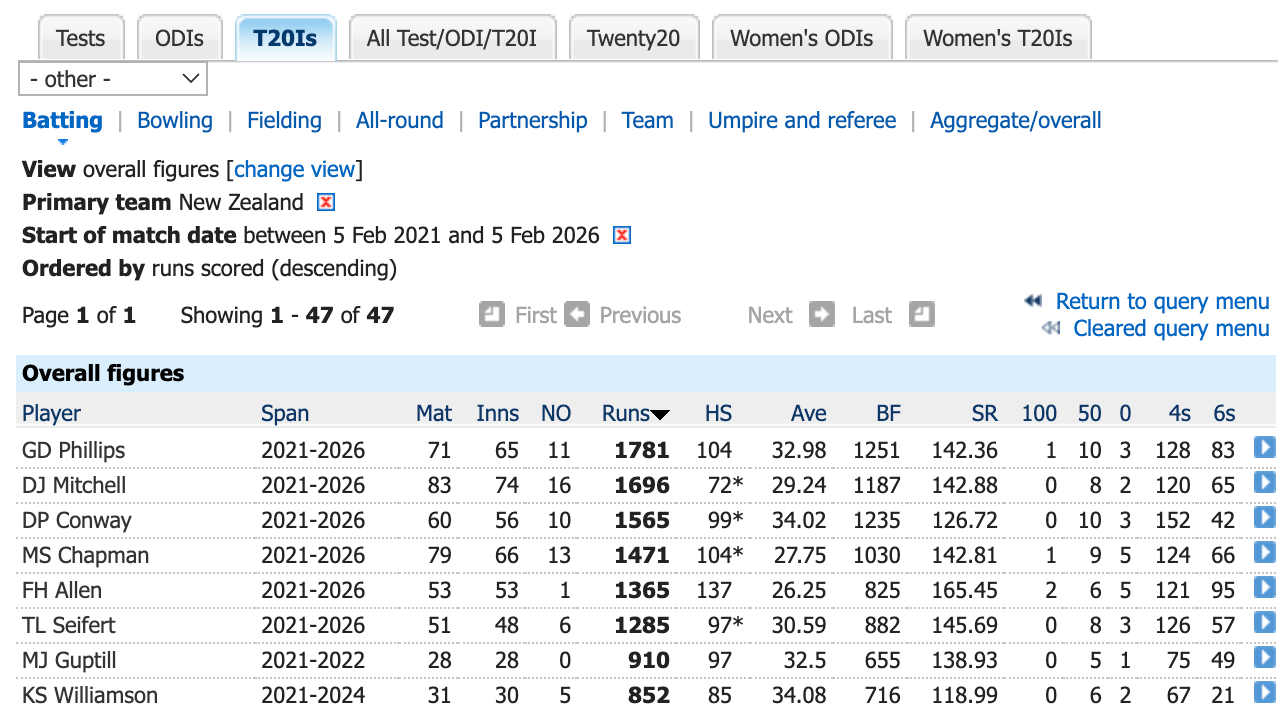
And the best news for New Zealand is that we seem to have the real Glenn Phillips back. In 2023 and 2024, something weird happened, as Glenn Phillips threatened to become an anchor, striking at just 120 and 128 in those years across decent sample sizes. In 2025, injury restricted Phillips to just one T20I.
Thankfully, across the Indian series, we saw signs of the old Glenn Phillips, getting starts in every game bar one and striking at 153.
If New Zealand are to win this tournament, the version of Phillips who strikes in the 120s is absolutely no good to us. We need the incredible, mercurial, all-action version who strikes at 150+.
Much like Glenn Phillips, there was a scary little period there in 2023 where Daryl Mitchell threatened to become an anchor. Across 18 T20Is in 2023, Mitchell struck at a paltry 122.
Thankfully, this proved short-lived, as in 2024 he remembered he’s a massive, imposing dude with long levers that can whack the ball a mile, and bounced back to strike at 158, then 141 in 2025. Currently, in 2026, he’s striking at 186.
Across the Indian series, we saw Mitchell show consistently high intent, as he got starts in every game. Based on the way this lineup is taking shape, it seems they want Mitchell to be a finisher, as he came in at number six three times in the Indian series.
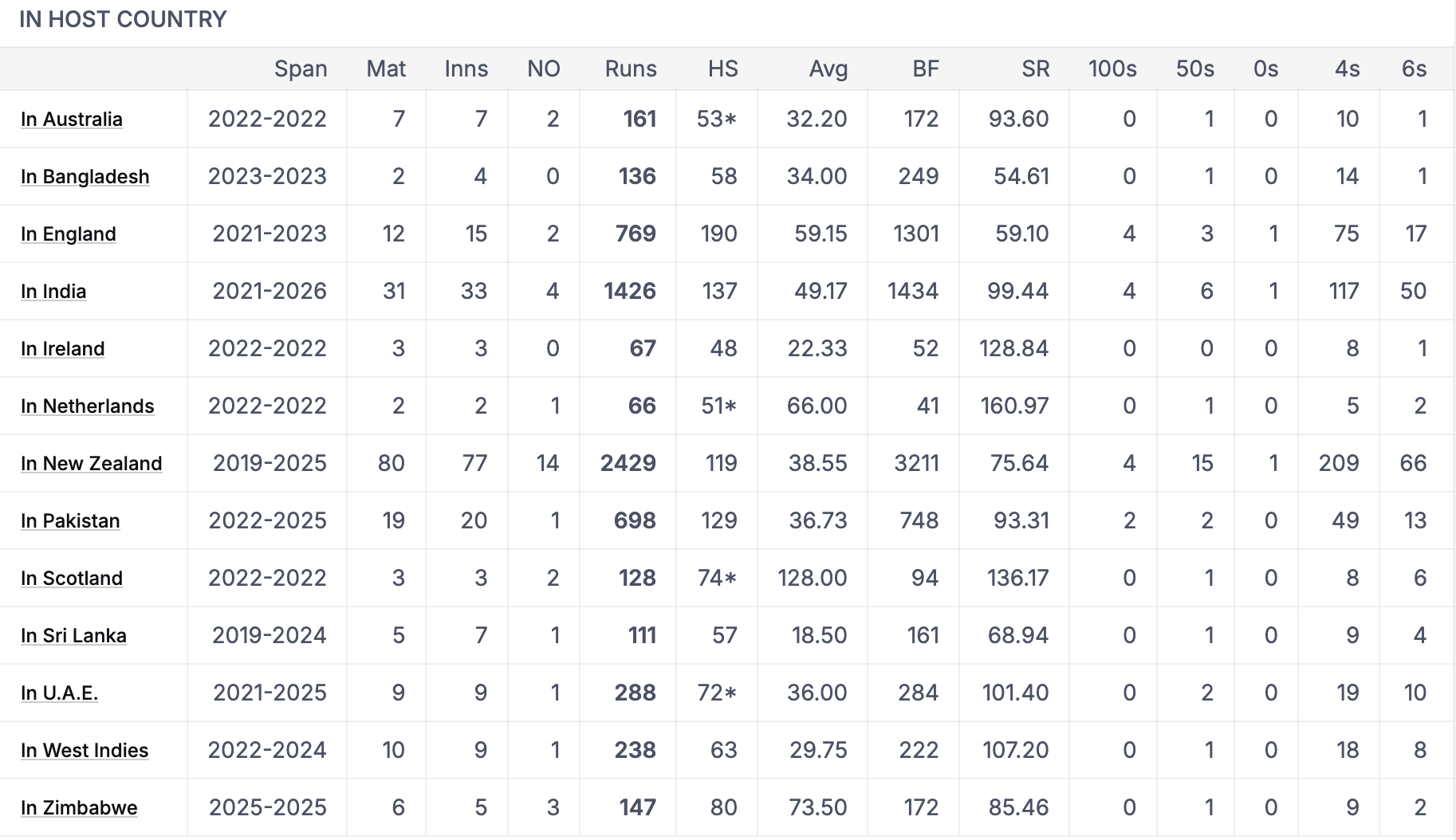
Hopefully, Mitchell’s love affair with India will continue, where he averages 49 and strikes at 99 from 31 international appearances across Tests, ODIs, and T20Is.
I’m grouping these two together because it’s worth discussing them as a new-ball pairing. Plus, I’ve already covered Duffy’s remarkable 2025 in much more detail here:
Jacob Duffy and The Power of Perseverance
·
December 26, 2025

I swear, I know who Jacob Duffy is. I could pick him out of a police lineup. I’m confident I’ve watched at least 80% of the balls he has bowled in international cricket, and a higher percentage than most domestically, too. Hell, I’m about to write 3,000 or so words about his career. I know who Jacob Duffy is.
Anyway, put simply, these two hold the key to New Zealand’s World Cup fortunes. Among teams competing in this tournament, only the Pakistani seamers have taken more T20 wickets in the past year, while Pakistan are also the only team to have a better strike rate than New Zealand’s 15.2.
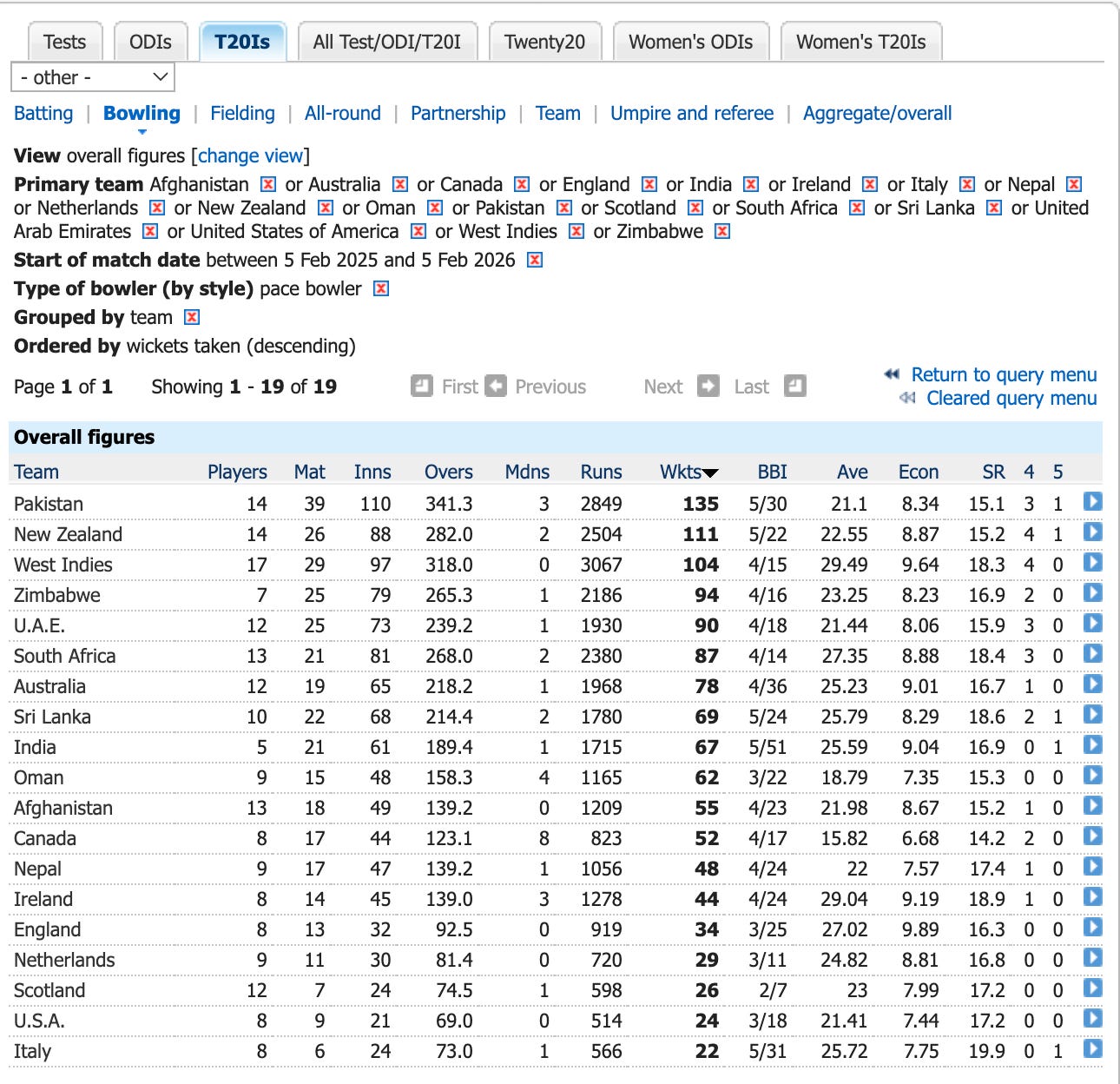
Given there are question marks over New Zealand’s spin options and ability to chase big totals, which I will touch on shortly, New Zealand’s chances realistically hinge on these two being able to take consistent powerplay wickets.
There are two more names who are written into the XI in a pretty heavy pencil, but aren’t (or at least, shouldn’t) be considered locks: Rachin Ravindra and Lockie Ferguson.
Rachin is most likely battling with Devon Conway for the number three spot in this side. Ravindra has definitely not cemented his spot in T20 cricket yet, averaging 19 and striking at 135 overall, but started showing signs of his true talent in 2025, where he averaged 30 and struck at 150 from 13 matches. So far in 2026, his average is back down to 16, but he’s still striking at 142.
On the other hand, Conway bounced back somewhat in T20 cricket last year, averaging 33 internationally, but only striking at 126. In the three years before that, Conway struck at 118, 110, and 122. That is quite simply not good enough in modern T20I cricket, and, much like the current discussion around Babar Azam, is actively detrimental to the team at times, chewing up balls and putting undue pressure on other batters. If New Zealand must pick between two flawed options at number three (and don’t go for the left-field Santner option), I hope they back the younger, faster model who has shown a propensity for dominating ICC tournaments.
As ever, the question about Lockie Ferguson is not his ability but his fitness. Lockie played a T20 for New Zealand for the first time in 447 days—since November 10 2024—when he suited up for the fifth T20I against India. The good news is that he looked like he hadn’t missed a beat, taking 41/2, including both Indian openers, to return the best figures of the NZ bowlers.
The question is simply: can Lockie Ferguson stay fit and sustain his pace? Because if we get anything close to the 2024 version of Ferguson, who took 20 T20I wickets at 9.25 with an economy of 4.88, you can move his name firmly into the section above. If not, Kyle Jamieson looms as his primary competition within the squad, with Ben Sears also around as the travelling reserve. Jamieson has never really taken to T20Is in the same way as the other formats, though, averaging 36 at an economy of 9.73 from his 26 appearances so far.
Despite all the good things the Black Caps are doing in the T20I format, two massive, glaring deficiencies remain, which threaten to derail the entire campaign: spin bowling and finishing the innings with the bat. Regrettably, as far as weaknesses go, those are two pretty major ones.
Here’s an incredibly discouraging statistic if you’re a Black Caps fan: since the start of 2025, no set of spinners has a higher economy rate than New Zealand’s at 9.13. For a World Cup taking place in India and Sri Lanka, of all places, that is a pretty massive weakness, particularly with Michael Bracewell battling to come back from an injury and lacking match fitness.
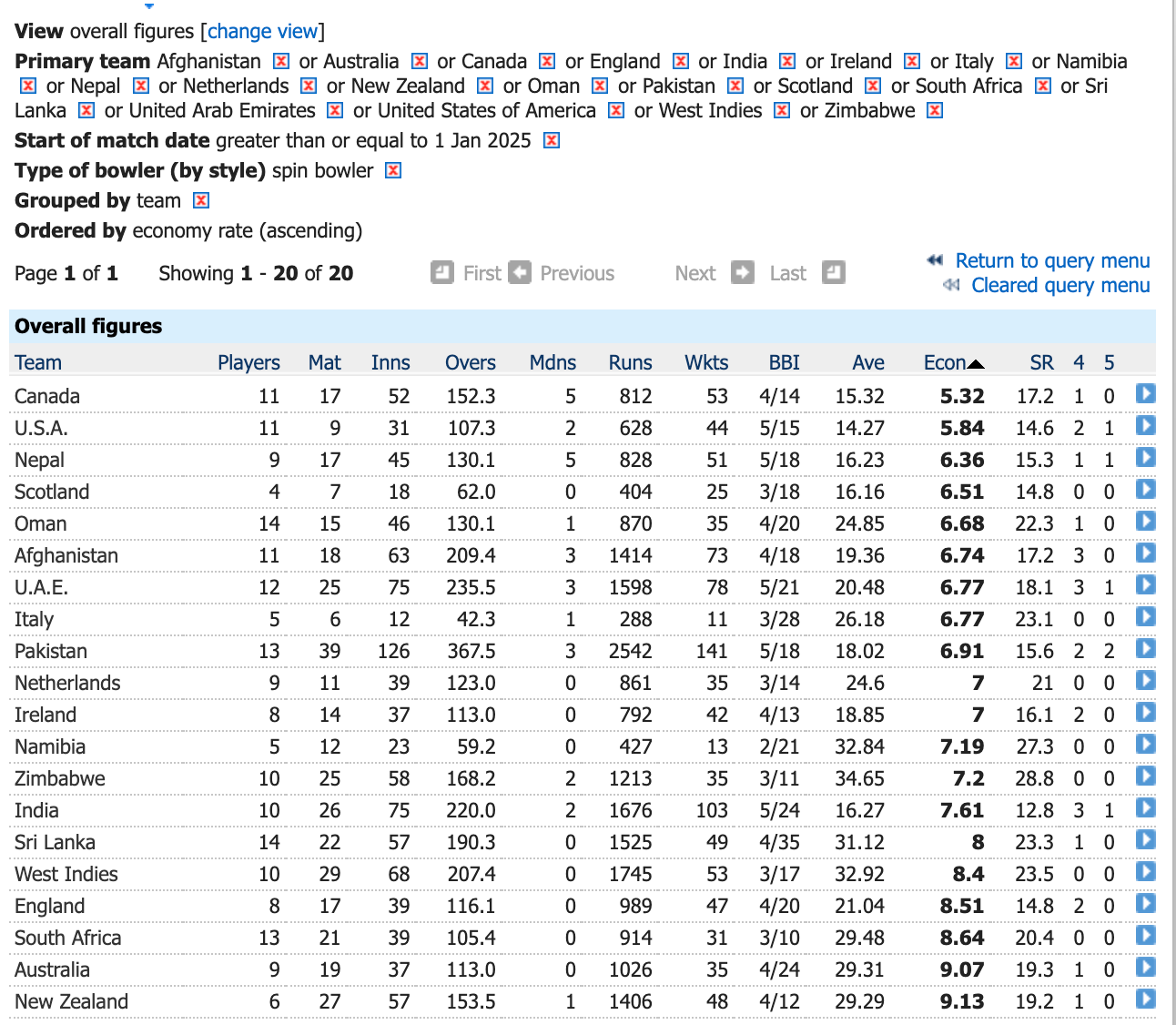
In fact, among spinners who have taken at least 10 T20I wickets since the start of 2025, Ish Sodhi and Mitchell Santner have the two worst economy rates. In the series against India, Santner went at 11.9 per over, and Sodhi went at 12.9.
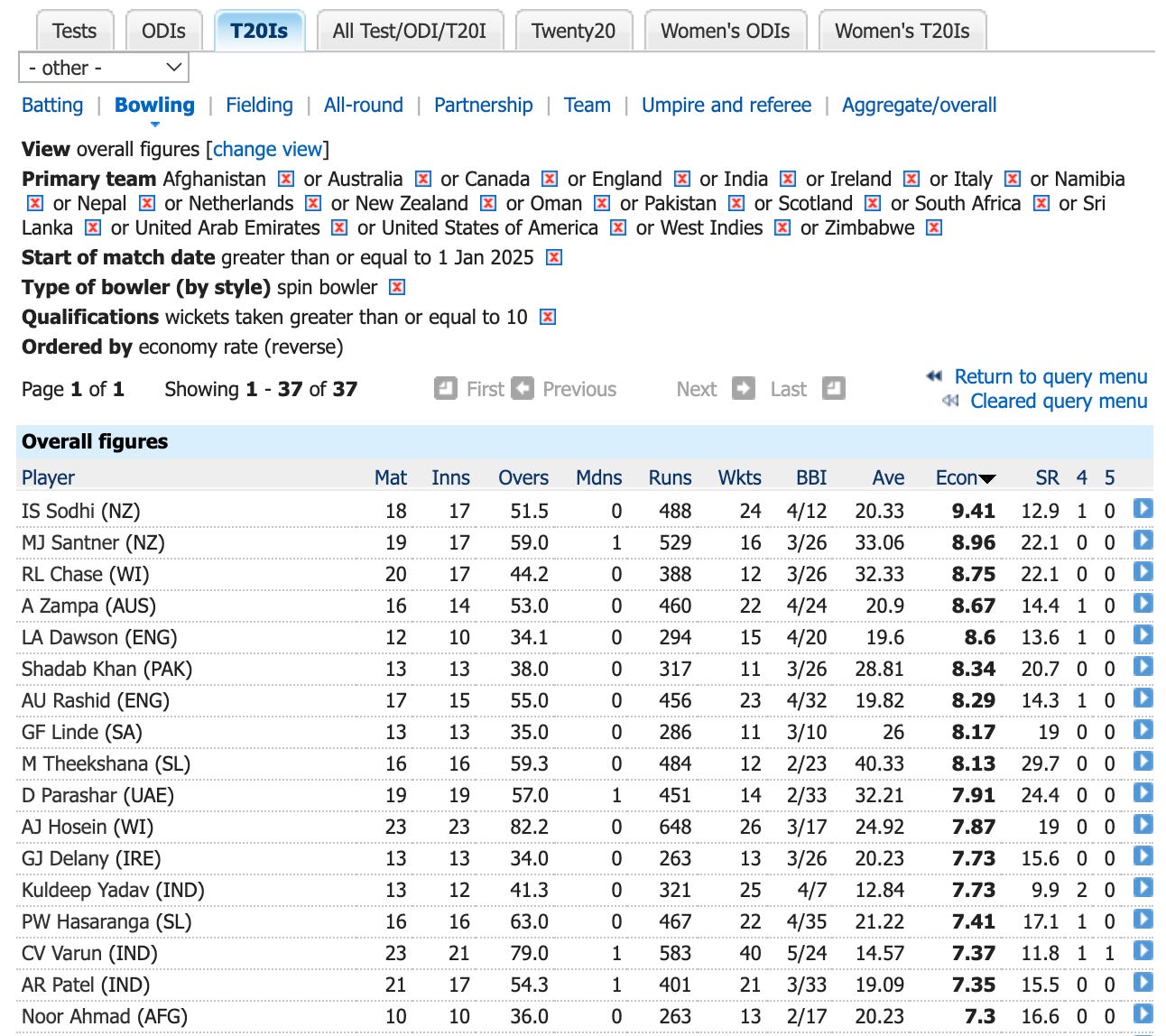
If we reduce the qualifying criteria to 5+ wickets taken, Michael Bracewell also has one of the 10 worst economy rates for spinners in this period.
I’m not particularly worried about Santner’s ability to rectify this and return to his usual miserly self, but New Zealand’s second spinner, either Bracewell or Sodhi, with perhaps some part-time overs from Rachin and Phillips, will almost certainly be targeted heavily by the opposition. To win this tournament, we don’t need our second spinner to be a world-beater, but we do need them to at least hold their own. Travelling around the park at 9+ runs per over won’t cut it.
The other standout deficiency in this side is New Zealand’s ability to finish the innings with the bat. Over the past two years, New Zealand’s top order (1-5) boasts the fourth-highest strike rate among nations competing in this tournament—144, only behind India, Australia, and England.
On the other hand, New Zealand’s number 6 and 7 batters rank 11th out of 20 for strike rate among teams in this tournament, worse even than Ireland, the USA, and the UAE. Over the past two years, New Zealand’s number 6 and 7 T20I batters have averaged just 14.9 and struck at a glacial 117.
Based on the squad selected, two of Mark Chapman, Jimmy Neesham, Mitchell Santner, and Michael Bracewell will fill these roles. Santner we’ve already covered, and if he doesn’t bat at three, he should probably come in at six in this current side, as he did in the final T20 of the series against India.
I adore Jimmy Neesham, so it pains me to say this, but the simple fact is, he is in this squad on reputation, not form. Since the start of 2024, Neesham is averaging just 10 with the bat in 21 T20Is while striking at barely more than a run a ball. The numbers do not make for pretty reading. I really hope I am wrong.
Similarly, Chapman hasn’t had that much time or success batting at number six in T20s: he has only spent six innings there internationally, averaging 8.4 and striking at 104. Chapman did have a good year in 2025, averaging 21 and striking at 159, but these innings all came batting at 3 and 4.
That just leaves Michael Bracewell in this squad who has had any recent success as a finisher, striking at 140 and averaging 19.5 when batting at 6 or 7 over the past two years.
In this sense, I can’t help but feel like the Black Caps have missed a trick by not selecting Bevon Jacobs, who had an incredible year in the Super Smash, pillaging 361 runs at 90.25 while striking at 165, and would have slotted in nicely at number six, instead of Jimmy Neesham.
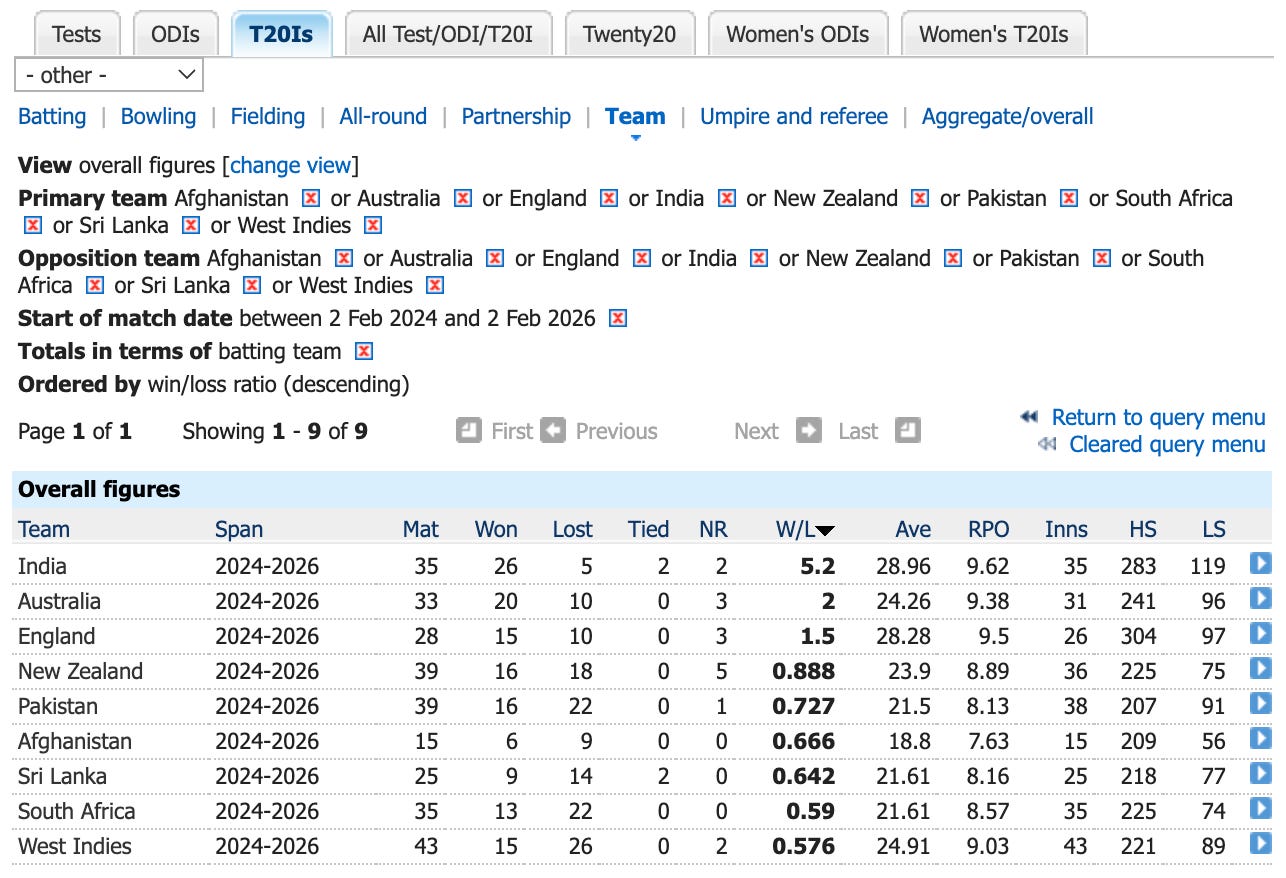
Overall, New Zealand will come into this World Cup with the fourth-best record (16-18) in matches between the major contenders over the past two years, though there is a significantly bigger gap in terms of W/L ratio between the first and second-ranked teams than between the second and ninth-ranked teams. India is miles in front with a 26-5 T20I record over the past two years, dwarfing Australia’s mark of 20-10. India is also the only team that hasn’t been bowled out for less than 100 in this period, demonstrating their higher floor.
The good, albeit somewhat confusing, news is that the toss is of little relevance to New Zealand. In fact, the stats tell us that they’re much better off losing it. Over the past two years against top-10 ranked opposition, New Zealand have a 0.63 win/loss ratio (7-11) when they win the toss in T20Is, which basically doubles to 1.285 (9-7) when losing the toss. For whatever reason, the Black Caps are more than twice as likely to win a T20I after losing the toss than winning it over the past two years.
Equally, New Zealand are a much more successful T20I side when they bat first. Over the past two years against top-10 ranked opposition, New Zealand have a 1.25 win/loss ratio when batting first (10-8), which drops to 0.6 (6-10) when bowling first. So, clearly, the toss does matter to the Black Caps; it’s just that they’re terrible at deciding what to do if they win one.
To further drive this point home , here is the Black Caps T20I record against the top 10 ranked teams over the past two years under different toss permutations:
Win Toss & Field: 0.66 W/L Ratio (6-9)
Win Toss & Bat: 0.5 W/L Ratio (1-2)
Lose Toss & Field: Only happened once, for a loss.
Lose Toss & Bat: 1.5 W/L Ratio (9-6)
Clearly, the Black Caps are never better in the T20I format than when they lose the toss and are asked to bat; the worst outcome for my heart rate, as I sit on the edge of my chair expecting a first-ball wicket.
In large part, this is due to the fact that New Zealand still struggle mightily in chases of 200+. To be clear, no team is good under these circumstances, but the other main title contenders are all far more capable of holding their own in these chases.
In games between the top-nine ranked sides competing in this tournament (sorry, Bangladesh), Sri Lanka, New Zealand, and Afghanistan are the only teams that haven’t successfully chased 200+ in a T20I over the past five years. Afghanistan have only had three opportunities to do so, and Sri Lanka at least tied one of their 200+ chases, before losing in the Super Over to India. New Zealand have lost all six.
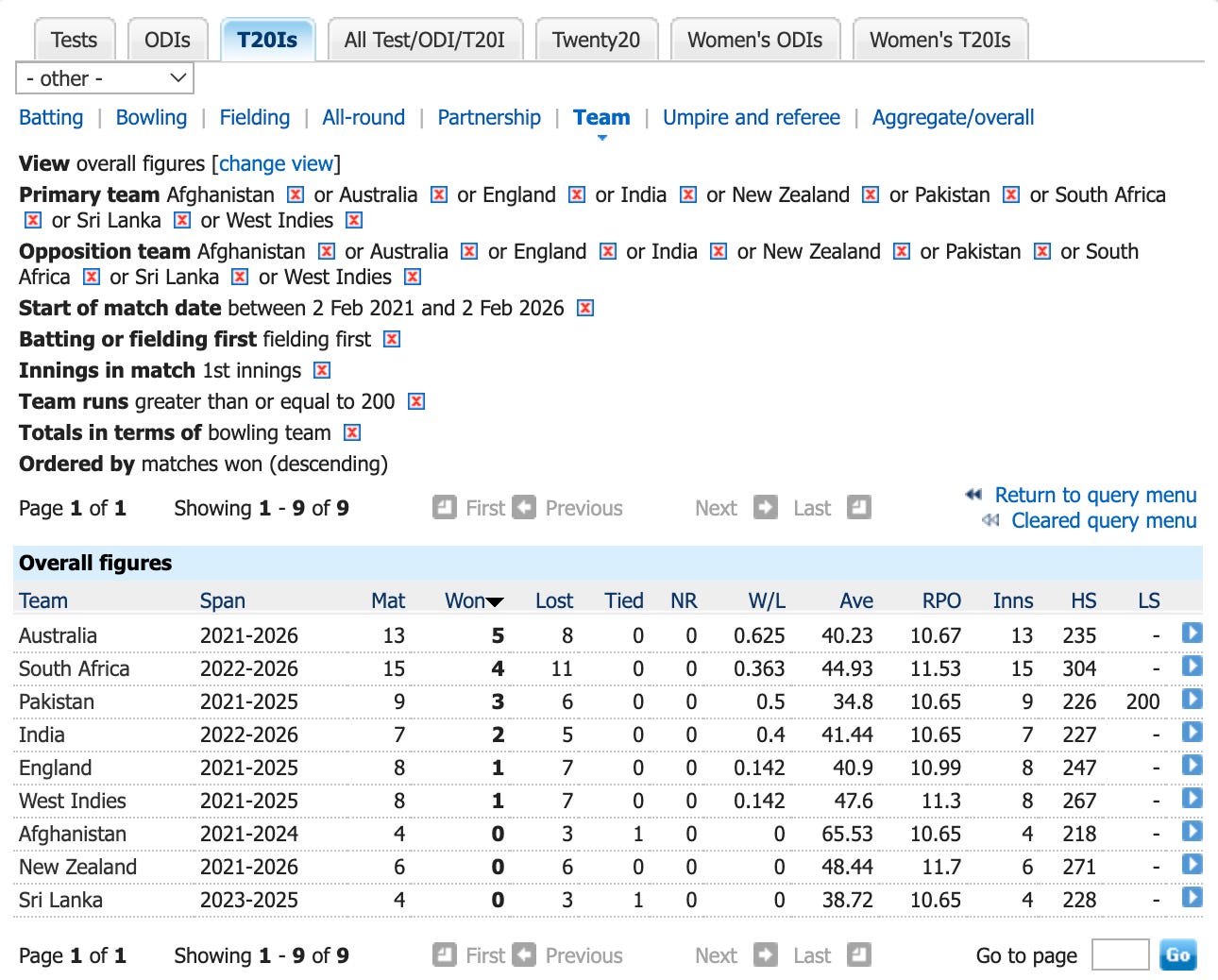
On the other hand, Australia have chased down 200+ five times, South Africa have done it four times, Pakistan three, India two, and England and the West Indies once each.
Lower the mark to 180, and New Zealand have still only had two successful chases in the last five years. However you slice the numbers, New Zealand are inordinately bad at chasing large totals in T20Is; a fact which was reinforced twice throughout this recent India series, as New Zealand were asked to chase 238 and 271 and never got close.
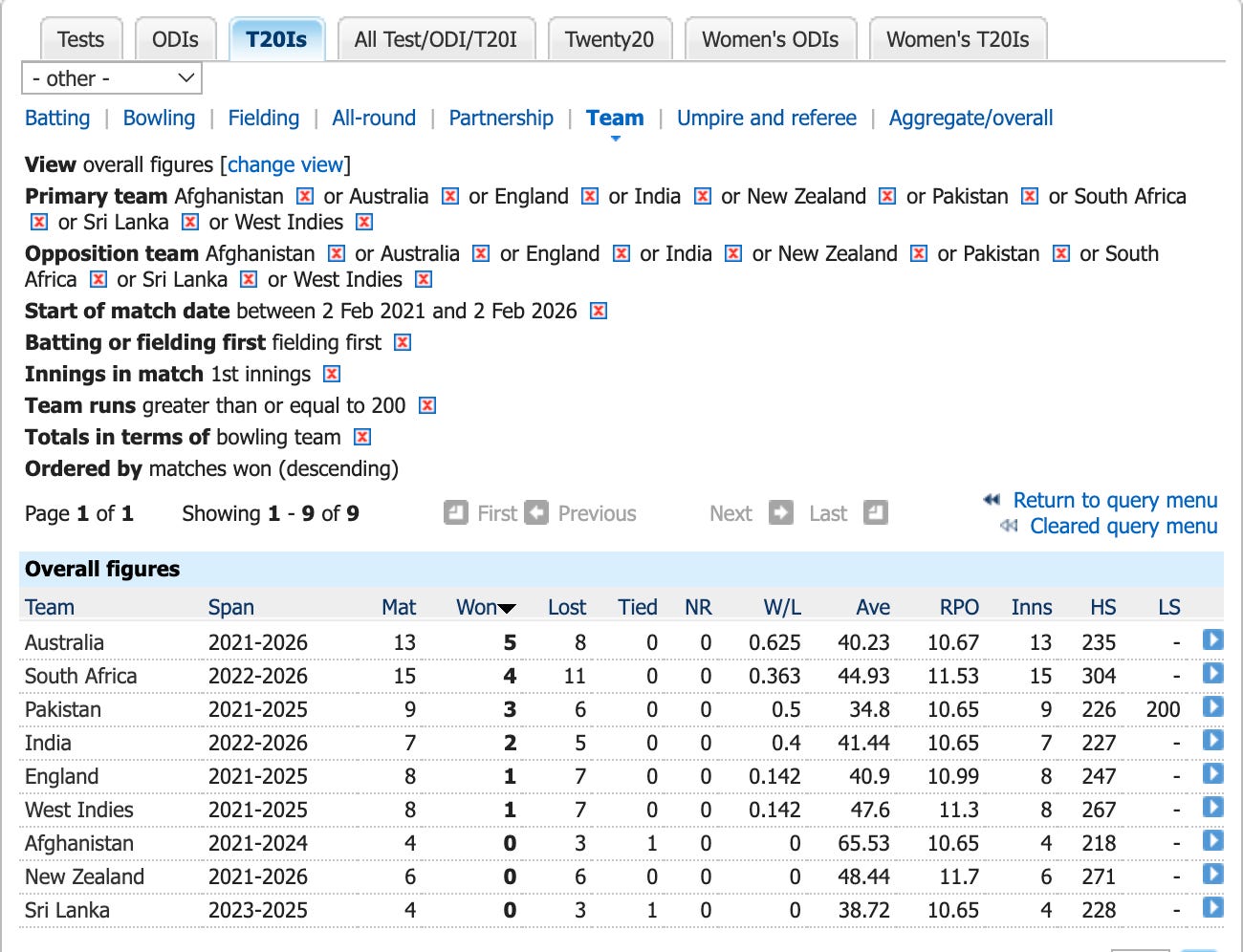
Similarly, New Zealand aren’t much better at defending 200, winning two and losing three when posting 200+ over the past five years. Accordingly, New Zealand fans should be crossing their fingers and toes that this ends up being a low-scoring tournament, as World Cups often are, and bucks the general trend of flat, batting-friendly white-ball surfaces in India.
This may be a rather faint hope, as the average RPO is 10.13 in T20Is in India over the past 12 months, and is climbing fast.
New Zealand might get a slight advantage from playing three of their four group games in Chennai, with the other game, against South Africa, at Ahmedabad.
Since 2023, a third of New Zealand’s 15-man World Cup squad—Devon Conway, Rachin Ravindra, Daryl Mitchell, Mitchell Santner, and Kyle Jamieson—have featured in CSK’s IPL squad, meaning they should be familiar with the conditions, and may gain a slight ‘home away from home’ advantage. It probably won’t count for that much, but hey, you’ll take whatever slight advantages you can get.
In the 2025 IPL, the average score batting first in Chennai was 163.5, while it was 169 in 2024.
On the other hand, New Zealand will play South Africa at Ahmedabad, where South Africa will be more acclimatised, as that will be their third consecutive game at the venue.
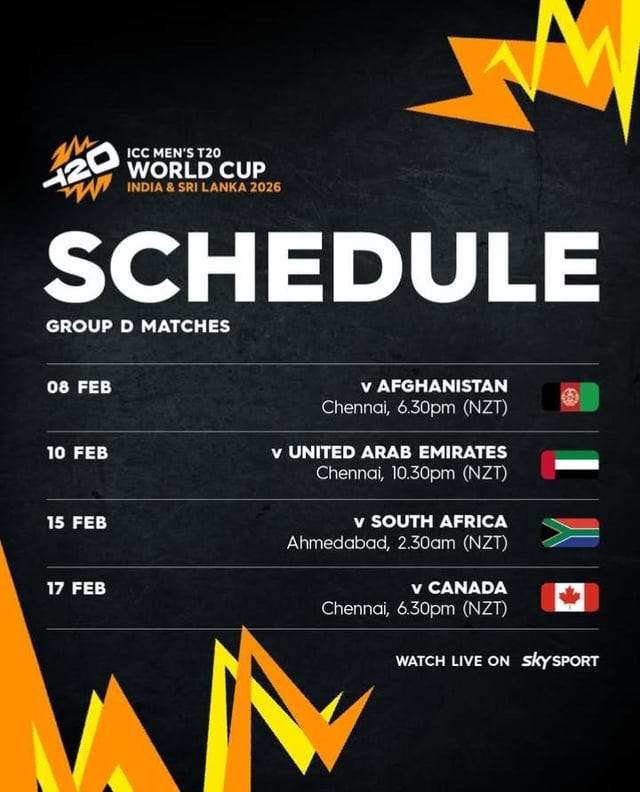
Afghanistan, the other main contender in New Zealand’s group, don’t play consecutive pool games at the same venue, unlike NZ and SA, which again may impart a slight advantage.
Afghanistan have tuned up for this tournament by beating the West Indies 2-1 recently and winning both of their warmup matches against the West Indies and Scotland, while South Africa has prepared by losing 3-1 to India before beating the West Indies 3-0 at home.
Thanks for reading! Like my work? Please consider supporting me via a paid subscription or Buy Me A Coffee. For more info on how your support helps me produce this work and what your contributions go towards, see my About Page!
Like my work, but not that much? Fair enough! If you still want to support me, the best thing you can do is share this article far and wide: whether that’s with friends and family, teammates at your local club, on Reddit, or in your obscure cricketing Discord server, I cannot emphasise enough how helpful every single share is.
Just keen to keep reading about cricket? Same! If you liked this article, you might also enjoy:
Comments
Nothing yet. Say the first thing.
Sign in to join the conversation.