
James was alive before Daisy died. He was there in the house with us, a soft, happy baby with round cheeks and opinions about puréed food. Daisy held his head in both hands. In photographs, she looks down at him with the grave concentration of someone who has just been entrusted with a rainbow.
He knew my body then. My arms, my breasts, my smell, the lap he was placed in.
By the time James was old enough to know me as someone separate from himself, I was already the woman who came after. He has never met the woman I was before his sister died.
He knows the woman who spends the warm months wandering around outside in varying states of dampness, muttering to herself like a groundskeeper with no clear employer. He has always lived in a house with a backyard full of chickens with silly names.
He knows the woman who occasionally goes quiet mid-sentence and returns a moment later like nothing happened. He lets it go because, as far as he knows, this is simply a thing mothers do sometimes, the way some mothers hum or some mothers bite their nails.
James has never known me without grief, which means he does not know which parts of me are grief. Neither do I anymore.
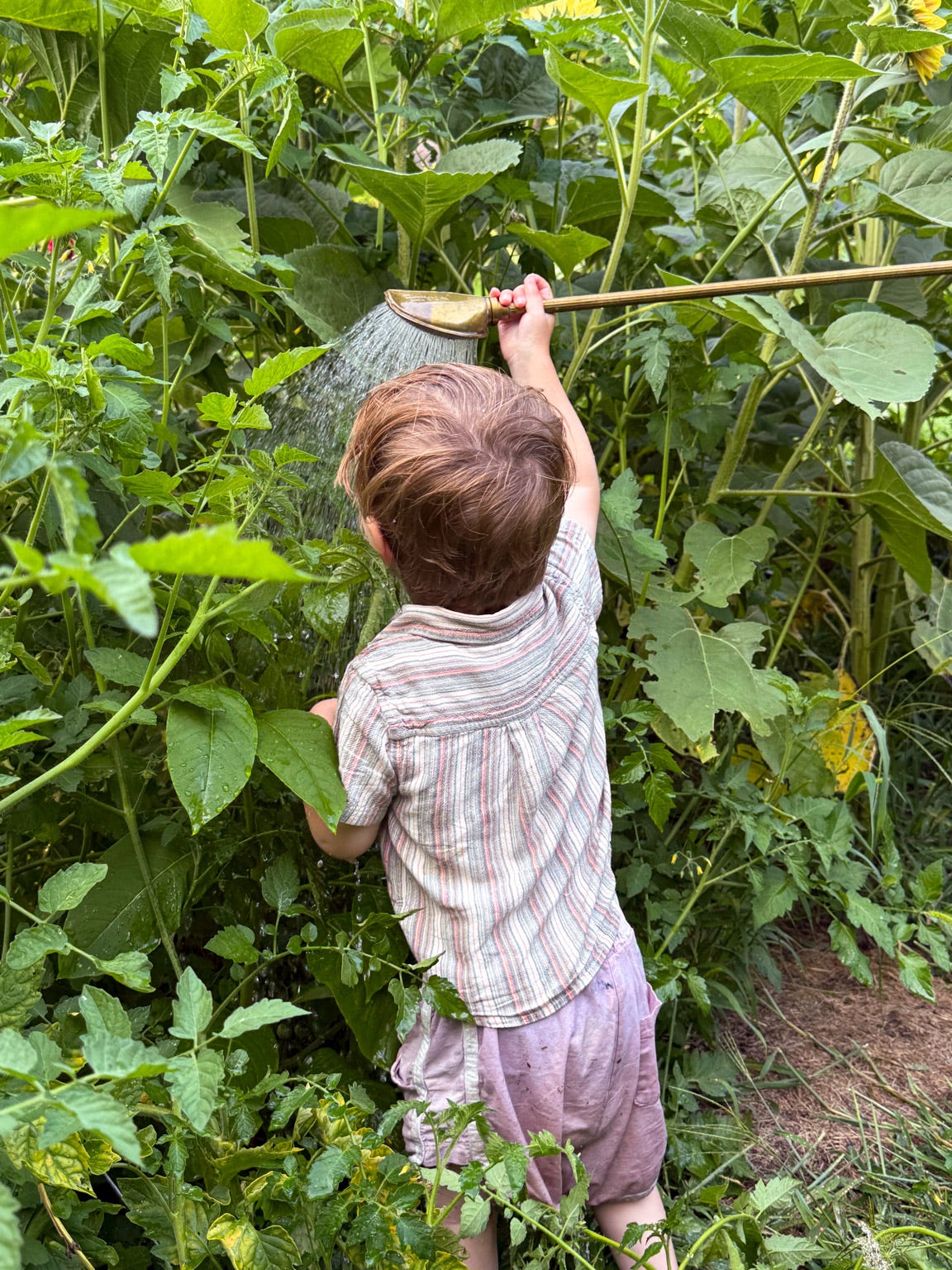
This may be one of the few mercies of being three. His mother isn’t a person with a before and after—I’m simply the person who knows where his shoes are, except when I don’t. I’m the person who cuts his food incorrectly, finds his missing elephant, wipes his face, takes too many photographs, and becomes unreasonably animated when he helps with the watering.
My sadness is not evidence of an event. It’s one of my ordinary features, like my red hair or the dirt under my fingernails.
I hate the suggestion that losing one child teaches you how to love another correctly. I loved her completely. I love him completely. No one needed to die to improve my technique.
Grief has not made me wiser. It has made casualness difficult.
I know that an ordinary morning is not evidence that an ordinary afternoon will follow. I know a child can be picking blueberries one day and then, through a series of doors and scans and conversations, become someone I refer to in the past tense. I know that a body can stop being a future.
James does not know that I know this. He only knows that I watch him—sometimes too closely.
After Daisy died, people reached for James as though he were a railing.
At least you still have him.
You are so lucky to have another child.
Thank god for James.
Here, they meant. This part remains.
But James is not part of the house that remained standing, and I should not be expected to stop mentioning the fire. He did not cancel Daisy out. I did not have two, lose one, and retain a mathematically acceptable percentage of motherhood.
I had Daisy.
I have James.
Those are two separate facts, not a calculation.
James is not the boy left over. He is not the reason the ending is bearable. He is not a sequel, a consolation, or an argument on behalf of life. His life is not her afterlife. He is James. And Daisy was his sister. He knew her once. There are photographs of them together—Daisy beside him, touching his face while smiling at the camera or looking down adoringly at him. She knew the weight of him. She heard him cry and came to him every time.
Her hand on his head is part of his history, but it won’t become part of his memory. Someday he’ll look at those photographs and see himself inside a life he cannot retrieve. He will know, because we tell him, that this girl loved him. He will have to accept that love as fact without remembering what it felt like.
I don’t know what remains in him from that time. A voice lodged somewhere below language. The feeling of her leaning over him. A particular rhythm in the house. Perhaps nothing reachable.
Someday he’ll be old enough to ask real questions, and I don’t know yet what he’ll want from the asking. Maybe just the facts—what her laugh sounded like, what she called him, whether she came when he cried.
One day I’ll have to give the loss to him in a clearer form.
Right now, Daisy is a name and a face in photographs—his sister. Later, there will be more. There will be hospitals. There will be the months he was raised by my family. There will be the government clinical trial I called hope because the alternative was admitting she was going to die. There will be the big empty room at the funeral home with Daisy’s body at its center. There will be the cremation. There will be the mania and the impulsivity and the bitterness. There will be the gardening and the writing—all the things I made while I was coming apart. There will be the person all of that made. The mother he got.
For now, he knows what he knows.
I’ve never told him he saved me, because he didn’t. He was a baby—he had no idea I required saving. He needed breakfast and clean clothes. He needed to be carried and buckled and found and washed. Later, he needed the correct cup, then the other cup, then the first cup again.
Grief would have preferred to abolish clocks. James still wanted breakfast. His needs moved me through hours. They did not move me out of grief.
He did not lead me back to life. He kept living in front of me, noisily and specifically. He grew out of clothes and developed preferences. He woke up the next morning and the next morning and the next. I followed because somebody had to find his shoes.
That is not redemption.
It is childcare.
There were days when loving him made the loss of Daisy more painful, not less. His warm body beside mine made her absence more exact. There were days when his laugh turned my body toward the sound before I knew whose laugh I was hearing.
Then he was himself again.
James is not Daisy, but there are places where they touch. A sound, the shape of a hand, a phrase said with her exact rhythm. A flash of her in him so quick I can barely tell whether I saw it or made it.
I do not want to spend his childhood searching him for her. I also cannot pretend she is nowhere in him. She is his sister whether he remembers her or not.
I wonder sometimes what James will make of all this when he is older. Will he ever think of himself as a younger brother if he cannot remember having an older sister? Will he resent the space grief occupied in his childhood? Will he wonder whether he was enough?
I want to tell him now, before he can ask, that enough was never the question. No child can be enough to replace another child. No child should have to be.
I want him to know that he did not fail to fix me. He was never assigned that job.
He was allowed to be difficult, loud, delayed, funny, furious, particular. He was allowed to require things from a mother who sometimes felt she had nothing left to give. He was allowed to be a child.
Daisy was not a symbol. James is not a reason. They are my children.
Somewhere between the mother Daisy had and the mother James got, I became this person. Not a better person or a more grateful person. Not someone who has discovered the secret spiritual purpose of suffering. Just someone who remained.
I don’t say that to make him sound shortchanged. The mother he got built a life close to the ground. Not nobly—mostly by accident. His childhood is full of chickens, mud, flowers, and small jobs. He carries a can of gravel out to the chickens most afternoons, self-appointed, dropping little handfuls through the fence like an offering. Nobody asked him to do this, or even showed him how. He decided it was his job sometime in May. He does it the way you do a thing you have simply always done—no ceremony or meaning attached. Just a small, competent motion in the world.
I watch him and think: he has no idea what an achievement that is—to do something with your hands and have it mean nothing but itself.
I don’t have that anymore. Almost nothing I do with my hands out there means only itself. I deadhead a flower and some old accounting kicks in anyway—what else is finite, what else I will not get to keep. Vigilance did not leave when the emergency became the past. It became the way I look at the world. I notice what is browning, what is limping, what has gone quiet. James only knows this worn-in version, so old it passes for temperament. He thinks this is simply what a mother’s attention feels like from the outside.
To him, I’m not post-traumatic or transformed. I’m not a woman divided by a date he does not understand. I am mommy. Mommy is outside. Mommy is taking a picture of a bug. Mommy is crying. Mommy is fine. Mommy is not fine. Mommy wants everyone to come see the zinnia.
He comes. He looks. Then he goes back to the chickens, where the gravel is waiting. I go with him. As far as he knows, this is simply what mothers do.
Comments
Nothing yet. Say the first thing.
Sign in to join the conversation.