
By late July, gardening becomes less about growing things than discovering what happened while you were asleep.
I go out most mornings before it gets hot, while the air still smells like it did overnight and the grass is still cool enough to notice against bare ankles. High summer in the Berkshires smells damp before it smells warm—wet earth, compost, tomato leaves that leave their green, faintly acrid smell on my hands for the rest of the morning no matter how many times I wash them. Sweet flowers. Something just starting to rot beneath it all. The smell of things growing so fast that decay has to keep pace.
I always start with the tomatoes. They’re the first place I look, because they’re the part of the garden most likely to surprise me overnight. A fruit that was green yesterday has blushed orange. Another has split after the rain. One has bite marks on it.
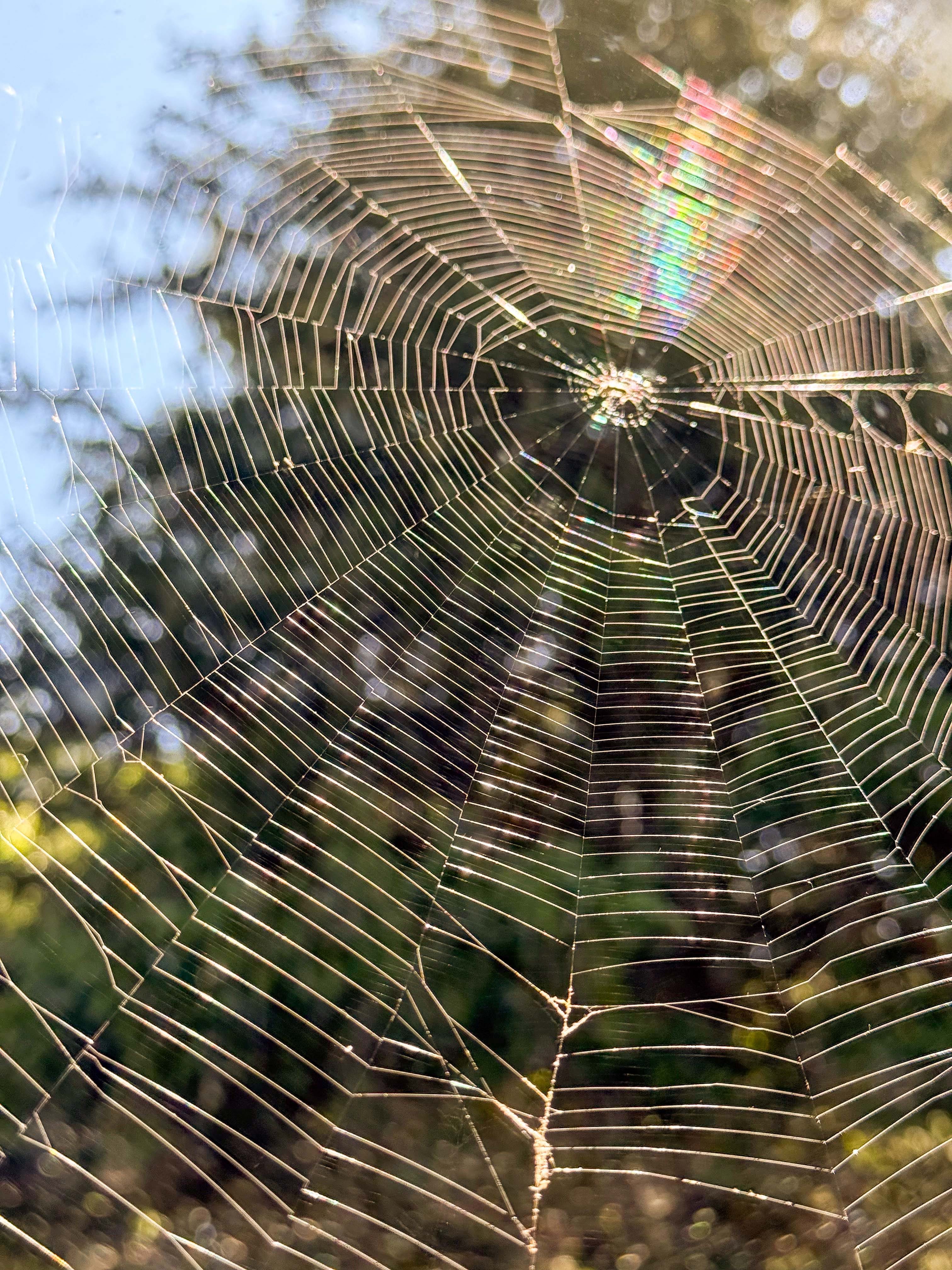
Every morning there’s a new orbweaver web stretched between two tomato cages, jeweled with dew if I’ve beaten the sun outside, gone by midday. I apologize as I inevitably walk through it anyway, some strand catching across my face or wrist.
Cicadas start up sometime after breakfast and build all afternoon into something closer to pressure than a sound—the kind of noise you stop hearing and start feeling, low in the chest. Barn swallows stitch the evening sky together while dragonflies patrol the vegetable beds at ankle-height, veering after mosquitoes I never knew were there. The crickets take over at dark, right around the time the light turns that particular gold-going-blue.
The bluebirds never moved into the cedar nesting box I researched, assembled, mounted, and equipped with wildlife surveillance technology, at a cost I’ve chosen not to revisit. Months of anticipation got me exactly zero tenants. The bluebirds nested somewhere else entirely, out of range of cameras and my heart. They still visit, dropping onto the fence posts before disappearing into the grass after beetles.
Rabbits appear and disappear between the raised beds like poorly remembered dreams. Hummingbirds materialize around the bee balm and vanish again before I can convince myself I actually saw one. Foxes pass through the yard toward the chickens, on the rare occasions Lady isn’t out there. They run low to the ground and move fast along the tree line at dusk, gone before I’d finished registering what I was looking at. The neighborhood bear makes its presence known only through the occasional garbage raid when I forget to close the garage doors. The bear, unlike the bluebirds, has no reservations about accepting my hospitality.
Lady, for her part, treats the raised beds like an obstacle course. She isn’t hunting anything, she’s just being Lady. Last week alone she flattened a trellis mid-zoomie, dug a cooling hole clean through the onions, and trotted around the yard carrying a large branch from the peach tree like she'd personally pruned it. She is the one creature here I actually chose—which has made absolutely no difference.
Out by the potato patch there’s still a hole that may or may not belong to Gerald, the groundhog who terrorized my garden last summer. I haven’t seen him this year, though that doesn’t mean much. Absence has never meant much in this yard.
For reasons I don’t entirely understand, the deer avoid my yard altogether. The hostas stand almost untouched because of it, save for a few industrious slugs working the lower leaves. I found out recently why the damage never gets worse than a few nibbles: there’s a toad living under the big hostas in the front yard, fat and unbothered, the color of wet bark. I nearly watered him directly a week ago before he shifted, just slightly, and revealed himself as something alive rather than a clump of mulch. We’ve reached an understanding since. I check before I water. He stays exactly where he is.
This is the arrangement, then. I plant things with intention. Every flower feeds something. Every leaf shelters something. Every quiet corner already has a resident, whether or not I ever formally meet them. The orbweavers reroute my mornings. Gerald may still be tunneling beneath the potatoes. The bluebirds visit on their own schedule. The toad earns his keep beneath the hostas. The bear needs only a moment of human error. Nobody seems especially interested in the fact that I planted any of it.
All that time I thought I was making a garden, I was making habitat.
So many things pass through. I don’t necessarily see them, but I find evidence. I still catch myself saying my tomatoes, my flowers, my yard. It’s a useful fiction. The truth is, somewhere along the way I stopped being the gardener and became one more creature moving through it.
All flourishing is mutual.
—Robin Wall Kimmerer
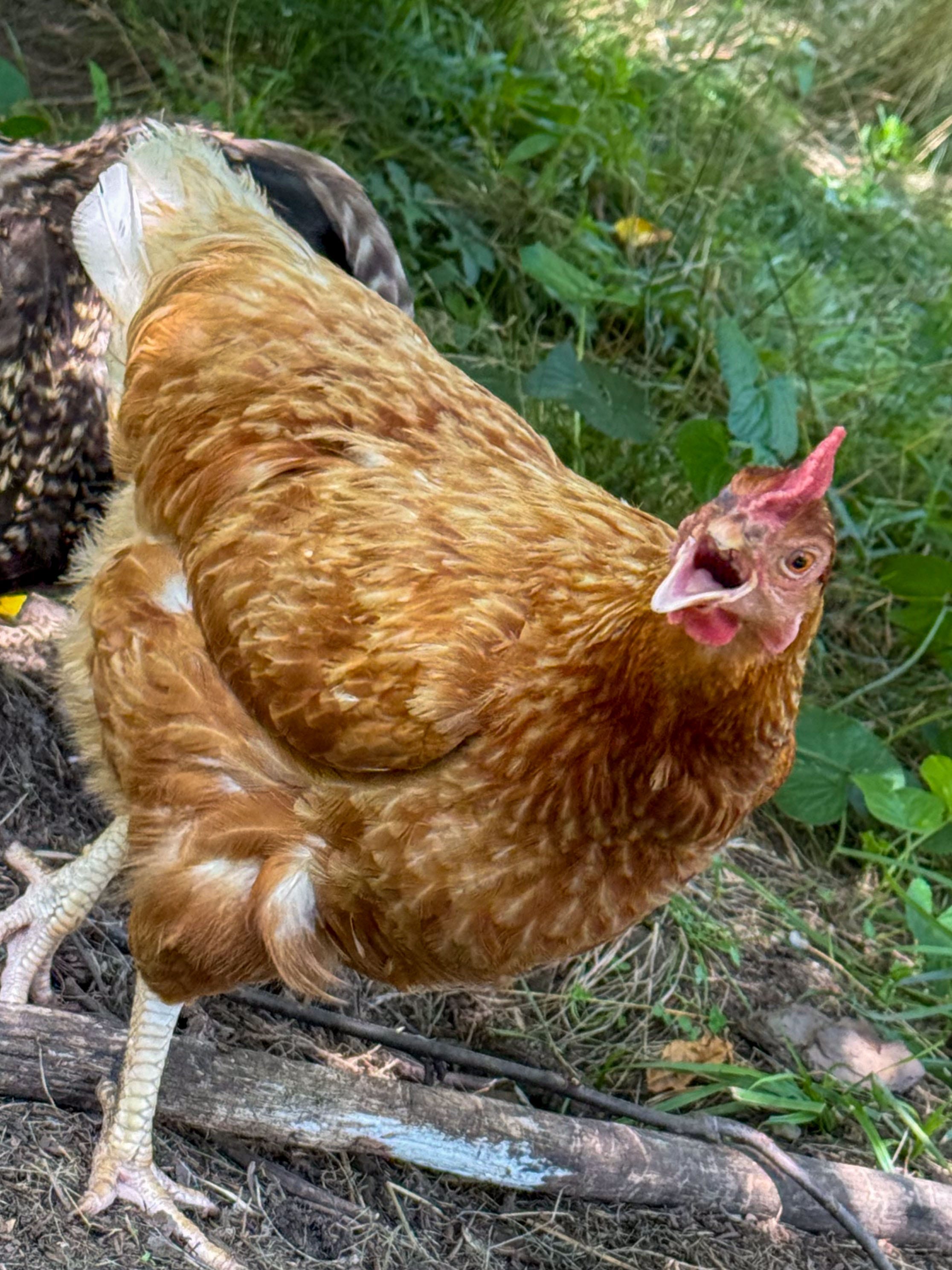
The other day, I stood in the shade watching Emily Chickinson. She was pecking at the air in this slow, deliberate rhythm, and I decided that she was having a spiritual experience. I said out loud, “she’s really in her own world today,” the way you’d describe a poet at the window. Emily, patron saint of quiet afternoons.
Reader, she was not having a spiritual experience. She was running a kill count. She was murdering flies mid-air, one after another, snapped out of existence with a little wet click I will be hearing in my nightmares. She’d go still—genuinely still, poet-at-the-window still—and I’d think, ah, the moment has passed. It had not passed. She was tracking.
I’m still processing it.
And that would have been the whole dispatch—a humbling little nature note—except that minutes after this happened, Emily and resident cock Feather Locklear were standing beak to beak, so close their combs were basically touching, close enough that I actually said “oh” like I’d walked in on something. Let’s just say there’s the normal “standing near another chicken,” and then there is whatever this was.
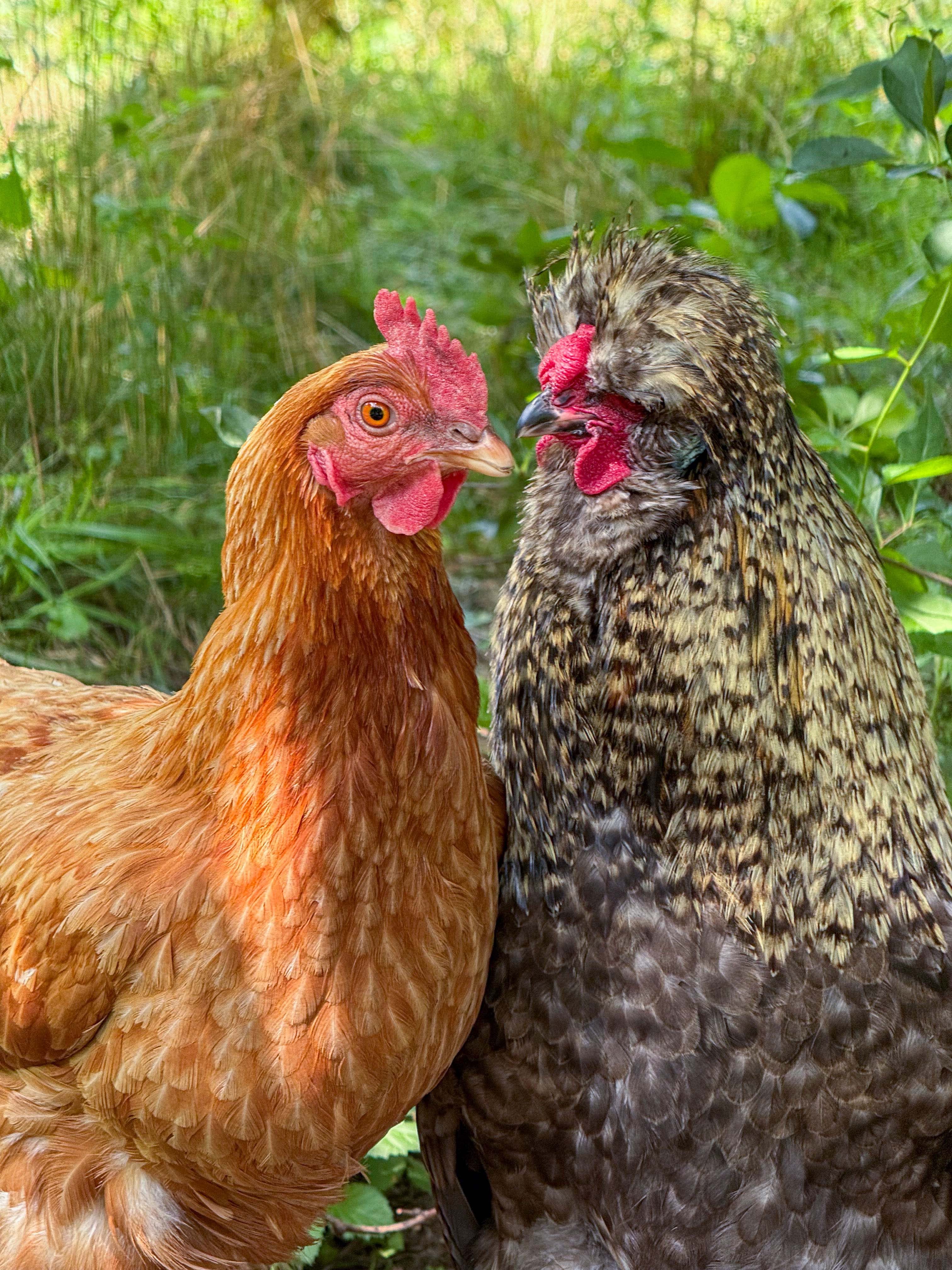
I don’t know what I walked in on. I have theories. None of them are good.
Theory one: they’re having an affair, if chickens can be said to have affairs, which—based on the eye contact alone—I now believe they can, and further believe that Emily is the one having it, while Feather is simply along for the ride.
Theory two: Feather owes Emily money. She’s been visibly richer in bugs since the fly incident, and he has never once in his life paid for anything.
Theory three: Emily has recently discovered violence and is trying to bring Feather into the organization. This is less a romance than a recruitment drive.
Theory four: Feather has accidentally agreed to something. Emily has the unmistakable energy of someone finishing a very convincing pitch. Feather has the face of a man who has just nodded along without reading the terms.
I stood there, phone half-raised, waiting for one of them to break first. Neither did. They held the pose like they knew I was watching, like the whole thing was already over and I'd simply arrived too late to catch the part that mattered.
Eventually I was the one who left, which, in hindsight, feels like losing.
Emily, I suspect, got exactly what she wanted.
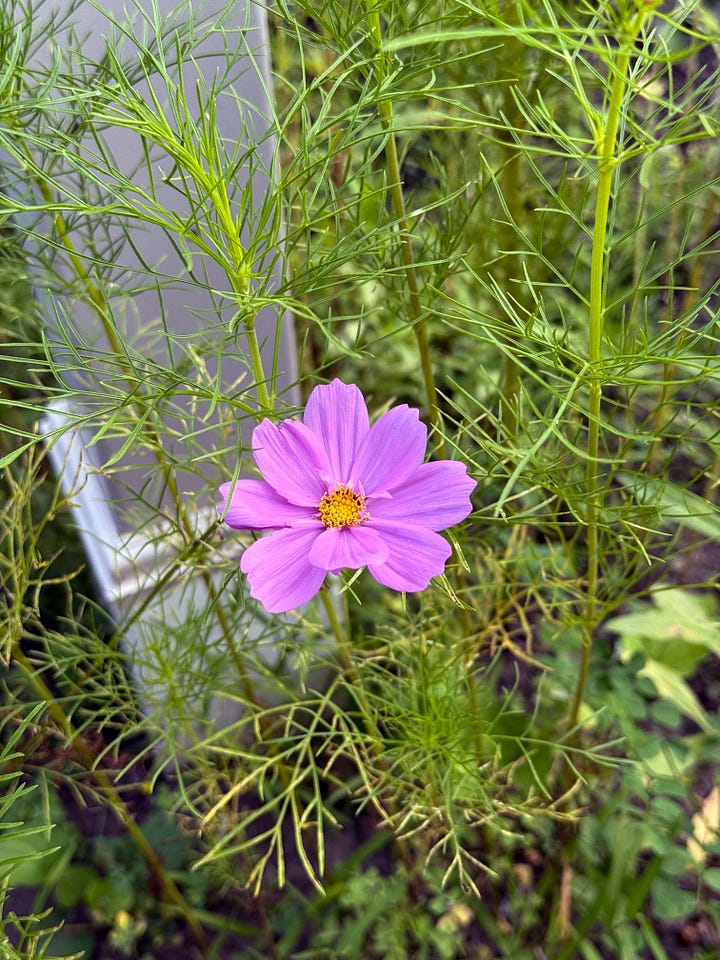
The first cosmos opened this week, floating above their threadlike foliage. Cosmos always feel improbably delicate until you remember they happily bloom right through neglect, wind, and extreme heat.
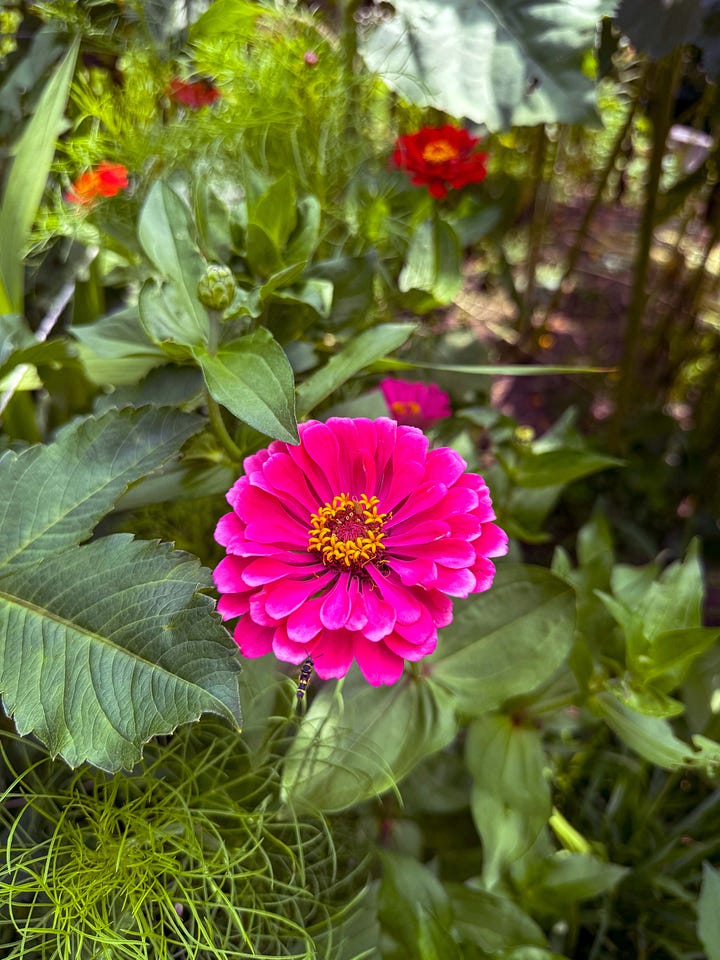
And the first zinnias! Loud, unapologetic, and incapable of blending into the sunflower forest surrounding them. After weeks of leafy anticipation, the cutting garden is officially open.
I knew this day would come.
Every gardener eventually reaches the stage where they wander around the yard holding a half-eaten tomato like it’s a murder victim.
After a week at the beach, I approached my tomato bed expecting the first ripe tomato of summer waiting for me.
What I found, however, chilled me to my core.
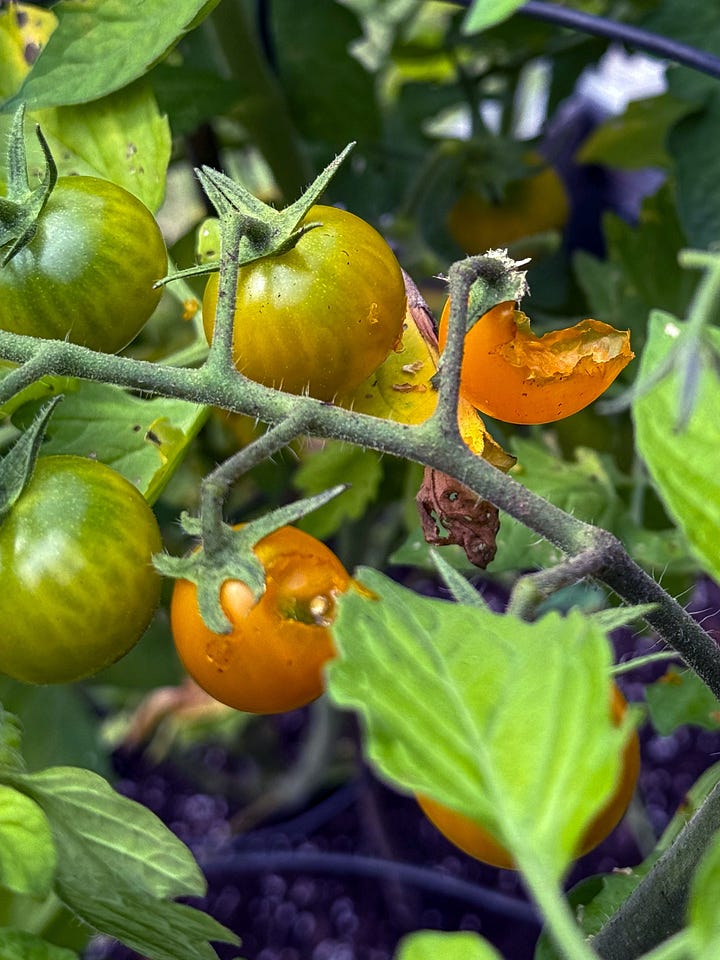
I first discovered a few neat bites taken out of the Sungolds—not plucked, not stolen, but opened, like a locket. Something meant to be looked at rather than eaten. Half of it dangles there by a single thread of skin, catching the light, presumably so I'd be sure to see it. I don't know who does this. I don't know why you'd leave the other half swinging instead of just taking the whole thing and sparing me the visual. This isn't hunger—this is theater, and I did not buy a ticket.
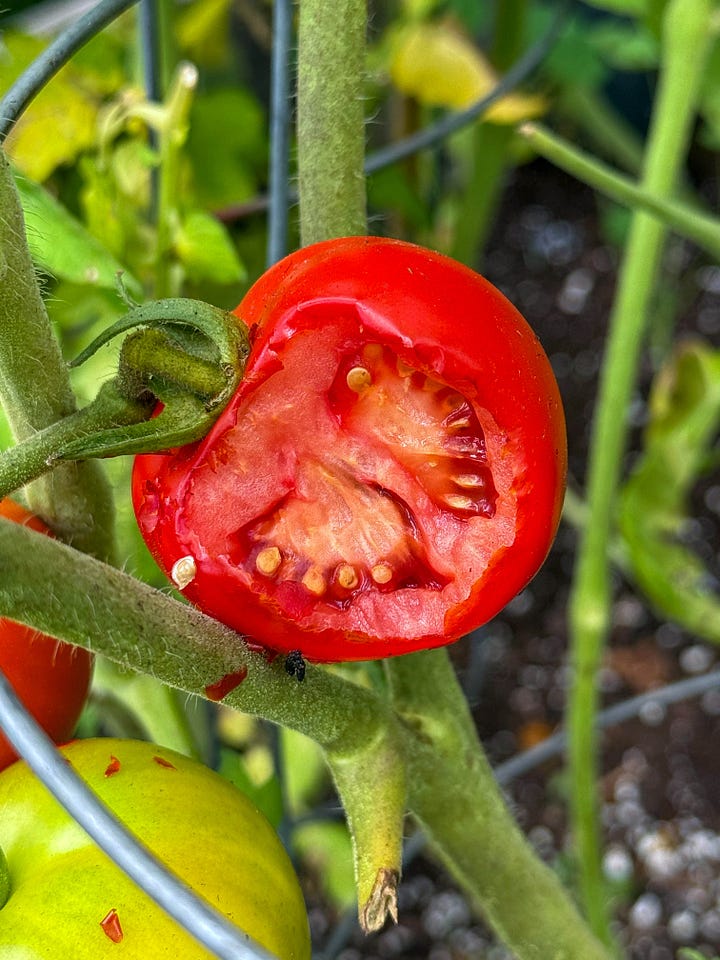
Then I found the Early Girl—a ripe red tomato, opened almost exactly in half, seed cavity exposed to God. This one wasn’t nibbled—this one was processed. Someone got in there with surgical intent, examined the seed count, and left it hanging as a message.
I’ve spent an embarrassing amount of time trying to reverse-engineer bite marks. Bird? Rabbit? Chipmunk? Squirrel?
At first I accused Gerald the Groundhog, assuming he’d be back for at least one more psyop. But I walked it back within the hour on the grounds that groundhogs lack the vertical ambition and upper-body strength required to climb a tall raised bed. I’ve considered birds, but the bite radius feels oddly precise for a beak. It reads less “peck” and more “melon baller,” which is an unsettling level of craftsmanship to be up against.
My leading theory currently involves malice from a creature no larger than a loaf of bread with a very small, very specific set of teeth.
I’d like to tell you I accepted that gardening means sharing. Instead, I purchased forty-five feet of bird netting and threw it over my plants with the grim resolve of someone boarding up windows before a storm that is, almost certainly, just one (1) squirrel.
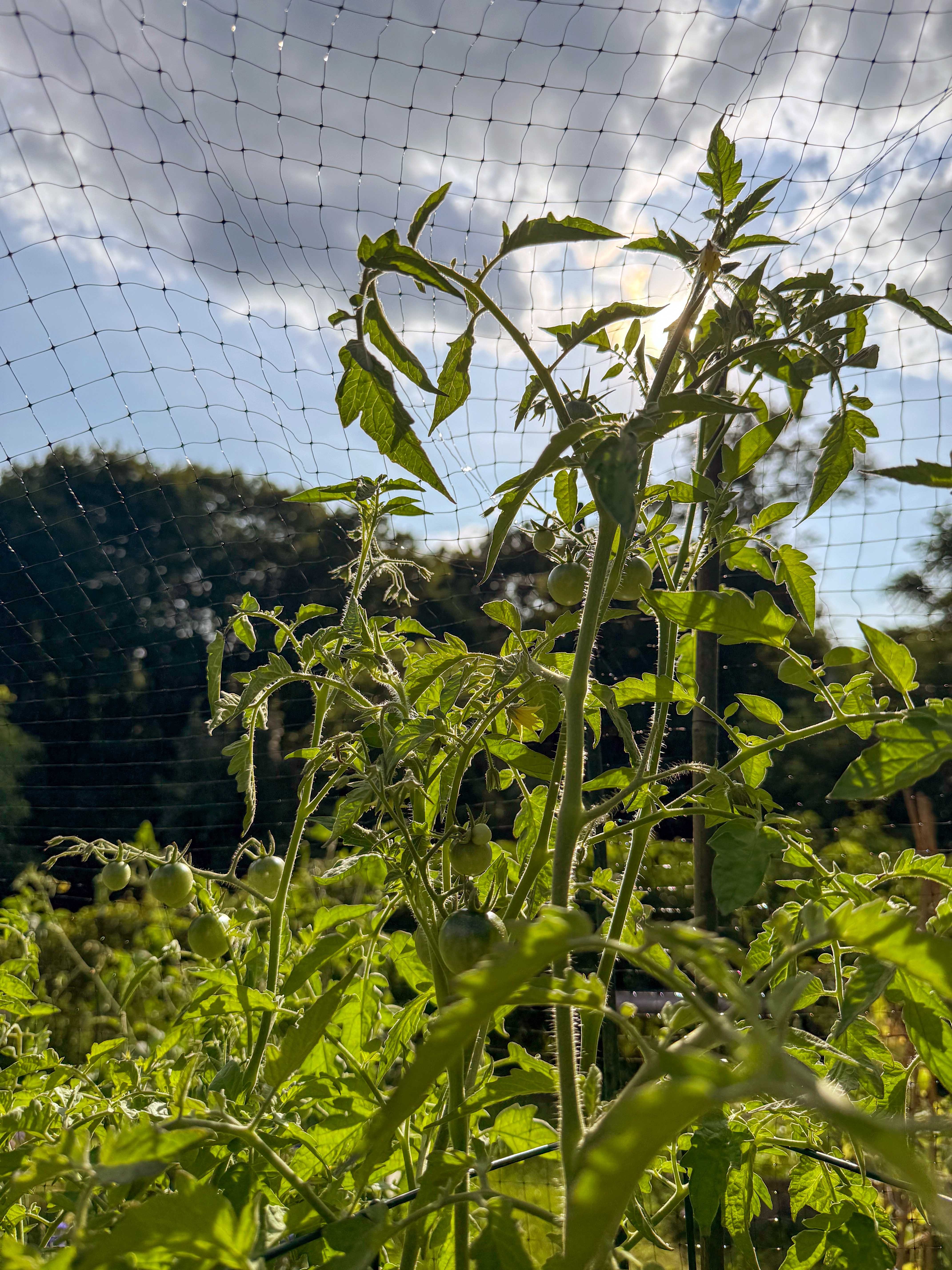
Harvesting a tomato will now require unstaking the net, lifting it over my head, crawling underneath, and—nine times out of ten—getting tangled in my own perimeter defense, extracted from my own garden like a fish caught in a net it built to catch something else.
The tomatoes now live in maximum security, the suspect remains at large, and I am, several weeks into summer, still waiting for my rite of passage tomato.
I never manage to cut just one thing. I go out for three stems of something specific and come back twenty minutes later having taken a little from everywhere, unable to leave one plant looking too bare, or walk past one more stem of purple.
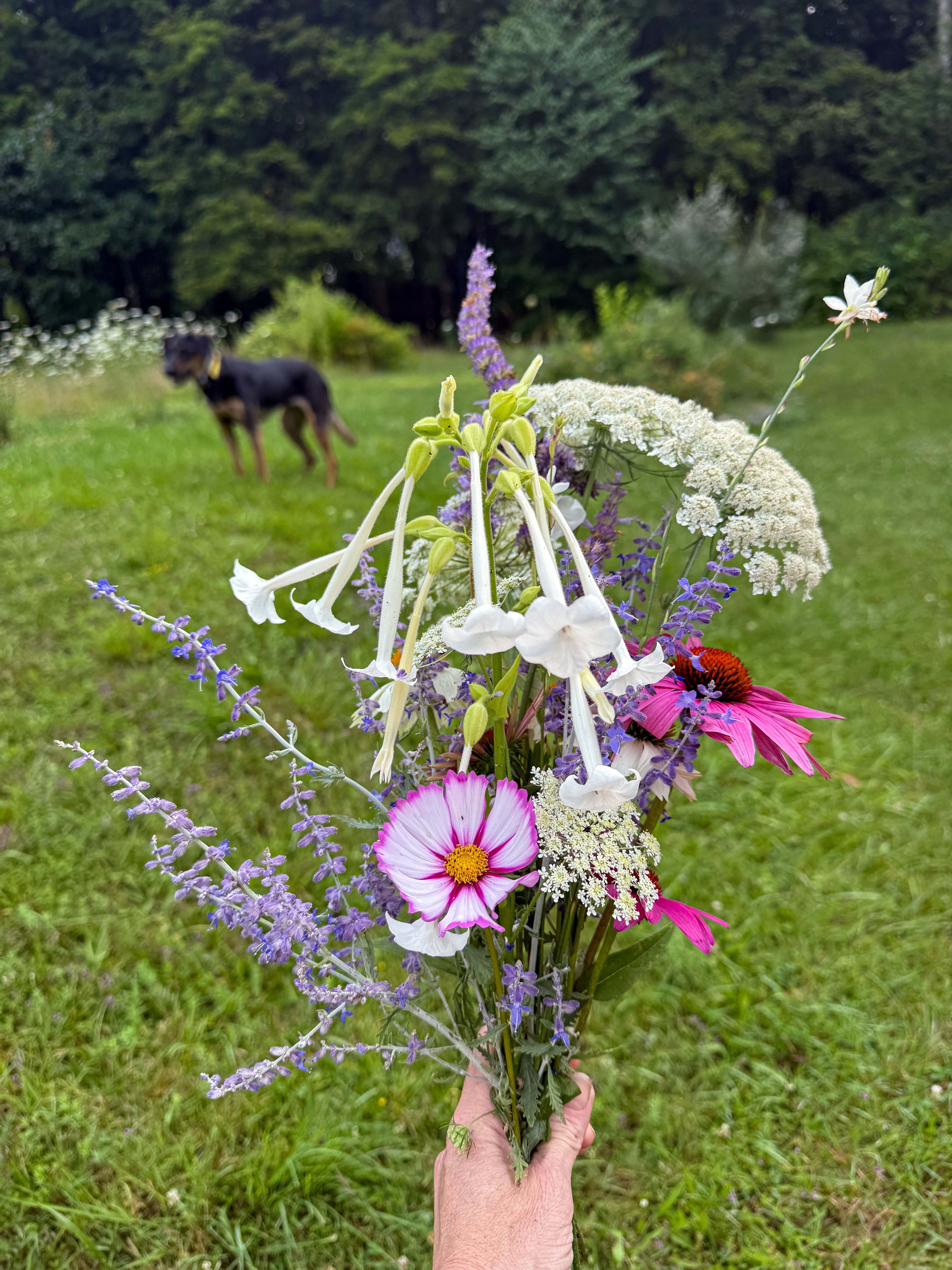
There’s no real logic to it, which might be the whole appeal.
By the time I get back to the house, I can retrace my walk just by looking at what I’m carrying. Anise hyssop means the bees were busy. Nicotiana means I lingered longer than I’d planned because evening was getting closer. Queen Anne’s lace means I wandered to the edge of the meadow. Perovskia means I stopped to run a hand through it. Gaura means I waited for the stems to stop dancing long enough to cut one. Cosmos means I found the one that had finally opened exactly the way I’d been waiting for. Coneflowers mean it was, unmistakably, late July.
The bouquet is less an arrangement than a map of where I got distracted.
There is a correct shape for every vegetable in a salad, and I will not be taking any questions.
Let’s start with cucumber, since it’s the most offensive category when done wrong. A cucumber slice—thin, round, wobbling on the surface of the bowl like a coin someone dropped in a fountain—is not a food shape. It’s a garnish that wandered in from a spa water pitcher. I need cucumber in substantial chunks. Something with shape and spine, something that holds its water and requires chewing.
Tomatoes are worse. A whole cherry or grape tomato, dropped into a salad fully intact, is a trap. You bite down expecting resistance and instead receive a surprise beverage at high velocity. Quarter it. Halve it. Give the thing a fighting chance to behave like a solid.
And while we’re here, enough with the giant tomato wedges. They’re too big for one bite and too slippery for two. You either have to unhinge your jaw like a python or perform surgery with whatever cutlery you have on hand—which, in a salad situation, is usually a butter knife. If I need to cut the salad after you’ve already cut the salad, then you have not, in fact, cut the salad.
Red onions deserve dignity. Onion ribbons are Schrödinger’s vegetable: you can never quite catch one on your fork, and yet somehow every single bite contains one anyway. It’s less an ingredient than an ambient condition—weather the salad is having. I need onion with mass. A real dice, something a fork can actually lift, something that arrives in my mouth because I put it there, not because it happened to survive the trip.
And carrots—my god, the carrots. Julienned carrots have the structural integrity of orange thoughts. They behave less like a vegetable and more like packing material. I don’t want flavorless carrot confetti upholstering my throat. I want a chunk—something you can feel doing work in your mouth, something that tells you that you’re currently eating a carrot and not decorating a cake.
Every vegetable in a salad has a job, and its job is to be forkable, chewable, and structurally honest about what it is. Give me chunks, all the way down. I’ll die on this cutting board.
Cocteau Twins — “Heaven or Las Vegas”
Some weeks require lyrics. This one requires atmosphere—the soundtrack to that exact 20-minute window when the sun drops behind the trees, the crickets start up, and you’re waiting to feel that first faint twilight chill.
Comments
Nothing yet. Say the first thing.
Sign in to join the conversation.