
I didn’t get chickens because I wanted a simpler life. A simpler life does not involve chipping frozen shit from the coop ramp in February, or standing in the yard at dusk trying to persuade a bird to enter the structure where she has slept every night of her egg-laying life.
There is a version of chicken keeping that exists almost entirely on the internet—an apron, a wire basket, six brown eggs in a shallow ceramic bowl beside a rumpled linen napkin with one sprig of lavender allowed to enter the frame, and suddenly you are not the woman who spent the morning scraping feces off a ramp with an old knife. You are participating in the old ways. You understand seasons.
I told myself this was about self-sufficiency, about teaching James where food comes from. None of that survived contact with an actual chicken.
Chickens are not pastoral accessories, although they will stand very still in beautiful light and briefly suggest otherwise. They are not a return to the land. They are not proof of self-sufficiency, unless self-sufficiency means constructing a predator-proof compound for an animal currently devouring its own egg.
People say, “At least you get fresh eggs,” as though the eggs arrive independently of the coop itself, fencing, feed, bedding, waterers, feeders, locks, latches, roofing, mealworms, niblets, heated bases, and one emergency Sunday evening trip to Tractor Supply because a rooster who normally attacks me has stopped, and I’ve decided this is a medical event.
At the current rate, each egg has a street value comparable to saffron.
They might have remained livestock if I hadn’t insisted on naming them. You can maintain a practical relationship with “the black hen.” You can tell yourself that livestock is livestock, that nature is unsentimental, that losses happen. But once you have named a chicken Emily Chickinson, you have agreed to worry about a creature you watched, within a few hours of bringing her home, fall asleep standing up and topple gently sideways into the dirt.
I named them to make myself laugh. Then the names became theirs.
They know I open the coop in the morning. They know the sound of the sliding door. They know the white bowl usually contains something fresh from the garden and the compost pail usually contains a variety of older material. They know that if I say “dibble-dibble-dibble” in a certain register, there’s a reasonable chance something tasty will follow. Sometimes I call out, “Come get your government cheese!” just to take a photograph. They come running anyway, all feet and hope, and I betray them for content.
I am not a bereaved mother to them. I’m not a woman making a series of questionable decisions while wearing rubber boots. I am the large animal who controls the doors. I am a familiar voice, a pair of legs, the source of water, the enemy of hawks, the possible bearer of peaches.
They do not understand me. But they know when it’s me.
This is not the same thing as love, probably, though I have never let uncertainty stop me from assigning elaborate interior lives to animals who would eat a Band-Aid. When I come around the corner, they run toward me. I love watching a chicken run—the body pitched forward, wings slightly out, feet moving with the desperate speed of someone about to miss a bus.
Keeping chickens has not made me better, more patient, or more accepting of nature’s cycles. I do not rise serenely before the sun, unless being awakened at 4:47 a.m. by a rooster screaming into the damp grey morning counts as serenity. Sometimes I lose forty-five minutes because Emily has begun staring fixedly into the water and I now need to know what she knows. Beyond that, they have not taught me to slow down—in fact, they have taught me to move extremely quickly, particularly when Feather Locklear flares his neck feathers and begins the sideways dance that means my shins have been targeted.
I have learned skills with an increasingly narrow range of application, like how to hold a bird so the wings stay folded and how to feel beneath feathers for weight loss. I know the difference between a conversational cluck, the long, rising note asking for a snack, and the fracas when someone has been displaced from the roost or witnessed a misdemeanor.
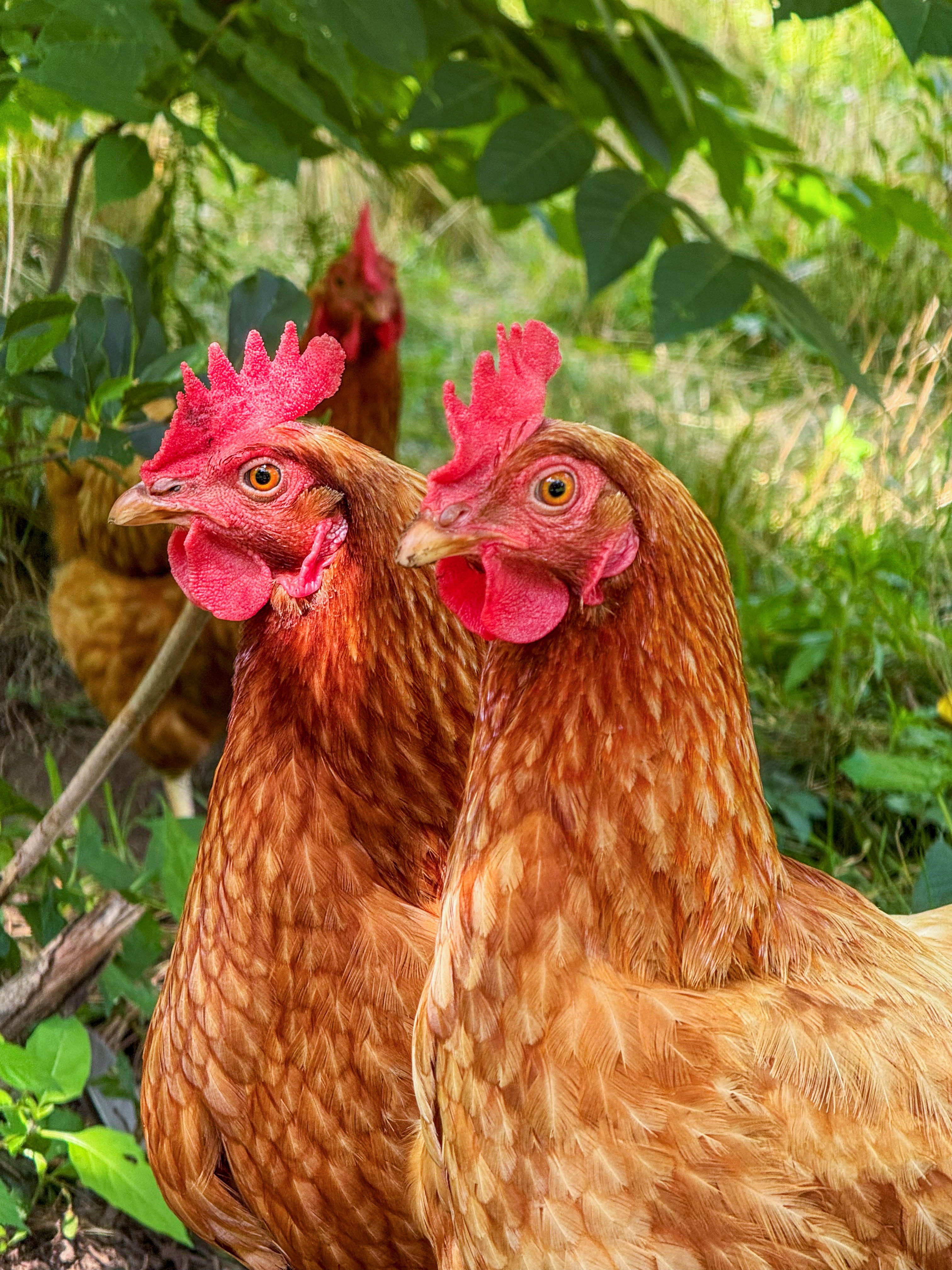
From a distance, they look like a flock. Up close, they are nothing alike.
This one complains before laying.
This one crouches when approached.
This one sometimes takes food carefully from the hand.
This one attacks me.
This one is a poet.
The distinction matters because chickens disappear. I don’t know what they understand about loss. Maybe they remember, maybe they don’t.
I remember Yolko Ono limping through the run. I remember how Chickolas Cage routinely laid double-yolkers. I remember how long it took my eyes to stop counting the wrong number. The yard does not become generally sad. It becomes quiet in one exact place.
So no, chickens are not a lifestyle. They are not an aesthetic, a moral project, a shortcut to authenticity, or a redemption arc with feathers. They are greedy, suspicious, vain, violent, curious, frightened, industrious little dinosaurs who produce breakfast under chaotic conditions. They are five specific, uncooperative creatures I go outside to take care of at least twice a day, in whatever weather, for reasons that stopped needing to be good reasons a long time ago.
The eggs are useful. They are not why I count heads at dusk.
In the evening, they put themselves to bed in more or less the same order. One by one, they climb the ramp and arrange their strange warm bodies along the roost, complaining as they press against one another despite having several feet of unused space. I count them before I close the door.
Hen.
Emily.
Eggward.
Benechick.
Feather.
Five. Then I close the door.
🪱 COMPOST FOR THE SOUL
Love is the perception of individuals.
—Iris Murdoch
🪰 PEST SUPPORTING ACTOR GOES TO…
The Call Is Coming from Inside the Mouse
Last week, after discovering a series of tomatoes opened with the cool precision of a mob warning, I purchased forty-five feet of netting and turned the raised bed into a maximum-security agricultural facility.
Nothing could get in. This included birds, squirrels, chipmunks, and, increasingly, me. Harvesting required unstaking one corner, lifting damp mesh over my head, and crawling underneath while trying not to catch my nose ring, shorts, or remaining dignity. The tomatoes were safe. I had prevailed.
Then I found the holes.
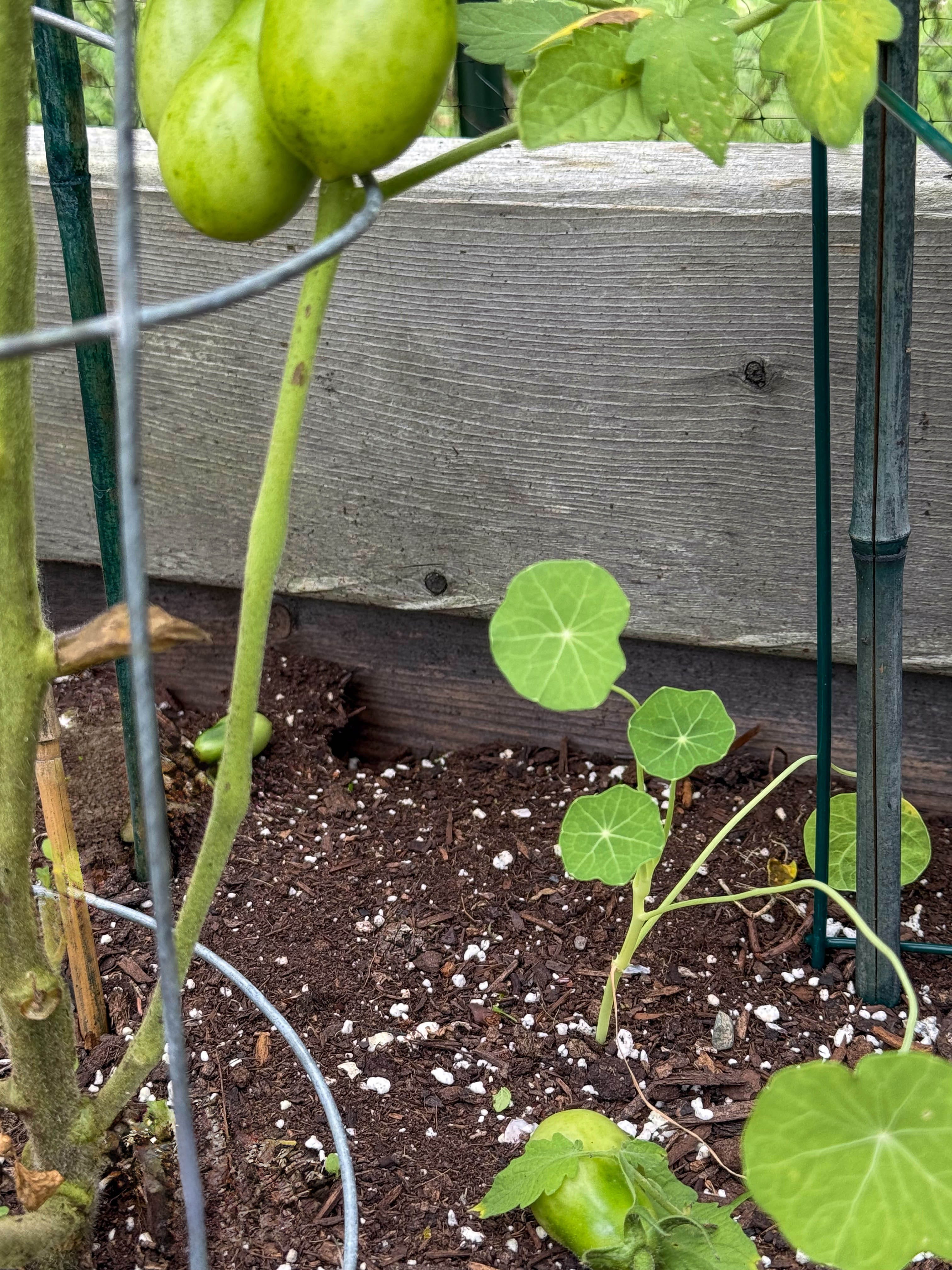
Not outside the raised bed, attempting to enter—inside it, already at home. Neat little burrows along the wooden perimeter, tucked beneath the tomato plants and nasturtium like a private service entrance with excellent landscaping, if I do say so myself.
The suspect had not been breaching my defenses.
The suspect had been living inside them, rent-free, eating my summer.
I sat with this for a moment. I had spent real money and most of an afternoon building what I thought was a fortress around the tomatoes. What I had actually built was something closer to a screened dining pavilion over the mouse’s existing home. It had underground access to unlimited tomatoes.
“Mouse” is currently a prosecutorial term meaning any small mammal that has successfully converted my raised bed into an all-inclusive gated community with very generous amenities: organic heirloom tomatoes, fresh water, shade, nasturtium cover, a peculiar woman periodically crawling through the ceiling to curse and rearrange the buffet, and full immunity from the hawks, the foxes, and one deeply confused dog who would have otherwise handled this for free.
I will not be spraying anything—a decision I’ve chosen to describe as principled rather than admit is mostly vibes. The netting is staying too. It is already up, which has become the strongest argument in its favor.
Now, the moment a tomato shows the faintest blush of color, I pull it from the vine and hide it on a dish towel in a re-outfitted Reebok shoebox on the kitchen counter. The shoebox is witness protection. Harvesting has become an evacuation. This is the only reason the tomatoes now make it into the kitchen at all: I pick them unripe, before either the mouse or I can eat them beside the raised bed.
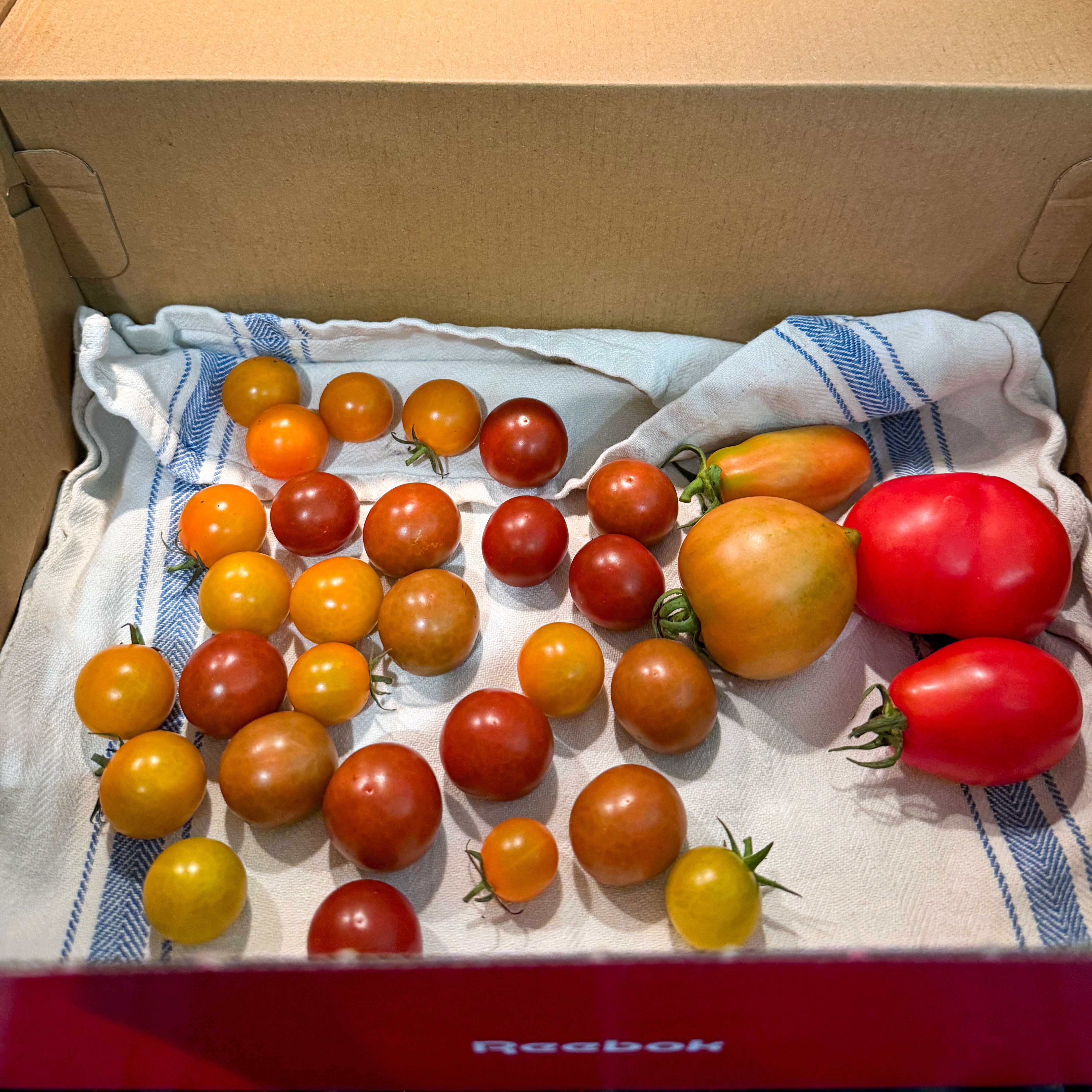
The tomatoes are safer in footwear packaging than they ever were behind forty-five feet of professional-grade netting. A return to the land indeed.
🌹 BLOOM REPORT
Zinnias—peachy and unbothered.
Black-eyed Susans—there is no such thing as planting just one.
Sunflower—currently under bee occupation.
Gladiolus—all ruffle, no restraint. Hello, fellow traveler.
🎃 GOURD OF THE RINGS
A Wren of One’s Own
I don’t know where the gourd came from. Not in the vague way you don’t remember where half your kitchen tools came from—I mean I have no memory of buying it or making a single decision regarding its presence in my peach tree. As far as I can tell, it has simply always been there, the way certain rocks are just already in a yard when you buy the house.
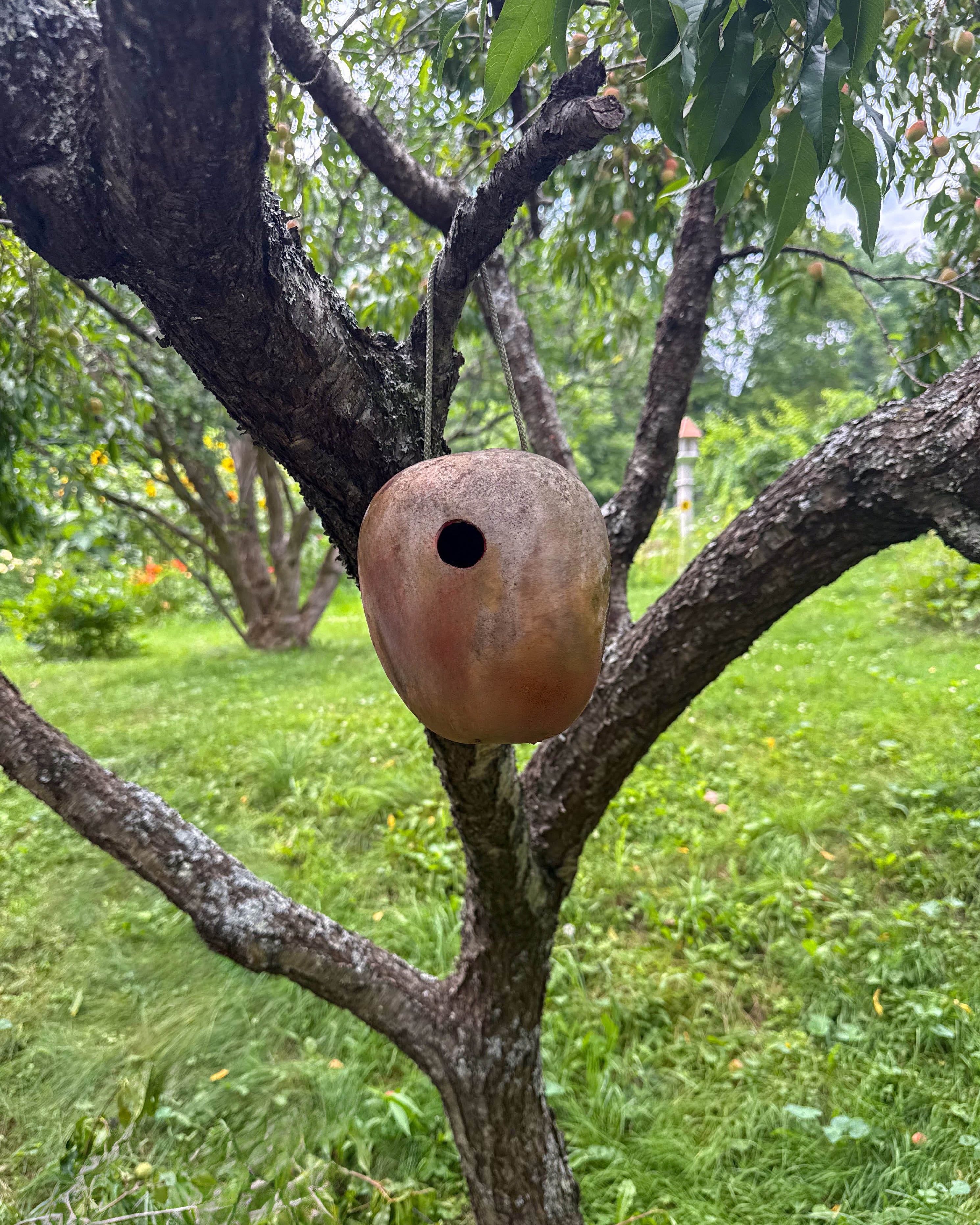
My only continued interaction with it, if we’re being honest, has been walking directly into it.
Up the hill, a different birdhouse got a solar panel, a wifi camera, a dedicated app, and my full, deranged attention. I built that one on purpose—leveled the post, aimed the door southeast, did actual math on morning light. Nobody came.
Turns out a family of wrens had moved into the gourd, where they built a nest and raised five children. I found them because the gourd began screaming. From the outside it still looked empty: one dark opening, the whole thing knocking gently against the branch, probably still reeling from our last collision.
I looked in expecting the worst, because that’s just who I am now. Instead: five nestlings pressed together, all unfinished feathers and big yellow mouths, each one somehow larger than the bird producing it, all five instantly and completely certain I was about to be useful.
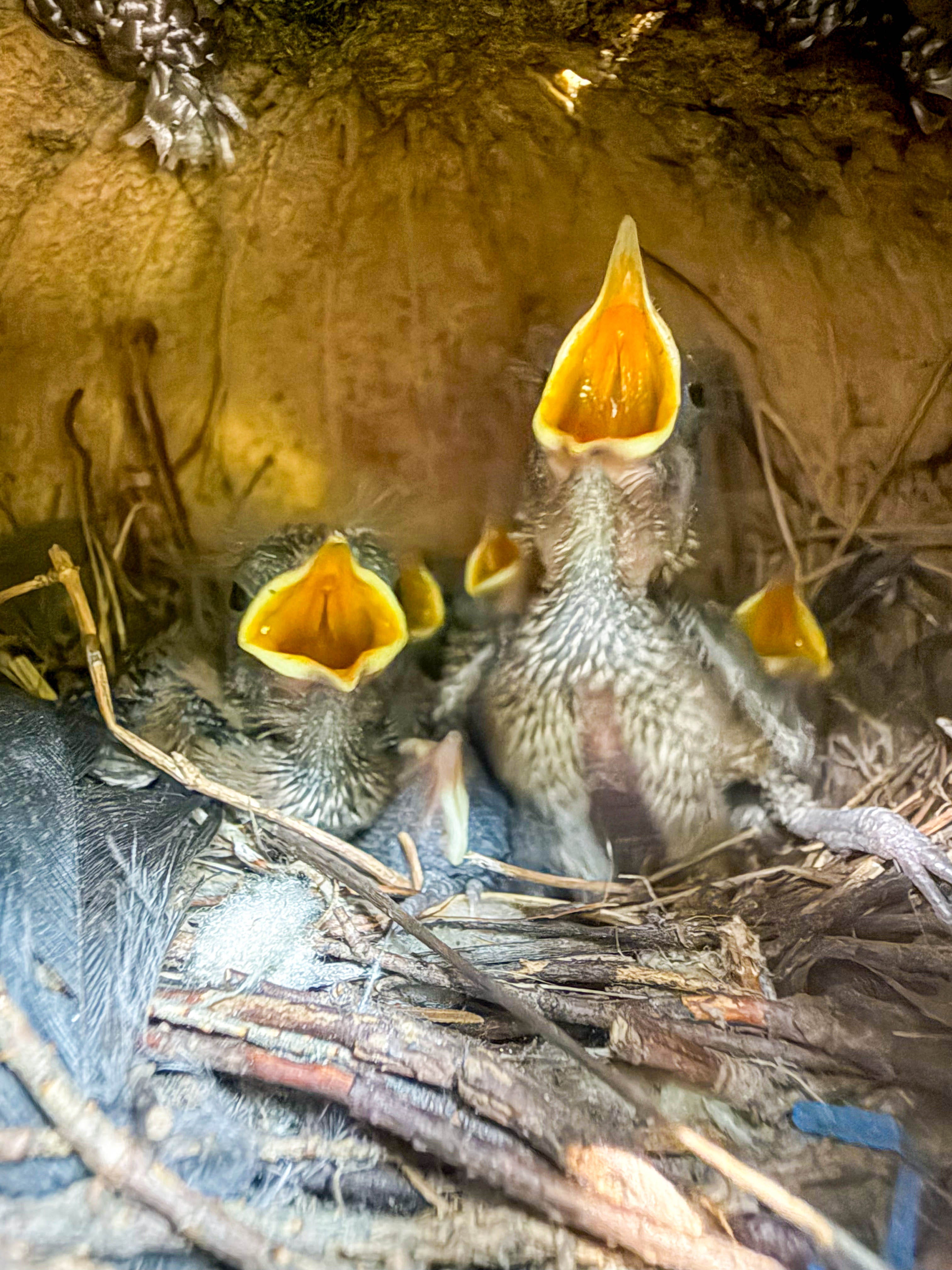
This seemed like a good moment to consider whether I was becoming a problem. I had, after all, just spent several minutes standing directly in front of their door hole with my phone held up like a warrant. James had begun answering the question with less ambiguity, hurling a semi-ripe peach at the gourd, then another at me, because I was simply a larger and more responsive target. He then lost interest in ballistics altogether and went off to collect sticks.
So I looked it up. Keep my distance, the internet said, and I have taken this instruction extremely seriously, in the sense that I have redefined the word distance several times over the past week to suit my own behavior.
I no longer stand directly beneath the gourd. I stand several feet away with a telephoto lens. When one of the parents arrives with a moth in its beak, I turn my body slightly to communicate respect while continuing to point a camera at its children.
I’ve taken to watering the tomatoes directly beneath the peach tree, despite the fact that the tomatoes are on the other side of the yard, where they remain, as far as I know, thirsty.
The babies change almost daily. At first they were mostly mouths with a small amount of bird attached. Then came the pinfeathers, the open eyes, the first suggestion that five separate wrens were forming in there rather than one many-headed creature demanding caterpillars.
Their parents work without pause—insect, gourd, insect, gourd, insect, gourd, all day long, while I contribute by standing nearby drinking seltzer and periodically reapplying sunscreen and checking whether everyone remains alive. We each have our role.
I no longer walk directly into the gourd. James has mostly stopped throwing peaches at it. The parents keep returning, the babies keep becoming birds, and every time the gourd begins screaming, I look up.
🥕 PICK ME DIRTY
From Farm to Probably Pasta
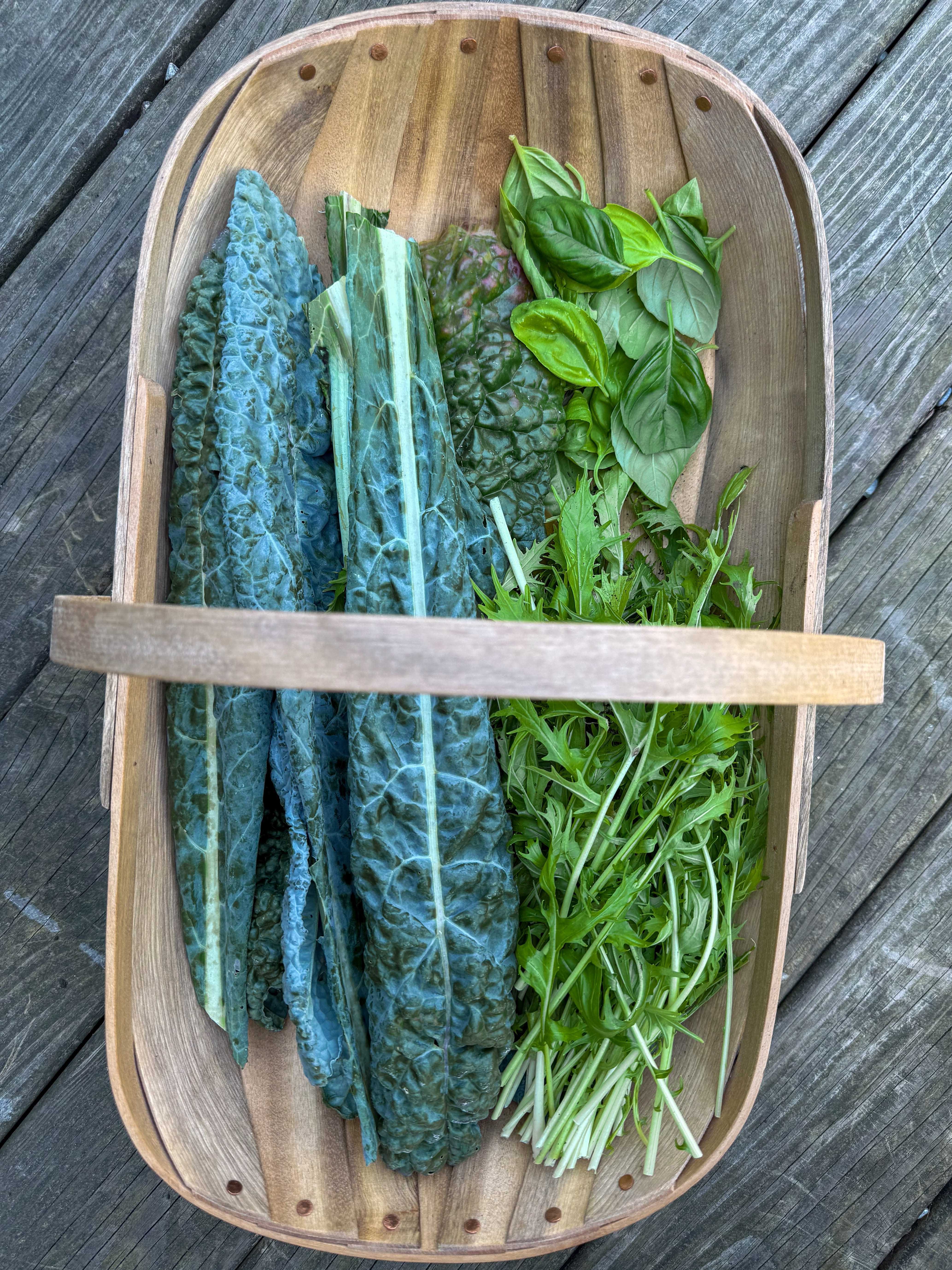
Lacinato kale, basil, and mizuna, gathered and photographed just before I compromised the nutritional atmosphere with an irresponsible amount of butter and cheese.
🔍 DIRTBAG GARDENING CORNER
Krim and Punishment
Tomatoes crack when they take up water faster than their skins can stretch. Usually the soil gets dry, then it rains hard, or I remember the hose and try to make up for several days at once in one sweeping humanitarian gesture. The tomato swells. The skin splits.
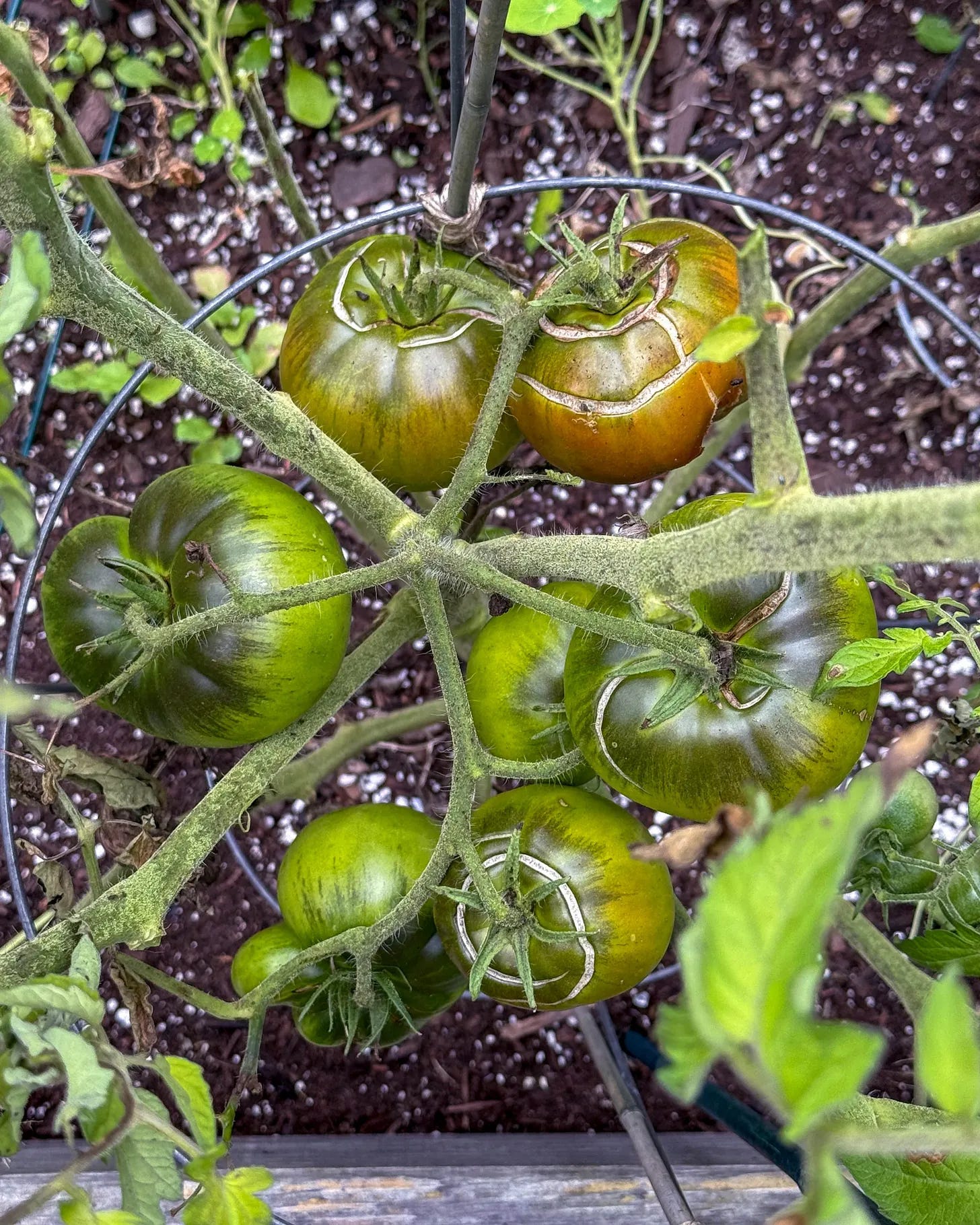
Drama queens like Black Krim are especially prone to it. Their skins are relatively thin, their shoulders are broad, and, frankly, they have the emotional constitution of something bred for prestige rather than durability.
People who know what they are doing keep the soil evenly moist, water deeply, and mulch. They also look at the forecast and pick tomatoes that have started to color before a hard rain. They also probably know when they last watered.
My current irrigation system is decentralized and largely emotion-based. I water when the leaves droop, when I trip over the hose, or when rain is forecast and I decide the plants could use a head start. Then it rains for six hours and I walk outside the next morning shocked to discover that cause and effect remain operational.
A fresh, clean split is usually fine. Pick the tomato, cut away the damaged part, and eat it soon. If it smells sour or has started to mold, the compost pile can have it.
Will I fix this next season? Probably not. Next August, I will stand in the garden with secateurs in one hand and a split tomato in the other, carry it inside, cut around the damage, and eat the rest over the sink with juice running down my wrist, mourning nothing.
🎧 BEET DROPS
Tom Petty and the Heartbreakers — “The Waiting”
August gets called peak season. As far as I can see, everything is still arriving: tomatoes blushing, peaches softening, moonflower vines climbing a trellis without yet blooming, dahlias holding themselves shut, chickens lingering outside as the light drains from the yard. Nothing is finished yet, and all I can do is keep checking, keep tending, keep showing up at the same hour.
Tom understood.
Comments
Nothing yet. Say the first thing.
Sign in to join the conversation.