
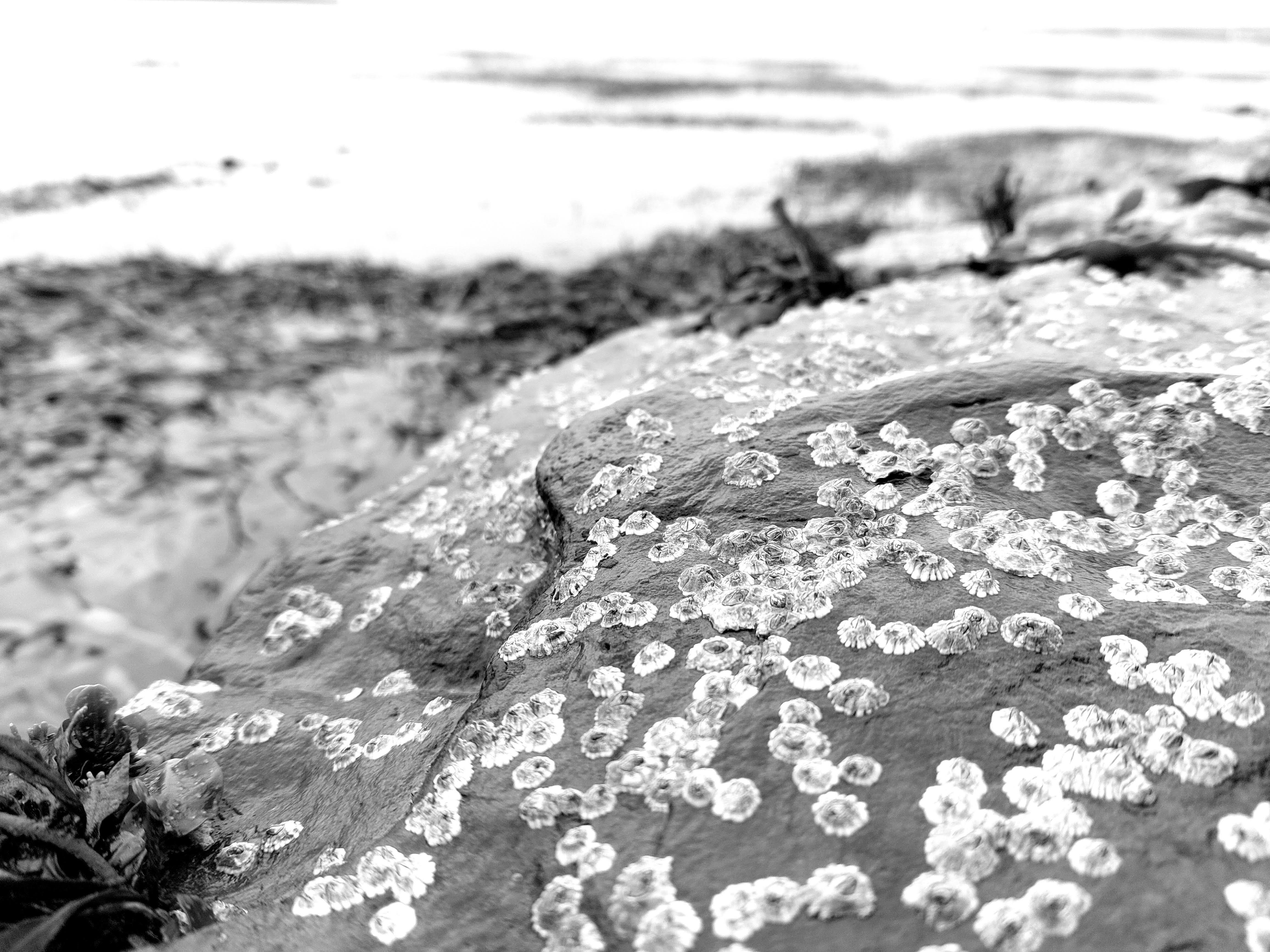
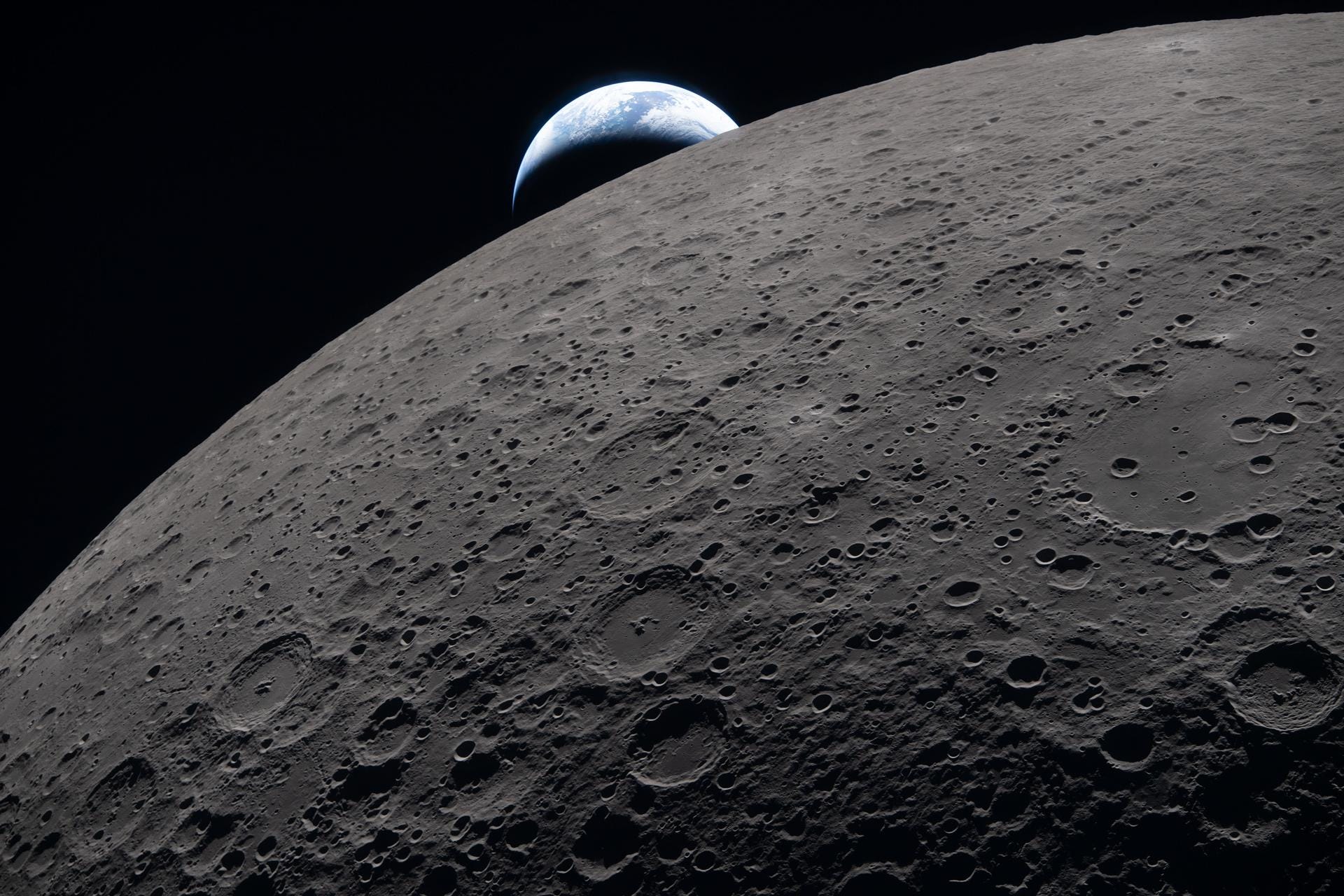
Beneath my feet, a moonscape in miniature. Here: the Lunar Highlands, there: the Sea of Tranquility, the Ocean of Storms. Except this moonscape is not made of moonrock, it is comprised of the calcareous mantle of barnacle shell—miniature mountains built upon a bed of Devonian rock. But if I squint, there is not so much difference between NASA’s new photographs of our moon’s craterous skin and this barnacle-encrusted rock. Both are full of wonder.
For my very first independent research project, as an undergraduate student, I was assigned the topic of ‘spatial patterns in animals’. This is the study of how individual animals organise themselves in geographic space. Since seeing wild killer whales off the coast of Vancouver Island the summer before, I had become enraptured (some might say obsessed) with them (I still am enraptured (obsessed) with them) and so I excitedly told my project supervisor that I’d like to work on killer whale spatial organisation. As in, I wanted to find out if killer whales swim in predictable spatial patterns. To this, he raised his eyebrows and said ‘okay’ in such a way that I understood this might be a lofty ambition. But, as all good supervisors do, he let me explore my idea, and let me come to my own understanding of its limitations.
His sceptical ‘okay’ was, of course, right on the money. There weren’t many aerial photos of killer whales available back then, and it was these that I needed in order to analyse their spatial patterns. So, I went back to the drawing board. And I don’t remember quite how the idea came, but I set my mind on looking at the spatial patterns of barnacles. Which, alas, does not sound quite as alluring as looking at killer whale spatial patterns, but, actually, I was pretty excited about the idea.
There were three reasons for this excitement.
Firstly, I’d always thought that barnacles form curious patterns on rocks (and I am speaking about acorn barnacles, here, which are ubiquitous on the British coast). But when I looked into whether we knew much about these patterns, it turned out the answer was no. And mysteries have always excited me.
Secondly, barnacles have weird lifecycles. They start life as tiny, free-swimming larvae which are released from their parent in Spring and swept out to sea. These miniscule larvae ride on ocean currents until they reach whichever coast the tide tumbles them onto. And on this coast, which can be hundreds of miles from where their parent released them, they must crawl across rocks and choose a spot in which to settle, a spot in which they will live the entirety of the rest of their lives. There is no option to move; once they are settled, they metamorphose into an adult, build their calcareous shells, and stay forever. So, a lot rests on a barnacle’s decision about where to set up home, and I don’t know, maybe I’m in the minority here, but I think there’s something fascinating about that. The stakes of it all.
And, finally, looking at barnacle spatial organisation meant I got to do fieldwork. There was no budget for fieldwork, hence why I couldn’t buy a drone and spend months taking aerial photos of killer whales, but, thankfully, asking my parents to take me to Anglesey and roping them into helping me photograph barnacles was free1. I love fieldwork, and I had a lot of fun. You’d have to ask my parents what they thought about it all (although I’m pretty sure they were happy to have an excuse to go to Anglesey, and we didn’t spend all day looking at barnacles).
I won’t go into the details of the analysis, except to say that I spent three months looking at the photographs we’d taken and painstakingly recording the exact coordinates and size of each barnacle in each photograph. Which added up to thousands and thousands of barnacles. Some days this was peaceful, meditative. Some days this was a chore, but a doable one. Some days it felt like an eccentric (and self-inflicted) form of torture. But the mystery drove me on.
The work turned into my first research paper, published in Population Ecology a decade ago. What we found is this: when barnacle larvae wash into their new coastal home, they look for other barnacles, and they snuggle up as close as they can to them (as much as a barnacle can snuggle; I imagine this to be a rather awkward and unyielding affair). They don’t need to do this. Adults can reproduce from a distance of over two centimetres apart, and yet they bunch up at the scale of millimetres. They most likely do this because being in such a close-knit group affords them various protections: from bad weather, from predators, and from having to invest too much in building thick shells (because their neighbours’ shells help to shelter them).
And maybe this is a hard sell, I don’t know, but I just love this. From miniscule larvae, rudderless in the open ocean and swept to wherever the currents take them, barnacles crawl across rocks in search of others and there, tucking much closer to the group than their basic needs suggest they should, they build their permanent home.
Basically, the patterns barnacles form are the result of needing community, and it is a much closer community than we previously thought it would be.
Every time humans have gone into space, they have spoken of the Overview Effect. This is the sense of awe and wonder that astronauts get when they see the earth from afar—its beauty, its fragility, the fact that it, this tiny blue spot floating in desolate darkness, is home to every single creature they know, all of us floating here, in the darkness, together. The Artemis astronauts, on last week’s lunar mission, spoke of the same feelings.
This scratches at something in me. I am, of course, so glad that those astronauts are feeling the Overview Effect, but I can’t help thinking: do we really need to fling ourselves around the moon to feel this? Surely we don’t need to see the entirety of the earth to understand its beauty and fragility, to put ourselves in perspective and realise we are all interconnected, to feel inspired to protect and nurture this struggling planet of ours—surely, surely, all we need to do is look, and learn about the things we are looking at, right here, right down at our feet and up in our skies.
The Artemis Programme is estimated to cost $100 billion. Imagine what else we could do with that money. Instead of inspiring a sense of fragility and interconnectedness in the handful of humans who have the opportunity to go to space, we could inspire millions of people to feel the Overview Effect right here on earth. But we don’t have to wait for hefty financial investment into environmental education (investment I fear will never come)—I mean, sure, it would help, but we can all do our bit towards nurturing the Overview Effect at a scale that is within everyone’s reach. All it takes is sharing wonder with anyone who will listen. Sharing the beauty of a feather or a flower or a barnacle-encrusted rock. A rock that, if you squint, looks a little bit like the surface of the moon. A rock that harbours one hundred alien lives who were once floating in the wild open ocean, and who were thrust here, onto this piece of land, and who found community here, and safety, and a little spot to call home.
A quick note to say that for the next little while I will be sending a newsletter fortnightly rather than weekly. I’m currently working on my second novel and I’m at the (delicious, frustrating, all-consuming) point of being so far inside the world of that book that climbing out in order to write anything else is becoming a challenge! So, for a short while, I’ll be focussing on the novel, and appearing in your inbox every other Sunday rather than every week.
Thanks, as always, for being here!
Rebecca x
If you enjoy my work, you might like to pre-order my debut novel, These Glass Bodies.
‘An absorbing, unmissable and moving debut novel of love, disconnected people and our fragile relationship with the natural world’
You can also support my work by becoming a free or paid subscriber, or leaving a tip. All my posts are free, and paid subscribers (thank you thank you!) allow me to keep it this way.
If you’d like to become a founding member, you’ll receive an original watercolour painting. Currently I’m working on sea-swimming selkie women, but the odd whale is springing into life, too.
And two years later, I was working with killer whales (it was worth the wait!).
Comments
Nothing yet. Say the first thing.
Sign in to join the conversation.