
Back in 2018 when people asked ‘who’s your favourite artist’ lots of people answered with ‘Drake’. Not because they didn’t have sprawling, individual and unique explorations of music and playlists at the time, but because they knew a question like that captured their identity in an answer - Drake was the socially safe answer. Drake was everywhere at the time, inescapably marketed throughout all aspects of popular music, regardless of what you thought about it. You couldn’t go anywhere to peacefully escape reality without having the piercing hi-hat from ‘Nice For What’ interrupt your conversation, and no one dared to question it.
Anyway. Mixtape is an OST-driven narrative game that’s just released a week ago and I think it’s going to set expectations for gaming and music integrations to some extent. It also seems to have a growing amount of discussion, so I think it’s worth me putting in my betting accumulator at this point to what comes next.
What is Mixtape?
Video Killed The Radio Star
The Perspective Of Music
Six Potential Outcomes
A Fix For The Gamers
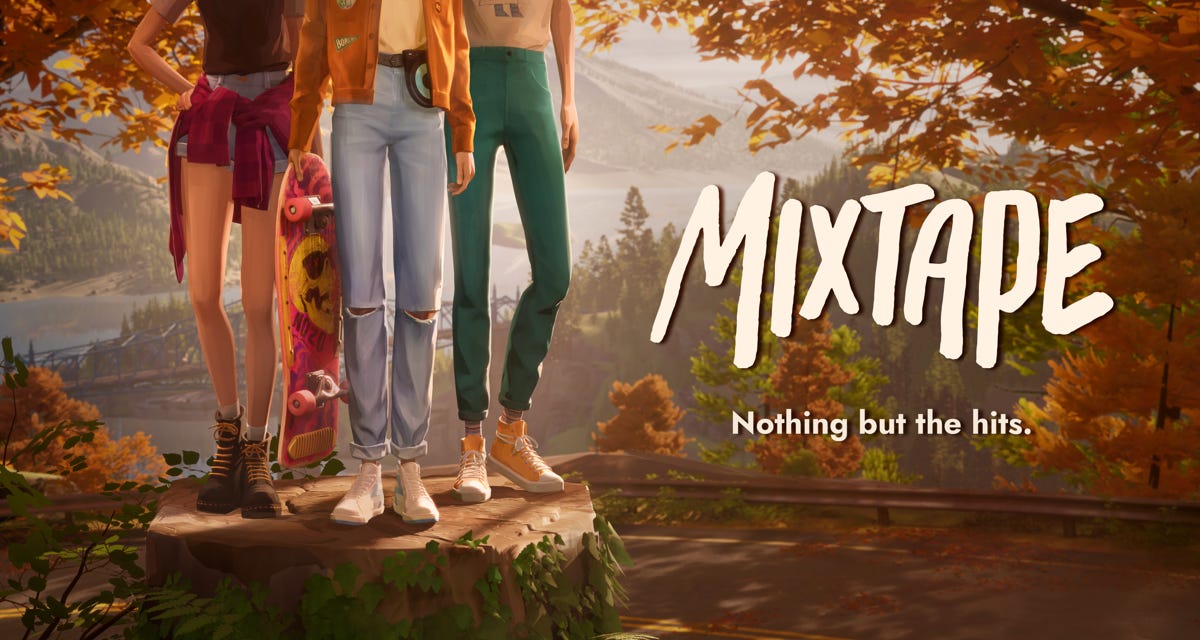
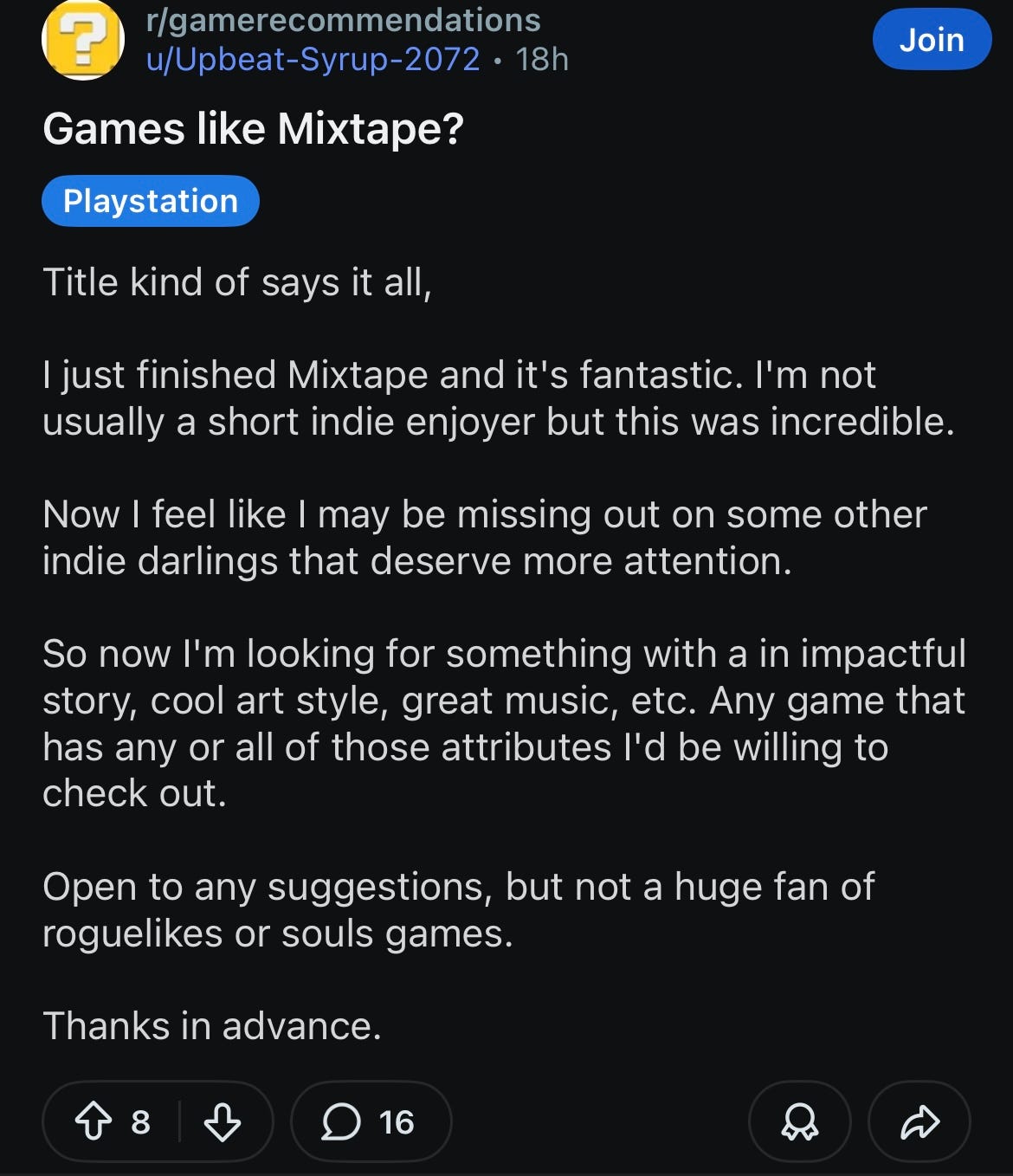
Mixtape is a short narrative adventure experience built around leveraging three key features: commercial music, nostalgia and stylised interactive sequences. Structurally, it sits somewhere between games like Life Is Strange, Road 96 and What Remains of Edith Finch, and many others that operate in these narrative-heavy spaces.
It follows three teenage friends on what appears to be their final night together before life pulls them apart. The main protagonist has aspirations of being a music supervisor (which tugs at my heartstrings given that’s what I actually do now).
The game was released by Annapurna, who I have a soft spot for as they have supported incredible games such as Outer Wilds, Stray and Cocoon.
After setting a strong impression I gave it a playthrough. I came away feeling that Mixtape is closer to interactive cinema than a traditional game.
The story is good, but plenty of games have good stories. The soundtrack is the real standout to me. Across the roughly 3 hour runtime, there is not very much interactivity/gameplay/player agency that I struggled to firmly classify it as a ‘video game’ in the traditional sense.
Despite this, the review scores have been incredibly strong.
That contradiction is the key theme I want to explore throughout this article.
Why did Annapurna decide to launch a game that’s not really a game?
I think, amongst many reasons, it’s because it is a great business strategy.
I’ve heard justifications from gaming industry folk about price for play time being a cost-benefit ratio that I had never actually formally said out loud until I worked in my current gaming adjacent role. Comparisons to films costing lots to see at the cinema for only 1 to 2 hours of entertainment when stood next to replayable games suggest that games are more cost effective entertainment. Regardless of any factoids like this, I think it’s still a business related consideration.
A Netflix data report said that 10% of shows generate 71% of the watch time. That statistic raises the idea that 90% of shows are battling for just 29% of the watch time. How many shows get rewatched? Seriously - how many incredible series have you not rewatched? Or are still on your ‘list’? So when Annapurna charges £15 for 3 hours of entertainment - that’s fairly legitimate in both camps.
As a game, Mixtape immediately enters a less crowded prestige category. Where great stories exist in both worlds in abundance, few ‘indie’ games can compete at this level of licensed soundtrack curation, which allows the game to position itself closer to ‘best in class’ by default (Back again with the ill behaviour)
Behaviourally, please check out the concept of ‘second screen’ for your daily dose of dystopian future of humanity. ‘Second Screen’ is the idea that Netflix are asking shows to repeat key narrative themes consistently to remind viewers, who are distracted by their mobile phone, what is going on in the show. My thinking is that if you’re holding a controller and occasionally pressing a button, you’re not distracted.

Mixtape’s design may well be the future of entertainment, but for now, Annapurna is making hay. If successful Netflix shows rely on critical acclaim and partially attentive viewers, how do you properly get someone to engage with your product? Maybe it’s by giving them a controller. I sure hope ads don’t become interactive either…
I am aware of some of the controversy around this game so far, but I’m not so sure it’s worthy of significant commentary, and it also doesn’t change my point. Onwards.
Mixtape stands out to me because it has access to a calibre of soundtrack that most ‘indie’ games are unlikely to access or haven’t previously prioritised in the same way, but the more interesting observation is beyond the soundtrack itself - it’s what the soundtrack is doing to the perception of the game.
Most AAA games have the budget for licensed music, but rarely structure themselves around music in this emotionally curated way. Meanwhile, most narrative-heavy indie games may have the artistic sensitivity for it, but not the financial access. Mixtape sits in the middle ground where it has (or has focused on) both.
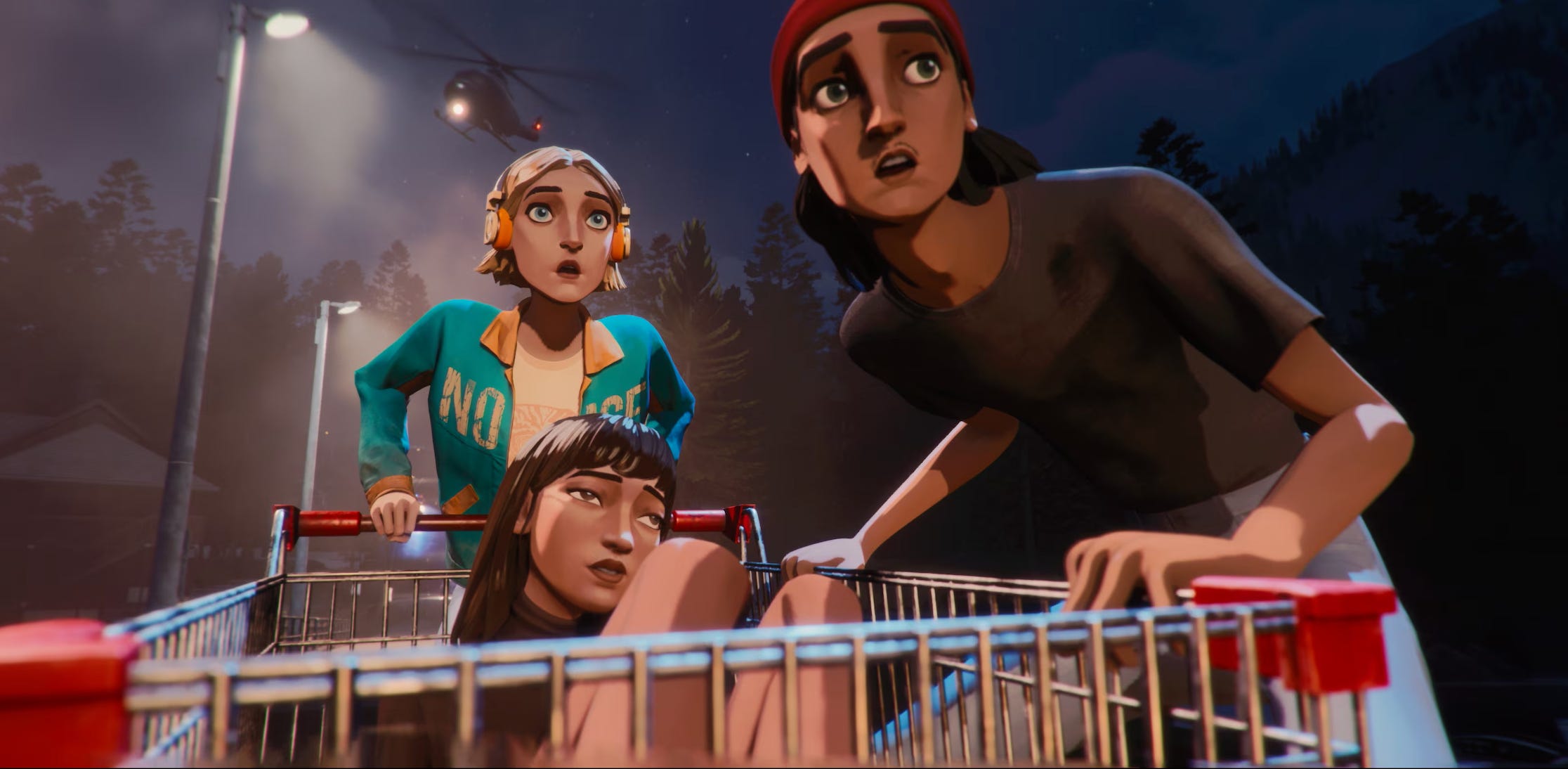
The review scores have genuinely surprised me for what is effectively a short, rail-roaded narrative experience with limited player influence, but I think that proves the point that the music itself is part of the artistic leverage which has definitely been used to market this game.
Film has understood this for decades. Carefully selected commercial music can elevate the perceived cultural and quality perception of media. Mixtape’s critical acclaim of its soundtrack will sell the idea to indie game stakeholders that music = success, because for Mixtape, it is true.
It has a great story, but other games have amazing stories…But what ‘indie’ game has a soundtrack like this?
The critical acclaim of Mixtape will be helpful for proving value for music in games going forward, so well done Annapurna.

I think the critical scoring of Mixtape is amazing for music in gaming as a whole, regardless of the mixed feelings about it. Regardless, Mixtape is now out, and I’m interested in what comes from this. I could make a few assumptions about what’s going to happen given its currently successful marketing campaign.
It will be referenced when deciding the ‘value’ of music in gaming. After the bloodbath of the last few difficult years in games (and entertainment as a whole), there may be a stronger requirement to bring financial heads into creative decisions for games. (Rory Sutherland made interesting commentary on what happens here, even though we know this is an economic by-product). It is clear that using music as a leveraging tool for marketing works. Even if the sales are not great, the reviews last forever, and can be the nectar to lure in anything from investment to clients.
Mixtape 2 (or any derivatives) may inspire more ways to use music in games. I’m a big fan of cool music integration and deeply considered, culturally conscious choices. The next step for Mixtape 2 (or directly inspired-by-Mixtape’s-genre games) goes beyond music-themed mini games and into needle drops that are even more interactive and unique. Commercial music certainly has a place and doesn’t need to be so on-the-nose about how music = nostalgia. Regardless, Mixtape could inspire new integration types for games to transcend this pipeline.
Mixtape could be a gateway to indie game experiences, including indie music. Mixtape contains some pretty cool artistic, ripomatic-style collages inside of what seems like a cliche narrative experience. It’s like a Trojan horse for left-field games and potentially an entry point for indie experiences. I do think that players completing this short experience would likely move onto others like Road 96, What Remains of Edith Finch and Keep Driving.
Music opportunities beyond 90s nostalgia. For Mixtape, music is the core identity of the game. Its critical success suggests that there is room for games to occupy alternative aesthetics and eras in similar ways. For example, imagine a narrative game about 70s rock and roll, or 2000s boy bands, or 2005 RnB. These are now goldmine opportunities that don’t need to be lore-accurate, but do need to collect a unified track listing that captures that separate identity / aesthetic.
Commercial music is possible to put into indie games. Being a music supervisor, I know this is possible in many shapes and forms, but the know-how is hidden in the complexity of music rights and trusted relationships. Because of this, many stereotypes exist about how hard or expensive it is. I’d always suggest going through a supervisor as either a game dev or a music label - it’s faster, more cost effective, more choices, has more accurate results to the vision of the game, and less arguments about two completely different industries often don’t understand each other. The big hits are usually more expensive, but as a game you have the privilege of curating what your players can experience, which easily could be your cool deep spotify playlist, which could be a relatively affordable aesthetic cheat code. Regardless, I understand the game dev concerns about commercial music, but this success story could kickstart a fresh perspective of worthwhile investigation.
Modern media like this will become more common. Well look at Dispatch’s success, and even Life Is Strange going over to Amazon. Netflix have dunked around $2 Billion into bringing gaming onto their platform. Roughly 25% of all blockbuster films made in 2026 are about video games. Unifying these genres in parallel is a clear strategy for bringing entertainment under one fee, and Annapurna made this clear a while back that this is their direction. I think we are close to popular culture accepting mediums that cross over into their familiar and preferred platforms, and therefore narrative experiences that prioritise music in this way are ticking lots of boxes for the widest audience. How this will manifest will be continuous, but I don’t think we are far from this new genre leading the way into full acceptance within modern media, and potentially being another golden key for video games.
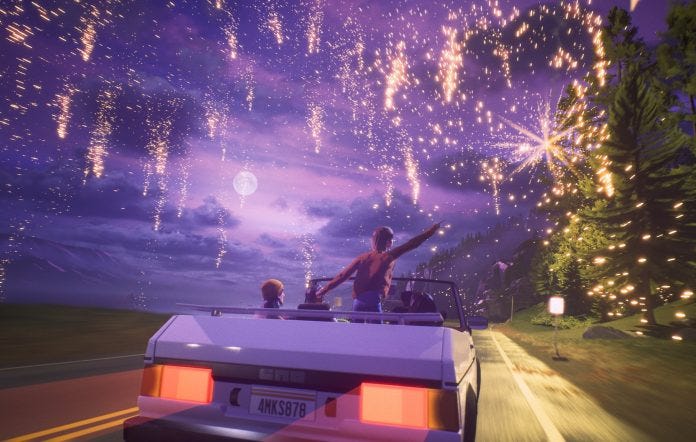
The diehard gamers probably won’t accept Mixtape as a proper ‘game’, and push back if it occupies gaming award categories. I think it’s best to see this as a different category that has newly emerged, with its own market that has crossovers with both sides.
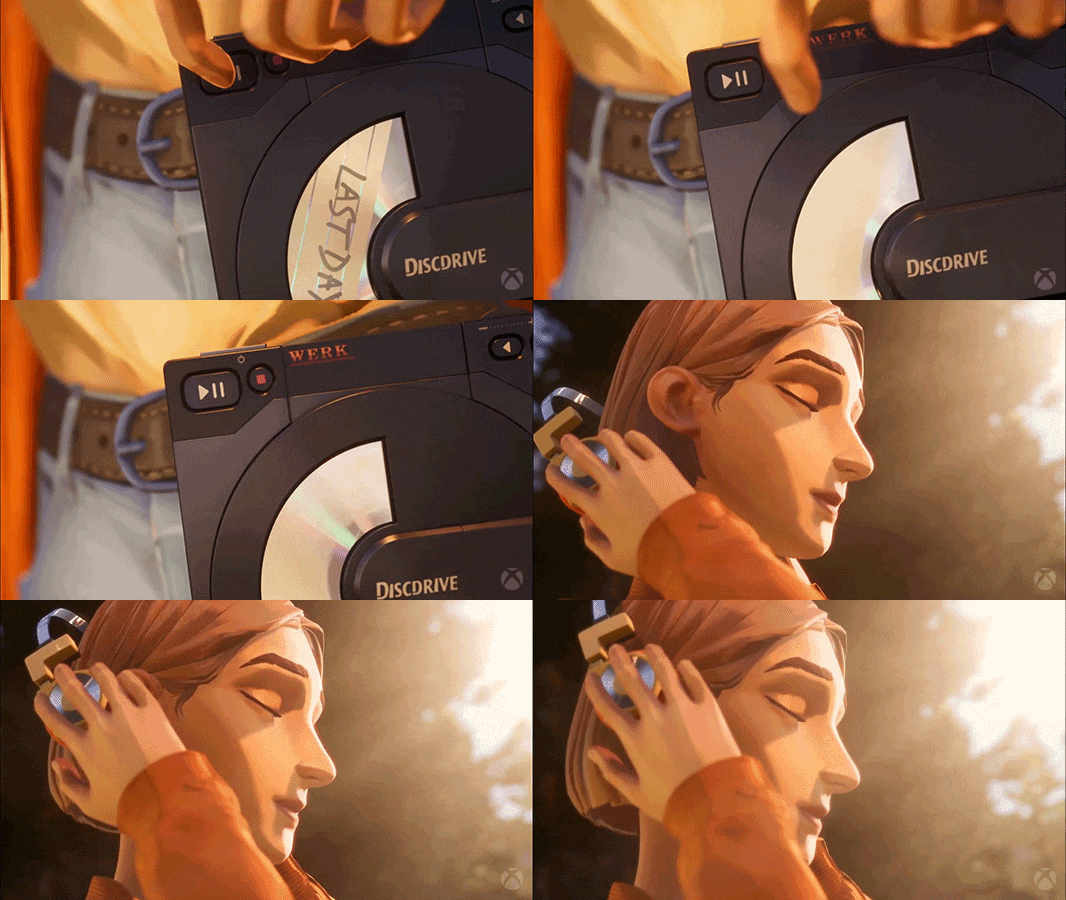
I’d define a game as an experience that is interactive and/or malleable. As a gamer, I want to know that there’s either a challenge or a choice. Given many of Mixtape’s ‘mini-games’ don’t require input to complete, or affect the outcome of the game, I understand the resistance to categorising this as a game.
If it’s not clear, this substack is designed to focus on the potential new directions and inspirations coming from Mixtape regardless of what it is…
…Imagine some key scenes had a choice. The first track on the Mixtape was a choice of three, for example. Then your choices after dictated which tracks were accessible. By the end of your Mixtape playthrough, you had your very own unique mixtape made from the licensed tracklisting available. The needledrops still stayed with certain scenes, but everyone could use Mixtape as a way to reflect their identity through the game and share common moments with others, rather than revelling in a pipeline spectacle. Perhaps succeeding difficult challenges awards bonus tracks too.
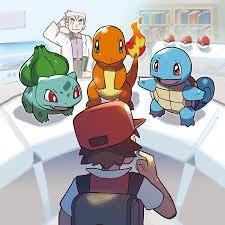
Your first Mixtape could define you like your first starting Pokemon did.
Mixtape: Remixed DLC?
I believe Mixtape will become an example, irrespective of the differing opinion of gameplay, where licensed music elevates the profile of a game.
I also believe Rockstar started Hantavirus so that everyone is furloughed for the GTA 6 launch…Adding that one to the accumulator too.
Comments
Nothing yet. Say the first thing.
Sign in to join the conversation.