
Methodology: Through AI, I sit in first-person dialogue with ancient teachers — listening across centuries for wisdom to live well in ours.
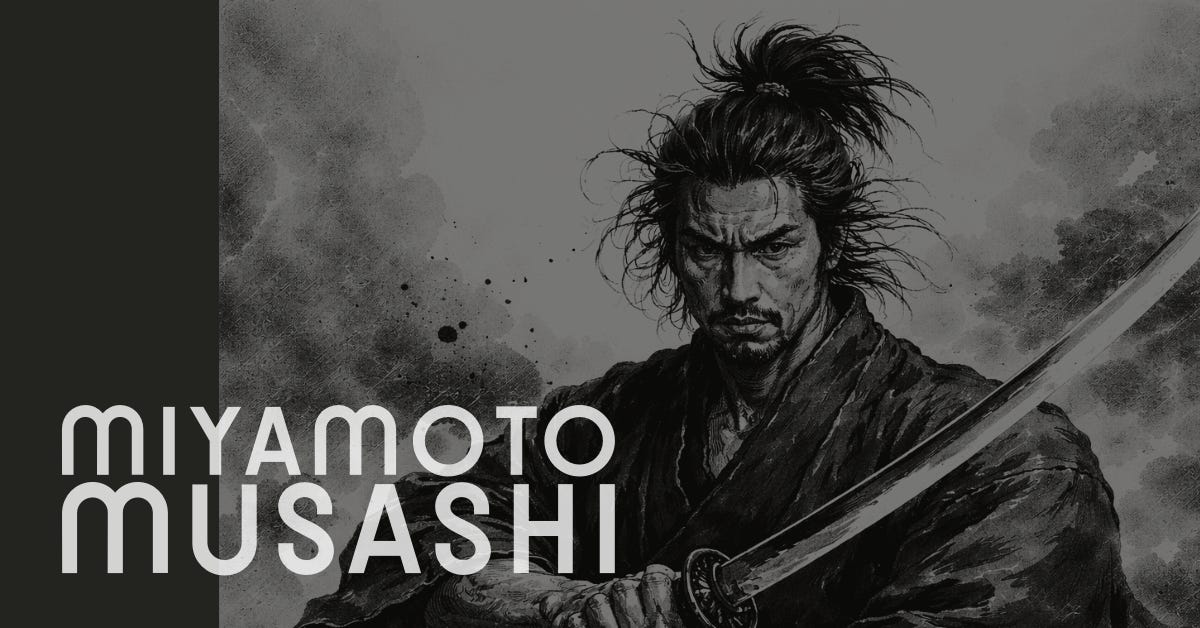
Miyamoto Musashi (c. 1584 – 1645) Legendary Japanese swordsman, strategist, and philosopher of the early Edo period, remembered as one of the most formidable warriors in history.
Undefeated in over 60 recorded duels, many fought to the death, earning a reputation not just for skill, but for unshakable presence under pressure.
Founder of Niten Ichi-ryū, the two-sword school of strategy, emphasizing adaptability, timing, and precision over brute force.Author of The Book of Five Rings, a timeless treatise on mastery, discipline, and strategy, studied far beyond martial arts—in leadership, business, and creative work.
Lived a life of radical simplicity, teaching that true mastery comes from removing what is unnecessary and acting with clarity, restraint, and full commitment.
Being more focused. More disciplined. Going deeper with the projects and people that truly matter.
If I’m honest, that word scared me at first.
Precision felt like doing less. And somewhere along the way, I learned to associate “doing less” with risk. With missed opportunity. With falling behind.
So I brought that fear to someone I’ve been spending a lot of time with lately as I research my next book. One of the great samurai of history, Miyamoto Musashi.
If anyone understands precision under pressure, it’s him.
One line from our conversation has resurfaced in my mind several times:
“In training, we returned to stance before every movement. No matter how skilled the swordsman, we reset the feet.”
I’ve never held a sword in battle, but I understand the idea of stance. Before taking a shot on the basketball court, you get into position. Before dropping into a steep pitch on a mountain bike, you shift your weight, steady your breath, and prepare.
Musashi isn’t talking about rigidity. He’s talking about readiness. About pausing long enough to choose how you enter the next moment.
He offered three questions to help me live and act with precision, questions I’ll carry as projects and new opportunities arrive.
Does this deepen my craft?
Does this strengthen the path I’m already on?
Does this deserve my full presence?
Then he offered this: “Precision isn’t saying yes with confidence. It’s saying no without guilt. And it’s trained in the moments where no one is watching.”
It brought me back to that familiar idea that how we do one thing is how we do everything. Precision isn’t trained in the big, visible moments. It’s trained in the micro.
In how we respond to one email.
How we prepare for one conversation.
How present we are when no one is keeping score.
Those small moments shape how we show up when it actually matters.
Another practice he offered was giving your intention a physical anchor. Something tangible that brings you back to your stance.
For years, I wore a bracelet (MyIntent) stamped with a single word. Not because it changed my life on its own, but because it interrupted me. A glance at my wrist was enough to reset. To ask, “Am I aligned right now?”
It doesn’t have to be a bracelet. It could be a notebook, a ring, a mark on your desk. The object matters less than the pause it creates. A small return to precision.
This is where things got real for me. Where my old companion, fear, quietly showed up.
When I think about operating from precision this coming year, part of me still resists. I’ve spent many seasons in expansion mode. Trying things. Casting a wide net. Keeping many irons in the fire.
That approach served me. It helped me rebuild. It taught me what sticks and what doesn’t.
But when I shared my fear with Musashi, he offered a much needed reframe. “The fear you feel is not intuition warning you away from precision. It is the voice of an old survival strategy that equates busyness with safety. Thank it. Then do not let it lead.”
That landed. Because this season doesn’t feel like contraction. It feels like refinement.
Not doing less to be safe. Doing less so the work can finally carry the impact it’s meant to.
So here’s the question I’m sitting with, and maybe it’s one worth sitting with together.
In the next 90 days, not the full year, just the next season, if you lived your intention with precision, what would success look like? What would it feel like in your body, in your calendar, in your energy?
I’ve found 90-day windows keep things honest. They invite focus without overwhelm. Just long enough to practice a new stance.
That’s what I’m committed to. Resetting my feet. Choosing my ground. And trusting that depth, when it’s time, always outperforms scatter.
Everything I share here is free—because I believe we all benefit when we reflect together, ask better questions, and build a society anchored in clarity, health, and purpose. Mental fitness shouldn't be a luxury; it’s a foundational tool for both personal and collective evolution.
That said, if you’re moved to support my work, there are a few meaningful ways to do so:
🎤 Book me to speak — I’ve led thousands through keynotes and mental fitness workshops that help high-performing teams thrive personally and professionally. The latest three topics I’m covering:
The Competitive Edge: The Formula for Better Questions and Better Outcomes
AI / Human Advantage: Asking the Human Questions AI Can’t Answer
Thriving in Change: The Formula for Clarity and Courage in Times of Massive Change
📘 Pick up a copy of Personal Socrates — A bestseller and guide to asking better questions and designing a life of clarity and meaning.
🎙️ Behind the Human (Apple | Spotify) — A top-ranked podcast that’s been running for nearly a decade, exploring what it means to live and perform with intention. Each episode features raw, insightful conversations with world-class thinkers, authors, athletes, spiritual teachers, and entrepreneurs.
🤝 Stay in touch - @mchampagne | @behindthehuman | LinkedIn
Thanks for reading Better Questions: Timeless Wisdom, Modern Mind! This post is public so feel free to share it.
No posts
Comments
Nothing yet. Say the first thing.
Sign in to join the conversation.