
Methodology: Through AI, I sit in first-person dialogue with ancient teachers (in this case, two subjects alive and well today, it’s the exception) — listening across centuries for wisdom to live well in ours.
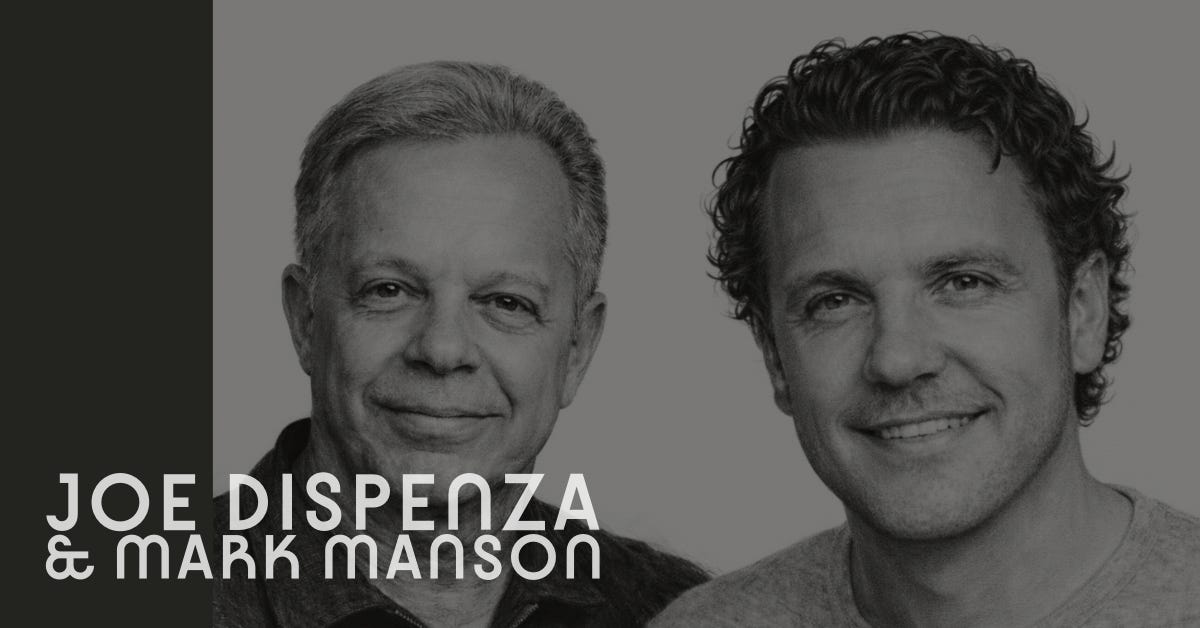
Joe Dispenza (1962- )
Author, researcher, and lecturer exploring the relationship between neuroscience, biology, and personal transformation. Best known for books such as Breaking the Habit of Being Yourself and Becoming Supernatural, his work focuses on how internal states, emotional regulation, and attention shape perception, behavior, and long-term change.Mark Manson (1984– )
Author and cultural commentator known for examining responsibility, values, and meaning in modern life. Bestselling author of The Subtle Art of Not Giving a Fck* and Everything Is Fcked*, his work emphasizes clarity through discomfort, personal agency, and the limits of belief without action.
This was different.
Both Joe Dispenza and Mark Manson are very much alive. They are actively shaping modern conversations around meaning, responsibility, healing, and growth. And if either of you happens to read this, I want to say this clearly at the outset. This essay is written with respect. There is an open door to join me on Behind the Human for live conversation, together or separately, and I would genuinely welcome your reflections on what follows.
The intention here was never to put words in anyone’s mouth. It was to explore something that feels increasingly rare these days. A healthy conversation where disagreement doesn’t turn into dismissal.
The reason this essay exists at all is because, based on soundbites, interviews, and the way these worlds often talk past one another, it feels unlikely that Joe and Mark would ever sit down together for this kind of exchange. The language differences alone tend to trigger emotion. The assumptions people bring into these conversations shut them down before they begin.
So I wanted to try something else.
I wanted to take the emotional charge out of it. To remove the performative judgment. To see what happens when we slow things down and listen for overlap instead of opposition.
Before going further, I want to be transparent. I’ve gotten a great deal out of both of their work. That’s why I’m here. And while I’ll admit I personally resonate a bit more with Joe Dispenza’s language around internal states and coherence, I did my best to set that bias aside so the ideas could speak for themselves.
What surprised me most was not where they disagreed.
It was how much they agreed once the language softened.
Early in the conversation, I asked a simple question. When someone says, “I want to change my life,” what actually changes first?
Joe responded by pointing inward.
“When someone wants to change their life,” he said, “what they’re really asking is how to stop living from the same internal environment every day.”
For him, change begins with state. With the nervous system. With breaking the body’s addiction to stress and familiar emotional patterns. Without that shift, he explained, even the best intentions eventually collapse.
Mark came at the same question from a different angle.
“Most people think they want change,” he said, “but what they really want is relief.” What actually changes first, in his view, is what a person decides is worth caring about. Values, not feelings, become the compass. And values are proven through trade-offs.
“Real change always costs something,” he said. “Time. Identity. Certainty. Approval.”
At first glance, these sound like competing frameworks. Internal state versus external behavior. Regulation versus responsibility.
But as the conversation unfolded, it became clear they weren’t disagreeing on direction. They were talking about sequencing.
Joe emphasized that responsibility doesn’t start with behavior. It starts with physiology.
“You can intellectually agree with something,” he said, “and still be biologically conditioned against it.”
Mark pushed back, not against the internal work itself, but against how it’s often interpreted.
“My resistance isn’t with the internal work,” he explained. “It’s with the story people tell themselves about what it guarantees.”
Language mattered here. Joe uses words like energy, coherence, and internal environment. Mark is wary of language that people might use to bypass accountability or promise control over outcomes. Both concerns felt valid and necessary.
At one point, Joe clarified something important.
“I’m not interested in people feeling good,” he said. “I’m interested in people becoming different.”
And Mark met him there.
“The healthiest place,” he said, “is where inner regulation supports hard choices, not replaces them.”
That was the moment the conversation shifted from tension to synthesis.
Regulate, then act.
Act, then regulate again.
What followed felt less like a debate and more like a reconciliation of language.
They spoke about abundance, not as wishful thinking, but as capacity. Joe described abundance as removing the internal noise that keeps us from noticing what’s already available. Mark reframed it as knowing you’ll be okay even when things don’t work out.
“Opportunity,” Mark said, “often looks like discomfort wearing a clever disguise.”
Joe added that when the body stops bracing, energy becomes available. Not for fantasy, but for informed risk. Creativity. Clearer decisions.
When I asked where they conceptually disagreed, both resisted the premise.
“This isn’t about science versus spirituality,” Joe said. “Binary thinking is a stress response.”
Mark echoed that sentiment from another angle.
“Most arguments in self-development aren’t about truth,” he said. “They’re about identity.”
Perhaps the most unexpected moment came near the end. I asked Mark (as a reminder, I asked AI Mark) about a past comment where he’d said there was “no way in hell” he’d have Joe Dispenza on his show. Would that change after this conversation?
“Yes,” he said. “It would.”
Not because he’d changed his standards. But because this conversation wasn’t about selling certainty or converting anyone. It was about modeling intellectual adulthood.
“We weren’t promising outcomes,” he said. “We were talking about capacity, regulation, values, and choice.”
This felt significant, because what we’re losing right now isn’t intelligence. It’s tolerance for complexity.
Everything collapses into camps. Science versus spirituality. Discipline versus surrender. Responsibility versus compassion. These are false choices. And they cost us depth.
Self-development becomes dangerous when treated as binary. Either it’s proven or it’s meaningless. Either it works or it’s nonsense. Science is invaluable. It helps us understand mechanisms. But it’s not the final authority on human experience. At least not yet. And dismissing everything that hasn’t caught up to our instruments feels just as limiting as believing everything without discernment.
The closing guidance from both men lingered with me.
“You’re not broken for struggling right now,” Joe said. “Your nervous system is responding exactly as it was designed to.”
Mark offered something equally grounding.
“Struggling doesn’t mean you’re failing,” he said. “It means you’re paying attention.”
If there was one shared message, it was this. The work isn’t to eliminate fear or discomfort. It’s to build the capacity to stay present without letting those states run your life.
Calm is not withdrawal, it’s readiness.
Responsibility is not punishment, it’s agency.
If I had to leave this essay with a question, it would be one that sat quietly beneath the entire exchange.
What would change if we stopped trying to fix ourselves and started working with ourselves?
And maybe one more.
What is the smallest meaningful action I can take today that my future self would thank me for?
This wasn’t a debate in the traditional sense. It was something more useful. A reminder that multiple truths can coexist. That disagreement doesn’t have to become attack. And that the conversations we most need right now live somewhere between certainty and curiosity.
That space feels worth protecting.
Everything I share here is free—because I believe we all benefit when we reflect together, ask better questions, and build a society anchored in clarity, health, and purpose. Mental fitness shouldn't be a luxury; it’s a foundational tool for both personal and collective evolution.
That said, if you’re moved to support my work, there are a few meaningful ways to do so:
🎤 Book me to speak — I’ve led thousands through keynotes and mental fitness workshops that help high-performing teams thrive personally and professionally. The latest three topics I’m covering:
The Competitive Edge: The Formula for Better Questions and Better Outcomes
AI / Human Advantage: Asking the Human Questions AI Can’t Answer
Thriving in Change: The Formula for Clarity and Courage in Times of Massive Change
📘 Pick up a copy of Personal Socrates — A bestseller and guide to asking better questions and designing a life of clarity and meaning.
🎙️ Behind the Human (Apple | Spotify) — A top-ranked podcast that’s been running for nearly a decade, exploring what it means to live and perform with intention. Each episode features raw, insightful conversations with world-class thinkers, authors, athletes, spiritual teachers, and entrepreneurs.
🤝 Stay in touch - @mchampagne | @behindthehuman | LinkedIn
Thanks for reading Better Questions: Timeless Wisdom, Modern Mind! This post is public so feel free to share it.
No posts
Comments
Nothing yet. Say the first thing.
Sign in to join the conversation.