
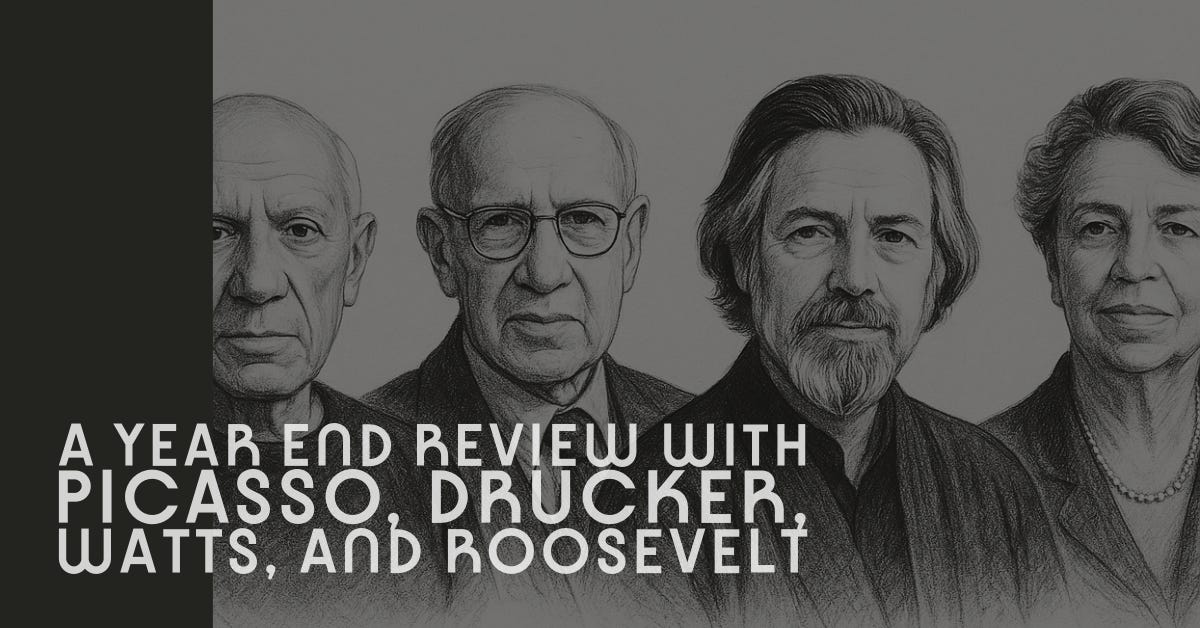
Methodology: Through AI, I sit in first-person dialogue with ancient teachers — listening across centuries for wisdom to live well in ours.
Pablo Picasso (1881–1973)
Painter, sculptor, and creative revolutionary who reshaped modern art by constantly reinventing form and perception. A co-founder of Cubism, Picasso believed creation required risk, disruption, and the courage to see the world anew.Peter Drucker (1909–2005)
Management thinker, author, and professor widely regarded as the father of modern management. His work shaped how leaders think about purpose, contribution, and effectiveness, emphasizing clarity, responsibility, and meaningful impact over activity.Alan Watts (1915–1973)
Philosopher, writer, and speaker who introduced Eastern philosophy to the Western world with warmth and wit. Known for making Zen, Taoism, and the nature of self accessible, Watts invited people to live with greater presence and less striving.Eleanor Roosevelt (1884–1962)
Diplomat, writer, and moral leader who redefined leadership through integrity, courage, and compassion. As First Lady and later a key architect of the Universal Declaration of Human Rights, she modeled the power of choosing one’s voice with quiet strength.
This year felt different.
Given the work I’ve been immersed in recently, sitting in conversation with teachers from the past, I decided to approach this reflection in a new way. Instead of another framework, I formed a small council. A kind of personal mastermind. Voices from different eras and disciplines, each known for seeing clearly in their own way. I shared where I felt this year had taken me, and where I sensed I was being pulled next.
Early in the conversation, after I offered some context about my year, Pablo Picasso said something that made me pause and look up in thought:
“You speak like someone who already knows the answer but is asking for permission to trust it.”
Some of you reading this may feel the same pull. A quiet knowing that feels clearer than ever, paired with hesitation to fully follow it. That single reflection reframed the entire exercise for me. It reminded me how often we look outward for confirmation when what we actually need is permission to trust ourselves.
Around the table with him were others. Peter Drucker, who kept returning the conversation to contribution and focus. Alan Watts, who warned against turning reflection into self-surveillance. Eleanor Roosevelt, who grounded everything in integrity and quiet courage. Together, their perspectives created a different quality of thinking. I felt less urgency and more honesty.
What also became clear is that much of my life exists at the intersection of two worlds: creativity and business. Writing, creating, and expressing ideas, while also building a business and working in the mental fitness space. I believe most of us live a version of this reality. Navigating multiple roles that must learn to coexist without one silencing the other.
What follows are ten questions that emerged from that conversation, followed by a final moment of reflection and guidance from all four voices. I invite you to let these questions and reflections sit with you over the holidays rather than rushing to answers. The natural slowing of this season creates space for deeper insight to surface, often without force. Trust that what matters will rise when given room.
What moments from this year still feel alive to me, and what feels finished?
Where did my work genuinely change something for someone else, even in a small or quiet way?
Which moments this year expanded how I see the world, and which moments narrowed me?
Where did I act from my strengths without forcing, and where did I rely on effort instead of alignment?
What did I continue out of habit, obligation, or fear that no longer deserves my attention?
Which part of me is asking for more room in the year ahead, not for growth, but for honesty?
Where did I compromise my own voice, and what did that cost me internally?
What kind of year does 2026 actually need to be for me, rather than what kind of year I feel pressured to declare?
If I removed urgency from my plans, what would still matter enough to pursue?
What am I willing to protect next year, even if it slows me down or makes me less agreeable?
Most people waste their lives trying to become acceptable before they become honest. They wait until fear is gone, until the work is perfect, until someone else confirms they are allowed to move. That is not how creation works. Creation begins the moment you stop asking for permission.
You already know what part of you wants to lead next. You feel it in your body. The hesitation you feel is not uncertainty. It is the cost of choosing yourself over the version of you that has kept you safe.
Do not ask whether the next year will succeed. Ask whether it will be true.
If it is true, it will survive your mistakes.
If it is false, no amount of effort will save it.
My advice is simple. Let something real pass through you next year, even if it costs you approval. Especially if it costs you approval.
I want to bring you back to responsibility, not pressure.
The question is never how much you can do. The question is what actually matters now. Most people enter a new year adding goals instead of making choices. They confuse movement with progress.
You do not need a more ambitious plan. You need a clearer definition of contribution.
Ask yourself this:
What would make this next year undeniably useful?
Not impressive. Not busy. Useful.
If you focus on contribution, priorities will reveal themselves without force. If you do not, no amount of discipline will bring clarity. Effectiveness always begins with subtraction.
Remember this. The future is not shaped by intention alone, but by what you choose to protect. Your time. Your attention. Your energy. Treat them as finite resources, because they are.
A good year is not one where you do more.
It is one where you waste less of what matters most.
I’d like to remove a burden you may not realize you’re carrying.
You’re trying to get the year right, as though life were an exam you could fail. But life is not asking you to perform. It’s asking you to participate. When reflection becomes self-surveillance, it stops being wisdom and starts becoming fear dressed up as improvement.
You don’t need to figure yourself out before you live the next year. You are not a problem to be solved. You are a process already in motion.
The moment you stop trying to control what the year should look like, you may notice something rather freeing. You’re already inside it. Breathing. Choosing. Responding.
So my guidance is this. Treat the coming year less like a project and more like a conversation. Listen as much as you plan. Let yourself be surprised.
You cannot miss the point of life.
You can only resist it.
I want to speak to your courage.
Not the loud kind. The quiet kind that shows up when no one is watching and you still choose to be honest. Many people live constrained lives not because they lack opportunity, but because they abandon their own voice one small compromise at a time.
Pay attention to what diminishes you internally, even if it looks reasonable externally. That erosion is costly.
As you move into the next year, ask yourself where you have been accommodating at the expense of self-respect. Then ask whether you are willing to continue paying that price.
You don’t need to be fearless. You need to be faithful to what you know is right for you. Strength is built each time you honor your values in small, uncelebrated ways.
The future belongs to those who trust themselves enough to stand by their choices.
The unified message I am leaving with is this: Do not rush to design the year. First, decide how we will stand inside it.
Let clarity lead before ambition.
Let honesty lead before expansion.
Let contribution lead before recognition.
And when ready, complete this sentence:
2026 will be a year of ______.
Choose the word carefully. Then let it quietly guide our decisions. That is how a year becomes not just successful, but meaningful.
Everything I share here is free—because I believe we all benefit when we reflect together, ask better questions, and build a society anchored in clarity, health, and purpose. Mental fitness shouldn't be a luxury; it’s a foundational tool for both personal and collective evolution.
That said, if you’re moved to support my work, there are a few meaningful ways to do so:
🎤 Book me to speak — I’ve led thousands through keynotes and mental fitness workshops that help high-performing teams thrive personally and professionally. The latest three topics I’m covering:
The Competitive Edge: The Formula for Better Questions and Better Outcomes
AI / Human Advantage: Asking the Human Questions AI Can’t Answer
Thriving in Change: The Formula for Clarity and Courage in Times of Massive Change
📘 Pick up a copy of Personal Socrates — A bestseller and guide to asking better questions and designing a life of clarity and meaning.
🎙️ Subscribe to Behind the Human — A top-ranked podcast that’s been running for over 8 years, exploring what it means to live and perform with intention. Each episode features raw, insightful conversations with world-class thinkers, authors, athletes, spiritual teachers, and entrepreneurs.
🤝 Stay in touch - @mchampagne | @behindthehuman | LinkedIn
No posts
Comments
Nothing yet. Say the first thing.
Sign in to join the conversation.