
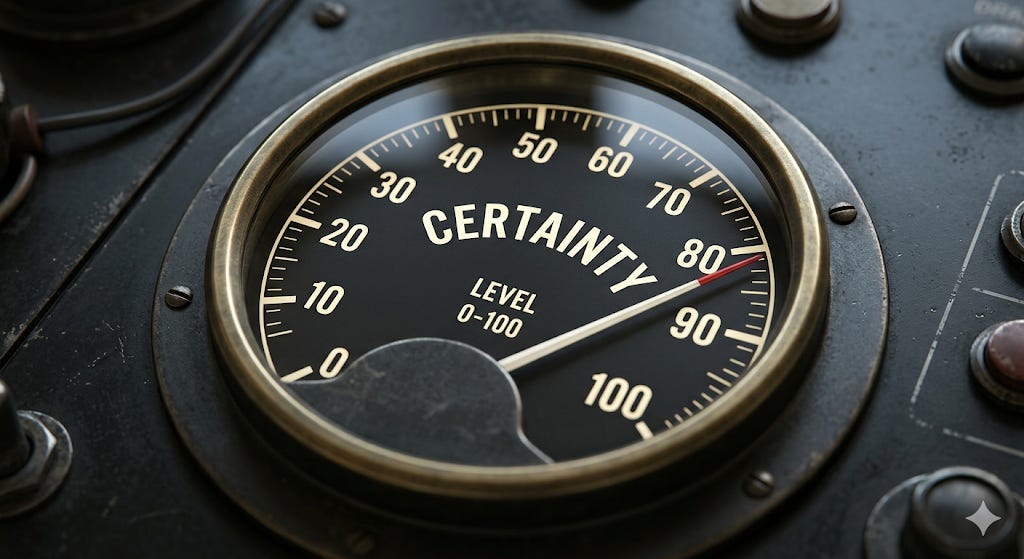
I’ve been a news junkie since I was a little kid. I credit it entirely to being dropped off at my babysitter, Bev’s, house early dawn by my hardworking, loving parents, and the only thing on TV at that hour being the news. I didn’t choose it. It chose me. Good Morning America was a favourite. And those scenes from the White House Rose Garden, a president at a podium, the flags, the gravity of it all — they got me early. Something about watching people navigate real stakes in real time never got old.
So when I say I watch a lot of news, I mean it. Decades of it. And for most of those decades, my reaction was pretty predictable. A certain politician — the one with the steady voice and the clear answer — made me feel calmer. Even when I didn’t agree with them. Even when something in me knew the situation was more complicated than they were letting on. The less certain one made me lean in, but also made me feel a little less solid. Especially when the world already felt shaky.
That has changed. These days, when I see that same clarity and confidence on screen, my first instinct is often suspicion. Not always. Not for every person in every moment. But often enough that I’ve had to ask myself why.
Here’s what I think I’ve figured out: certainty feels like safety — but only if the person projecting it has already earned your trust. If they haven’t, the same confidence that steadies others will make you feel more alert, not less.
Same signal. Opposite effect.
Understanding that gap is where better political leadership might actually begin.
Our brains hate unpredictability more than they hate danger.
Research suggests that when a threat is unpredictable, we stay in a state of constant anticipatory alert — which is exhausting, both physically and mentally. When a threat feels predictable — even if it’s still real and still scary — the brain gets something to anchor to. A shape. A timeline. Stress goes down. The situation feels like something we can get through.
This is the opening that certain leaders walk through. They don’t have to be right. They just have to sound like they know. The sense of relief that creates is neurologically real — but it’s not necessarily evidence of competence.
Leadership research adds another layer. Studies suggest that in both corporate settings and politics, more confident candidates are often favored — even when their competence doesn’t fully back it up. Overconfident people are especially hard to read correctly, because they believe what they’re saying. They don’t give off the signals we associate with bluffing. So we take them at face value. And we keep choosing them.
Over time, a quiet bias takes hold. Confidence is visible, so it gets selected. Competence is harder to recognize, so it gets overlooked. We say we want wise, capable, honest leaders. Yet we keep gravitating toward the ones who simply sound the most sure.
Once in power, the experience of power itself can nurture further overconfidence — reinforcing a system that selects for confident leaders and then makes them even more so.
To be fair, some research finds that overconfident leaders can drive real benefits — employee loyalty, bold decision-making, innovation. The picture is genuinely mixed. But in democratic politics, where decisions are imposed collectively and harder to opt out of, the downside of misjudging reality is harder to escape.
I want to stop here and push back on myself, because this argument has a real hole in it.
Sometimes certainty isn’t just appropriate — it’s essential. Churchill didn’t steady a nation by saying, “Well, there are a lot of variables here.”
When a city floods, people don’t need a leader who is openly working through the complexity. They need someone who says: Here’s what we’re doing, here’s where to go, follow me. In genuine emergencies, projected confidence isn’t manipulation.
And there’s another problem. A leader could read everything I’ve written so far and simply swap one performance for another — trading performed certainty for performed humility. “I don’t have all the answers” can be just as hollow as “I have all the answers” if the person saying it has no intention of actually finding them.
So let me try to be more precise about what I’m actually arguing — while acknowledging I may not have it entirely right (I don’t have all the answers!).
The problem isn’t confidence. The problem is confidence that has been decoupled from reality — projected regardless of what the situation calls for and whether it’s been earned. That’s what I think erodes trust over time. Not leaders who are sure when sureness is warranted. Leaders who are always sure about everything, because they’ve learned it works on us.
That distinction feels important. Though I’d genuinely love to hear if you see it differently.
So what might this call for?
Not less confidence. Better calibrated confidence.
In my Switches & Dials framework, confidence is considered a dial — something you tune to the situation’s actual needs. Some moments call for steadiness and reassurance. Others call for honesty about what’s still unknown. The skill is knowing which is which — and having the security to choose the harder option when it’s right.
Well-calibrated confidence might sound like this: Here is what we know. Here is what we don’t know yet. Here is what we’re going to do next.
Simple in theory. Genuinely hard to do under pressure, in public, when every hesitation gets captured and shared.
A study published in the Journal of Experimental Social Psychology found that voters in the US are more likely to support politicians who display intellectual humility — openness to their own cognitive limits — because those leaders come across as both warmer and more competent. Across party lines. The effect held regardless of whether the politician shared the voter’s views.
Admitting you don’t have all the answers may not cost you credibility. Pretending you do — and being proven wrong — might. That, at least, is what the research suggests.
Before any high-stakes moment — a press conference, a crisis statement, a difficult vote — there are three questions worth asking yourself. I offer these not as a prescription, but as a starting point.
What do I actually know?
Not what you’ve been briefed on. Not what sounds right in the room. What do you genuinely know to be true, right now?What don’t I know yet — and am I covering that up?
Overconfidence doesn’t always feel like overconfidence from the inside. It feels like clarity. Ask yourself honestly: am I filling in gaps I haven’t actually filled? Am I performing certainty because I’m scared that admitting uncertainty makes me look weak? If yes — name the uncertainty instead of burying it.What’s the next honest step — and can I say it simply?
You don’t need all the answers. You need the step. People can handle not knowing everything. What they struggle to handle, and what they remember, is feeling like you were pretending.
Leadership is hard right now. The problems are complex, the pace is relentless, and the margin for error feels slim. But people are watching more carefully than ever. And what I see, increasingly, is an appetite for something different.
Which means the moment we’re in might actually be an opening. Not for leaders who perform uncertainty instead of performing certainty — that would just be the same trick in different clothes. But for leaders who are genuinely willing to say what’s hard, sit with what’s unresolved, and still show up with a direction.
Part of me still wants the person on screen who seems completely sure. Who makes the world feel, just for a moment, more settled than it is. I understand why that’s appealing. I feel it too.
Sometimes I imagine that little girl at Bev’s house, the living room still dark, dawn just beginning to break through the curtains, eyes fixed on the television. She was so certain — so certain — that the people on that screen who seemed the most confident were the ones most worth trusting. It took me decades to understand that confidence and competence are not the same thing. That the most important thing a leader can offer is the courage to be honest about what they don’t yet know.
I wonder how differently she would have seen the world if she’d had those tools a little earlier.
This is one way of thinking about it — and I hold it with some humility, because I’m sure it’s not the only one. The relationship between confidence, trust, and leadership is genuinely complex, and context matters enormously. What lands as honest in one culture may read as weak in another. And in highly polarised political climates, intellectual humility might get weaponised.
So I’d love to hear from you:
Do you think calibrated confidence is achievable in today’s political environment?
Have you seen a leader do this well — or badly?
What’s your experience of this, from inside politics or watching from outside it?
Warmly,
Lisa
P.S. I should say, I ask these questions about my own leadership all the time. Probably more than any other questions I sit with. I’m not writing this from a place of having figured it out. I’m writing it because I’m still working on it, and I suspect I always will be.
Comments
Nothing yet. Say the first thing.
Sign in to join the conversation.