
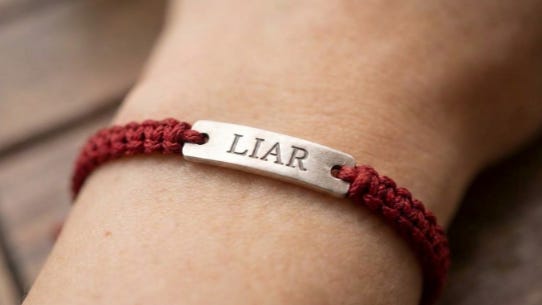
I once went on a date with a man who told me he wanted to marry someone willing to wear a bracelet that turned red whenever they lied.
The date did not last long.
Not because I am pro-lying. But because I could instantly think of many reasons I might want the freedom to lie: to protect someone, to keep a confidence, to preserve a surprise, to get out of danger, to avoid being needlessly cruel, or simply to buy time before saying something hard.
And then there are the less noble reasons too: to dodge embarrassment, smooth a tricky situation, cover a mistake, or wriggle out of trouble.
So, no, I do not want a “truth bracelet.” Not on dates and not in public life. My husband, after 28 years together, agrees: no truth bracelets.
And yet.
That story is useful for one reason: it reminds us that not all lies are equal. A lie to protect someone is not the same as a lie to win power. And that distinction matters.
Because Wales has just done something interesting. On Tuesday night, 17 March, the Welsh Parliament passed a law by 50 votes to 1 that creates a recall system so voters can remove Senedd members between elections in cases of serious misconduct or criminal conviction. It also paves the way for a new criminal offence covering false or misleading statements of fact made to help an election candidate during Senedd campaigns.
This will not apply to the May 2026 elections, and the offence is unlikely to come into force until 2030 at the earliest. Critics have warned that such powers could limit free speech and complicate democratic debate. Even so, Wales is drawing a line: knowingly misleading voters in order to win power should not simply be dismissed as politics.
And honestly, good. Because this is not only a legal question. It is a leadership question.
What kind of behavior do we want to normalize on the way into elected office? If someone knowingly misleads voters to get elected, that may not tell you everything about how they will govern. But it is a warning sign. It tells you something about how they see truth, power, and the public they are asking to trust them.
For too long, democracies have treated political lying like bad weather: annoying, corrosive, but somehow inevitable. We complain, fact-check, sigh dramatically, and move on.
This is where Geoff Mulgan’s – Professor of Collective Intelligence, Public Policy and Social Innovation at University College London — argument about a right to truth is helpful.
Liberal democracies have done a good job of protecting free speech. They have done a much weaker job protecting people from being knowingly lied to by powerful institutions. That is strange when you think about it. In finance, medicine, courtrooms, science, and consumer protection, we already accept that when the stakes are high, truth matters and deception carries consequences. Politics is more contested than those fields, of course. It involves values, interpretation, and competing visions of the future. But that is not an argument for tolerating knowingly false statements of fact in election campaigns.
If anything, democratic leadership should demand more respect for truth, not less.
Because leadership is not just about getting attention, dominating a news cycle, or saying whatever works. It is about asking people to hand you the power to make decisions that shape their lives. Voting is supposed to be an act of informed consent. If that consent is won through deliberate factual deception, leadership starts on shaky ground.
That is what Wales gets right. It says the truth is not just a nice extra in public life. It is part of the democratic infrastructure.
And it says something else important too: how people seek power matters. A candidate willing to knowingly mislead to get in is giving you crucial information about their leadership style. Maybe not proof, but a signal that citizens are not people to be respected in that model. They are rather targets to be managed.
Of course, this could still get messy. The moment you move from “deception is corrosive” to “the law should intervene,” things get complicated. What exactly counts as a false or misleading statement of fact? How do you distinguish factual deception from spin, rhetoric, prediction, or selective framing, or plain old nonsense? These are genuinely difficult legal questions — a verifiable claim like “we spent X amount on Y” can be true or false, but a promise, an opinion, or a selectively framed truth is far harder to prosecute.
So no, this is not yet a case for some grand government truth machine (or truth bracelets). It is a case for taking the problem seriously enough to try drawing a line carefully. The challenge is to avoid both passivity and overreach.
Still, here is where I land: We have spent too long acting as though honesty in politics is quaint — nice when available, but hardly essential. Meanwhile, candidates can say complete rubbish, ‘flood the zone’, and call it strategy.
If we want better political leadership, we need to stop treating honesty as optional. Not because politicians will never spin. They will. But because democracies tend to elevate the kinds of leaders their incentives reward. And, it shouldn’t be a political disadvantage to tell the truth.
A question to leave you with:
Should honesty be seen as naïve in politics, or as a basic condition of democratic leadership?
Warmly,
Lisa
Comments
Nothing yet. Say the first thing.
Sign in to join the conversation.