
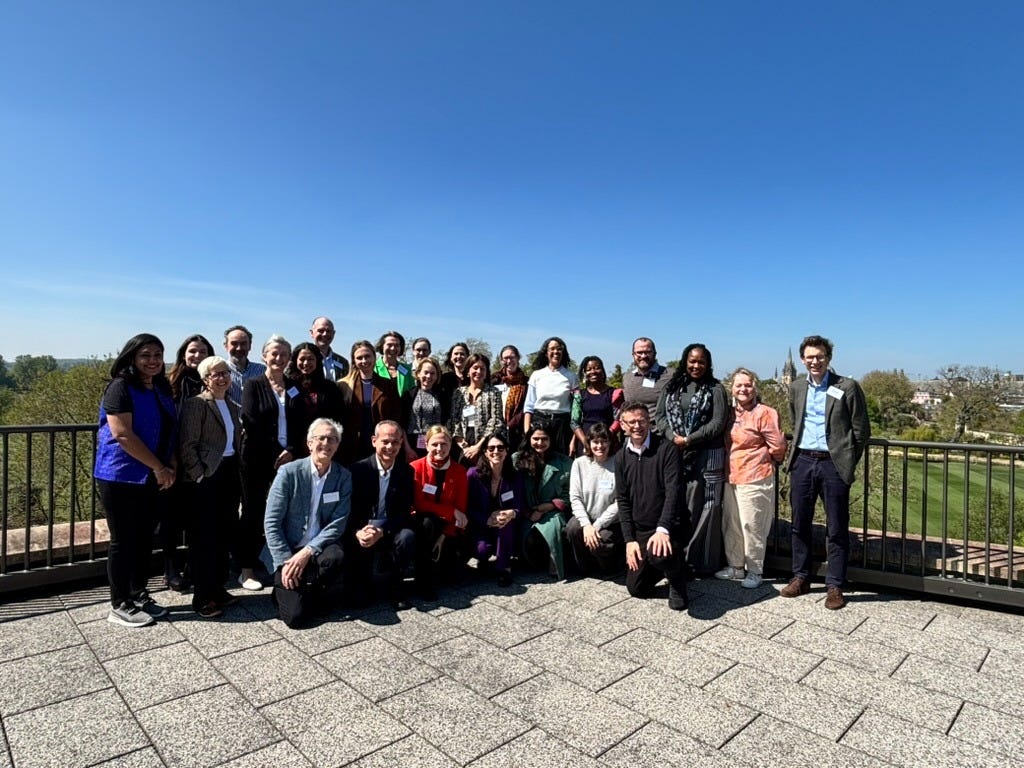
This is the first of several reflections to come from our roundtable in Oxford on political leadership in partnership with the Oxford Character Project and the Centre for Democratic Resilience at Oxford University.
She was standing on a doorstep, her newborn strapped to her chest, when someone got in her face and threatened her.
This wasn’t a war zone. This was just a local councilor doing her job — showing up in her constituency, being present for the people she represented. She kept going. She kept turning up. And the room at our roundtable last week went quiet when she described it, because we all recognized it: not an exceptional incident, but the baseline expectation of anyone who wants to hold elected office today.
Here’s the detail that stays with me: in the UK, local councilors don’t receive a salary. They receive a taxable allowance, typically around £7,000 a year on average, officially classified as part-time, voluntary public service. In practice, the role is open-ended — evening meetings, weekend constituency work, and the kind of always-on pressure she described. She was doing it all, with a newborn, for less than £100 a week.
I left that room thinking not about her resilience — which is extraordinary — but about the design of the job itself. Because what she is living isn’t a personal problem. It’s a structural one. And if we keep treating it as the former, we will keep producing the same results: exhausted leaders, a narrowing pool of people who can say yes, and governance that is worse than it needs to be.
A new study in Australia, led by my colleague Kimberly McArthur at the Better Politics Foundation — surveying around 300 federal, state, and local political leaders — found that almost two-thirds of politicians had their mental health damaged by the role. One in five had considered ending their life or harming themselves.
One in five.
These aren’t anonymous survey respondents. These are elected representatives — the people making decisions about your healthcare, your children’s schools, your community’s future. The research came to light after a Queensland MP found a colleague dead at his home. It shouldn’t take a tragedy to make us look at this seriously.
The science explains exactly why these numbers are what they are. Legislators across the world work hours that would be flagged as a health risk in any other sector. New MPs in the UK average 69 hours a week, with 8 additional hours of travel on top. Under sustained overload, the prefrontal cortex — the seat of judgment, empathy, and long-term thinking — goes offline. What takes over are the older, faster, threat-response circuits: reactive, tribal, zero-sum.
The very qualities we most deplore in our politicians are the ones that chronic overload reliably produces.
We are selecting the people who can survive the job. That is an entirely different thing from selecting the people best suited to govern wisely. And we compound the problem by building a role so demanding — and for local government, so financially unviable as a sole income — that whole categories of people rationally conclude they cannot do it. Parents of young children. People with disabilities. Carers. Those without a partner’s income or independent wealth to fall back on. We then wonder why our legislatures don’t look like the societies they serve.
Robert Newman, Executive Director of Amp Health — which works with ministries of health to strengthen leadership across the developing world — brought a concept to our roundtable that I keep returning to: Collective. The idea that real leadership is not a solo act. That it never really was.
Job-sharing in legislative roles is one of the most concrete expressions of that idea. And it is more than a flexibility measure, it is a governance argument. Two people sharing a seat can bring complementary expertise, such as lived experience of disability alongside policy depth, community knowledge alongside legislative skill.
The handover discipline job-sharing requires could actually improve transparency in a world where political decision-making is often opaque. And it opens the door to people currently locked out of the system — not as a consolation prize, but as a genuine widening of the talent pool our democracies can draw from.
The assumption that legislative office is uniquely incompatible with sharing has always struck me as less an argument than a bias wearing the costume of one. The job involves representation, deliberation, and voting — all of which can, in principle, be shared.
It already works in the private sector, in senior leadership, in the civil service. The case that political leadership is the one role that can never be redesigned this way has never been convincingly made. It has simply been asserted, loudly and repeatedly, by people whose identity is bound up in the current model.
This isn’t a thought experiment. People are already trying it.
In Australia, Lucy Bradlow and Bronwen Bock ran as joint independent candidates for a Melbourne parliamentary seat — alternating weeks in Canberra, handing over a literal laptop and phone every Friday. Legal barriers stalled them: the electoral commission refused to accept a joint nomination, their target seat was redrawn out of existence, and the 2025 election arrived before any of it could be resolved. But in the meantime, they founded a party, signed up 1,554 members in two months, and won a court order protecting them from a $500,000 government legal bill. They didn’t fail because the idea failed. The question of whether two people can legally share a seat in parliament remains unanswered.
In the UK, proposals for job-sharing MPs have been raised since 2012. Green Party members Clare Phipps and Sarah Cope attempted to stand jointly in 2015 and were rejected. The constitutional barriers are real — but they are political choices, not laws of physics. That means there are ways through.
Brazil is a case in point, and its language is instructive. They don’t call it job-sharing — they call it mandato coletivo: collective mandate. In 2016, Áurea Carolina and Cida Falabella were elected as separate councilors in Belo Horizonte, but chose to tear down the dividing wall between their offices and govern together as one team in a shared, open-plan space they called the Gabinetona — literally “the big cabinet,” deliberately feminized.
In 2018, five women — a journalist, a street vendor, a teacher, a trans lawyer, and a community activist — ran together for a single state assembly seat in Pernambuco under the collective name Juntas (”Together”), winning it with over 38,000 votes. Technically, only the registered candidate could legally vote or sign legislation; the others were classified as staff. But in practice, decisions were made collectively, the workload was shared, and the mandate was run as a genuinely plural enterprise.
By 2020, the practice of multiple people jointly running a single candidacy or pooling elected offices into one collective operation had grown to 313 candidacies in municipal legislatures — four times more than the previous election cycle. Brazil didn’t wait for the law to catch up. While the Anglophone debate remains stuck on whether it’s even legal, Brazil simply got on with it — and proved it works.
I want to be honest: I’m not arguing that job-sharing is obviously right. I’m arguing that we need to be experimenting — seriously, deliberately, with eyes open.
What could go right? Two people bringing genuinely different expertise and life experience to one seat. A handover process forces transparency as a structural habit. A pathway into politics for people who are currently locked out — and who might, a generation from now, reshape what executive leadership looks like too.
What could go wrong? A partnership that breaks down mid-term. A dominant partner who holds the seat while the other provides cover. Institutional cultures so adversarial that they crush the model before it can prove itself.
And the deepest question: is the problem the job design, or the culture surrounding it? Because you can redesign a role carefully and still have it destroyed by a culture that mistakes exhaustion for commitment and punishes anyone who asks for something different. I don’t think that’s a reason not to try. It’s a reason to try carefully, document rigorously, and build the evidence base. Brazil is experimenting. Australia tried and will try again. The UK has been debating it for over a decade. We should be watching all of it — and running more experiments of our own.
The councilor with the newborn stayed. She keeps going. She keeps turning up for the people she represents, for less than £100 a week, in a role the system officially calls “part-time” yet treats as all-consuming.
No one should be doing a full-time job that’s labelled and paid as part-time. Either it’s recognised and compensated for what it is, or it’s designed to work as a genuine collective endeavour—something people can realistically do alongside family life and other work.
That’s what job-sharing is really about. Not flexibility as a concession. But governance as a collective endeavor — built for the full range of human experience, not just those who can endure the current design.
We know how to build better systems. We do it in medicine, in business, in sport. The question is whether we have the will to demand the same of the institutions that govern our lives.
This piece wouldn’t exist without everyone who joined us at the Oxford roundtable last week — in the room and online. The quality of thinking, the willingness to sit with uncomfortable questions, and the range of experience people brought made it one of the most energizing conversations I’ve had in years. I’ll be sharing more reflections from this important meeting in the weeks ahead — on leadership, neuroscience, and what it might actually take to redesign political life for the better. This is just the first thread to pull.
Had you come across political job-sharing before reading this? What excites you about the model — and what worries you? Where do you think it would work brilliantly, and where would it fall apart?
Drop your thoughts in the comments. I read everything.
Warmly,
Lisa
P.S. The councilor with the newborn is writing a children’s book (we’ll share it when it is done) about what it’s like to be a local politician — a thank you to her own children for the evenings and weekends they’ve shared with the job, and a way of showing children everywhere why this work matters and who actually does it. I find that quietly wonderful. If we want the next generation to trust democratic institutions, we have to help them see what those institutions look like from the inside.
Comments
Nothing yet. Say the first thing.
Sign in to join the conversation.