
A few weeks ago, I was in Florence with a small group of friends — people I love, several of whom actively support the Better Politics Foundation, and all of whom actively support each other.
It was one of those weekends that felt full in the best way: long meals, real laughter, hard conversations about aging, and the particular magic of being in a city like Florence together. All that Medici beauty and ambition still hang in the air. Patronage, power, art, history — somehow still alive in the stones.
We learned our way through the city with our guide, Andrea. He was exactly who you’d want: erudite but light, with that Italian ease that managed to look both elegant and effortless — a brown suit, a baby-blue silk scarf, a kind of casual precision that made him seem part historian, part film character. He had so much to say about art, architecture, power, and beauty that he’d regularly lose track of time, and we’d gently have to move him along. Honestly, it was a joy to watch. There’s something deeply warming about being with someone genuinely raptured by their work. Not performing knowledge. Not packaging expertise. Just in love with what they know.
The monks’ cells
The moment I can’t shake happened at the Monastery of San Marco. In the monks’ cells.
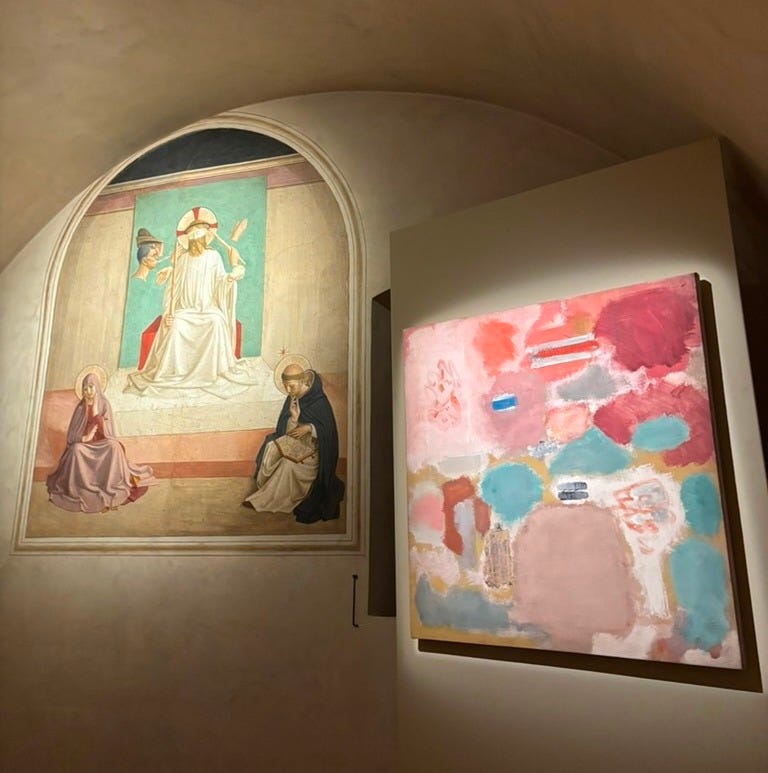
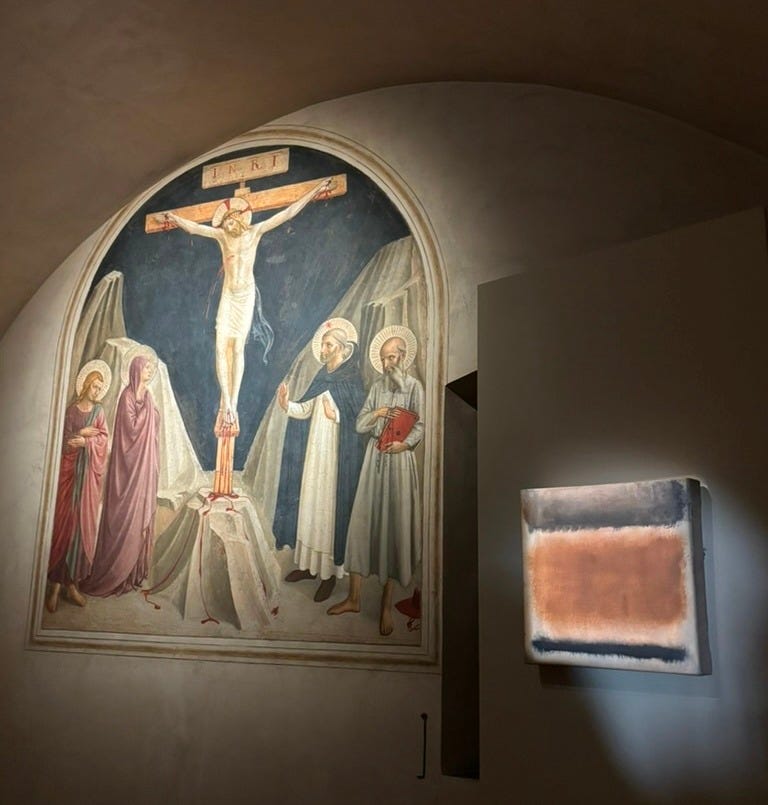
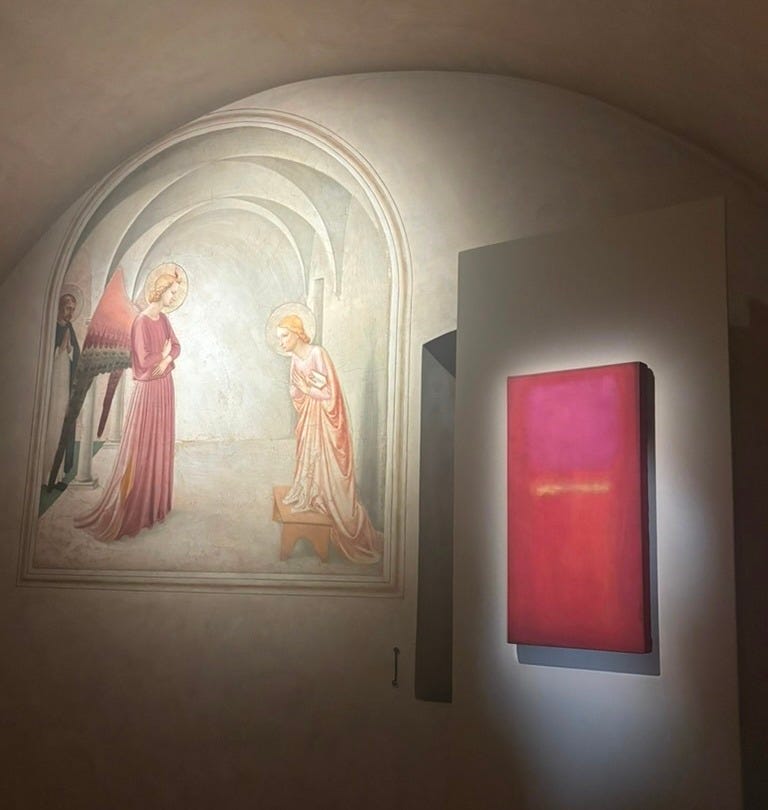
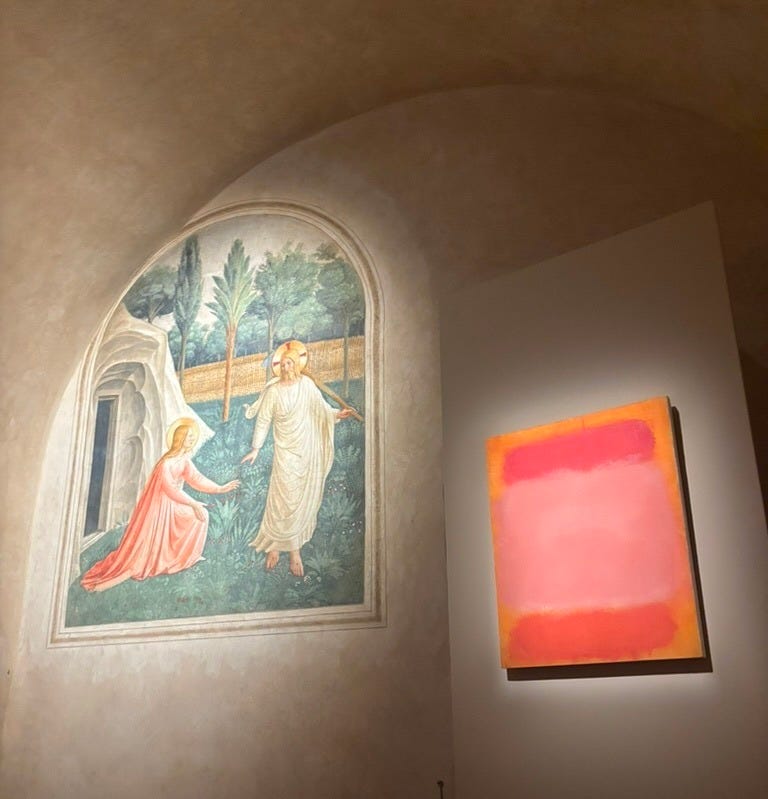
Small, spare, quiet rooms built for reflection. Rooms that seem to ask you to lower your voice before you realize you already have. On the walls were Fra Angelico‘s frescoes — the Annunciation, the Crucifixion, Noli me tangere, Christ Mocked. Images many of us “know,” at least in some vague art-history kind of way.
And then, there with them, were paintings by Mark Rothko — a 20th-century American Abstract Expressionist known for large canvases of layered blocks of color. They were part of a wider Rothko exhibition in Florence, shown primarily at Palazzo Strozzi, with additional works installed in San Marco. That pairing stopped me. The Rothko didn’t feel dropped in or imposed. They looked like they belonged there, as if they had been waiting for Fra Angelico all along. Then I found out that one of the exhibition curators was Christopher Rothko, Mark Rothko’s son. Somehow, that made emotional sense before it made intellectual sense.
Different route, same destination
Standing in the monks’ cells — the rooms where the Dominican friars of San Marco prayed, slept, and lived their entire interior lives — I found myself pulled into one of art history’s oldest tensions. Andrea presented the difference between representation and presence, and how to use that lens to look at the paintings around us.
Fra Angelico painted a fresco in each cell not as decoration but as a devotional tool — an aid to contemplation, placed precisely where a monk would kneel alone each day. These weren’t public altarpieces meant to impress. They were intimate, functional, spiritual technology. The question of whether they were meant to represent the divine or to make it present in that small room is not an art historical footnote — it was the whole point.
Representation is art as a picture of something else — a stand-in, a likeness, a sign pointing beyond itself. The painting refers to a person, a place, a story. Its job is to depict. You look through it to what it shows.
Presence is when the work stops being a window and becomes a thing in itself — when you feel you are with something, not just looking at something. The object has its own weight, its own demand on you. It doesn’t point elsewhere; it arrests you here.
Fra Angelico gives you both. We see figures, gestures, story, and theology — you can clearly describe what is happening. But in those cells, so much has been stripped away that the distance between you and the scene collapses. The paintings stop feeling like illustrations and start feeling like encounters. You don’t feel like you’re looking at something from afar. You feel like you’ve walked into a sacred moment already in progress. His representations create presence.
Yet, Rothko removes representation almost entirely. No figures, no story, no scene to decode. And yet he arrives somewhere surprisingly similar. His paintings change the emotional temperature of a room. They slow you down. They make you stay. They ask something of your interior life. In the absence of representation, he creates presence.
Representation can lead to presence, but it does not ensure it, and it is not needed for it.
I keep finding this distinction not just in art, but everywhere I look, including, perhaps especially, in politics.
What politics shouldn’t fake
So much of what we ask of political leaders now is representational: messaging, positioning, stagecraft. And those things matter. But they can be done well and still leave people cold.
People can follow a leader without feeling held by one. That gap — between being led and feeling led — seems worth taking seriously.
And it rhymes, I think, with what I felt in those cells.
Presence in leadership is harder to cultivate than representation — and much harder to fake. It’s not polish. It’s not branding. It’s not “executive presence” in the thin, over-coached sense. It’s the felt sense that a person is grounded, coherent, and morally awake. Able to hold pressure and create steadiness in others. You know it when you’re in the room with it. And you know, fairly quickly, when it’s missing.
What struck me in San Marco was that Fra Angelico and Rothko — working centuries apart, in utterly different visual languages — were both doing something deeper than depiction. They were creating conditions for presence. For attention. For a kind of interior slowing-down that lets something true land.
What if that’s what we actually need from political leaders? Not better representation, better presence. Leaders who don’t just communicate, but also orient. Who don’t just perform conviction, but embody seriousness, calm, courage, and humanity in a way people can actually feel.
What Florence does to you
There’s one more thing that has stayed with me. Rothko spent time in Florence, and the city clearly fed something in him. He wasn’t just looking at paintings — he was absorbing the city. The architecture, the history, the food, the river, the forests, and the feeling. Florence helped deepen his sense of what art could do: not just show something, but hold someone. Surround them. Alter their state.
That is what art can do when it’s really working.
It slows us down enough to notice what is true. It gives us language for something we’ve felt but not yet named. It deepens us a little.
That weekend didn’t give me a tidy conclusion. It gave me something better — a layer, a feeling, a question I’m still sitting with.
What would politics feel like if we cared as much about presence as we do about representation?
Warmly,
Lisa
Comments
Nothing yet. Say the first thing.
Sign in to join the conversation.