
Most leaders are fluent in why and what. Almost none are fluent in how. That gap is the crisis.
Let me tell you what’s actually going on in most of the rooms I walk into. Smart people. Real stakes. Urgent problems. And almost always, the same shape: we spend 80% of our time on why things need to change and what should be different — and about 5 minutes, right at the end, on how.
After thirty years of this, I want to say something direct: that gap is costing us everything.
I call it the elbow grease gap — the distance between a clear vision and the grinding, specific, unglamorous work of actually delivering it. It’s where great ideas go to die. And it might be the most important leadership problem that almost nobody names.
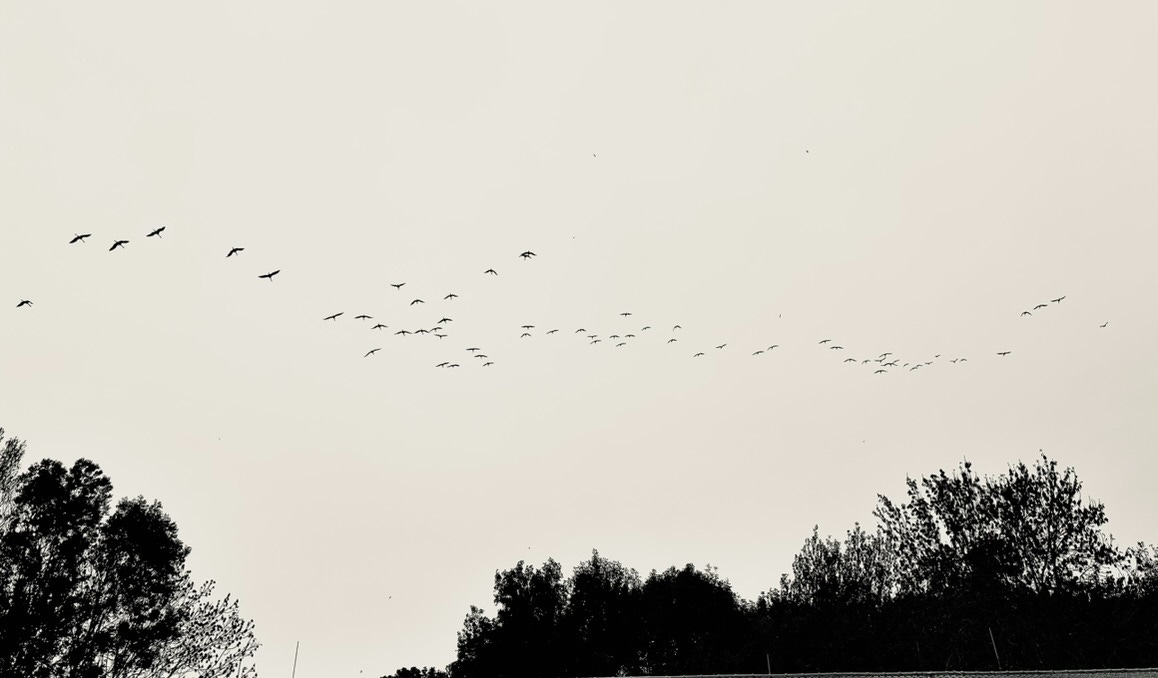
The idea came from watching the spring migration recently, outside our barn in the Uckermark — an hour north of Berlin, one of Europe’s great migratory resting places.
Cranes, ducks, geese — tens of thousands of birds moving through in a matter of days. But it was the geese that pulled my focus, as they always do. My father, Bill, was a serious bird hunter. Geese were his specialty. I grew up in their orbit, and I’ve never quite left it.
I spent countless hours of my childhood working alongside him: organizing the goose decoys, reloading shotgun shells at the kitchen table, practicing calls until I could mimic a Canada goose well enough to be convincing. I know how geese respond to one another, how the formation works, how they communicate in flight. I have watched them, studied them, and listened to them for most of my life.
Standing outside in the early morning during migration, you hear what I can only describe as a living orchestra tuning before a performance it has been rehearsing for thousands of years — layer upon layer of calls, wingbeats, honking, the occasional piercing solo cutting through the chorus. It is, quite simply, one of the most extraordinary sounds I have ever heard. A free symphony, performed twice a year, for anyone willing to get up early enough.
So when I say the geese have something to teach us, I’m not reaching for a convenient metaphor. I’m drawing on something I’ve been paying attention to for decades.
Every spring, a flock prepares to fly north. They don’t debate whether the season is turning. They don’t commission a report on conditions at the destination marsh. They feel the lengthening days, they form a V, and they go. The lead goose breaks the headwind. When it tires, it drops back. Another takes its place. The analysis is done — written into their bones — and now they’re doing the work.
Meanwhile, a group of well-intentioned people at the edge of that marsh has been meeting for three years about the declining goose population. The reports are excellent. The diagnosis is airtight. In that same time, the geese completed three migrations — some 6,000 miles of actual movement — while the thinking stayed where it was.
I want to be careful here. I’m not suggesting that complex human problems yield to the same logic as migration. They don’t. Geese aren’t running healthcare systems or navigating democratic trade-offs. I know that. But they do four things worth sitting with.
They separate the analysis from the action — and don’t relitigate it at the departure gate. At some point, the analysis is done. The flying must begin.
They rotate the burden of the how. The V isn’t a hierarchy — it’s a moving system. No one bird carries the headwind until it breaks. Someone else steps up. Organizations tend to fail here: responsibility is either so diffuse nobody owns it, or so narrow the people carrying it burn out.
They adjust without meetings. When the wind changes, the formation changes. Immediately. No governance process. Just responsiveness — local, continuous, real.
They don’t wait for perfect conditions. They fly in fog. In the rain. Because not flying is worse. The organizations I’ve watched waiting for the right moment — the right funding, the right political window, the right data — are still waiting.
None of this is instinct for us. We have to choose the how. And that choice — to move from clarity of vision to the specific work of delivery — is the one we consistently, predictably defer.
Over thirty years of building things, I’ve come to know something about myself: I come alive in the how. The mechanism. The moment a plan meets reality and has to adapt.
I had to learn to love it — it didn’t come naturally. Throwing out ideas was more fun, faster, and easier. The how is none of those things. But there is a particular joy — one that’s hard to explain to people who don’t feel it — in watching something that existed only as an idea actually start to work in the world. That’s where you can see whether you’re actually changing anything.
I still have to remind myself of that joy sometimes. The pull toward the new idea, the clean concept, the untested plan — it doesn’t disappear. It just gets easier to recognise it for what it is.
And I’m imperfect at the how. I’ve launched before the system was ready. Handed off implementation to people without the authority to course-correct. Fallen so in love with the elegance of a plan that I missed what was obvious to anyone closer to the ground.
So I’m not writing this from mastery. I’m writing it as someone who still gets it wrong — and who, after thirty years of watching the same patterns repeat on the biggest problems of our time, has run out of patience with systems that never really try.
The elbow grease gap isn’t a character flaw. It’s a cognitive pattern — and a well-documented one. Which is both reassuring and, honestly, a little maddening.
Trope and Liberman’s construal level theory tells us something simple but useful: the further away something sits — in time, in space, in likelihood — the more abstractly we think about it. Strategy lives at a distance almost by definition, so leaders reach naturally for abstractions — vision, purpose, direction. Yet execution demands the opposite movement. The “how” requires descent: into the resistant system, the underfunded team, the colleague who does not behave the way the model assumed. That closeness is uncomfortable, and for many leaders quietly intolerable — which is why so many strategies are eloquent at altitude and inert at ground level.
Completion bias makes it worse. Research on symbolic self-completion suggests that when we articulate a goal — name it, share it, write it down — the brain registers a form of progress even before any action has been taken. The relief of “we have a strategy” is neurologically real, and it quietly displaces the sustained attention delivery actually requires. We feel like we’ve dealt with the problem. We’ve only described it.
And status finishes the job. “Strategic” is a compliment. “Operational” is neutral at best. The people who know where the bodies are buried — who will implement, who see the edge cases, who understand why the last three versions of this failed — rarely have the standing to be heard by the people who designed the vision.
We’ve known all of this for decades. We have done remarkably little about it.
At the Better Politics Foundation, we made a deliberate choice: we were not going to be another voice adding to the 95% of conversations that stop at the diagnosis. Our mission is to move political leadership from handwringing to action — identifying what effective leaders actually need and building the global infrastructure to develop them.
We built the Better Politics Accelerator to do exactly that — working with political entrepreneurs to either establish or upskill organizations that recruit, train, and support leaders at every stage of their political journey. To date, we have accelerated 48 Political Leadership Entrepreneurs across 37 countries.
And we’ve done something else that I’m quietly proud of: we’ve named and built a field. Through the Political Leadership Entrepreneur Network, we now convene more than 150 organizations from across 57 countries — political entrepreneurs and innovators all doing the elbow grease: the unglamorous, specific, system-level work of actually changing how politics works in their contexts. Not talking about it. Doing it.
And because you can’t improve what you don’t measure, we built the Better Politics Index — the world’s first tool to measure the support and development of political leaders as democratic infrastructure across 10 countries and 4 dimensions.
What the 2025 Index revealed stops me every time I say it out loud: in most countries, political training focuses almost entirely on getting people elected — not on governing once they are elected. The campaign gets the investment. The actual work of leadership gets almost nothing. That’s not a leadership problem. That’s a how problem. And we’ve been misdiagnosing it for decades.
Implementation fails in predictable ways — which means it can be guarded against. I call it The How Test. I ask these of myself before anything goes out the door. I don’t always like the answers. I ask anyway.
1. Have you mapped the system you’re entering? Who benefits from things staying the same? What assumptions haven’t been tested against reality? That’s where the how breaks down — quietly, early, before anyone with authority notices.
2. Have you run a pre-mortem? Gather the people who will implement, not the people who designed, and ask: It’s two years from now and this has failed. What happened? Write it down. It’s uncomfortable every time. It has saved us more than once.
3. Do you know when something is going wrong — and do you find out early enough to fix it? That requires more than an open-door policy. It means short reporting cycles, direct access to the people closest to implementation, and a culture where the person who flags a problem first is thanked, not managed.
4. Who owns the how — with real authority? Not a coordinator. Not a committee. Someone who can make calls, redirect resources and change course without having to book three meetings first. If you can’t name that person, you’ve found your problem.
5. What are your leading indicators? By the time failure is visible, it’s expensive to fix. Name your early warning signals before you launch. If you can’t, you’re not ready.
6. Do the people doing the how have the mindset and skills to deliver? This is the most under-asked question — to the point of negligence. We spend enormous energy on who designs the vision and almost none on whether the people responsible for execution are equipped for it — not just technically, but temperamentally. Implementation requires a particular kind of person: someone who finds problem-solving under pressure energising rather than depleting, who can hold the original intention while adapting the method, who doesn’t need the spotlight to stay motivated, and who is genuinely curious about why something isn’t working rather than defensive about it. That’s not everyone. It’s not even most people. And yet we routinely hand the how to whoever is available, rather than whoever is suited. Matching the right people to the how — and then investing in their development, their authority, and their support — is not an HR question. It is a strategic one.
The polite version is: “Can we spend 15 minutes on the how?”
But I want to go further. Because after thirty years, the polite version isn’t enough.
What if we flipped the ratio entirely? On the issues where we’ve been discussing the why and the what for decades — where there is no meaningful disagreement that the problem is real — what if we simply stopped devoting 80% of the meeting to rehashing it? What if we walked in and said: we know why, we broadly agree on what, so we’re spending 80% of today on the how.
That means starting not with the problem but with the mechanism. Not “isn’t this urgent?” but “who has tried this before and what specifically got in the way?” Not “what do we want?” but “what would have to be true for that to be achievable — and what are we doing about each of those conditions?” Not “can we agree on principles?” but “who owns the next step, with what authority, and how will we know if it’s working?”
The why and the what do sometimes evolve — new evidence opens new doors, a different political moment changes what’s possible. When that happens, revisit them. But the test is simple: would going back to the why and what produce a different how? If the answer is no — and it usually is — then you’re not refining the strategy. You’re avoiding the work of delivering it. You have your answer about where to spend the next two hours.
The meetings I remember — the ones where something actually shifted — were never the ones with the best diagnosis. They were the ones where someone had done the unglamorous work of understanding what was blocking progress, and arrived with a specific, arguable, testable idea for how to move it. The how was the agenda, not the afterthought.
After thirty years, I want more of those rooms. Full of people who’ve settled the analysis, agreed the direction, and shown up ready to fly in formation.
The vision has had its moment. It is long past time the flight did too.
Warmly,
Lisa
0:00
-1:00
This audio was recorded at the barn in the Uckermark during spring migration. Any guesses what bird this is?
Comments
Nothing yet. Say the first thing.
Sign in to join the conversation.