
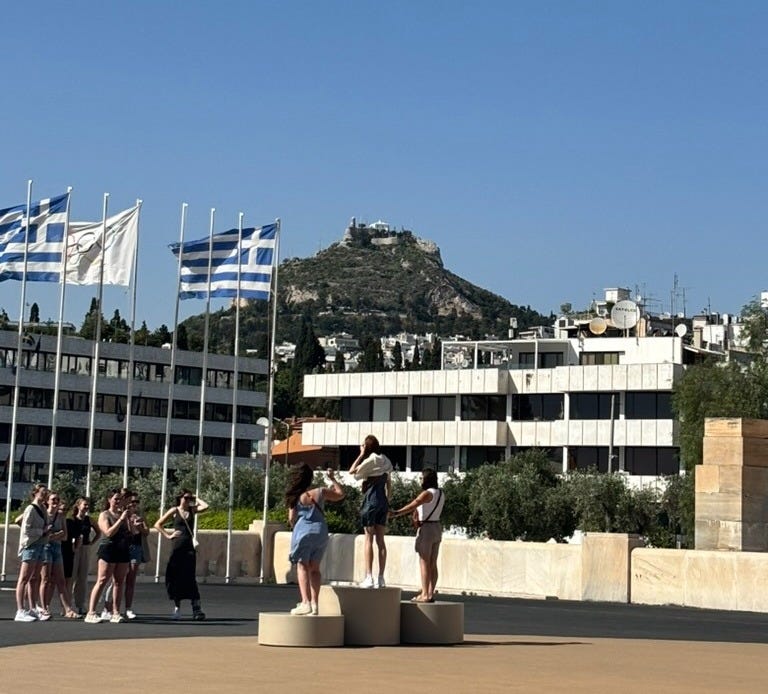
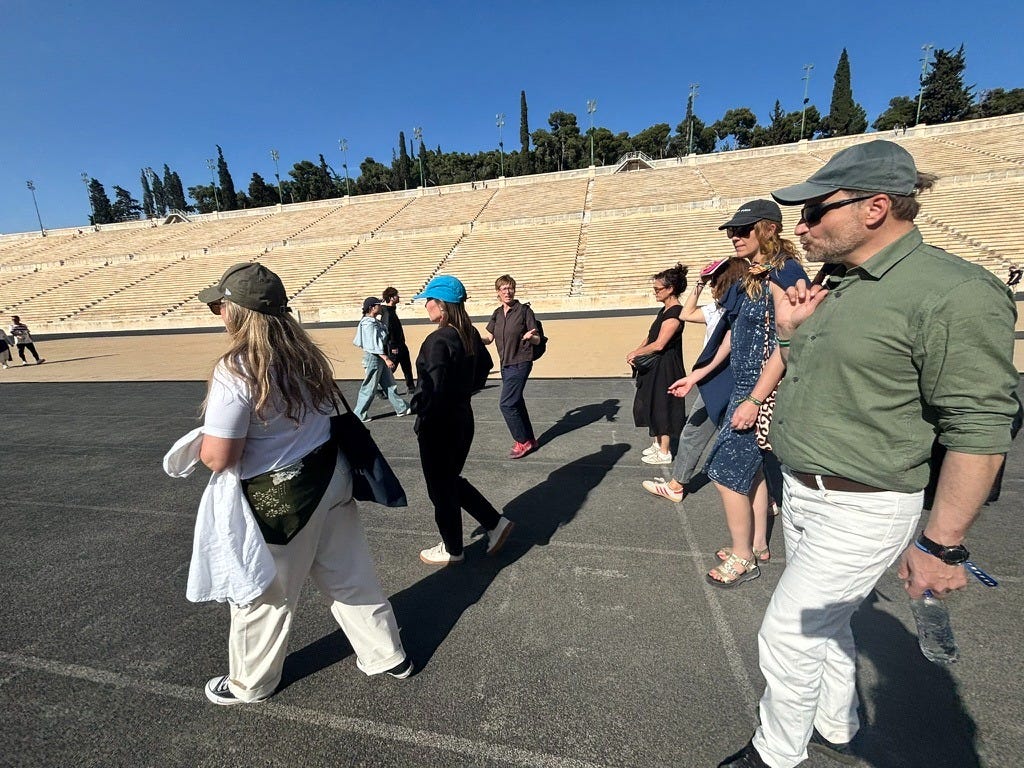
Last week, I stood beneath the Acropolis at a dinner hosted by the Futurific Institute alongside the World Beautiful Business Forum — a gathering of founders, CEOs, and creative leaders exploring how beauty transforms organizations. Futurific’s CEO, Rachel Goslins, asked each of us to share what gives us awe. When my turn came, I led the room through a group “Yum” — arms waving in the air, voices together, a full-body expression of shared delight. People stopped watching me and started watching each other. Under one of the oldest monuments to human aspiration on earth, a room full of executives was grinning at strangers.
We were a little concerned for the wait staff trying to set down plates of gorgeous strawberry pavlova while we were all waving our arms above our heads. But that’s part of the point. The moment was beautifully imperfect, a little chaotic, and entirely human.
I’ve been sitting with that experience since, alongside Dacher Keltner’s book Awe: The Science of Everyday Wonder and How it can Transform Your Life, and I keep arriving at the same place: what happened under the Acropolis wasn’t just a fun icebreaker. It was a leadership act. And it points to something most leadership models completely miss. Often, it is completely free.
Keltner, a psychologist at the University of California, Berkeley, studied awe across 26 countries and 2,600 people. The key finding for leaders: awe produces what he calls the “small self.” Your ego recedes. You feel part of something larger. And the effects persist — people who’ve recently experienced awe become more generous, more humble, more attuned to collective needs. Awe makes it easier for people to lead well — and harder to lead badly.
You know awe is happening when you feel simultaneously smaller and more connected. Not smaller and more afraid — that’s a different emotion. Your chest opens. Time stretches. Self-consciousness goes quiet.
Now think about what political leadership often selects for: big-self energy. Dominance, certainty, self-promotion. And think about the problems politics needs to solve: climate, inequality, polarization. These are collective-action problems that require small-self thinking. There’s a mismatch. But I don’t think it’s permanent. I think it’s a habit — and habits can change.
I didn’t need Keltner to tell me this. Some of the most formative experiences of my life have come from awe in nature — it’s where the biomimicry work I write about in this Substack comes alive. When I’m home in the Pacific Northwest, I still get it regularly. We have a phrase: “the Mountain is out.” It means Mount Rainier has emerged from the clouds — all 14,411 feet of it, suddenly there against the sky. When the Mountain is out, people tell each other. Your barista mentions it. Someone in a meeting pauses and says, “Hey — the Mountain is out.” And everyone turns to look.
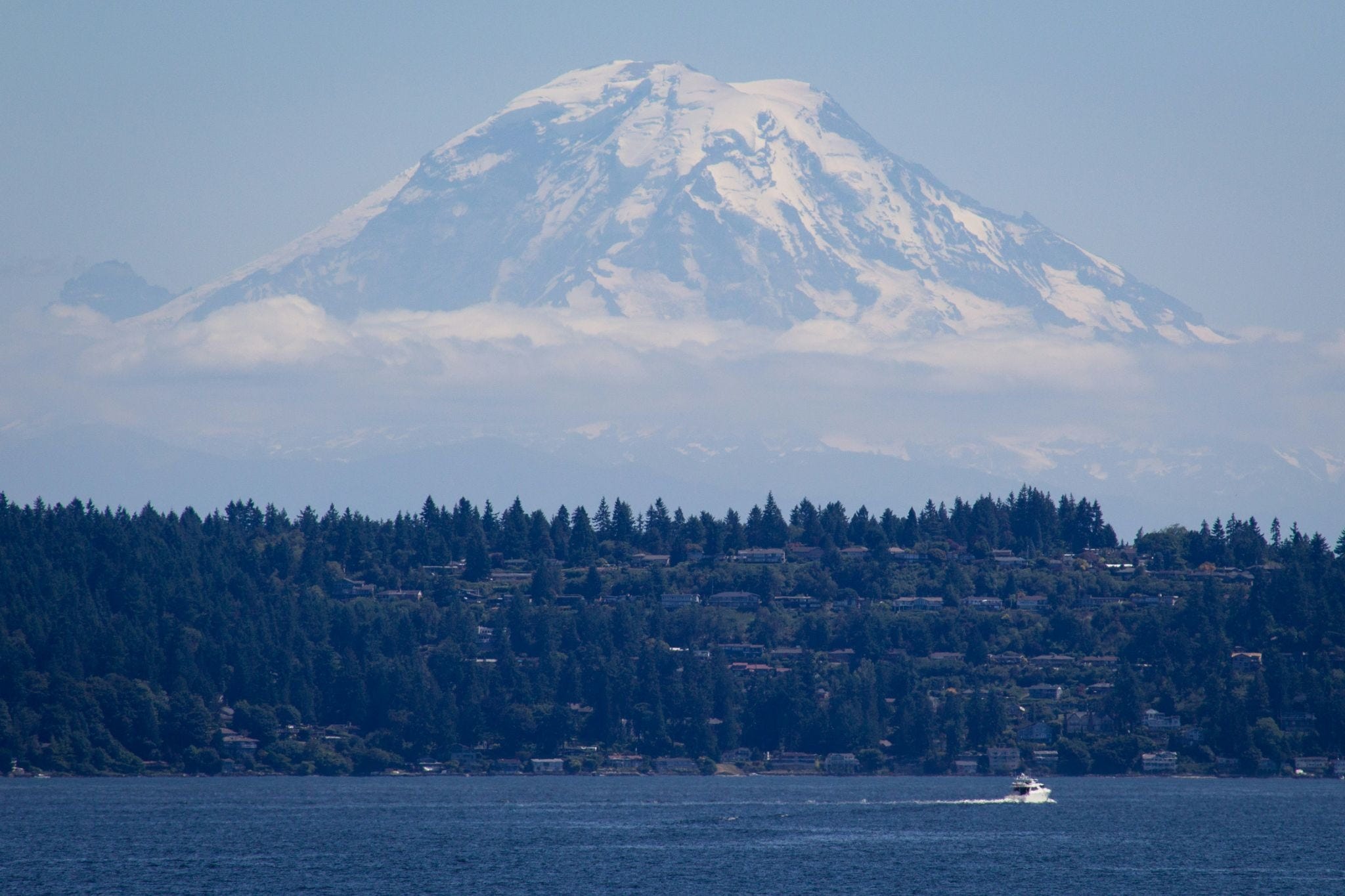
That instinct — I’m experiencing something, and I want you to experience it with me — is one of the most undervalued things a leader can do. Not performing. Not directing. Just pointing at the thing and saying: Look at this with me.
Keltner identifies eight sources of awe: moral beauty, collective effervescence, nature, music, visual design, spirituality, life and death, and epiphany. The order they showed up in his research matters. Moral beauty came first across all cultures. What most reliably produces awe in human beings is watching someone act beyond what self-interest would predict.
That should stop every political leader in their tracks. The most powerful tool a leader has for building trust and collective identity isn’t a policy platform. It’s the ability to surface and share stories of people at their best.
So much of political leadership runs on moral outrage. Outrage has its place — but when it becomes the default, it shrinks the world to us-versus-them. Moral beauty does the opposite. It says: Look what’s possible within us. The leader who tells stories of moral beauty is inviting people into a larger identity. Right now, the balance is off. But I see signs that it’s starting to shift.
One of my favorite pieces of media is NPR’s My Unsung Hero. As an American living abroad, it’s one of the things that still makes me proud of where I come from — this quiet insistence on surfacing ordinary people at their most extraordinary. There’s an episode I remember: a nurse named Kate Elsley, commuting during California’s Proposition 8 fight — the 2008 ballot measure that amended the state constitution to ban same-sex marriage, passing just months after the California Supreme Court had ruled such marriages legal — walking past sign after sign supporting the ban. Then one cold morning, she sees an older man standing alone on the opposite platform, silently holding a sign declaring he was against Prop 8. He wasn’t giving a speech. He was just standing there, in the cold, when he could have stayed home. Elsley has been married for 17 years now. She still tears up remembering this. She never got his name.
Here’s the leadership point: that man was leading. No title, no authority, no words — just a sign and the willingness to stand in the cold. If he can do that, imagine what a mayor or minister could do by making it a core practice to point at moral beauty in their communities and say: this is who we are at our best.
If you’re reading from outside the U.S., I’d love to know — is there something like My Unsung Hero where you are? If not, maybe that’s worth creating. Every country has these stories. They’re just not being told with intention. That could be a leadership act in itself.
Former Prime Minister of New Zealand, Jacinda Ardern (check out her book, A Different Kind of Power) showed this after the Christchurch mosque shootings in 2019. She didn’t lead with anger. She wore a hijab, held grieving families, and said: “They are us.” Then she pushed through gun reform within weeks. She made herself small so the collective could feel large — and backed moral beauty with decisive action. Her approval ratings surged. That’s a data point worth taking seriously.
In the Swedish town of Eslöv, a civic hall was designed with the explicit aim of fostering “good citizens” through beautiful architecture. The building’s manager describes how the crafted brass and woven upholstery transmit “a greater respect” in the politicians who meet there. The building does some of the leadership work. That’s not an accident. That’s design. Beauty as strategy.
Now, I have to name something uncomfortable. Every authoritarian in history has understood awe. The Nazis built cathedrals of light. Strongmen build oversized monuments. So this isn’t a call for awe at any cost. It matters which direction it flows. Authoritarian awe points upward — toward the great leader. Everyone feels small, and the leader stays big. I posit that democratic awe points outward — toward each other. Everyone feels small, and so does the leader.
That’s the difference, and it’s a choice leaders make every time they step into a room. The “Yum” under the Acropolis was the democratic kind. I led it, but I wasn’t the point. The point was what happened between people once they let themselves look ridiculous together. And I had to be willing to look foolish first to make that possible.
1. Redesign how your community makes decisions.
Move beyond the traditional town hall, where a few loud voices dominate, and most people leave feeling unheard, toward genuine deliberative democracy: citizen assemblies where randomly selected residents deliberate and deliver recommendations, and participatory budgeting, where neighbors directly allocate real public dollars. These structures distribute voice more equally, rather than rewarding the loudest person in the room.
Then design the experience itself around awe. Open sessions with 90 seconds of silence, a piece of music, or a shared physical act before anyone speaks. Rituals like these shift people out of adversarial mode before the first agenda item, and the research on collective effervescence (another of Keltner’s eight sources of awe) suggests shared synchronous experience makes groups more cooperative and more willing to compromise.
2. Tell one story of moral beauty from your constituency.
For every story of outrage in your next speech, newsletter, or social post, include one story of someone in your district who acted beyond what anyone would expect: a constituent, a volunteer, a civil servant. Name them. Describe what they did. Let the act speak.
This isn’t soft. It’s a leadership tool for building collective identity, and Keltner’s research suggests that witnessing moral beauty makes your audience more likely to imitate it.
3. Audit your spaces.
Walk into your city hall, your party headquarters, your legislative chamber, and ask: What does this room communicate to the people who enter it? Care, or indifference?
When politicians meet in rooms designed with intention, they govern differently than in rooms that say, “Nobody cares about this place.” Beauty in civic architecture isn’t a luxury line item. It’s infrastructure for better decision-making.
4. Take your politics outside.
Hold a constituency surgery in a park. Canvass in places that remind people they share a landscape. Walk a riverbank with residents instead of sitting across a desk from them. Host your next strategy session at a nature reserve, not a hotel conference suite.
This is applied science: nature is one of Keltner’s eight sources of awe, and his research shows that even brief exposure to vastness and beauty shifts people toward more cooperative, less self-interested thinking. A conference room will never do that.
Side-by-side conversation while walking also breaks down the performative dynamics of face-to-face meetings. People talk differently when they’re moving through a landscape together: more honestly, less positionally.
If you represent a rural constituency, you already have this asset; use it deliberately. If you represent an urban one, find the green spaces, the waterfronts, the views of open sky. Every district has somewhere that makes people feel small in the right way.
5. Build your own awe practice.
The leaders I work with around the world who sustain their effectiveness over time have this in common: they actively seek experiences that shrink the ego and expand the sense of what’s possible.
Listen to My Unsung Hero between meetings. Sit with a piece of art. Read poetry before a hard week. You’ll come back to the difficult calls not depleted, but recalibrated. Then share what moved you — in a speech, at a cabinet meeting, in a party WhatsApp group. Awe is contagious. Pass it on.
We don’t need more outrage. We need more awe. And I believe we’re closer to that shift than it looks.
The best leaders I’ve encountered around the world aren’t the loudest or the most certain. They’re the ones who create the conditions for other people to feel something bigger than themselves — and then step back. That’s the leadership this moment is asking for. I think more of us are ready to offer it than we realize.
Warmly,
Lisa
If this resonated, share it with someone who needs a little more awe and a little less outrage in their feed. Thanks to World Beautiful Business Forum and the Futurific Institute for the fantastic gathering.
Comments
Nothing yet. Say the first thing.
Sign in to join the conversation.