
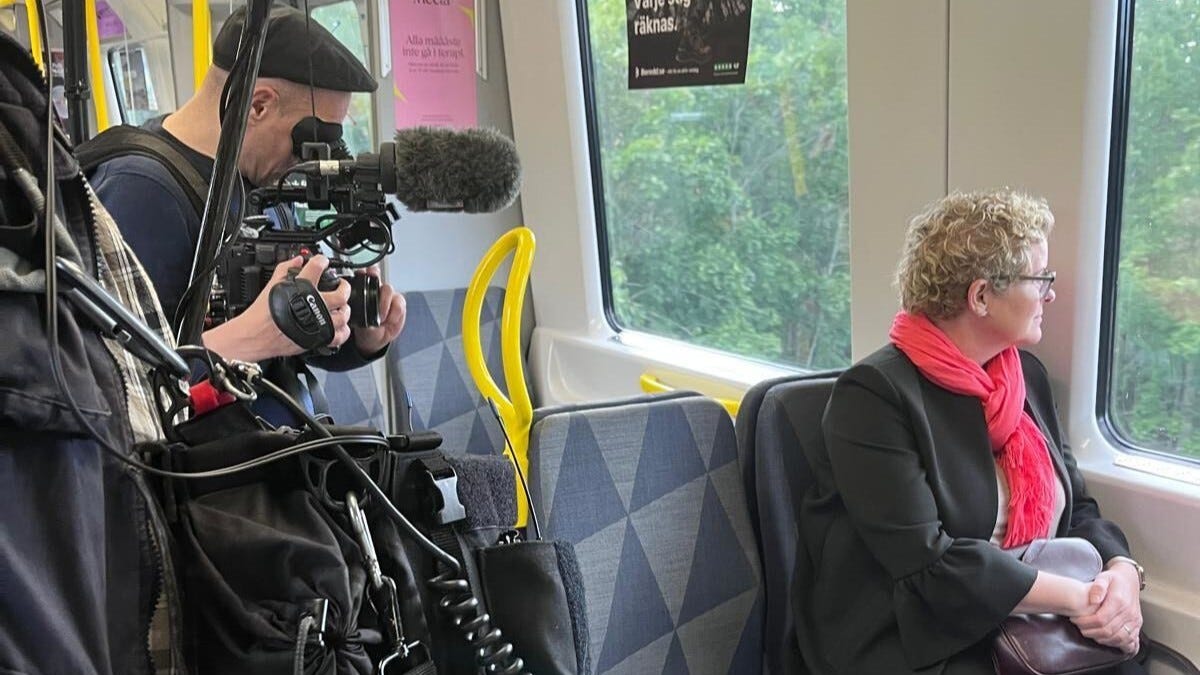
What might political leadership look like if helping citizens participate was not just part of the job, but one of the best parts of it?
That question stayed with me while watching With the People, a short (~20 minutes) documentary from the Better Politics Foundation created with the Alliance of European Mayors.
The film follows leaders in three European cities: Mayor Karin Wanngård in Stockholm, Mayor Matteo Lepore in Bologna, and Michael Lakomski, the Mayor’s Plenipotentiary for Smart City in Poznań.
What I appreciated most is that it does not present these leaders as perfect or suggest their cities have everything figured out. Instead, it offers something more useful: a grounded glimpse of leadership that is close to people and open to participation.
Trailer - With the People: City Mayors Rethinking Power
We often describe politicians as public servants, and there is much to admire in that idea. Service matters.
Most people simply want public life to work: water from the tap, trash collected, buses running, streetlights on. That depends on capable institutions and public servants doing their jobs well.
But watching this documentary made me return to a reframing that has stayed with me for several years: what if political leaders are not only servants of the public, but also facilitators of citizen participation?
I first heard that idea clearly articulated in May 2023, when I recorded a podcast conversation, Embracing the Power of the Citizen Story, with Jon Alexander. Jon, the author of Citizens: Why the Key to Fixing Everything Is All of Us, argues that:
democracy works best when people see themselves not as consumers of politics, but as citizens with agency.
In that frame, the role of leaders shifts as well. They are still responsible for decisions and delivery, but they also help create the conditions for people to contribute meaningfully to shaping public life.
Some decisions are simply better when the public is directly involved: how a neighborhood develops, how a city prepares for climate risks, and what priorities shape its future. These choices require local knowledge no leader can hold alone. In such moments, leadership may be less about acting alone and more about creating the conditions for people to contribute.
I have been thinking about that distinction ever since. And watching these three city leaders work, it felt less like a theory and more like something already quietly taking place in practice.
Part of the reason this resonated so much, is that some of the most important political lessons I learned also came at the city level.
In the late 1990s, I worked as a legislative aide to Peter Steinbrueck on the Seattle City Council. He taught me something I have never forgotten:
listen deeply to everyone, even and especially, to the people who did not vote for you.
Even when it wasn’t easy, you could see that engaging with citizens was the part of the job he enjoyed the most.
City politics can be a particularly good teacher of that kind of listening and engagement. Because the issues are often immediate and concrete. A park. A bus line. A summer job. A feeling of safety on a particular street. A place to cool down in a heatwave. That closeness does not necessarily make city politics easier, but it can clarify the connections between decisions, trust, and daily life.
In Stockholm, Mayor Karin Wanngård shows what participation can look like when it is tied to visible follow-through.
Each year, the city creates 10,000 summer jobs for young people, and in Skärholmen, a suburban district of Stockholm, more than 800 young people took part. Last year, some participants spent their summer asking other young people what changes they wanted to see in their area. Those conducting the surveys and those responding to them shared the same sense of possibility: that their ideas might actually become a visible reality in their neighborhood.
What stood out to me was less the idea itself, and more what the process communicated:
Your opinion matters, and it might connect to something real.
The same was true for the city’s safety walks. Residents walk through their neighborhoods with city officials, raise their concerns in real time, and receive a written protocol from the city within a week. Within six months, the city reviews whether these concerns have been addressed. Residents report that since the security walks began, they have seen visible changes in neighborhoods that once felt unsafe.
That kind of direct feedback loop matters. It suggests that participation is not only about being asked, but about being able to see what happens next. Being consulted means little if you never find out what came of it.
If there is one lesson from Wanngård’s example, perhaps it is this: people trust participation when they can see that speaking up actually changes something.
In Poznań, Michal Lakomski shows another side of this.
The city’s participatory budgeting allows citizens to propose projects. The city then checks whether they are feasible, and residents vote on them. For example, one project that emerged from that process turned part of the city zoo into a Japanese garden.
The example that stood out most was the city’s response to e-scooters. When e-scooters were first introduced, it seemed like a huge win for the city. But they soon began to clutter public space and cause discontent.
To address this, Poznań consulted citizens and also held special meetings between scooter companies and blind resident representatives, because they realized that, for some people, badly parked scooters were not only ugly or inconvenient; they also posed real safety risks. That conversation helped shape a more thoughtful and effective response for affected citizens, resulting in designated parking zones.
The e-scooter example is small, but that is partly what makes it useful. It shows that participation is not some grand democratic gesture — it is often just the practical discipline of making sure the people most affected are in the room.
Poznań’s example suggests something worth remembering: leaders do not lose credibility by listening, learning, and adjusting. In many cases, it may actually strengthen it.
In Bologna, Mayor Matteo Lepore offers perhaps the broadest version of the facilitation approach.
After pressure from grassroots activists, the city declared a climate emergency in 2018, and treated participation as a key strategy for developing a climate-resilient city.
It created Italy’s first citizens’ assembly on climate change — 100 randomly selected residents brought together to deliberate on the city’s response and help shape its direction, with participants financially compensated for their time.
In response, the city has built a permanent community hub in Montagnola Park — a space for workshops, cultural events, and climate education that has already hosted more than 180 events and engaged over 5,000 people.
Alongside this, Bologna is transforming underused urban spaces into climate shelters: places designed to offer shade, water, greenery, and social connection to residents during extreme heat. For a city that has faced deadly heatwaves, these are not amenity projects — they are infrastructure for survival, built with and for the people who will need them most.
But perhaps what stayed with me most was Lepore’s view of citizenship itself.
In the film, he argues that citizenship is not only about formal status — it is about participation. Bologna has opened parts of its participatory budgeting to non-residents, such as students and migrants, recognizing that they too help make the city what it is and are needed in concrete decision-making. It is a way of being in the city and for the city that does not depend on having the right document.
Bologna broadens who belongs by design — a randomly selected 100-person citizens’ climate assembly, and allowing non-residents to participate in decisions that affect them. We learn that when more people are included in the decision, the outcomes that follow are more likely to matter.
That distinction between servant and facilitator also points toward a broader body of work worth knowing.
Claudia Chwalisz and DemocracyNext have been seriously developing this territory. DemocracyNext’s work treats engagement as a genuine democratic craft rather than a box-ticking exercise, and gives intellectual and practical substance to exactly the kind of leadership this film depicts.
It also connects with the Better Politics Foundation’s Circular Power Politics guide, co-written by Jon Alexander and Omezzine Khalifa, which lays out a framework and case studies showing that leadership is not only about holding authority, but also about helping power move more constructively between institutions and the people they serve — and that doing so can generate political dividends for leaders themselves.
None of these examples is presented as flawless, and I think that is part of the documentary’s strength.
With the People does not suggest there is one formula to copy. It offers practical examples, thoughtful design choices, and a few encouraging reminders that political leadership can still be relational and participatory.
In a time when many people feel discouraged about politics, that feels valuable.
Not because it proves everything can be fixed at the city level, or that flipping a metaphorical switch solves all problems, but because it shows that leadership can look different from what many of us have come to expect. These leaders are not the only ones trying new approaches, and if you know of other examples worth learning from, I would love to hear about them.
Politicians still need to serve. But this film suggests they may also need to facilitate.
That will not solve every problem, but it may strengthen the relationship between citizens and public life — and make the work more gratifying for leaders themselves.
And for the leaders in this film, helping people participate does not appear to be an obligation they reluctantly accept. It seems to be one of the most meaningful parts of the work.
That may be one of the most useful lessons city leadership can offer right now.
So the question I’m left with is this:
What might change if we expected political leaders not only to serve people, but also to help people participate in shaping the future — and if citizens expected to take part in that work as well?
Because democracy does not depend only on what leaders do. It also depends on whether both leaders and citizens see participation as part of their responsibility.
Warmly,
Lisa
The full documentary With the People is available to watch here.
P.S. A Necessary Condition: Safety for Public Leaders
One honest concern many politicians share with us is that engaging more directly with the public, especially in open or less structured settings, can feel risky.
In many countries, threats, harassment, and even violence against elected officials have increased. For some leaders, the idea of spending more time in unmediated public spaces does not just raise logistical questions; it raises safety ones.
That reality should not be dismissed. Research such as Mere Mortals, the first global study on the mental health of politicians published by the Better Politics Foundation, has documented the pressures many leaders face, including harassment, threats, and the emotional toll of public life.
If we want more participatory politics, we also have to take seriously the conditions that make it possible. That means investing in better protection for public officials, addressing online and offline harassment, strengthening norms of respectful disagreement, and being clear that intimidation or violence has no place in democratic life.
Participation works best when it is safe for everyone involved. Creating those conditions is not only the responsibility of politicians. It is a shared responsibility for institutions, platforms, and citizens, too.
Comments
Nothing yet. Say the first thing.
Sign in to join the conversation.