
You’re probably reading this with one eye on the World Cup.
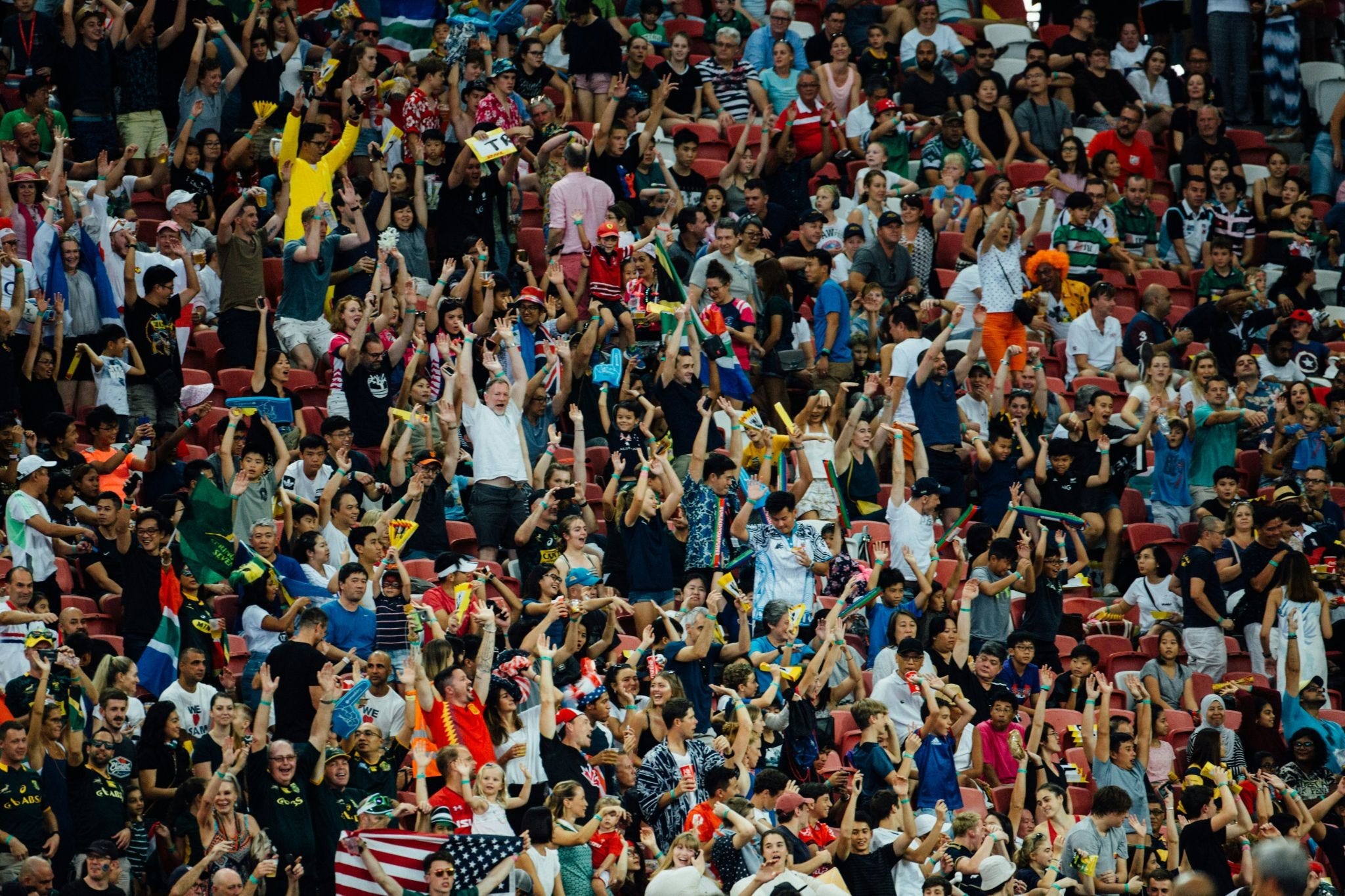
Half the planet is watching right now—strangers in matching jerseys hugging in bars, whole countries holding their breath. Work productivity is quietly collapsing across a dozen time zones. Almost nothing else pulls so many different people in the same direction at once.
This is worth reflecting on. The World Cup creates a sense of shared purpose among people who may agree on little else, turning a fleeting moment of joy into a collective experience. It is a powerful model of unity. Political leaders struggle to recreate this kind of spontaneous unity.
This is a piece about sport and belonging, and what leaders can learn from both — centered on a basketball speech.
I’ve previously explored my sports obsession—and what political leadership can learn from the game—in The Metaphor That Finally Makes Sense of Modern Politics.
My first team was my hometown team, the Seattle SuperSonics. I spent my childhood with my mom on the living-room floor, bathed in the glow of our old TV, sitting way too close to the screen, watching them claim the 1979 NBA championship. I can still see Jack Sikma’s pioneering “Big Stretch” signature reverse-pivot jumper, and “Downtown” Freddie Brown’s effortless long-range shots, even before the NBA instituted the three-point line. Those games are hardwired into my DNA. (I’m counting the days until they return; I’ve already promised myself a seat.)
But… I also lived in New York for over a decade. I had both of my babies there. From the day I arrived, I felt like a New Yorker. Not eventually, but right away. I feel like New York hands you belonging before you’ve earned it, then dares you to live up to it. I took the dare. The city got into my blood the same way the Sonics did: as a feeling of being part of something collective, swept into a crowd that had decided I was one of theirs.
So, when I watched NYC Mayor Zohran Mamdani speak at the Knicks Championship parade last week, I felt all those feelings again. He took a city of strangers and made everyone feel like they had been there for the whole 53-year wait. Great rhetoric does not guarantee great governance, but it can reveal something about how a leader understands community and belonging.
I want to walk through the speech with you, focusing on the specific moves that do the real work. I highly recommend watching the video of the speech if you can, because as we all know, delivery matters. A game brings people together on its own; the win does the work. A speech doesn’t have that luxury. Mamdani had to build the same feeling out of words alone — doing on purpose what the game did by accident.
This isn’t about whether you like him or his politics; it’s about what you can learn from his leadership. What looks like a sports speech is a working demonstration of how political leadership creates belonging. Once you see these moves, you can’t unsee them.
Move one: he made everyone a witness
Watch and listen to how he opens.
“For 53 long years, we have watched, and we have waited. We have watched from nosebleeds and through gritted teeth, on televisions in the windows of electronic stores, and from projectors balanced on fire escapes.”
He doesn’t start with the team. He starts with us. He names where we were—the nosebleeds, store windows, fire escapes. The cramped apartment where you sat alone with your head in your hands.
That’s a leader telling a fractured city that whatever corner you watched from, you were part of this. He builds the “we” before he ever mentions the win.
The lesson: Belonging often starts with recognition. Name the specific, uneven ways people lived through a moment, and the “we” you build on top will feel real instead of imposed.
Move two: he honored the people who never got the glory
Most politicians would thank the stars. Instead, Mamdani spends a stunning amount of time on the players who lost for years.
He names Toney Douglas, who he watched tie a franchise record from the stands in 2011. He names Jared Jeffries and Lance Thomas and Langston Galloway as “players who gave everything, every game, even when a 20-win season was all that was in sight.”
“This championship belongs to them, too, because championships aren’t just built in one season.”
Read this as a leadership statement, and it transcends basketball. It is a theory of how anything good is built: by people who put in work long before the win was visible, who held the line through the bad years. He tells every overlooked person in that crowd that their unglamorous effort counted.
The lesson: Belonging means honoring the people who did the work when no one was watching. The leader who only celebrates winners builds a thin, fragile “us.”
Move three: he turned a comeback into a creed
This is the heart of it. He walks the crowd back to Game 4: down 20 with nine minutes left. Analysts gave the Knicks a 0.4% chance.
And then:
“It is in that .4% that we go to work.”
He repeats it like a drumbeat. In that 0.4% is where Brunson proves the doubters wrong; where Karl-Anthony Towns finds the strength to mourn his mother and still pull in rebounds; where Jose Alvarado shows every kid in public housing that a son of Brooklyn and Queens can win for all five boroughs.
Then he pivots from the team to the city: :
“The Knicks did not just win for New York City. They won like New York City. What is New York if not your back up against the wall? A dream that feels just out of reach? A rent payment you don’t know how you’ll ever make?”
That is the move. A 0.4% chance stops being a basketball stat and becomes a portrait of their lives, and the comeback becomes proof of what they already survive every day.
The lesson: The most powerful civic stories are mirrors. People belong to a story the moment they see their own life inside it.
Move four: he named the rarest gift of all
Buried in the middle of the speech is the line I keep coming back to.
“So often, when this city comes together, it is because we are forced to by a moment of tragedy or adversity. What a gift it is to be brought together by pure, unfiltered joy.”
I’ve thought about that sentence more than any other. It is true of every city, yet almost no leader says it.
We often come together for funerals, disasters, or attacks. Too often, grief is the glue. Mamdani noticed that this time the glue was joy,and that joy is rarer and more precious than we admit.
This is what sport does. It manufactures joy at scale, letting strangers feel it together. A leader who names why it matters helps people carry that feeling longer.
The lesson: Joy may be one of the most underused tools in politics. Don’t wait for a crisis to bring people together — and when joy does the gathering, say so.

What he doesn’t do, and why it matters
Notice what is missing: he never makes it about himself. There is no “my administration” or list of accomplishments. He ends not with a demand but with a request: “One last time, New York, stand with me.”
Stand with me. Not look at me. That is the grammar of belonging.
Now the cautions, because belonging cuts both ways
If I stopped here this would merely be a fan letter. And I’d be doing the exact thing I warn leaders against: showing you only the flattering half.
Belonging is powerful, which is precisely the danger. The same speech that unites a city can, in other hands, exclude others. “Us” can turn into “us versus them” faster than expected.
So hold these next to the lessons.
Service can be a costume. Some dismissed the display as performance. Research shows that while serving others draws better people into politics, doing so in public also covers those wearing a ‘costume’ of service. You can’t always tell conviction from choreography, but you can watch what leaders do after the confetti has been swept away.
Avoid owning what you didn’t make. That joy came from the people, not City Hall. A leader can only tend it. Treating collective belonging as personal property turns something public into something private.
The test for all of it: Did the speech make the circle bigger — or put the speaker in the center of it? Read Mamdani’s speech again. For eight minutes, he kept choosing bigger.
It is vital, however, to be clear-eyed about the limitations of this model. Rhetorical belonging is a fragile bridge, not the destination. It gives leaders the opportunity to build trust, but it does not create trust on its own. A leader can master the rhetoric of belonging and still fail to address the structural conditions that undermine it. Inclusion is not a substitute for governance; it is a multiplier.
Why this isn’t really about basketball or the World Cup
Trust often follows belonging. People trust institutions once they feel they belong to a place. Belonging is rarely built by policy papers. It’s built in moments like this—by leaders who know what to say when the moment arrives.
Mamdani knew what to say. He stood in front of his city and told it the story of itself, honored the people who’d been forgotten, named the joy out loud, and asked everyone to stand together rather than to look at him.
Whether he keeps faith with that craft after the parade is the only question that matters. It’s the one none of us can answer yet.
Watch the World Cup. Feel that pull toward strangers. That feeling is the raw material of trust, which is the raw material of democracy. Leaders worth watching widen that feeling rather than weaponize it.
This is the thread I’m pulling on during my sabbatical: the ties between sport and better politics, and how their relationship can lead to better outcomes for people and the planet. I’ll have more to say soon.
Warmly,
Lisa
Comments
Nothing yet. Say the first thing.
Sign in to join the conversation.