
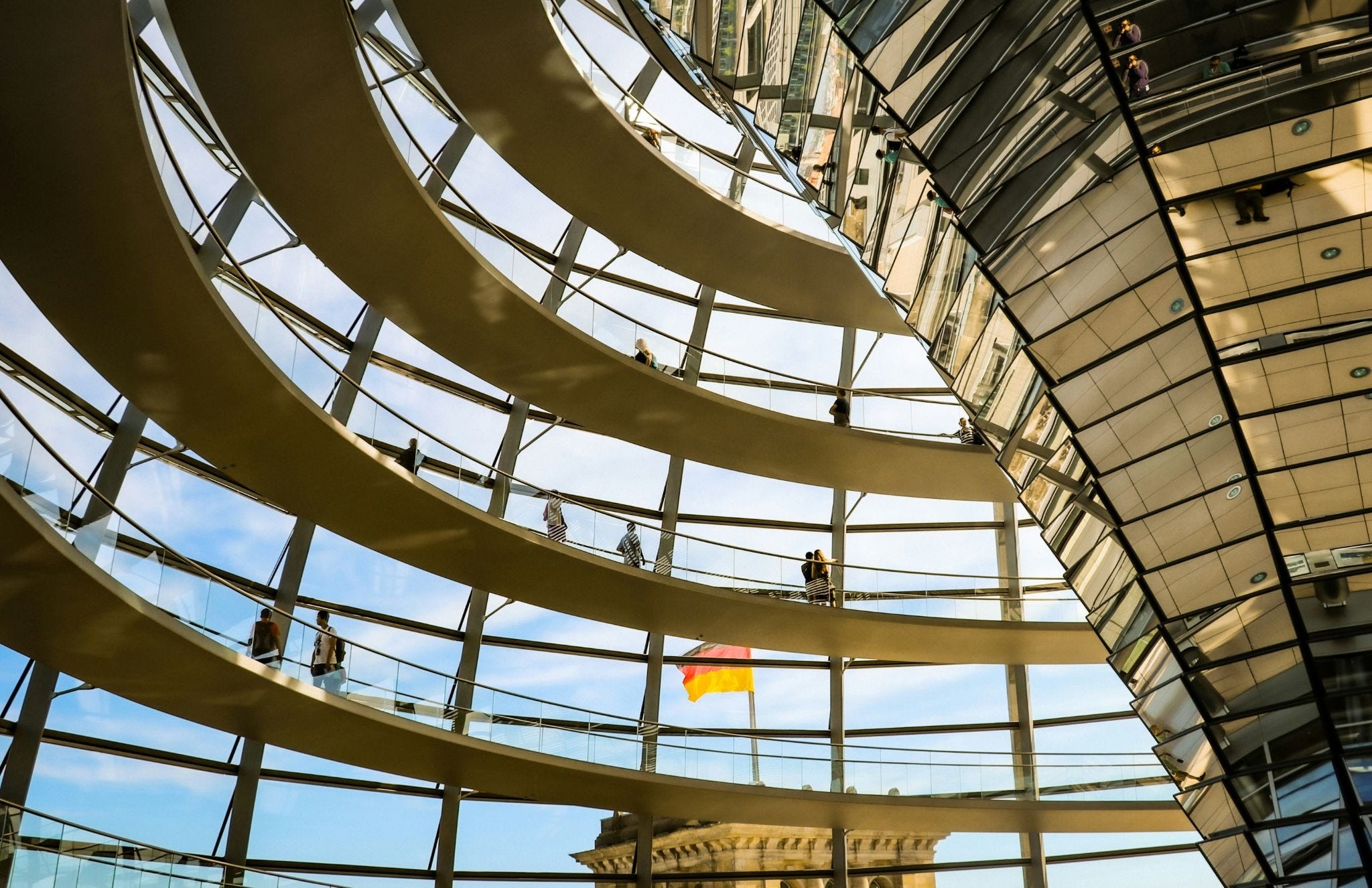
A member of the German Bundestag recently described her mornings to us by contrasting them with those of a predecessor. A friend’s father served in that same parliament from the 1970s through to the early 1990s. Every morning, he’d settle into his office for a quiet hour alone, reading the newspaper and catching up on the world before his day officially began.
Her reality is vastly different. She checks the news too, but by then eighty Signal messages have flooded in, a call is coming through, emails are piling up, and she might already have a Zoom call before her day has even officially started.
These are two members of the same parliament, holding the same title, just thirty years apart. Yet their jobs are unrecognizable from one another. The demands of the role have shifted dramatically, yet far less has changed about how we prepare people to meet them. Our new study set out to uncover what that disconnect looks like in practice.
Funded by the Robert Bosch Stiftung, this study conducted by the Better Politics Foundation followed newly elected Bundestag members through their first year.
Drawing on fifty interviews across the political spectrum, the findings feel universal. Germany currently holds the top position in the Better Politics Index, a pioneering global benchmark that treats the development and support of elected officials as essential infrastructure for a healthy democracy. If these gaps exist in one of the most well-resourced systems, it suggests representatives everywhere are likely facing similar, if not steeper, challenges.
The first year is a marathon run at a sprint pace. The hope that things will calm down after a few months rarely materializes; the pace stays relentless from early morning until night.
Learning happens on the fly, not through training. Across every skill the job demands, people pick things up informally, in the moment. The system assumes competence rather than building it, despite a clear hunger for structured guidance.
Informal networks are essential infrastructure. Access to knowledge, influence, and support often hinges on informal relationships within and across parties. This works for the well-connected, but it quietly reinforces existing inequalities for everyone else.
Mentoring is wanted, but only happens by accident. The single most requested form of help is an experienced person to talk to in the first weeks. But right now, it materializes only through luck: office proximity, a familiar face, an old connection. Even then, it’s the newcomer who has to know to ask.
Overnight, a representative becomes an employer. You win a seat and are suddenly managing a small organization, usually with no preparation. Almost every MP names this as one of their greatest and most underestimated challenges. Talent on a stage doesn’t make someone a good manager, and when it doesn’t, the people working for them bear the cost.
Overload is treated as a personal failure, not a systemic one. Exhaustion is widespread, but admitting it is seen as a career risk. So the subject stays taboo, and institutional support beyond basic work-life-balance measures is largely missing.
The most valuable skills are the ones no one asks for. Negotiation, political judgment, and getting clear on one’s own role and goals are abilities MPs tend to assume they already have, so they rarely name them as needs. Yet, those who are trained on these capabilities in a structured setting consistently rate them as among the most useful things they learn. The need is hidden; the impact is high.
It’s clear why this is happening: the demands of political office have evolved beyond recognition. Communication is instantaneous, scrutiny is constant, and the debate culture has sharpened. A representative is now expected to be reachable, visible, and an expert on a massive range of issues. As one first-term MP noted, there’s no job description, just endless, mounting expectations.
The toll is real. Our international study Mere Mortals found that politicians’ well-being is, in some cases, lower than that of emergency service workers. When people are constantly in crisis mode, their capacity for the very things the work depends on — careful negotiation, patience, and long-term thinking — erodes. Persistent overload isn’t just a personal struggle, but a structural weakness in democracy itself.
In other high-stakes fields like elite sport or top-tier business, we systematically invest in development and mental resilience. We wouldn’t expect someone to thrive in such an intense environment without support. Yet in politics, we still operate as if competence is an inherent trait that arrives fully formed. That gap is where new representatives are left to struggle alone.
We view this through the Political Leadership Impact Path, our bespoke model at the Better Politics Foundation that maps a political career as a loop rather than a ladder, one people re-enter and revisit as their roles change.
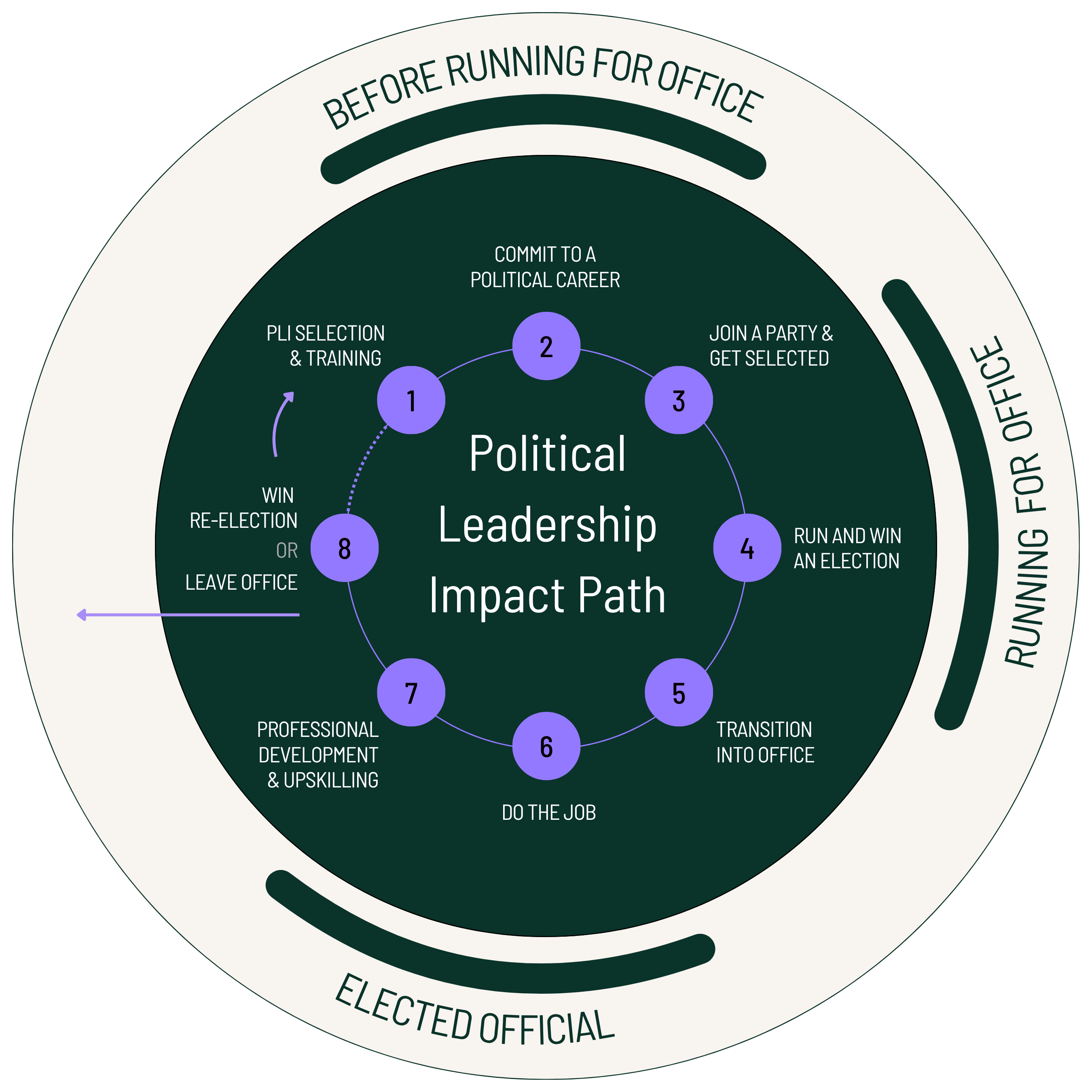
Seen this way, the gaps become obvious. Support (if any) often arrives in bursts — during the campaign when there’s no time, or during onboarding when there’s too much to process all at once and then thins out exactly when it would help most. And the needs themselves keep moving. At the start it’s practical questions about communication and setting up an office; later it’s strategic press work and ruthless prioritization; over time it’s self-care, role clarity, and strategic direction.
Support delivered once, at the beginning, can’t keep up with a target that keeps moving throughout the political path. And one transition carries more weight than the rest: stepping into office and starting the work. This is where early habits are set, first failures compound, and credibility is established or lost. It is precisely this high-stakes passage that the burst-then-silence pattern serves worst — everything dumped at onboarding, then little sustained support through the months when the role is actually taking shape.
The good news is that much of this is solvable, and that where support is offered, it’s embraced. But the study is equally clear on something more difficult: no single actor, and no amount of individual grit, fixes this alone. The taboo, the missing structures, and the mistimed support are properties of a whole ecosystem, and they shift only when parties, parliaments, foundations, and cross-party groups actually coordinate rather than work past one another. With that in mind, here’s where to start:
Formalize mentoring systems so that every newcomer can count on it.
Teach leadership and management as a core competency through structured introductory training and offer refresher courses.
Destigmatize overload. Leaders who speak openly about the strain lower the barrier for everyone else. Structural problems need structural solutions, not just personal resilience. For example:
A senior politician saying, “I don’t take calls after nine because tired people make bad calls on behalf of the country.” That framing, where the limit reads as competence rather than weakness, is the only one that holds up when your opponents are looking for a soft spot.
Party leaders standing behind a colleague who steps back for health reasons without that being the end of their career. Jacinda Ardern’s “not enough in the tank” resignation got a lot of attention, but it was an exit, not an example of how to stay, which tells you how little room there still is to do this and keep going.
Leaders being honest that the job has limits built into it: nobody masters defense, health, the budget and foreign affairs all at once, so leaning on others isn’t the leader falling short — it’s the role working the way it’s supposed to.
Build in methodological decision-making. For example:
A dedicated “futures” committee inside parliament. A permanent “futures” committee whose whole job is the long view: what the country faces in twenty years, not next year’s budget. Finland has one, its Committee for the Future, a standing all-party group of 17 MPs acting as parliament’s in-house think tank on long-term threats. The fuller version would route major bills through it for a “what could this look like in twenty years” check, the same way bills already get a routine cost estimate before they’re voted on.
A non-partisan foresight office working for parliament, not the government. Long-range thinking mostly happens inside the executive, who have every reason to forecast a future that flatters their plans. Give parliament its own futures analysis so the opposition isn’t stuck with the government’s version. The model already exists for money: the UK’s Office for Budget Responsibility and the US Congressional Budget Office were built so everyone argues over the same non-partisan numbers. A foresight office does that for the future, one shared forecast instead of whoever’s in power owning the only one.
A required “imagine it failed” step before any big decision. A required “imagine it failed” step before any big decision. Before signing off on something major, run a pre-mortem: assume the policy collapsed two years on, and explain why.
Create cross-party spaces — and run them deliberately. The best learning happens when rival-party representatives speak candidly in a setting their own parties can’t offer: small recurring groups, Chatham House rules, a neutral facilitator, stable membership, a shared task. Germany’s Brand New Bundestag and JoinPolitics do this, convening politicians from the Left to the CDU/FDP “at eye level” with civil society. Participants consistently say the relationships outlast the training content, which is why the convening itself is the deliverable.
Here’s the part that should matter to everyone who has never run for office and never will: the quality of the decisions that shape your life depend on the quality of attention the people making them can bring. Exhausted decision-makers, working without support in a job that has outgrown its preparation, make worse choices. Supporting representatives isn’t just sympathy for a profession few of us envy; it is, surprisingly, a matter of self-interest. It’s maintenance on the system we all depend on.
If you want to know more about our Bundestag study, come to our launch event on 25 June, 17:00–18:30, at the Deutscher Bundestag (Platz der Republik 1, Berlin). It features a cross-party panel with sitting MPs from the SPD, CDU, Bündnis 90/Die Grünen, and Die Linke. Register here.
Warmly,
Lisa, with Cäcilia Riederer, Senior Program Manager at the Better Politics Foundation.
Special thanks to lead researcher Corina Scholz.
P.S. Although this study was conducted in Germany, we believe the pattern is close to universal, and the model travels. If you’d like to see this research replicated in your own country, we’d love to hear from you.
Comments
Nothing yet. Say the first thing.
Sign in to join the conversation.