
Ruth Forrest is an accidental politician.
She grew up on a dairy farm in north-west Tasmania. She trained as a nurse and midwife. She spent more than two decades working with women and families, where trust isn’t a brand value; it means survival for mother and child. You don’t get to “message” your way through a complicated birth. You deliver, adapt, listen, and stay steady.
Then, in 2005, Ruth ran for office as an independent, with no party backing, no political career ladder, and having “never set foot in parliament” until she was elected.
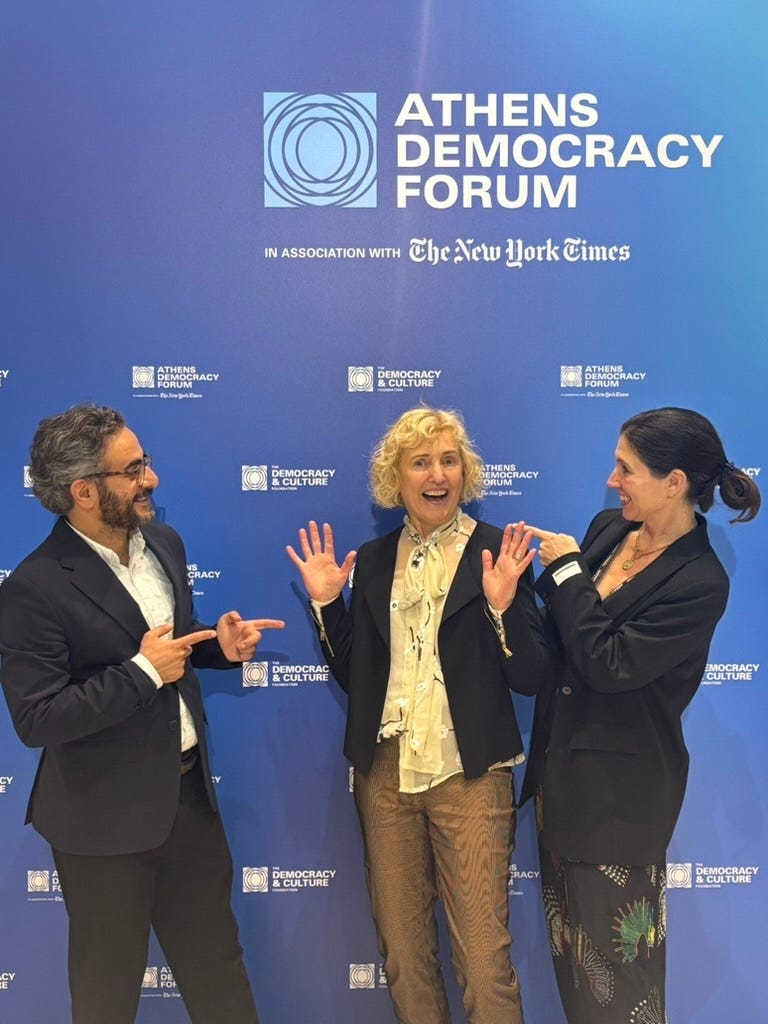
In 2025, the Better Politics Foundation inducted Ruth into our Democratic Innovator Hall of Fame at the Athens Democracy Forum in partnership with the Democracy and Culture Foundation. She was recognized for the two decades she spent modelling the calm, principled, accountability-first leadership that democracies quietly depend on.
Her story isn’t just inspiring. It’s a clue.
Because if you want to understand what’s missing in politics right now, especially in an age of polarization and institutional burnout, watch what happens when a midwife walks into a legislature.
Video: Ruth shares how she went from nurse and midwife to independent MP, why relationship-based maternity care shaped her leadership style, and her experience navigating a steep learning curve in parliament.
We often talk about representation in politics as if it’s only about demographic identity. It’s also about training and professional background.
In most democracies, political power funnels through a handful of professional lanes, especially law, business, and politics-adjacent roles.
Globally, lawyers are significantly overrepresented in politics. The U.S. is one clear example: in the 118th Congress, about 30% of House Members and 51% of Senators had law degrees and practiced law. Globally, a large-scale study conducted by The Economist estimated that lawyers comprise about 20% of the world’s politicians. Yet, lawyers make up only about 0.09% of the global population, roughly 1 in 1,100 people. That means lawyers appear in legislatures at more than 200 times their share of the population.
And politics tends to reinforce familiar pathways.
In the US, 80% of House Members and 82% of Senators had served as public servants or elected officials before arriving in Congress. Comparative research shows similar patterns elsewhere: political careers in many democracies increasingly follow professional pathways through party organizations, government roles, or political staff positions.
This isn’t about lawyers or career politicians being the problem. Democracies need legal expertise. And institutional experience matters.
But when one worldview becomes the default operating system, it shapes what the system optimizes for. You get people trained to interpret laws, build arguments, navigate institutions, and manage coalitions. All essential political skills, but different from the less glamorous work of delivery.
This is where midwives matter.
Video: Ruth reflects on entering politics after midwifery—shifting from evidence-based decisions built around shared outcomes to a system shaped by party positions, vested interests, slower processes, and the need to build consensus to move good ideas forward.
Midwifery builds leadership muscles that modern politics has let atrophy:
In the birthing room, your nervous system matters. If you escalate, everyone escalates. If you stay grounded, other people can stay grounded too. Midwives get trained over years to keep their prefrontal cortex engaged when things get intense, allowing judgment and calm to guide action instead of panic.
Politics right now can keep people in a constant threat response. Midwives bring regulation back into the room.
Ruth describes decisions as a blend: listen deeply, observe carefully, and trust experience. Then go find the evidence, hear the counterargument, and stress-test your assumptions.
That’s good clinical practice. It’s also good governing.
And here’s the difference that matters: in healthcare, reality gives fast feedback. You can’t spin outcomes, because you live them. In politics, feedback is often slower, noisier, and easier to confuse with the news cycle or narrative.
Healthcare hierarchies are real. Ruth learned early to challenge powerful doctors and male-dominated health structures, not to score points, but to protect the women in her care and improve their outcomes.
Translated into politics, that becomes rare: a leader who can confront power without needing to become it.
Politics is often tribe-loyal. Healthcare people are often outcome-loyal.
Video: Ruth makes the case that parliaments should reflect the diversity of the people they represent and explains why a mix of life experience and training leads to stronger scrutiny, better policy, and better outcomes.
A legislature stacked with lawyers will be great at spotting legal flaws. A legislature stacked with political insiders will be great at reading the room.
But midwives and other health workers notice different things. Because they have worked directly with the real human consequences, they notice where policy looks good on paper but strains in practice.
They also bring a different relationship to time. In maternity care, you learn that change unfolds in stages. Push before the body is ready and you cause harm. Wait too long, and you cause harm as well.
Because the system isn’t built for outsiders.
Ruth is candid about how steep the learning curve was. And she’s right: we expect people to walk into one of the hardest jobs in society and instantly know how to do it, with barely any structured onboarding.
As a result, the political leadership pipeline quietly filters for prior political exposure— staffers, advisers, and party insiders—because they already know the system.
But if we only recruit people who already know the system, we shouldn’t be surprised when politics continues to optimize for insiders.
The fix isn’t “hope harder.” It’s to build real pathways for outcome-driven professionals — like midwives, nurses, paramedics, and public health leaders —to enter politics without being punished for not already speaking the language.
If we want politics to be more trustworthy, we need more people trained in trust.
If we want better policy delivery, we need more people trained in delivery, literally and figuratively.
That’s why we need more midwives and other healthcare professionals in politics.
How can we make that happen?
Peer pull: Professionals like Ruth can play a powerful role by tapping and mentoring other health workers to step into public leadership.
Professional on-ramps: Associations and leadership programs can start treating politics as a legitimate pathway for people from clinical and frontline backgrounds, introducing them to the basics of policymaking and public leadership.
Targeted recruitment: Political talent organizations can systematically reach into healthcare and build professional-friendly pathways to run for office.
Ruth Forrest didn’t plan to become a politician.
Which is exactly why her leadership is so valuable right now.
Because the people who have spent their lives helping others through the most intense moments—birth, illness, emergencies, grief—might be among the best equipped to help democracy through this one.
Thanks, Ruth!
Warmly,
Lisa
Check out more clips of my interview with Ruth:
Ruth reflects on how her strong sense of justice shaped her path into leadership and politics. From childhood she believed in fairness and equal treatment, and as a midwife she advocated for better care and choices for all women, challenging power structures in healthcare and later working through the College of Midwives to push for policy change.
Ruth discusses how social media has increased the hate and abuse politicians face, particularly the misogynistic attacks directed at women. She highlights the importance of supporters calling out sexism, correcting misinformation, and initiatives like Flip the Hate that counter online hate with facts.
Ruth explains how she uses AI tools to save time by organizing and refining her thoughts for debates or writing, exploring the pros and cons of issues, and summarizing dense reports—while noting the importance of verifying the information since AI is not always accurate.
Ruth talks about her experience of being an independent politician in a polarized political system. She explains that while being independent can be lonely and requires a lot of work without the resources of a political party, it allows her to remain accountable to her constituents rather than to party positions.
Comments
Nothing yet. Say the first thing.
Sign in to join the conversation.