
As discussed in our Substack last week, the GSIB surcharge is an additional capital requirement that applies only to the eight most systemically important banks in the U.S. (global systemically important banks or GSIBs) to account for the economic and financial damage their failure would cause. When the Federal Reserve Board (Fed) calibrated and adopted the GSIB surcharge in 2015, it released an important paper that built its GSIB framework around a simple but powerful concept: the “reference bank.”
According to the Fed’s methodology, since the GSIB surcharge was to apply to only the most systemic banks, the reference bank was intended to represent the largest banking organization whose failure would not require extraordinary government intervention. In that way, the reference bank served as the anchor for calibrating the surcharge, and banks posing more systemic risk than the reference bank would have higher capital requirements than banks posing less systemic risk. Therefore, accurately determining the reference bank is critical to the entire basis for the GSIB surcharge.
In 2015, the Fed used a hypothetical reference bank that was based on both the experience from the 2008 financial crisis and systemic risk data. GSIBs want the reference bank to be as large as possible because a larger reference bank means a lower GSIB surcharge, and a lower GSIB surcharge means less capital they have to hold to protect against losses.
However, the facts changed in March 2023. Silicon Valley Bank (SVB), which, as described below, was much smaller in size and systemic importance than the Fed’s reference bank, became the first U.S. large bank failure since the GSIB surcharge was adopted that forced regulators to answer the too-big-to-fail question again in real time. Did the failure of Silicon Valley Bank pose a systemic risk serious enough to justify extraordinary government intervention? The Fed, the FDIC, and the Treasury Department (with the concurrence of the President of the United States) answered with an unequivocal yes.
Using the Systemic Risk Exception Indicates a Bank’s Failure Is Systemically Important
Within two days of SVB’s failure, regulators invoked the “systemic risk exception” that can only be used if regulators determine the failure of the institution would have “serious adverse effects on economic conditions or financial stability.” This emergency government intervention guaranteed all the uninsured deposits of SVB (and Signature Bank, an even smaller regional bank). The Fed also created the Bank Term Funding Program using its emergency lending authority to prevent broader contagion. Current Fed Board members Powell, Barr, Bowman, Waller, Jefferson, and Cook all supported those extraordinary actions along with current FDIC Board Chair Hill and Under Secretary of the Treasury McKernan.
The implication of those events for the GSIB surcharge is straightforward. The Fed no longer needs to estimate where the intervention threshold lies because it has already revealed the answer through its own actions. The central question is whether the Fed is willing to update its framework to reflect that evidence. In other words, the reference bank is no longer hypothetical; it is SVB—or smaller.
The Fed’s Recent GSIB Proposal Ignores the 2023 Banking Crisis
Yet the Fed’s March 2026 GSIB proposal ignores the single most important piece of real-world evidence produced since the surcharge framework was created.
Instead, the proposal continues to rely on the same hypothetical reference bank developed more than a decade ago, without asking whether the events of March 2023 changed the calibration’s central assumption.
That omission matters because the U.S. government’s revealed preferences are more informative than its earlier assumptions. Economists use the term “revealed preferences” to describe what institutions actually choose when confronted with real-world decisions. Those choices provide stronger evidence than hypothetical models because they reflect decisions made under real-world constraints. Put another way, before 2023, the Fed had only a theory of the reference bank; after the failures of SVB and Signature, it had evidence.
Calculating the New Reference Bank
The numbers illustrate why this matters.
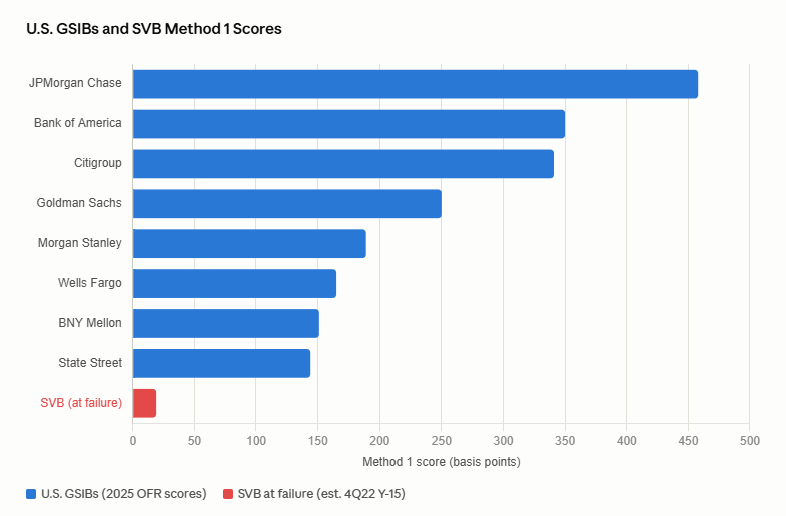
The GSIB surcharge is calibrated by calculating a Method 1 “score” across several systemic risk factors that measure a bank’s systemic importance relative to the largest banks. When the Fed calibrated the surcharge in 2015, it concluded that the reference bank had a Method 1 GSIB score of roughly 130 basis points (for more information on Method 1 scores, see this link). The Fed used the reference bank level to scale the GSIB surcharge for the GSIBs (those with scores above 130 basis points). Note that we discussed the Fed’s Method 2 GSIB framework in a previous Substack.
SVB’s estimated Method 1 score at failure was approximately 19 basis points—roughly one-eighth of the threshold embedded in the current framework. Put another way, the Fed, other banking agencies, the Treasury Department, and the President felt compelled to take emergency actions to address the failure of a bank far smaller than what capital calibration models assumed.
Former Fed Vice Chair for Supervision Randal Quarles reinforced the significance of Method 1 only weeks before SVB failed. Speaking at the Office of the Comptroller of the Currency’s February 2023 Bank Merger Symposium, Quarles explained that Method 1 remains the Fed’s best measure of systemic importance because it relies on internationally agreed indicators specifically designed to identify banks whose failure would threaten the global financial system. Quarles was correct on that narrow point. Method 1 is a sensible framework for identifying globally systemically important banks.
The problem is that the systemic risk exception is not a global standard. When the Fed, FDIC, and Treasury invoked it for SVB and Signature Bank, they were deciding whether their failures would have “serious adverse effects on economic conditions or financial stability” in the United States, not the global financial system. Those are different standards. A framework calibrated to global systemic importance will, by design, fail to identify banks that are systemically important within the United States but not globally. As we recommend in our comment letter on the capital proposal, the logical solution is a domestic systemically important bank (DSIB) framework calibrated to the U.S. intervention threshold the government revealed in 2023—not to global systemic importance standards designed for a different purpose.
The Fed continues to use Method 1 scores and surcharges in a number of key regulatory frameworks. For example, in considering bank mergers, the Fed relies on a combined firm’s Method 1 score to assess the financial stability effects (for example, Capital One’s acquisition of Discover in 2025). The Fed also uses a GSIB’s Method 1 surcharge for the enhanced supplementary leverage ratio and total loss-absorbing capacity requirements. Clearly, the Fed continues to treat Method 1 as an important measure of systemic importance.
A Proxy Calibration of Method 1 Surcharges
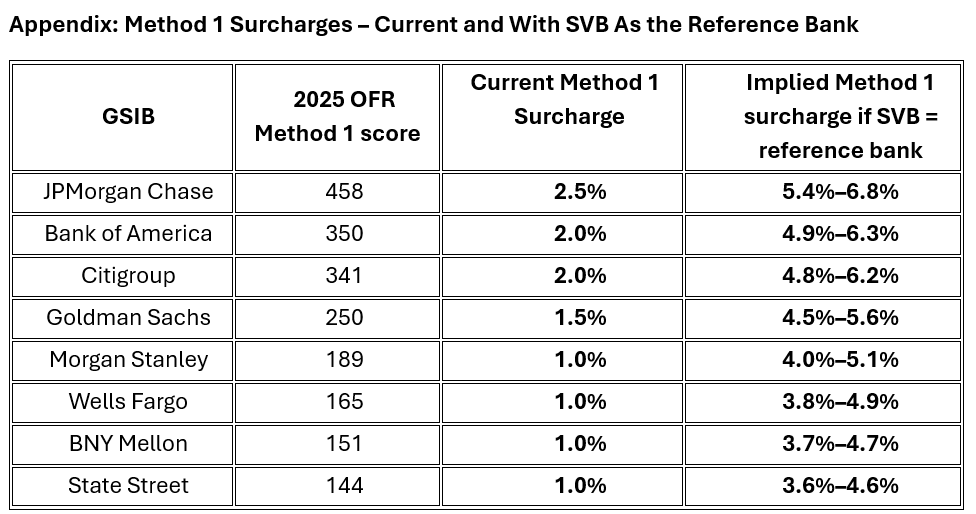
As shown in the Appendix, Better Markets in our comment letter to the proposal applied the Fed’s own calibration methodology using SVB as the reference bank and the 2025 Method 1 scores for the eight U.S. GSIBs.
Under this approach, every U.S. GSIB would face a substantially higher Method 1 GSIB surcharge—not a lower one as the Fed proposed. This higher outcome is consistent with those from the Fed’s own economists who have warned for over a decade that Method 1 surcharges are far too low.
For example, JPMorgan Chase’s implied Method 1 surcharge would more than double, from 2.5 percent to between 5.4 and 6.8 percent. Even the “least systemically important” U.S. GSIBs would see their required capital quadruple, going from a current 1 percent to a surcharge approaching 4 percent.
Those results are intuitive because if the government’s actual intervention threshold is much lower than regulators assumed in 2015, then the amount of capital necessary to offset the subsidy associated with being too big to fail must necessarily be higher as well.
Whether one agrees with that outcome is beside the point. Agencies can make reasonable estimates and predictions when evidence is unavailable. However, they are not free to ignore better evidence once it exists. The 2023 banking crisis supplied precisely the evidence the Fed lacked when it originally calibrated the GSIB surcharge.
The proposal repeatedly claims to “better align” GSIB surcharges with systemic risk, yet nowhere does it analyze whether the government’s March 2023 invocation of the systemic risk exception changes the calibration of the reference bank.
Conclusion
In any final rule, the Fed cannot simply ignore the most important evidence produced since the GSIB surcharge was adopted. We recommend the Fed analyze whether SVB, or a similarly situated institution whose disorderly failure required extraordinary government intervention, more accurately reflects the revealed systemic risk threshold in today’s banking system. Only after conducting that analysis can the Fed reasonably conclude whether GSIB surcharges are too high, too low, or appropriately calibrated. Our analysis suggests that the Fed is seriously missing the mark; until the Fed completes its own rigorous review, it cannot conclude that GSIB surcharges are too high.
Sources: (1) Office of Financial Research GSIB Data available at: https://www.financialresearch.gov/bank-systemic-risk-monitor/; (2) Fed calibration white paper Calibrating the GSIB Surcharge, and related explanatory materials describing the expected-impact framework and calibration methodology; (3) SVB’s 4Q22 FR Y-15 and the Fed’s 2022 Method 1 global denominators.
No posts
Comments
Nothing yet. Say the first thing.
Sign in to join the conversation.