
This is the first post in a series on what artificial intelligence is doing to the real economy—your job, your savings, your loan, your energy bill, your local bank—and who ends up capturing the gains and bearing the costs.
There is no serious argument left about whether artificial intelligence is reshaping the economy. The money settles that question on its own. As highlighted in the chart below, investment in AI companies roughly doubled over the course of 2025 to around $580 billion. Generative-AI funding more than quadrupled over the same period, and U.S. private AI investment alone is currently near $286 billion.
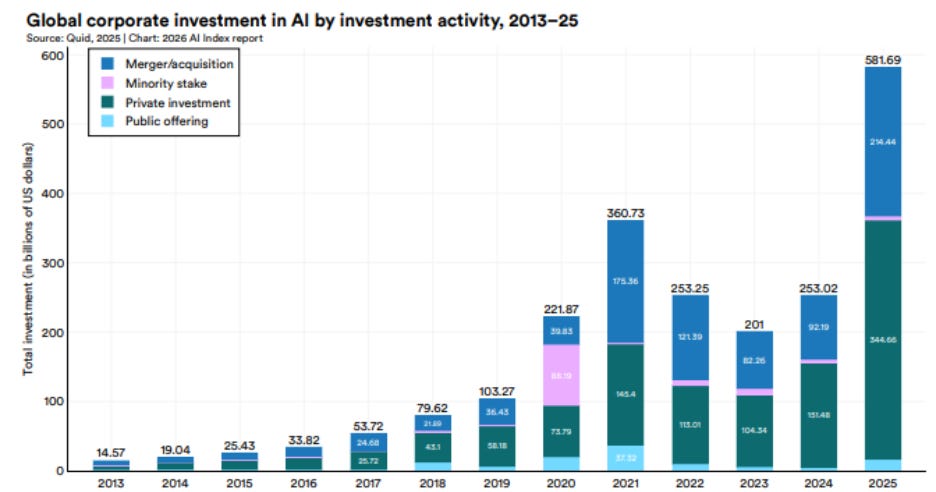
Source: Stanford HAI’s 2026 AI Index Report
By almost any measure, this is one of the largest and fastest capital deployments in the history of American business: for example, the Wall Street Journal reported that projected AI infrastructure spending by four U.S. tech giants in 2026 (as a percent of GDP) is bigger than most of the United States’ largest capital outlays other than the Louisiana Purchase!
The interesting questions are not whether or how big AI will grow. They are quieter, and they matter more to most people’s lives: Who captures the value AI creates? Who carries the risk? And who pays the bill?
That is what this series is about. Over the next several weeks, we will work through how AI touches each part of a household’s and a small business’s economic life: work and wages, retirement savings, credit, financial stability, energy costs, and the rules that are supposed to govern all of it. Some of what follows is genuinely good news. Some of it is alarming. Most of it is contested, and we will try hard to be honest about which is which.
The through-line is a single idea: change is certain, progress is not. AI is contributing to economic growth and an extraordinary wave of investment. Whether that translates into broad progress and prosperity or simply concentrates wealth and risk in a few hands is not predetermined, but rather contingent on choices made by policymakers. Which path we choose will be determined by tax policy, social safety nets, financial regulation, and our legal structure, along with the hundreds of decisions that are being made by business leaders and policymakers right now, mostly without much public attention.
AI investment is growing at a breakneck pace
While AI’s scale is the story, it is also important to look closely at where the money is going.
As of year-end 2025, approximately 35 gigawatts of data-center capacity were under construction across North America—roughly equivalent to the annual electricity consumption of the UK or Italy. The largest cloud-computing companies (the so-called “hyperscalers”) are on track to spend somewhere near $700 billion on capital projects in 2026 alone. That spending now is increasingly financed with debt, as AI-linked borrowing stands at around $430 billion in 2025.
This is a buildout of historic proportions, and even some of its own architects are uneasy. Jeff Bezos has called the moment an “industrial bubble.” That doesn’t mean the technology is fake, but it’s a striking word from someone with every reason to cheer.
How much does our economy depend on AI?
As you will see in future posts, there is still much debate on how AI has and will impact the U.S. economy. For example, Harvard economist Jason Furman calculated that information-processing equipment and software—essentially the computing hardware and code behind the AI buildout—was responsible for 92% of GDP growth in the first half of 2025, despite only accounting for just 4% of GDP. Once this growth is stripped out, the rest of the economy grew at something like 0.1%. Economists from the Federal Reserve Bank of St. Louis estimate that AI investments made up 39% of GDP through the first three quarters of 2025, and Renaissance Macro found that AI capital spending added more to GDP growth than consumer spending.
Each version of the story points to a remarkable share of recent U.S. economic growth riding on AI-driven capital investment. When a single investment wave is doing that much of the lifting, the question of whether it pays off, and for whom, starts to matter not just for the companies involved, but also to the banks, private credit vehicles, and other investors financing AI’s development. This future also matters to policymakers, who have a lot riding on continued American economic growth.
Why the gains and the costs land in different places
There’s a structural reason the headline economic numbers can look healthy while specific people feel squeezed.
Capital spending on tangible products such as chips, servers, and data centers quickly manifests into economic statistics. You build the thing, you buy the equipment, and it shows up in GDP. However, the effects on workers, wages, and small businesses move on a slower and much harder-to-read clock. They show up as a hiring freeze that’s never announced, a raise that doesn’t come, an entry-level job posting that quietly disappears, or a local bank that cannot keep up and sells to a bigger one.
Thus, you can have a macro picture that looks strong and a Main Street picture that feels precarious at the same time and for the same reason. That gap between what the aggregate numbers say and what households and small businesses experience is where this whole series lives.
What this means for you
It’s fair to ask what a $580 billion investment wave has to do with your life. The answer is: more than the abstraction suggests, and in ways that depend a lot on who you are.
If you’re a Main Street household—a worker, a saver, a borrower, a ratepayer—the AI buildout reaches you through channels you didn’t choose and mostly cannot see. Your retirement account will soon be exposed to a handful of AI-related giants, whether or not you ever bought their stock, because index and target-date funds hold them by construction. Your electricity bill is being shaped by data centers competing for the same power you use. Your next loan application may be decided by a model whose reasoning no human at the bank can fully explain. And if your work involves tasks a machine can now do (or at least your employer believes it can do), the pressure on your job and your raise is real. All these changes can be true even as the headline economy looks strong. The recurring theme of this series is that the gains of this wave are easy to capture if you build and own the technology, and the costs are easy to pass down if you don’t.
If you run a small business, you face a sharper version of the same squeeze. You’re subject to the same automation incentives as large firms but without their capital, their data, or their access to AI talent. You’re a ratepayer with thinner margins to absorb rising energy costs. And if you bank with a community lender—the institutions that make more than 35% of small-business loans according to Better Markets’ research—you have a stake in whether those banks can keep up with megabank and fintech technology or get consolidated away.
But the impact doesn’t stop at Main Street. Workers in highly paid, highly exposed white-collar fields—software, law, finance, consulting—may feel the displacement edge of this wave as much as anyone, in some cases sooner. Investors and retirees of every income level are exposed to concentration risks related to the largest AI companies’ growth within the stock market. Communities hosting data centers, whatever their economic profile, absorb the grid strain and the local costs. State and local governments are negotiating tax and utility deals whose terms will outlast a news cycle. And all of us, as participants in a democracy, have a stake in whether the same technology that can scale fraud and manipulation also gets used to strengthen public participation. This is a story about distribution, and almost no one sits entirely outside it.
What’s at stake for Main Street
To make the rest of the series concrete, here’s the ground we’ll cover, framed as the things AI is poised to touch in your own economic life:
Your job and your raise: who keeps work, who captures the productivity gains, and why the tax code quietly tilts the field toward replacing people.
Your retirement: how index funds and target-date accounts have made nearly every saver an unwitting bettor on a handful of AI giants.
Your loan, your rate, your limit: where algorithmic credit expands opportunity and where it scales old discrimination.
Your legal standing: the unsettled questions of who are responsible when an autonomous system makes the call.
Your energy bill: who pays for the power the data centers consume.
Your small business: facing the same automation incentives as big firms, without the capital, data, or talent.
Your local bank: and what a town loses when the relationship lender disappears.
On most of these topics, we will lead with the genuine opportunity and then turn to the risk, because the opportunity is real and worth defending. AI can extend credit to people that the old system ignored. It can make small institutions more efficient. It can give ordinary citizens tools to follow what their government is actually doing. The builders working to make those things happen responsibly are allies, not adversaries.
What we won’t do is pretend the outcome is settled. It isn’t. The technology is going to change the economy, no matter what we do. Whether that change amounts to progress that is broadly shared, with the risks fairly borne, depends on choices we are making right now.
Remember: change is certain, progress is not.
Next up: the AI-and-jobs debate has lurched from “white-collar bloodbath” to “delighted to be wrong” in barely a year. We will trace how the argument itself has evolved since ChatGPT and what we know today about the impact of AI on the American workforce.
No posts
Comments
Nothing yet. Say the first thing.
Sign in to join the conversation.