
In March 2026, the federal banking agencies—the Federal Reserve, the Office of the Comptroller of the Currency, and the Federal Deposit Insurance Corporation—issued three proposals that will fundamentally reshape the banking industry. Contrary to the agencies’ assertions, however, the proposals will significantly reduce capital requirements for the biggest banking conglomerates and entrench the dominance of their financial markets-centric business models, increasing financial stability risks and diverting financial resources away from the Main Street economy.
The reason is straightforward: the proposals would make it more profitable for those banks to continue focusing on financial markets instead of lending to Main Street while materially lowering the capital cushions that prevent those banks from failing. Moreover, lowering big bank capital would further expand their substantial funding, competitive, and regulatory advantages compared to their smaller banking peers, especially community banks.
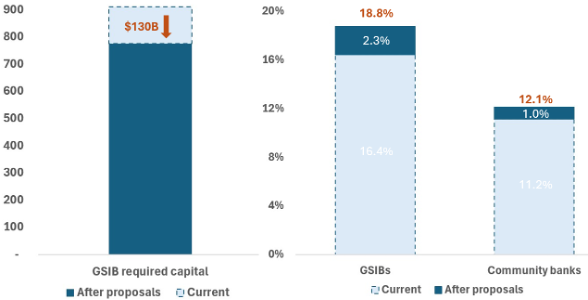
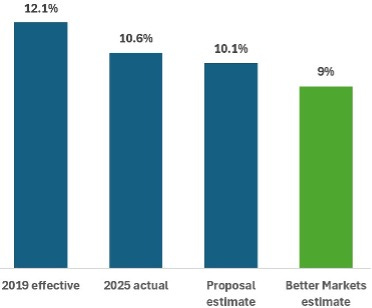
In Better Markets’ three comment letters on the proposals (see Basel III, GSIB surcharge, and standardized approach), we break down how the proposals are repricing more than $20 trillion of assets on banks’ balance sheets. For the biggest, systemically important banking conglomerates in the U.S. (so-called “GSIBs”), we estimate that required capital would decrease by 1.6 percentage points relative to 2025 requirements—and substantially more relative to 2019 requirements—or approximately $130 billion, despite the fact that GSIBs engage in the riskiest activities and their failure would be catastrophic to the economy and financial markets, something even recognized by the agencies in their proposals. As a result, GSIBs would be grossly under-capitalized relative to their systemic risk, unfairly giving them a substantial boost to their profitability and competitive advantages over smaller banks.


Below we highlight some of the most significant issues with the proposals, each of which Better Markets will delve into further in future Substack posts.
The Fed’s GSIB Proposal Ignores Both the Data and the U.S. Government’s Actions
The Fed created the GSIB surcharge after the 2008 financial crisis to reduce the likelihood that the failure of a GSIB would cause widespread economic and financial devastation by requiring those banks to hold more capital.
The Fed is proposing to permanently reduce the GSIB surcharge under the premise that current surcharges “overstate systemic risk.” But the Fed did not identify a single institution, failure, or market episode since 2015 (when the surcharge was finalized) demonstrating that this is true. In fact, what the post-2015 record shows is the exact opposite: every major stress event—the 2019 repo crisis, the March 2020 Treasury market disruption, the blow-up of the Archegos fund, the 2023 failures of Silicon Valley Bank, Signature, and First Republic, and the emergency rescue of Credit Suisse—all ended with extraordinary government intervention. These episodes show that the current surcharges likely understate systemic risk.
Before the Board can finalize the proposed surcharge reductions, it must address eight threshold legal and procedural deficiencies identified in Better Markets’ comment letter. This includes the unjustified reductions in the coefficients (the inputs to the formula for the GSIB surcharge), which drive the majority of the capital decrease for GSIBs estimated under the combined effect of the proposals. In fact, Fed Vice Chair Bowman’s sworn congressional testimony revealed that the proposed coefficient reduction was a political compromise to secure votes on the Fed Board, rather than one driven by data or analysis.
It also includes what may be the GSIB surcharge framework’s most significant flaw: the Fed’s GSIB framework appears to calibrate the threshold for systemic importance roughly seven times higher than the threshold revealed by the U.S. government’s interventions during the 2023 banking crisis. The framework assumes that a bank must have a GSIB score of about 130 basis points before extraordinary government intervention becomes likely in the event of its failure. But in March 2023, the U.S. government intervened to prevent the failure of Silicon Valley Bank, whose GSIB score was only 19 basis points. The government’s actions provide the clearest evidence of where policymakers believe systemic risk actually begins. Yet the Fed now proposes to reduce GSIB surcharges without first reconciling its framework with the U.S. government’s own actions during the 2023 banking crisis.
Notwithstanding those concerns, Better Markets supports several elements of the proposal that we believe should be finalized immediately—including daily averaging of GSIB risk indicators to end the decade-long “window dressing” problem and to better measure risky wholesale funding. When banks engage in “window dressing,” they temporarily alter their balance sheets around reporting dates to artificially reduce their measured risk and lower their required capital.
In our next Substack post, we will examine the GSIB surcharge proposal in more detail.
Proposed Rules Would Incentivize Banks To Do More Lending to Nonbank Financial Institutions Like Hedge Funds and Private Equity Funds
The agencies’ principals have said repeatedly that they are concerned about the increase in bank lending to nonbank financial institutions—or NBFIs like hedge funds and private credit vehicles—and the steady migration of lending out of banks to nonbank lenders, such as nonbank mortgage lenders. However, key parts of their proposals go directly against these concerns and would in fact incentivize even more of these activities by making them more profitable for banks and NBFIs.
NBFI financial activities rely heavily on bank credit lines. For example, nonbank mortgage lending is entirely funded by bank loans, and hedge fund borrowing from the largest U.S. banks is at an astonishing $3.3 trillion. That’s because the current bank capital rules perversely make it more profitable for banks to make loans to NBFIs than to other companies, small businesses or individuals, which is why last year loans by the largest banks to NBFIs increased around 50 percent, as opposed to zero growth in other loans.
Notwithstanding the current trends, the proposals would make NBFI loans even more profitable than loans to the real economy, incentivizing more NBFI lending and less lending to households and businesses. First, the proposals would lower the capital requirement for certain securitization exposures backed by loans to nonbank lenders, including nonbank mortgage companies and other nonbank financial institutions. Because nonbank lenders use these loans to support their lending, the result would be to shift more lending out of the banking system and toward nonbanks. Second, the proposals would give large banks significant discretion to determine which of their loans made to companies qualify for a much lower capital requirement. This light-touch approach would allow them to assign that lower risk weight to loans to investment funds, such as private equity and hedge funds, incentivizing more lending to investment funds and less to corporate lending, including small businesses.
The Agencies’ Claims about Reduced Capital Leading to Increased Lending are False
As noted above, the banking industry—and now the agencies’ principals—continually use the argument that reducing (or “freeing up”) capital requirements would incentivize banks to increase lending. This is a long-running fallacy that Better Markets has shown in multiple publications is not supported by the evidence.
First, big banks are more likely to use reductions in capital requirements to increase payouts to equity shareholders through dividends and stock repurchases or increase executive compensation. Furthermore, after the capital proposals were released and showed an estimated capital requirement reduction, none of the largest banks announced major new lending initiatives and instead announced increased dividends and stock repurchases.
Second, loans are funded in large part by bank deposits made primarily by individuals and businesses (basic banking is taking customer deposits and using those to reinvest in communities through lending). Capital funding, which comes from equity investors, is only a small portion of funding for a bank loan. Therefore, reducing a bank’s capital requirement does not magically create money for it to make new loans. A bank would also need to increase its deposits or borrow from other sources in order to actually increase lending, something that requires planning and is often difficult to do.
Third, the proposal could reduce lending to the real economy over the long run by tilting the regulatory scales toward big banks over their smaller competitors. By significantly reducing capital requirements for the GSIBs, the proposals would increase their profitability and competitive advantage relative to the 4,300 smaller banks that make up the rest of the U.S. banking system. Over time, that would likely allow them to capture an even greater share of banking assets, deposits, and lending. And because the biggest banking conglomerates devote a much smaller share of their balance sheet to traditional lending than smaller banks, greater concentration in the U.S. banking system would likely reduce lending to households and businesses.
Not only would the proposals fail to boost real economy lending as claimed (and in fact will likely decrease it in the long run), the proposals also would drive more large bank lending toward wealthy individuals, large corporations, and NBFIs. That is because the proposals would make lending to them much more profitable than lending to low- to middle-income borrowers and small businesses. Put simply, the proposals would shift lending away from Main Street and toward Wall Street and the financial sector.
What We Support in the Proposals and What’s Coming Next
In addition to the GSIB surcharge changes we support, Better Markets’ comment letters identify several elements of the Basel III and standardized approach proposals that would strengthen the capital framework. These include recognizing unrealized gains and losses on available-for-sale securities in capital, revisions to the definition of a commitment, and targeted improvements to the credit risk framework that would better support Main Street lending. Where the agencies have gotten the policy and the analysis right, we say so and encourage them to finalize those elements in due course.
Over the coming weeks, we will publish a series of Substack posts examining the proposals’ most consequential elements in detail. We will begin with the Fed’s outdated assumptions in the GSIB surcharge that ignore the extraordinary government intervention after SVB’s failure and the proposals’ incentives to increase lending to private credit and other NBFIs. We will then examine how the proposals could reduce lending to the real economy, why the Fed must finally address banks’ widespread window dressing of the GSIB surcharge, and why our impact analysis concludes capital requirements would decline far more than the agencies estimate.
We also want to hear from you. We plan to host a Substack Live soon to answer questions, discuss these proposals, and hear readers’ views. Stay tuned for details. Be sure to drop any questions you hope to see answered into the comments.
Thanks for reading The Public Interest by Better Markets! Subscribe for free to receive new posts and support our work.
Comments
Nothing yet. Say the first thing.
Sign in to join the conversation.