
Fourth in a series on AI and the real economy. Last week: AI automates tasks, not jobs, and the damage lands hardest on the entry rung. This week: why that's not just a market outcome, it's a policy choice written into the tax code.
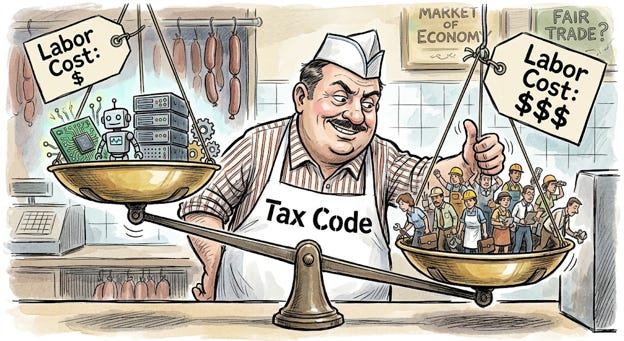
Image generated by Google Gemini
Suppose you run a mid-sized company, and you need a certain amount of routine work done: the document review, the initial drafting, the basic customer inquiries. You have two options.
Option A: hire a person. You find someone you’d pay $60,000 in wages. But that wage isn’t the actual cost of the hire. On top of it, you owe the employer’s share of payroll taxes plus unemployment insurance, workers’ comp, and benefits like health insurance and retirement contributions. Bureau of Labor Statistics data shows that, for private-industry workers, wages make up only about 70% of what an employer actually spends; taxes and benefits are the other 30%. To get $60,000 of someone’s work, you write a check closer to $85,000, and a big slice of that gap is a government-mandated surcharge you owe for no reason other than that you hired a human being.
Option B: buy a machine. A server, a software license, an AI system…basically something that does the same routine work. Spend the same $85,000 on it, and there’s no surcharge on top. No payroll tax, no unemployment insurance, no workers’ comp. Spend $85,000 on the machine and each dollar goes toward the capability you’re buying. With the worker, thousands of those dollars were peeled off for taxes before you got any work at all.
Same budget, same work, but hire the human and the government skims a surcharge off the top; buy the machine, and it doesn’t. That asymmetry isn’t an accident or an oversight; it’s the accumulated result of decades of policy decisions. And that’s before the machine’s other advantage, which comes from the 2025 tax law. More on that shortly.
If you want to understand why firms keep choosing displacement over augmentation, this is the place to look.
The Size of the Gap
The definitive work here is by MIT’s Daron Acemoglu and Andrea Manera, with Boston University’s Pascual Restrepo, in a 2020 paper titled, bluntly, “Does the U.S. Tax Code Favor Automation?“
Their answer is yes, and increasingly so. They add up everything the government effectively takes on each side: income taxes, payroll taxes, and the various deductions and credits that apply. For every dollar’s worth of work done by a person, the tax system takes 25.5 to 33.5 cents. For every dollar’s worth of the same work done by a machine or piece of software, the government takes only about 5 cents—down from roughly 20 cents on the dollar in 2000 and 10 cents in the early 2010s, with the 2017 tax reforms driving the last leg of the drop. About half of the decline since 2002, they find, came from the government letting companies subtract the cost of their machines from their taxes faster.
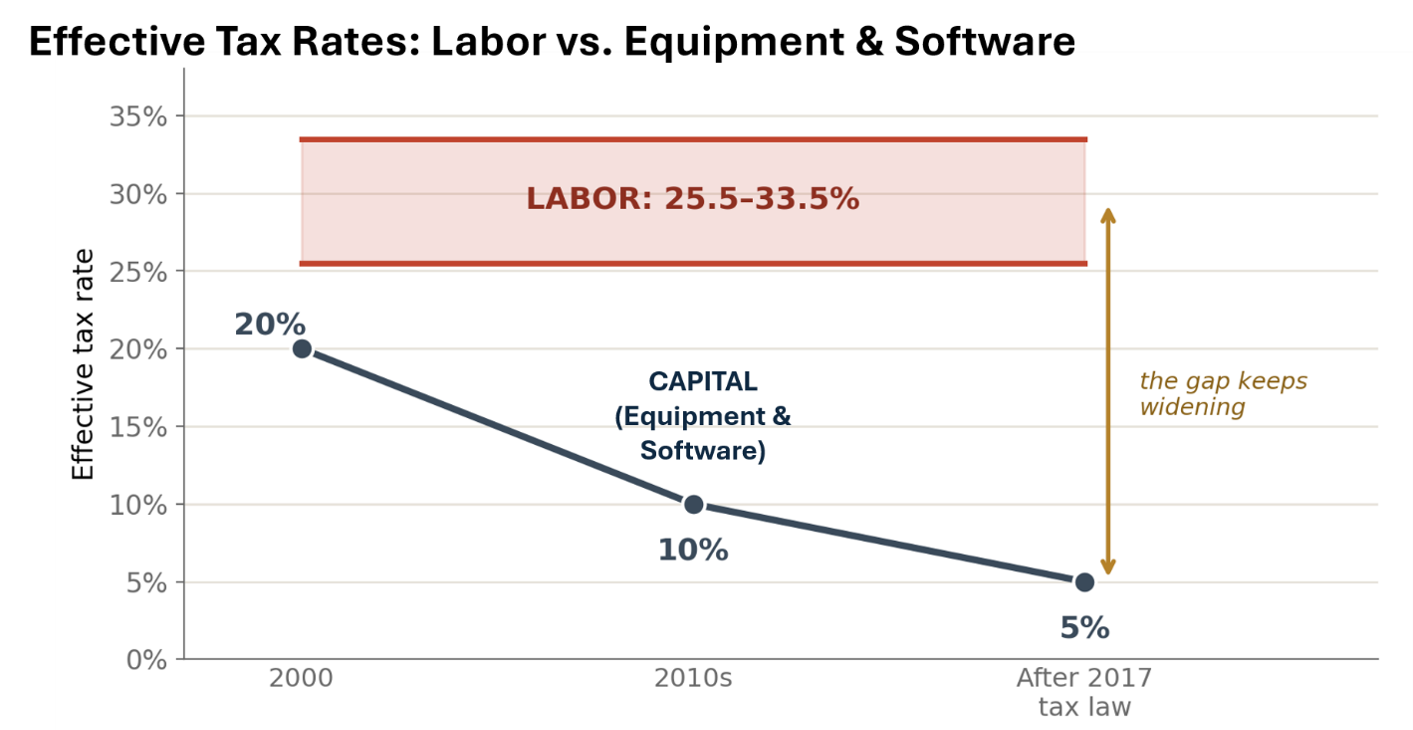
Source: Acemoglu, Manera, & Restrepo, “Does the U.S. Tax Code Favor Automation?” (Spring 2020)
The consequence, in their words, is that the tax system “has promoted levels of automation beyond what is socially desirable.” Their model suggests that rebalancing toward a smarter mix would raise employment by about 4% and lift labor’s share of the economy.
Their ideal policy isn’t to “tax robots heavily” but to tax labor less than capital, with roughly an 18% tax rate on employing humans and a 27% rate on the returns to purchases like AI software. Why? Because when a machine displaces a worker, the worker bears real costs the company never pays for: unemployment, lost wages, sometimes a permanent hit to lifetime earnings. A firm choosing between a person and a machine doesn’t see those costs on its own books. The tax code, as written, hands it an extra discount for ignoring them.
The Long Drift Behind the Gap
Zoom out and the pattern is decades old. In fiscal year 2025, about half of federal revenue came from individual income taxes and a third from payroll taxes, but only 9% from corporate income taxes.
At its 1952 peak, the corporate share was about 32%. Payroll taxes were 10%. The two lines have essentially traded places since then.
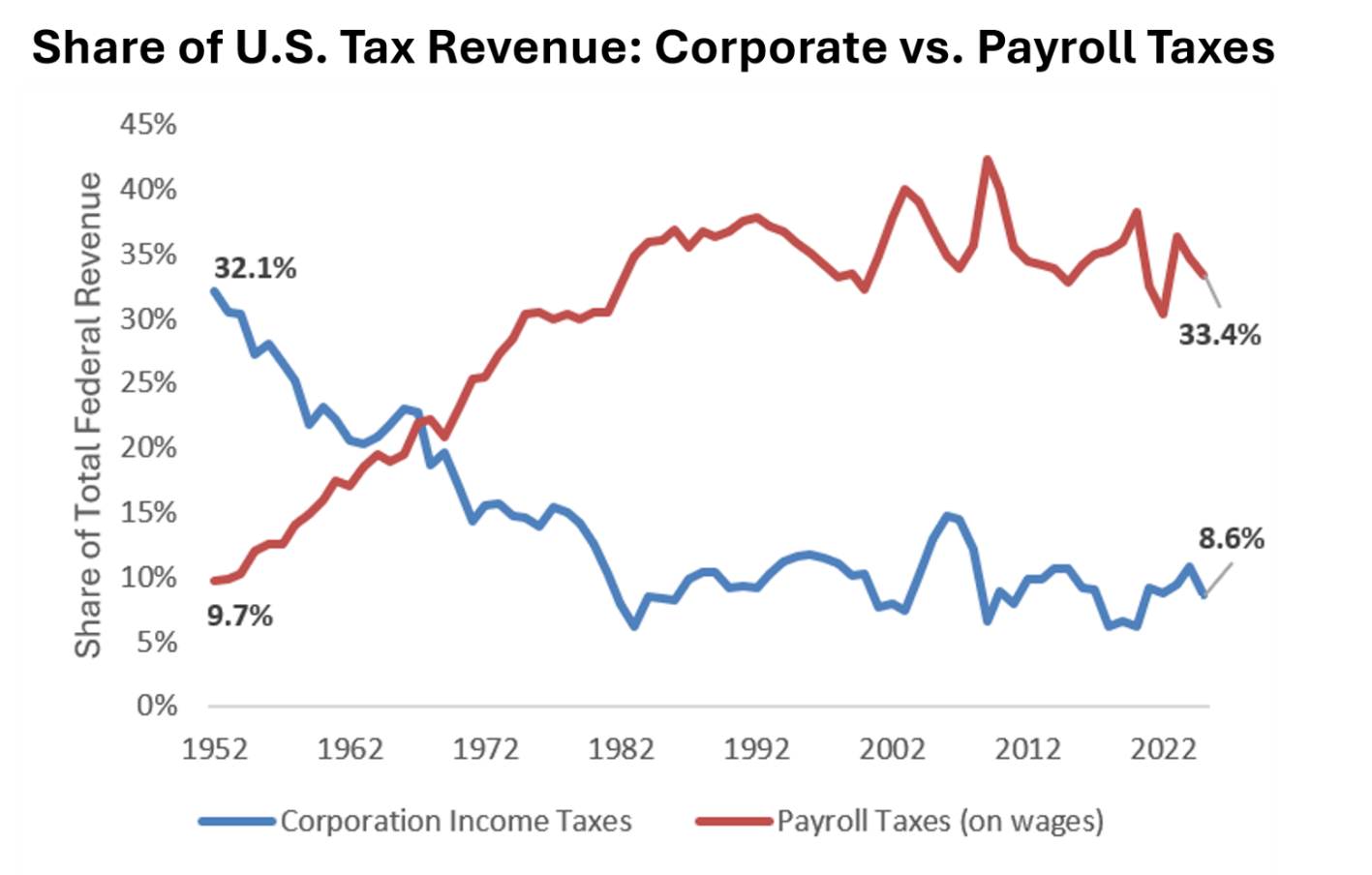
Source: Office of Management and Budget
Whatever you think about the right level of business taxation, the federal government has spent seventy years shifting its revenue base off of capital and onto labor. Every step made hiring people relatively more expensive and equipment relatively cheaper.
How Taxes Encourage “So-so Automation”
The tax code’s break for machines also encourages a particular kind of automation. Acemoglu has a useful name for it: so-so automation.
Think of the self-checkout kiosk, the automated phone tree, the AI chatbot that can’t quite answer your question. These technologies replace workers without actually doing the job much better. They’re not really an improvement; they just move the cost of the work off the company’s books and onto customers (who now bag their own groceries) and onto the workers who lost their job.
Here’s why the tax break matters so much for this specific category. Automation that makes a product dramatically cheaper or better is worth doing on its own, and a company will buy it with or without a tax break because it pays for itself. The automation that a tax break actually changes the math on is the marginal kind: the human-for-machine swap that a company would skip if the cost were the same. And that barely-worth-it automation is exactly the kind where the harm to workers and communities outweighs the modest gain to the company—the automation we’d be better off not nudging firms toward.
This is the uncomfortable possibility hanging over the AI moment. For all the talk of a productivity revolution, the hard evidence that today’s AI is delivering huge, economy-wide efficiency gains is still thin (a point we dug into two posts ago). If a lot of what’s being deployed turns out to be modest in its actual payoff but sharp in whom it displaces, then it’s precisely the so-so automation the tax code shouldn’t be tipping over the line. And right now, it’s tipping hard in no small part due to recent changes to the tax code.
A Not-So-“Beautiful” Tax Change
The One Big Beautiful Bill Act, signed July 4, 2025, made the gap permanent and wider. To understand how, it’s worth understanding the typical tax treatment of a company’s technology spend.
When a company buys a machine, it normally can’t deduct the cost all at once. It has to spread the deduction out over the equipment’s useful life—a little each year for, say, seven years. That’s called depreciation. “Bonus depreciation” lets a company skip the waiting and deduct the entire cost immediately, in year one. A dollar deducted today is worth more than a dollar deducted seven years from now, so immediate expensing is a real and sizable tax break as it lowers the true, after-tax cost of buying the machine. Wages, by contrast, were always deductible right away, so this is the machine catching up to a timing advantage labor already had, then pulling ahead on everything else.
The 2025 law did three things along these lines:
It made 100% immediate expensing permanent. With “bonus depreciation,” companies are now able to write off the full cost of equipment and software the year they buy it, forever. This break had been set to shrink and disappear, but instead this bill locked the tax break in.
It lets companies immediately deduct the cost of developing software domestically, notably including the software that AI runs on.
It roughly doubled a related write-off used mostly by smaller firms, letting them immediately expense up to $2.5 million of equipment.
While companies reap the tax benefits for employing artificially cheaper technology over humans, the bonus depreciation provision alone is costing the taxpayer an estimated $363 billion over ten years.
Note the timing. This landed as the biggest tech companies were ramping toward roughly $700 billion in combined AI spending for 2026, and the chips and servers are now fully deductible in year one. The largest capital deployment in modern corporate history is happening under the most favorable write-off rules in modern tax history. That’s not a coincidence. It’s design.
What This Means for You
You never see this comparison, but you live with its result. When a manager weighs “add a person or buy the software,” the software comes with no payroll surcharge attached. The pressure shows up as the opening that never gets posted, the team that doesn’t grow, the tool you’re handed instead of the colleague you asked for. This falls hardest on people trying to get a first foot in the door, since entry-level work is exactly where the machine-versus-worker math is closest.
In the end, every dollar of foregone corporate tax gets raised somewhere else—increasingly from wage earners.
What to Do About It
The fix isn’t to punish investment. It’s to stop making the decision to employ AI over people the artificially cheaper alternative.
Let companies write off investments in workers, not just machines. The surcharge isn’t the only place the code favors capital. Think about a firm deciding whether to spend $85,000 on a new machine or on upgrading its existing people by, for example, sending them back for a degree or funding a serious retraining program. The machine’s cost gets written off immediately, while investments in workers’ skills often can’t be. Money spent making a worker more capable should get the same treatment as money spent on equipment that replaces them.
Shrink the payroll-tax penalty on hiring, especially for entry-level workers. This is the asymmetry almost everyone concedes. A targeted break on the employer’s payroll tax for early-career hires would push directly against the pressure documented in last week’s post.
Consider a temporary tax on automation. Economists Guerreiro, Rebelo, and Teles find that a modest tax on labor-replacing machines makes sense while today’s routine workers are still in the workforce and should fade to nothing once they’ve retired. Not a permanent penalty on technology. A temporary bridge for the people caught mid-career. An automation tax is one Acemoglu and his coauthors outline as a politically palatable alternative to rebalancing taxes on humans vs. robots, noting that such a tax could raise employment around 1–2 percent.
A firm weighing a worker against a machine is looking at a price signal, and we’ve spent decades tilting it. A company that chooses the machine isn’t behaving irrationally or maliciously. It’s responding exactly as designed. And if we can find more than $360 billion to subsidize the machines, we can find the money to protect those they displace.
This means the outcome isn’t fate. We wrote this (tax) code. We can write it differently.
Next week: how you may be unwittingly funding the growth of AI…as well as making your retirement vulnerable to the industry’s downfall.
No posts
Comments
Nothing yet. Say the first thing.
Sign in to join the conversation.