
This is the sixth post in our weekly series on the federal banking agencies’ March 2026 capital proposals. This week we highlight how the biggest banks game the Federal Reserve’s (Fed) GSIB surcharge through year-end “window dressing” and why the Fed’s failure to close this loophole matters for the banking system and financial stability.
Jamie Dimon and Better Markets agree on one fundamental point: the Fed’s global systemically important bank (GSIB) surcharge capital requirement is open to manipulation, and the biggest banks are taking advantage of that. That matters to every American, because the GSIB surcharge is an extra layer of capital standing between a megabank failure and a 2008-style crash—the kind that costs people their jobs, homes, and retirement savings and puts taxpayers on the hook for bailouts.
The next GSIB surcharge measurement occurs on December 31. That’s barely five months away, and because the Fed still hasn’t closed this well-documented loophole, the biggest banks can game it again this year.
Better Markets has long supported the position that the Fed must address this issue. Jamie Dimon, JPMorgan Chase’s (JPMorgan) CEO, also agrees that this issue isn’t “great for the system,” telling his investors in April 2026:
“We will obviously use our brainpower … to find a lot of ways to serve our clients properly and reduce the GSIB charge, which is usually called arbitrage. So, I’m not sure the outcome is great for the system, but we will find ways to do it.”
In other words, the chief executive of the world’s most systemically important bank (by far) publicly announced that his firm will deploy its “brainpower” to reduce the most important part of its capital requirements by exploiting a well-known loophole in the Fed’s rule.
Dimon’s remarks also underscore a broader economic cost: regulatory arbitrage is economically unproductive. Rather than competing by providing better financial services, banks compete by becoming better at reducing regulatory requirements. The purpose of banking is to allocate capital, make loans, facilitate payments, and help businesses and households manage financial risks—not to devote some of the world’s most talented financial professionals to finding ways around the government’s rules.
An Open Secret, a Decade of Gaming in Plain Sight
Dimon was admitting something that the data has shown for nearly a decade. The practice, known as “window dressing,” involves big banks taking temporary actions that are designed specifically to reduce the GSIB surcharges exactly at the time the Fed calculates them at year-end (e.g., compressing derivatives books, pulling back from repurchase agreements). The huge benefit gained greatly outweighs the cost, which is why many GSIBs engage in this practice—GSIBs can lock in a lower GSIB surcharge on a single business day and enjoy a lower capital requirement for twelve months, while quickly rebuilding the temporarily suspended positions with clients in early January.
This practice has been extensively documented. The Fed’s own economists found in 2020 that derivatives held by GSIBs dropped 13.4 percent relative to non-GSIBs at year-end, and that the seasonal dip became more pronounced after the GSIB surcharge took effect in 2016. Researchers from the Bank for International Settlements also found that GSIBs cut their volume of repurchase agreements, specifically in the last four trading days of the year. These year-end contractions have been measured in the trillions of dollars of notional derivatives and hundreds of billions in repo.
Banks’ exposures that feed into the GSIB surcharge calculation drop sharply in December and bounce right back in the first quarter—a recurring “V” pattern, year after year (see appendix for an example). The financial incentive is obvious: if JPMorgan reduces its GSIB surcharge by enough at year-end, it can reduce its capital requirements by $10.7 billion. When that much money hangs on where your balance sheet sits on one calendar day, the outcome is predictable. It’s important to emphasize that JPMorgan is not unique—similar year-end patterns have been documented across the other U.S. and foreign GSIBs.
Where Better Markets Disagrees with Dimon
While we agree with Dimon that the Fed’s GSIB framework is being gamed, we part ways on how to address it.
Better Markets’ solution is to fix the measurement methodology. Our comment letter to the Fed on its GSIB proposal outlines our views: we favor requiring the inputs to the surcharge to be calculated as averages of daily values across the entire year to eliminate any incentive or possibility for window dressing. We also favor other technical changes to measure the surcharge more accurately that would reduce window dressing incentives. The Fed’s proposal included both of those fixes in forms that are at least directionally sound.
GSIBs generally acknowledge that there is “end-of-period balance sheet management” but ultimately propose nothing fundamental to address it. To the extent they support averaging in the GSIB calculation, it would remain measured at a frequency (e.g., quarterly) where a bank could window dress if it had the financial incentive to do so.
The Fed’s Failure to Act
When a regulated institution like JPMorgan publicly announces it will arbitrage a core prudential requirement, it is a clear sign that regulators have allowed this loophole to remain open despite years of evidence.
Even worse, this bank arbitrage behavior has been going on for over a decade even though the evidence was publicly available. Even the Basel Committee (the international forum through which the most consequential regulators are supposed to agree to minimum requirements) called window dressing “unacceptable” in 2018 and consulted the public on fixing this issue in the GSIB framework in 2024. Daily averaging has been technically feasible for years. Yet in 2026 the Fed is still only proposing options to fix the issue, with no implementation date.
The practical effect is that the largest banks may be operating with lower capital requirements than justified even though both Wall Street and the Fed have long known that banks actively manage their balance sheets around the measurement date.
False Claims of “Burden”
GSIBs and their trade associations have commented that using a daily average for the GSIB calculation would impose unnecessary compliance costs. However, they cannot credibly claim that daily reporting is prohibitively burdensome while simultaneously demonstrating extraordinary day-by-day balance-sheet management whenever it lowers their capital requirements.
GSIBs already have calculated daily data for other requirements—such as the leverage ratio, the liquidity coverage ratio, and the single-counterparty credit limits—for years. The marginal cost of a more accurate surcharge measurement is modest relative to the significant public benefit.
Conclusion
The GSIB surcharge exists because the failure of a JPMorgan or another GSIB would devastate the American and global economy and negatively affect every American. The GSIB surcharge is the federal government’s most direct answer to ensure that a 2008-style crash does not happen again.
A capital requirement this important should never be left open to manipulation, especially not by a decade of regulatory inaction. The next measurement date is December 31. The Fed knows exactly what will happen on that day. The only question is whether it will keep letting it happen.
Appendix: JPMorgan GSIB Score
The chart below shows JPMorgan’s method 2 GSIB score (the relevant calculation for the firm), calculated from the bank’s quarterly reporting filing with the Fed. The Fed calculates the official score only from a bank’s December 31 data; the other quarters (ending March 31, June 30, and September 30) show what the score would be if measured on each quarterly filing date.
In each of the past two years, JPMorgan’s GSIB score has fallen sharply and promptly rebounded by the bank’s first quarter filing. We use JPMorgan for illustrative purposes, as other GSIBs have also shown similar year-end declines.
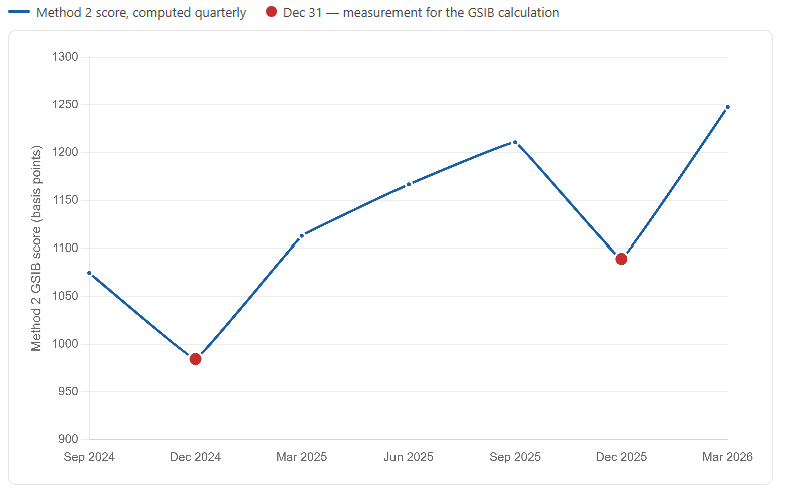
Sources: Author’s calculations; based on JPMorgan FR Y-15 Filings, 3Q24-1Q26, 12 CFR 217.405-6 (Method 2 Score and Short-term wholesale funding)
No posts
Comments
Nothing yet. Say the first thing.
Sign in to join the conversation.