
This is the 5th post in our weekly series on the federal banking agencies’ March 2026 capital proposals. This week we highlight the inadequacy of the Federal Reserve’s projected impact on bank capital requirements and why this matters for the banking system and financial stability.
The Federal Reserve’s (Fed) estimate of the reduction to big bank capital requirements that would result from its recent set of proposals is a farce. Put simply, instead of attempting to collect the relevant data for its recent capital proposal, the Fed used stale data from 2023 and, even worse, made questionable assumptions and failed to account for the reality of the capital-reducing incentives created by its proposals. Instead of a good-faith, well-reasoned impact estimate as required by law, the public cannot have confidence in the Fed’s analytical framework for a critical proposal that will affect over $20 trillion in banks’ assets.
Faulty Analysis By Design
First, the Fed relied on a grossly out-of-date and insufficiently detailed dataset from its failed 2023 proposal.
Ironically, Vice Chair Bowman, the banking industry and its army of lobbyists criticized the 2023 proposal’s impact analysis but now are conspicuously silent on the use of an even more tainted and questionable analysis for the current proposal. This hypocrisy can only be explained by the more favorable outcome the big banks will receive.
The Fed is asking the public to believe that the effects of a proposal issued in 2026 and implemented in 2028—or more likely later—can be estimated using a limited, voluntary snapshot of the banking system from 2023. Importantly, banks that participated in the 2023 data collection had incentives to submit data that would make the current proposals appear less impactful, potentially biasing the results in favor of weaker capital requirements. The Fed did not adequately explain how it accounted for these incentives.
The passage of time also reduces the credibility of the Fed’s current projection. Since 2023, banking organizations have materially altered their balance sheets, funding structures, trading activities, operational-risk profiles, and relationships with nonbank financial institutions.
The defect is especially severe because, as Better Markets has commented, the agencies selectively retained only those portions of the earlier data analysis that support the goals of the current proposal. The underlying data collection was designed to evaluate a broader and substantially different capital framework. Many components of the previous framework have now been eliminated, modified, or replaced entirely. The agencies did not adequately explain how the earlier data were adjusted to account for those changes, whether the assumptions remain valid, or whether the results continue to provide a reliable estimate of the effects of the proposal currently before the public.
Second, the Fed intentionally avoided including a meaningful assessment of how the biggest banks would change their practices in response to the proposal’s capital-reducing incentives. History has shown that large banks dynamically change their activities and even their bookkeeping to minimize capital requirements and optimize profits. In the current proposals, several components allow the biggest banks to take discretionary actions that would greatly reduce their capital requirements, and yet the Fed’s analysis fails to recognize that obvious eventuality. The failure to recognize that inevitable financial engineering and optimization renders the Fed’s analysis completely detached from reality.
Better Markets’ Analysis
The Fed estimates that the current proposals will reduce capital requirements for the GSIBs (the eight most systemically important U.S. banks) by roughly 5 percent, whereas Better Markets estimates a reduction of 15 percent. That’s because the Fed did not comprehensively account for the very obvious actions that banks will take in response to the changes. Big banks have historically made significant changes to their balance sheet every time changes to the capital rules have been implemented by the Fed. In fact, each GSIB currently employs professionals (sometimes in the hundreds) to do so already.
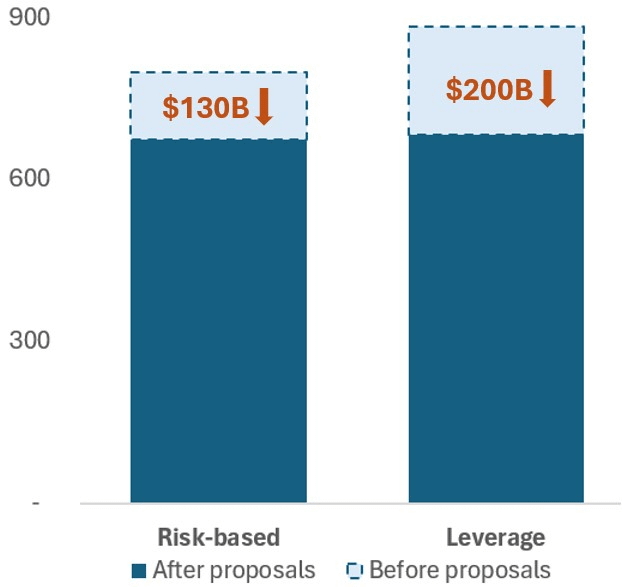
Better Markets used the Fed’s disclosed data to project the capital reduction without relying on the Fed’s rose-tinted assumptions. Our conservative estimate, detailed in the appendix to our comment letter, is a 15 percent reduction in required GSIB capital—roughly $130 billion—pushing the weighted average risk-based CET1 requirement from 10.6 percent today toward an effective 9 percent.
Such a dramatic decline has broader and serious implications for the overall capital framework, which is a “dual” requirement framework. That is, there are two requirements, the greater of which becomes the minimum—one that is based on the riskiness of specific activities (the current proposals) and one that creates a buffer across all activities. The 15 percent reduction based on the current proposals would leave the risk-based requirement nearly equivalent to the non-risk-based requirement (so-called leverage requirement) in terms of capital dollars required, defeating the purpose of having two requirements.
Dollars of Capital Required before and after Proposals – Risk-Based v Leverage
As an example of a realistic assumption Better Markets made that the Fed did not, the proposal would allow the biggest banks to subjectively decide on their own if a company to which they are providing a loan is considered “investment grade.” That designation would result in a significantly lower capital requirement than a loan to a non-investment grade company. Considering the investment grade determination would be effectively subjective (particularly given the current political direction over supervisors), it is realistic to assume that big banks would apply the investment grade determination to as many of their corporate borrowers as possible. Better Markets estimates that roughly half of GSIB corporate loans could end up classified as investment grade, cutting their corporate loan capital requirement by 17 percent, whereas the Fed assumed a significantly lower percentage.
Our Ask
The Fed has the supervisory authority to collect exactly the data needed to model behavioral response—they simply chose not to. An impact analysis is required for rulemakings (particularly of this consequence) so that the public can meaningfully evaluate the proposal actually on the table. This one measures a different proposal, under assumptions everyone knows are ahistorical and false, against a baseline nobody verified.
The remedy is to conduct a new data collection tailored to this proposal, publish a revised impact analysis that models RWA optimization dynamically, and give the public a chance to comment on it before any final rule. Until then, every headline number the agencies cite—starting with the 5 percent figure—should be treated as a floor, not an estimate. The real cost to the system’s loss-absorbing capacity is at least three times larger.
No posts
Comments
Nothing yet. Say the first thing.
Sign in to join the conversation.