
This is the third in a series on AI and the real economy. Last week we discussed how the AI-jobs debate lurched between panic and reassurance. This week we dive into what the current data actually tells us and what we should do about it. A warning: this is intended to be one of the longest posts in this series, in no small part because of the complicated nature of this topic.
Here is the sentence that organizes all the good evidence we have so far:
AI automates tasks, not jobs.
For three years, that line was mostly a reassuring thing to say at dinner. But in late 2025 and early 2026, the data caught up. Read together, the data doesn’t say “jobs are safe,” and it doesn’t say “the bloodbath is here.” They say something sharper: AI is chewing through tasks unevenly, and the damage is landing on one specific group first.
That precision matters because tasks and jobs point to opposite policy responses. If you think AI destroys jobs, you reach for the tools of mass unemployment such as fiscal stimulus or giant retraining programs. If you understand that AI reshapes the task content of jobs, you reach for sharper instruments: protecting the entry rung, ensuring that AI is used to support and not displace work, and disclosure rules that show what’s actually happening. Get the diagnosis wrong, and every prescription is wrong too.
The Jobs vs. Tasks Debate: How We Got Here
The framing isn’t new, as it’s the backbone of modern labor economics. In 2003, economists David Autor, Frank Levy, and Richard Murnane worked out that a computer doesn’t “do a job.” Instead, it does tasks, and only those you can write down as explicit rules. It substitutes for humans on routine tasks and complements them on non-routine, judgment-heavy ones. A job is a bundle of tasks, and whether technology helps or replaces you depends on which tasks are part of your bundle.
Two decades later, Daron Acemoglu and Pascual Restrepo pointed to the answer to the great economic mystery of our time: why the gap between winners and losers has widened so relentlessly since 1980. Their research found that between 50% and 70% of changes in U.S. wages over four decades trace to the wages of routine-task workers falling as those tasks got automated. Automation didn’t just eliminate jobs. It quietly redistributed income from the people whose tasks could be codified to the people whose tasks couldn’t. And it did so for forty years before anyone argued about ChatGPT.
That history is the reason to insist on the task lens now. The last great wave of automation didn’t show up as a spike in unemployment. Instead, it showed up as a slow, brutal divergence in wages, task by task, that we mostly failed to see coming because we were watching the wrong number. The jobs count stayed fine. The task composition of work, and who got paid for what, changed underneath it. If we make the same mistake with AI by watching the unemployment rate and declaring victory, we’ll miss the actual event again.
So, the question was never “will machines take our jobs?” It has always been: which tasks will AI replace, whose job is full of those tasks, and who captures the gain when those tasks are replaced?
Augmentation or Displacement: The Crux of the Debate
This is why the task framing decides everything downstream. If AI takes some of your tasks and leaves you the judgment calls, you become more productive. That’s augmentation. But if AI takes enough of your tasks that your whole job is redundant, that’s displacement, and you’re gone.
Same technology, opposite outcomes. And such outcomes are decided not by the technology itself but by how firms deploy it, which is exactly why policy has a seat at the table.
So which way are firms leaning? For the first time, we can check.
Large-Scale Displacement isn’t in the Data…So Far
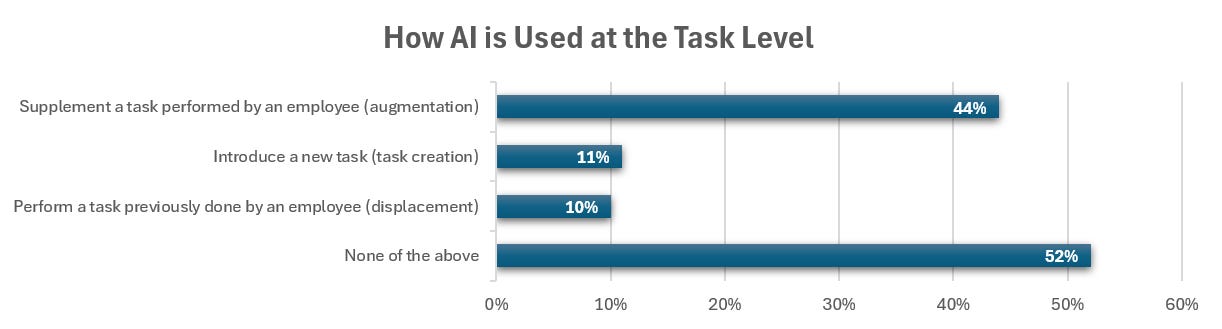
Although a number of companies have proclaimed AI-driven layoffs, the most direct evidence comes from the government. The U.S. Census asked over 100,000 firms how they are using AI, and just under half of the firms implementing AI use it to augment worker tasks. And augmentation isn’t just ahead; it’s four times more common than displacement: the survey found that nearly all AI-using firms reported no employment change attributable to AI, with only a handful of firms reporting any employment decline. At the same time, 16% of AI-using firms report AI replacing software or equipment.
So, for now, the data shows that AI is eating other software, not payrolls.
Source: U.S. Census
But the Damage is Real, and Younger Workers are Currently in the Crosshairs
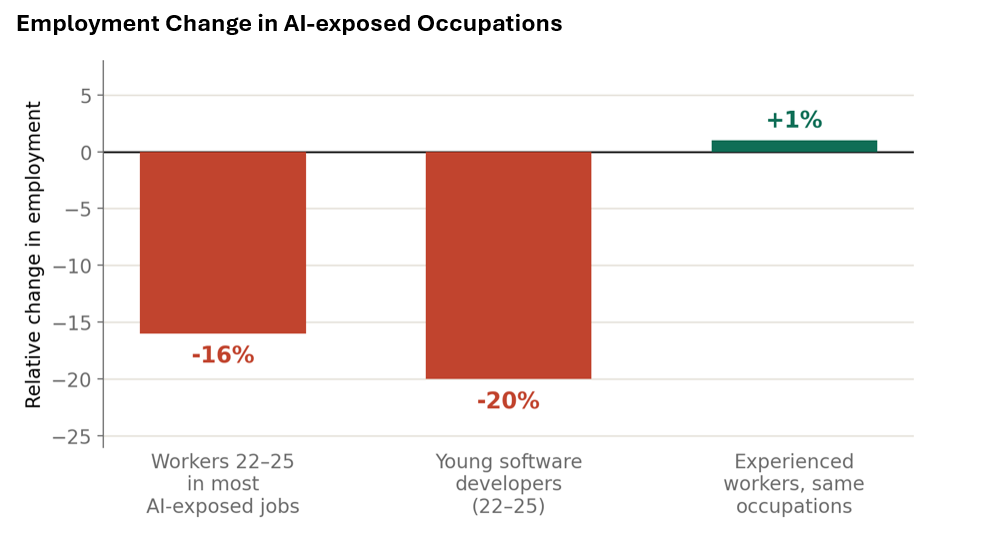
“Tasks, not jobs” doesn’t mean “no one gets hurt.” It means the hurt is concentrated. In late 2025, a Stanford team led by Erik Brynjolfsson published their analysis of payroll records covering millions of workers and titled the study “Canaries in the Coal Mine.” In this case, the canaries are younger workers:
“Early-career workers (ages 22–25) in AI-exposed occupations experienced a 16% relative decline in employment, controlling for firm-level shocks, while employment for experienced workers remained stable.”
For young software developers specifically, employment is down nearly 20% from its late-2022 peak. Meanwhile, experienced workers in the same occupation or in less exposed occupations remained stable or continued to grow.
Source: Brynjolfsson, et al., “Canaries in the Coal Mine? Six Facts about the Recent Employment Effects of Artificial Intelligence” (Nov. 2025)
Why the young? Because entry-level work is the automatable work: draft this, summarize that, write the basic code. These are the routine, self-contained tasks that Autor and his coauthors flagged in 2003. Better Markets’ own The State of the Economy for Young Americans report contextualizes this point, noting that the more your role is a discrete task, the more exposed you are. Early evidence confirms this for some professions, as freelance designers and copywriters reported sharp declines in work and pay after the arrival of ChatGPT.
What Large-Scale Job Displacement Could Look Like (Even if it isn’t Here Yet)
Even if the data isn’t showing a wholesale displacement today, it’s worth being clear-eyed about what a genuine wave of displacement would look like, because the undercurrents are visible even if the flood isn’t.
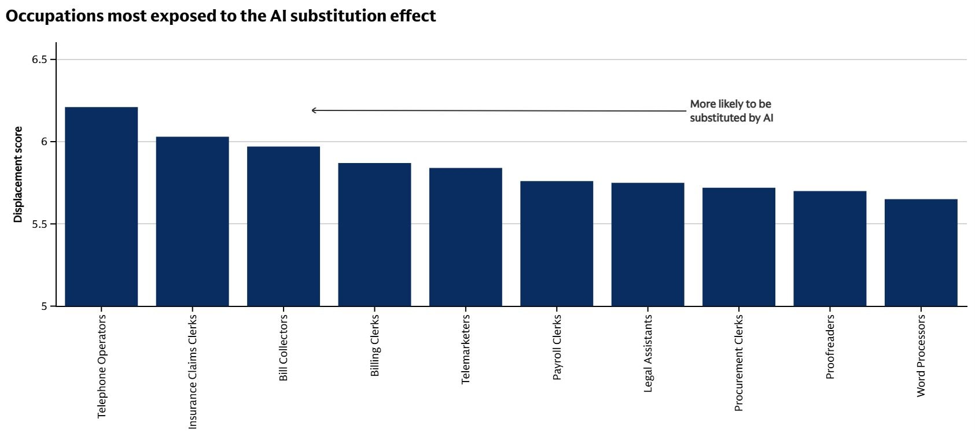
Picture the difference between AI trimming a task from many jobs and AI swallowing whole categories of work. The first is what the data mostly shows now: a customer-service rep handles more tickets, a paralegal drafts faster, a coder ships quicker. The second is what happens when a firm decides an AI system can handle enough of a role’s tasks that it stops backfilling the role at all and then does it across an entire function at once: A call center that quietly shrinks from 500 seats to 150 as an AI agent fields the routine contacts, or a content team that keeps two senior editors and lets AI do the work of the ten junior writers below them. None of these requires a dramatic “AI layoff” announcement; each is just a hiring freeze plus attrition, invisible in the monthly jobs report until the category is hollow.
These undercurrents are already showing up in some data. For instance, Goldman Sachs’ economists estimate that AI is already causing roughly 11,000 U.S. job declines on net each month over the past year, and they project that drag will grow as AI agents get more capable and firms move from pilots to full deployment. That is the mechanism of large-scale displacement caught in its early, still-modest stage, with some occupations more in the crosshairs than others.
Source: Goldman Sachs Research
The task lens doesn’t tell us the flood is coming, but it does tell us where to watch for it: in the functions built most heavily from routine, self-contained tasks, and in the hiring numbers for the roles that do them, not just the layoff numbers.
The Displacement Story isn’t Baked
Much of the conversation around AI and jobs has focused on layoffs and displacement at massive scale. So far, that hasn’t shown up in traditional employment statistics, although there is a push for better measurement of AI’s impact on the labor market.
The true impact of AI on the labor market will be the sum of countless business choices that are still being made. The same task automation that shows up as harmless “augmentation” in a survey can become displacement one budget cycle later, when a firm under margin pressure decides the augmented team of ten can be a team of four. Bad policy actively pushes that door open: when the tax code makes capital cheaper than labor—the subject of next week’s post—or when there’s no cost to letting the entry rung wither, augmentation quietly curdles into displacement because that’s the cheaper path. The technology permits either outcome. Incentives decide which one firms pick.
That is precisely why policy is not a bystander here. Because we genuinely don’t know which direction companies will take as AI capabilities grow—augment their workers or replace them—we cannot leave the outcome to be settled by whatever happens to be cheapest for firms in a given quarter. Policy is the mechanism through which the public interest gets a vote in millions of private decisions that, added together, determine whether a generation’s livelihoods are protected or discarded. Left alone, those decisions optimize for cost. Well-designed policy ensures they also account for the people on the other side of them.
So, the debate about large-scale displacement isn’t settled, and that uncertainty is exactly the reason to act in workers’ interest now, while the outcome is still shapeable.
What to do About It: A Task-focused Jobs Agenda
If the problem is task displacement—particularly among those on the entry rung—but with a real risk of wholesale displacement to come, the response should be targeted and should prepare for both.
Protect the bottom rung. Entry jobs are where people learn the judgment that makes senior workers un-automatable. Hollow them out and, as Better Markets argues, you “eliminate the entry points through which generations of Americans first built careers.” Widen the on-ramp: apprenticeships and early-career hiring incentives in exposed fields.
Steer deployment toward augmentation. Since firms make the augment-or-displace choice, incentives can tilt it. Start by ending subsidies that make replacing a worker with technology cheaper than keeping one. (See more in next week’s post on tax incentives.)
Require disclosure. The debate ran on anecdote because we couldn’t see inside firms. Make the measurement of which tasks AI substitutes, augments, and creates permanent and sharper before displacement shows up, not after.
Prepare for wholesale displacement, not just task-trimming. Hope for augmentation, but plan for the possibility that whole categories of routine work do get automated away. That means building the capacity to respond at scale before it’s needed: a modernized unemployment-insurance system that can absorb a fast, concentrated shock; transition support that isn’t contingent on a plant-closing-style triggering event; and a serious look at broader measures—from portable benefits to wage insurance—that share the productivity gains rather than letting them pool entirely with capital. Displacement may or may not arrive at scale; policy should not be caught flat-footed if it does.
Modernize the safety net for task displacement. Even short of mass layoffs, task displacement is quieter than whole-job loss and slips through a safety net built for downturns. The fix is to support workers through the transition, not just after a layoff: portable benefits that follow the worker between jobs, wage insurance that cushions the pay cut when someone is pushed into a lower-paying role, and effective reskilling initiatives paired with real job placement—thereby avoiding the failed Trade Adjustment Assistance program’s approach of offering training vouchers without an actual path to employment.
Take labor-market power seriously. A worker with options can insist on the augmentation path; a worker in a concentrated market can’t. Scrutiny of employer power and non-competes determines who captures AI’s upside.
None of this treats AI as a catastrophe to stop or a miracle to wave through. Each follows from the finding: tasks are moving, the entry rung is exposed, the aggregate is calm for now, and the outcome is not yet fixed.
Next week: how the tax code subsidizes the machine over the worker and what it would take to stop it.
No posts
Comments
Nothing yet. Say the first thing.
Sign in to join the conversation.