
Bank capital rules are incentivizing the steady migration of lending out of banks and into nonbank lenders. The reason is simple: the capital rules are too weak in a key part of the capital framework. This runs directly counter to what the principals at the banking agencies are incorrectly claiming, which is that the rules are somehow too strong. What’s worse, the steady migration of lending out of banks and to nonbanks could get even worse because the proposed capital rules would make the problematic part of the framework much weaker (as detailed in our comment letter).
Too much lending by nonbanks vs banks is bad for borrowers and economic growth because loans from nonbanks are more expensive than bank loans and create more risk in the financial system. Banks are the cheapest, most durable source of lending to the economy because 1) they have access to deposits funding, the cheapest source of funding in the financial system, and 2) the federal banking agencies take actions to make banks much safer. Nonbank lenders, on the other hand, add costs to borrowers, don’t have to comply with the same safety standards as banks, and add complexity to the financial system.
Nearly all nonbank lending is supported by loans from banks. That is, to fund their lending, most nonbank lenders use a combination of money from outside investors and money they borrow from banks (see figure for a generalized summary). For example, almost all the funding for mortgages provided by nonbank lenders like Rocket Mortgage comes from banks via short-term loans to the nonbanks. For many other types of nonbank lending, such as lending to small to midsized companies or auto loans to individuals, nonbanks also borrow significant amounts of funding from banks.
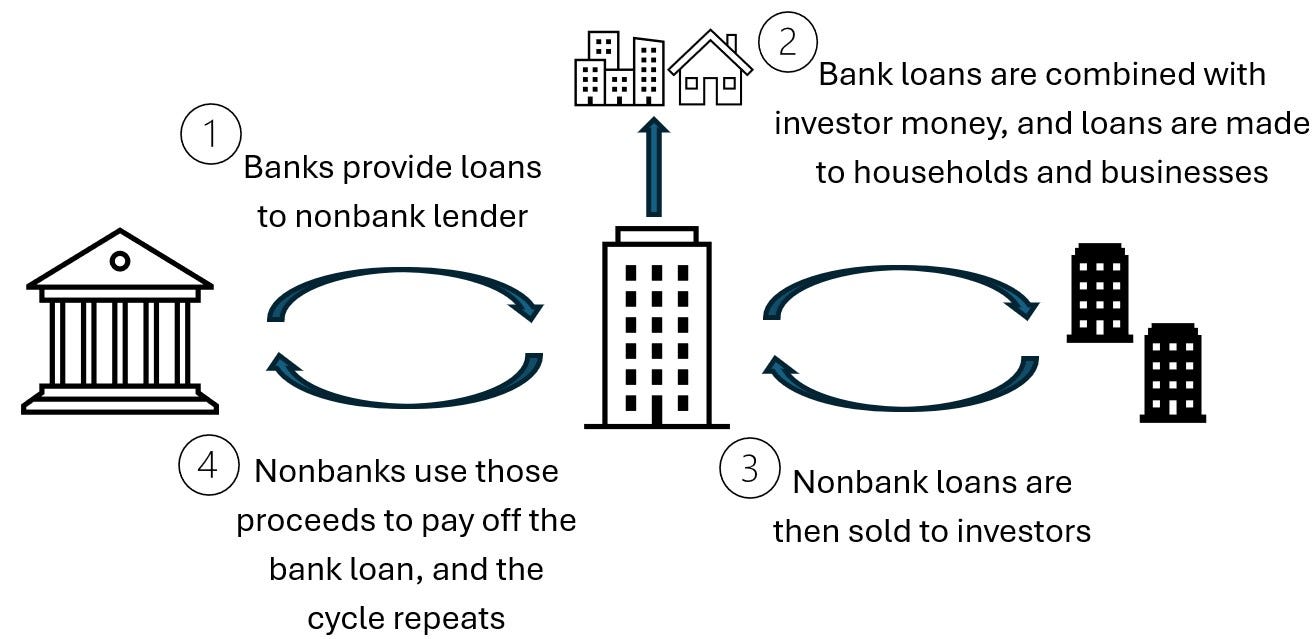
Put simply, bank loans are the foundation of nearly all nonbank lending, and so if banks provide more loans to nonbank lenders instead of directly to households and businesses, then over time banks will do less lending and nonbanks more lending. Unfortunately, the capital rules provide a strong incentive for banks to make loans to nonbank lenders instead of directly making loans to households and businesses, and banks have been taking advantage of that incentive. In fact, last year lending by the biggest banks to nonbank lenders increased around 50 percent, whereas their direct lending to households and businesses did not increase at all—zero percent (based on FFIEC Call Report data).
Essentially, the capital rules make it more profitable for banks to make loans to nonbank lenders as compared to making direct loans because a certain type of bank loan often used for nonbank lenders (a so-called securitization exposure) has a much lower capital requirement than direct loans. For example, under the current capital rules, the capital requirement for a securitization exposure can be as little as one-fifth the requirement that applies to a direct loan to a business. And the proposed rules would make the capital requirement for securitization exposures even lower.
Banks, therefore, would be even more incentivized to make loans to nonbank lenders instead of making loans directly to households and businesses, which would push more lending out of banks to nonbanks. This goes directly against the claimed goal of the banking agencies, which raises the question: What is the motivation? As with many other aspects of the proposed capital rules, this change would increase the profits of the biggest banks.
The agencies should remove the proposed reduction in the capital requirement for securitization exposures and continue with the current requirement if it can be justified by the data. Additionally, the agencies should cap the amount of lending that banks can make to nonbank lenders under the securitization exposure framework, after which point the significantly higher corporate loan capital requirement should apply. Beyond a certain amount of bank lending to nonbank lenders, there certainly are risks that the agencies can’t account for, because as banks become more interconnected with nonbanks, there is less visibility as to the true underlying risks. This has recently been made apparent with the losses some banks took on loans to so-called private credit nonbank lenders.
The agencies must stop putting the profits of the biggest banks above support for the real economy, especially the Main Street economy, and focus on bringing banks back to their core mission of taking deposits and making direct loans to households and businesses.
No posts
Comments
Nothing yet. Say the first thing.
Sign in to join the conversation.