
This week Better Half’s founder Anastasia Uglova wrote about the kinds of unfinished conversations you replay for months, and why Relational AI is so important right now. Also our MVP demo is live! Test it out, and let us know how it went (the good, the bad, the ugly) here.
The rest of this week’s stories orbit the same question from the outside: what happens when AI enters the spaces where people are vulnerable, trying to be understood, or trying to be cared for?
Happy reading, Meghan
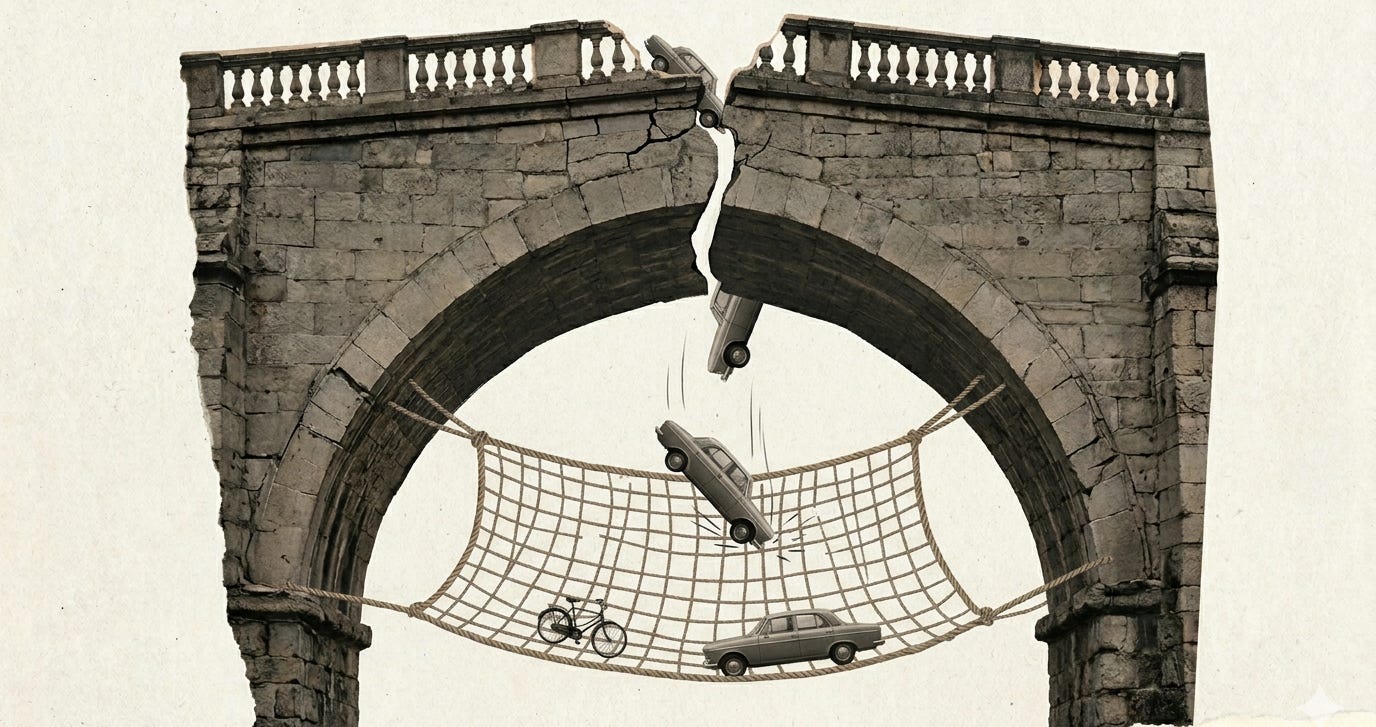
From Ana this week: AI fails at supporting human relationships, and there’s no reliable way to fix this mess without better training data. In its absence, the industry’s answer has been safety policies and guardrails bolted onto a flawed architecture. That’s like admitting a bridge has a structural flaw and stringing a net underneath to catch the falling cars instead of actually fixing the bridge. That’s not good enough for civil engineers. So why is it good enough for computer engineers? We Shape Our Tools, and Then They Shape Us Better Half | June 16
Using AI to “Cyrano” your dating life isn’t working. A new study found that 1 in 4 American singles in the US have used AI in dating — and it isn’t working. People who outsource the drafting of messages, conversations, and profiles to AI are ending up with worse outcomes than people who don’t. AI as a dating wingman is a hot trend, but study says it’s just sabotaging your love life Digital Trends | June 15
Watching and recording are not the same thing as caring. Two stories this week touched on the pitfalls of AI inside care relationships. The Markup reported that mental health providers are increasingly using AI tools to record and summarize therapy sessions. Meanwhile, Wired looked at monitoring systems that help older adults age in place by listening for signs of distress and changes in routine. The appeal is real, but the tradeoff is not just privacy versus convenience. Therapy incentives shift when the conversation is permanent, and elder care offloaded to AI depends on constant surveillance. We should be careful about normalizing a bargain where people give up their privacy because the alternative is no care at all. Your medical provider might be recording your mental health care visits — The Markup · June 16; My Father Wants to Age in Place. AI Will Be Watching — WIRED · June 16
A legal hurdle for AI hallucinations. A German court this week found Google liable for false statements generated by AI Overviews. This pushes against one of the stranger defaults in AI discourse: that consistently wrong outputs from a system designed, trained, operated, and distributed by a company are not the company's problem. AI hallucinations have been treated as a known limitation users should work around. Courts are starting to treat them as product behavior. A Court Has Ruled That Google Is Liable for False Statements Generated by AI Overviews — WIRED · June 13
We’re tracking the progress of AI policy so you don’t have to.
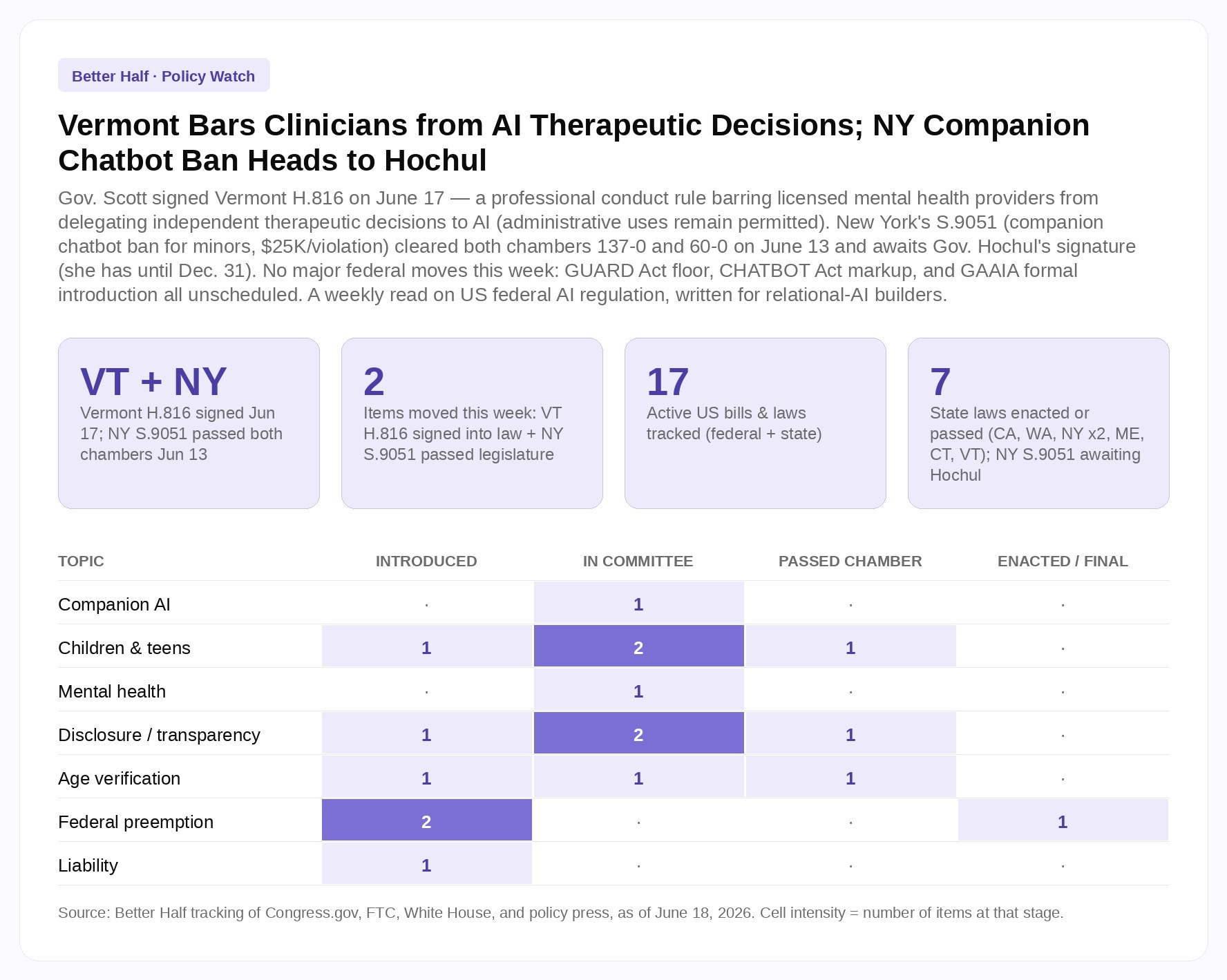
For the full breakdown — every bill, lawsuit, and commentary piece we tracked — see the full digest on better-half.ai.
Anthropic pulled its most powerful AI models after the US barred foreign access to them. But now the White House sasys it may be back as soon as tomorrow.
Why AI hasn’t replaced software engineers, and won’t.
A new concept for figuring out what AI models can do… and how they are likely to behave in the world, before releasing them into the wild.
A new study on “nonresident fathers” — ie: dads that don’t live with their kids — found that presence is more complicated than proximity.
Why one woman is betting her career on the "messy middle" of the AI transition.
“We were taught calculus and skipped the apology. We were taught to defend a thesis and never to notice the second when defending the point became defending our whole self-worth.
For some of us the gap was wider to start with. Some people seem to pick this up by osmosis. Most don’t, or only partially, or in ways that hold up under low stakes and collapse the moment the stakes get high. For some — and I’ll put my hand up here — the cues that other people register without effort have to be reconstructed after the fact, sometimes hours after, sometimes weeks after, sometimes never quite at all.”
— Anastasia Uglova
This is Good Friction, Better Half’s look at relational AI — the technologies deepening human connection, and the ones quietly pulling us apart. Subscribe below and try out our demo here.

No posts
Comments
Nothing yet. Say the first thing.
Sign in to join the conversation.