
When I was twenty-two, I had a conversation with someone I loved that I didn’t understand for years.
It was unremarkable on the surface. We were sitting at the kitchen table on a Sunday afternoon in late summer, eating leftovers from someone’s birthday dinner the night before, talking about something neither of us would remember a year later. Somewhere in the middle of it they said something that I think now was an invitation. I read it as a complaint, said something back that I think now was a defense, and watched them get quieter for the next half-hour while I kept talking, not understanding why the air in the room had changed. We went to bed. The next day we both acted normal.
Thanks for reading Better Half! Subscribe for free to receive new posts and support my work.
But something had shifted, and I didn’t know what.
I replayed it for months in the shower, on the walk to work, at 2am when I should have been sleeping, scanning for the moment something had changed and rehearsing what I would have said differently if I’d known what I was watching. I couldn’t find it. I couldn’t even tell what kind of thing I was looking for. The conversation didn’t end the relationship in any visible way. We dated for another year and a half, had other fights none of which felt as quiet or as final as that one, and eventually ended things for reasons that on paper looked completely unrelated to a Sunday afternoon at a kitchen table. By the time I had any of the vocabulary I would have needed to ask what had happened in that conversation, the person who could have answered it with me wasn’t around anymore.
What I didn’t have at the time was any framework for seeing a conversation as having something underneath it. I knew how to defend my point and how to apologize when I’d done something concrete enough to apologize for. I knew how to be the bigger person when someone else was being unreasonable. None of that helped me understand a conversation in which neither of us had clearly done anything wrong, in which we’d been more or less civil to each other, and something had still gone sideways in a way that lasted.
Years later, I read the research, the way most people who eventually try to get better at this end up reading the research. Decades of work, most of it from John and Julie Gottman, on what actually predicts whether a relationship sustains or comes apart. The finding that turns out to matter isn’t how often couples fight, or even what they fight about. It’s a small set of moves that show up inside the fights themselves and what each person does in the moments right after.
Contempt. Defensiveness. Criticism. Stonewalling. A particular pattern called failed repair, in which one person tries to come back to something and the other one doesn’t quite meet them. These are the things that predict the outcome more reliably than anything else, decades down the line, and none of them require either person to be a bad partner. They mostly happen between people who love each other and were never taught to read what they were doing or absorbing in real time. We were taught calculus and skipped the apology. We were taught to defend a thesis and never to notice the second when defending the point became defending our whole self-worth.
For some of us the gap was wider to start with. Some people seem to pick this up by osmosis. Most don’t, or only partially, or in ways that hold up under low stakes and collapse the moment the stakes get high. For some — and I’ll put my hand up here — the cues that other people register without effort have to be reconstructed after the fact, sometimes hours after, sometimes weeks after, sometimes never quite at all.
That kitchen table on a Sunday afternoon is the conversation Better Half is built for. Not literally, obviously. But the kind of conversation it is. The one you replayed for months without ever quite getting to the bottom of. The one where you’d have given a lot to have a sharp friend with the right training sit down with you afterward and walk through what had actually happened, with enough patience to ask the question you didn’t think to ask yourself.
What we built.
What we’ve been building is a co-pilot for that exact moment. You bring it a real situation, recent enough that you can still feel it, and it works through it with you the way a friend like that would, except calmer, more patient, and willing to push when you skim over the thing it can already see you flinching away from. It asks pointed questions about what actually happened, names the dynamic it sees underneath your surface account of it, and points at one concrete thing you might try differently next time. You walk away with a sharper read of what happened, not a softer one.
The shorthand we use internally is investigate, challenge, teach. Not validate, summarize, soothe. Most of the AI being built right now in this space soothes — it tells you you were right, it agrees with the read you walked in with, it summarizes the conflict back to you in a way that feels resolved without actually resolving anything. The whole training objective is engagement, which means the system optimizes to keep you in the conversation with it, which is the opposite of what you actually need from a tool that’s supposed to help you go have a hard conversation with a real person.
Relational AI is the category we’re trying to build. The way to think about it is in three flavors: productivity AI, which measures success in tasks completed; companion AI, which measures success in time spent; and this third thing, relational AI, which measures success in what happens in your relationships outside the app — whether you had the conversation you’d been avoiding, whether something shifted with the person you brought to us, whether you came back next month because a new hard thing came up rather than because we engineered a streak to drag you back.
We don’t expect everyone to agree the category needs to exist. What we do think is that the AI being built right now in the relational space is making people worse at being human, and the alternative we’re trying to build is worth taking seriously.
The ask.
What we have right now is a working MVP with two reasoning agents, Sage and Mystic, that take the same Socratic move and apply it slightly differently. You can try both on the same situation and see how each one reads it. The flow we’d love testers to follow is this: bring a real situation, crunchy and recent enough to still feel; spend at least ten minutes with Sage; then click “Relate” at the bottom of the screen, select Mystic, and bring the same situation to that second conversation. You’ll get a different read of what’s underneath, and that difference is part of what we’re testing.
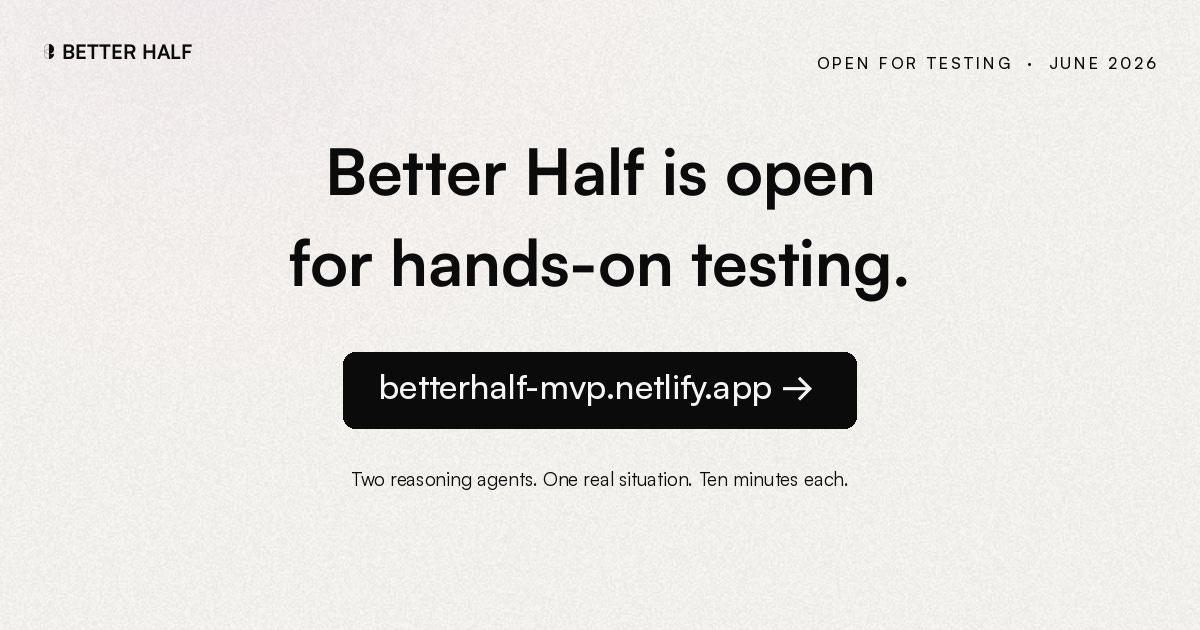
The demo is at betterhalf-mvp.netlify.app. The feedback form is at this Typeform. As a thank-you we’ll send you a free PDF guide we wrote on the same territory, called The fight underneath the fight. It’s a field guide to the conversations that didn’t go the way you wanted.
What I’d ask, more than anything, is that you tell us the unflattering things. The places where it went vague when it should have pressed, where it pressed when it should have backed off, where it said something that sounded canned or didn’t sound like a person with a point of view would have said it, where it missed something obvious about your situation. The MVP is built so we can learn from how it actually lands with real people working through real moments, and the only way that works is if testers tell us where it fell down.
I built this for the version of me that sat with that conversation for months without ever quite finding what had happened in it, and for everyone I’ve ever talked to who has at least one of those conversations of their own. I’d love your help making it real.
Thanks for reading Better Half! Subscribe for free to receive new posts and support my work.
Comments
Nothing yet. Say the first thing.
Sign in to join the conversation.