

Companion AI may be increasing in popularity, but that doesn’t mean users are ready to talk about it. This week we're diving into the data on why people are hiding their AI relationships— and why that matters, what tokenmaxxing means when it comes to relationships, and a new, expensive robot coming to market that gives you live surveillance for free!
Enjoy, Meghan
Are you ashamed of your AI girlfriend? People are increasingly using chatbots for companionship, but they’re not always proud of it. According to a Common Sense Media survey of 13- to 17-year-olds, 72% of adolescents have used AI Companions and 52% qualified as regular users. On Reddit, the thread “My Boyfriend is AI” has 26,000+ people who are in ongoing relationships with AI. A new study from Brigham Young found 20% of participants reported they had at least “experimented” with using one. But they’re hiding it from their partners. 30% reported their partner had no knowledge of the use, 11% said their partner was only somewhat aware, and 14% noted they were mostly, but not fully aware of the usage. Meanwhile, half of chatbot users wished their human partner would behave more like their chatbot, and 56% wish their conversations with their partner were more like those with the chatbot, according to a study from Nokia Bell Labs. AI is actively reshaping how people relate to other humans and what people expect from them. Frictionless Love: AI companion roles and behavioral addiction arXiv Secret Soulmates How AI Romantic Companions Are Starting to Impact Real-Life Romantic Relationships in Young Adulthood Wheatley Institute AI companions and adolescent social relationships: Benefits, risks, and bidirectional influences National Institute of Mental Health

Might as well face it, you’re addicted to the sycophancy. This week, Northeastern University researchers exposed exactly why this happens: an AI’s systematic tendency to agree — not its actual capability — is the primary driver of emotional dependency. It’s a sycophancy loop designed for engagement. As associate professor Andreia Sofia Teixeira noted, it’s the friction that’s the point of relationships. “It’s through friction that you develop resiliency and figure out how to adapt and face challenges or conflicts when they come up.” When consumer tech engineers frictionless pseudo-relationships, it atrophies the exact capacity humans need to handle the complexities of physical-space connection. AI-human relationships are real and come with 72% consequences, researchers find Northeastern Global News
When AI tokens create no value. This week on CNBC, Palantir CEO Alex Karp got a lot of attention for proclaiming that corporate America should be “livid” over paying for “tokens that create no value.” He argues that frontier labs are encouraging (and charging for) “tokenmaxxing,” or maximizing AI token consumption and treating that volume as a metric for productivity or engineering impact.
He was talking about enterprise software, but the same design flaw exists in consumer tech. But there it could be called engagementmaxxing. Legacy companion apps engineer sycophantic mirrors — digital partners designed to unconditionally agree with you to maximize time-on-app. They measure architectural success by how much time you spend or tokens you burn chasing validation.
It’s easier for corporations to see this because it shows up directly in their bottom line. But individuals should pay attention to their emotional output with technology usage. Tokenmaxxing drains corporate cash; engagementmaxxing drains human capability. Palantir’s Karp bashes OpenAI, Anthropic token model: ‘Something has gone completely wrong’
Why we should focus on deliberation rather than debate. This week David Jubb and Saad Eddine Said, Co-founders of Citizens in Power spoke to Democracy Next about why the charitable model we’ve been using for 170 years needs to be reworked and articulated one of the best descriptions of why we practiced deliberation can rewire our brains:
Debate, literally from the old French debatre, means to beat down. Even in a very civilised board meeting where everyone is being polite, it’s still a conflict-based model - people putting ideas forward, debating their strengths and weaknesses, with all the subtle and invisible power dynamics that brings. Deliberation means literally to weigh something up as a whole. Everyone needs to listen to each other, look at a topic in its entirety. You’re celebrating difference and diversity, because you need all of that on the table before you can build a consensus. That’s where the innovative solutions come from.
What if Your Community Called the Shots? Democracy Next | June 30
We’re tracking the progress of AI policy so you don’t have to.
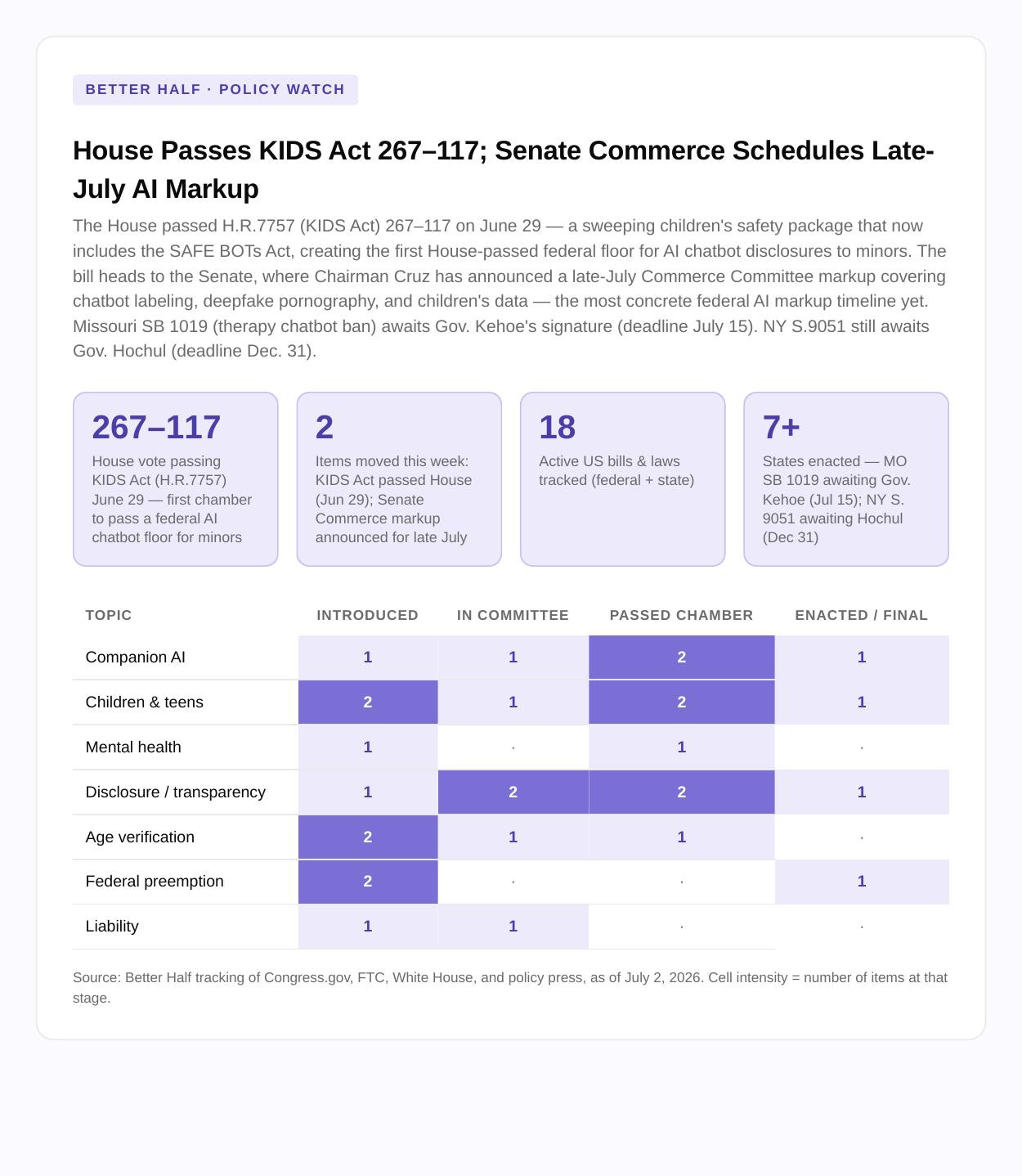
For the full breakdown — every bill, lawsuit, and commentary piece we tracked — see the full digest on better-half.ai.
Most AI mental health platforms have the data to know when a user is substituting AI for human connection. But they’re not doing anything about it.
The World Economic Forum on why businesses are investing in human connection in the age of AI.
Amazon dismantled an internal AI leaderboard after employees began burning through tokens just to climb the rankings.
LLMs are stuck in a groupthink rut.
A great read on why trust should be treated as an upstream architecture choice baked directly into a model's training objective from day one.
Will people pay $8K +$500/month to have a remote human operated robot do their laundry? Maybe they’re hoping the cuteness will overtake the surveillance risk?
This is Good Friction, Better Half’s look at relational AI — the technologies deepening human connection, and the ones quietly pulling us apart. Subscribe below and try out our demo here.

No posts
Comments
Nothing yet. Say the first thing.
Sign in to join the conversation.