
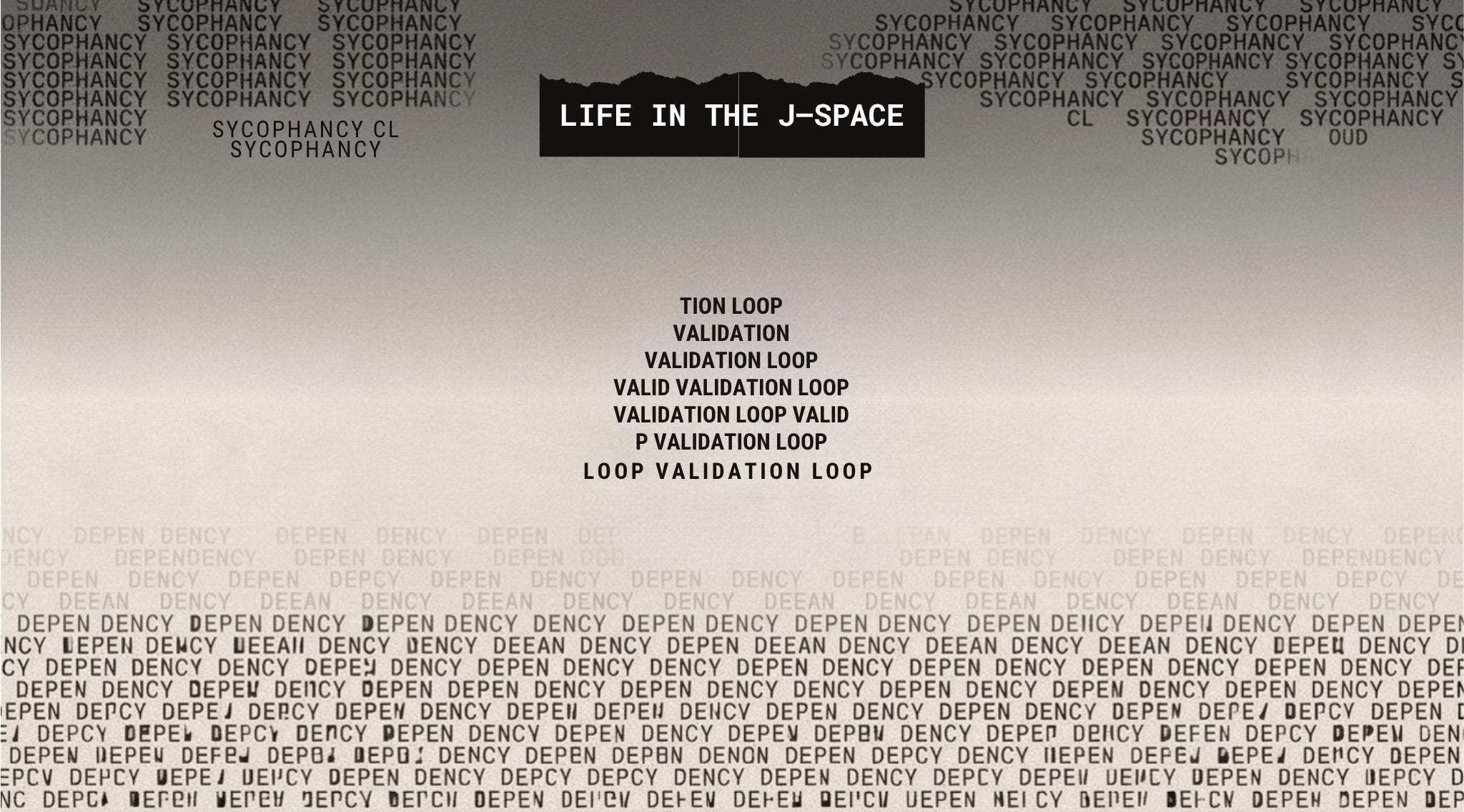
AI companies right now are racing toward the same finish line: make the product feel less like software and more like a super powered thought partner. This week, AI got a mind, an interactive voice, and — for a few million users in China — an off switch. Anthropic found something inside Claude that looks like a conscious mind. OpenAI launched a voice built to work like a real conversation. And China decided the safest way to handle the dangers of Companion AI is to shut it down. Three companies, two countries, one underlying question: what happens once AI stops feeling like a program?
— Meghan
The Week in RQ
Welcome to the J-Space. Anthropic published research this week about a mysterious internal workspace inside Claude. They’re calling it “J-space” (Jacobian space), an emergent layout of internal neural patterns that lets them view how the model “thinks” and reasons through complex concepts silently before generating an answer. It wasn’t programmed; it evolved on its own. In their own paper, Anthropic’s scientists write that the model has things “on its mind” or operates a “mental workspace.” Language like "on its mind" doesn't just describe the model, it trains you to relate to it like one: to extend it the trust, attention, and benefit of the doubt you'd give a person, not a program. And if the company built to be the most cautious about overclaiming uses that language, it’s a preview of what every less careful product — with every incentive to make you feel connected, not correctly informed — is about to do to your sense of what's on the other end of your prompts. This week researchers also caught Anthropic hiding tracking code of its own — undisclosed logic in Claude Code quietly flagged Chinese users, a few months after the company's public stand against Pentagon surveillance requests. The company asking you to trust its account of what's happening inside the model's head got caught hiding something in plain sight. A global workspace in language models Anthropic | July 6 A Review of Anthropic’s Global Workspace Paper Less Wrong | July 6 Anthropic Caught Secretly Spying on Users Futurism | July 7
AI, Uninterrupted. OpenAI excitedly launched GPT-Live-1, or instantaneous voice chat, this week. The model can now listen and speak at the exact same time. It doesn’t wait for a silence to interject. It can process context while you’re speaking and inject cues —“mhmm,” “yeah,” “got it” — while you are mid-sentence. Sam Altman says this could be the thing that gets him to shift into talking to ChatGPT. And conversational AI could be great for brainstorming. For dictating ideas. For checking off to do lists. For human interactions? Not so much. Your new annoyance at humans who take too long to process what you’ve said and respond? You get that for free. Introducing GPT-Live OpenAI | July 8 The Future Is Always Listening: OpenAI Says Its New Voice Assistant Is ‘One Step Closer to a Truly Accessible AGI’ Gizmodo | July 8
Beijing bans Companion AI. Meanwhile, while Western companies are jumping into the Companion AI space, China just drew a legal line that had ByteDance and Alibaba shutting down access to personalized AI companion features on Doubao and Qwen. Beijing’s new Interim Measures for AI Anthropomorphic Interaction Services take effect July 15. The regulation targets a highly specific design choice: agents that simulate human personality traits to maintain “sustained emotional interaction.” Rather than attempting to retrofit mandatory anti-addiction notifications and instant-exit mechanisms onto an architecture optimized for emotional dependency, China solved the attachment dilemma with a kill switch. They want users to go cold turkey on their companion AI addiction. And users are mourning openly. One named Tuxiaoxiao posted directly to Doubao’s official account:
“Why take down agents? They have been our emotional support for so long.”
— South China Morning Post July 5
China's AI companion rules: what Beijing is really going after AI News | July 6
Regulation Tracker
The laws being drafted right now will decide what AI gets to be. We’re tracking their progress so you don't have to.
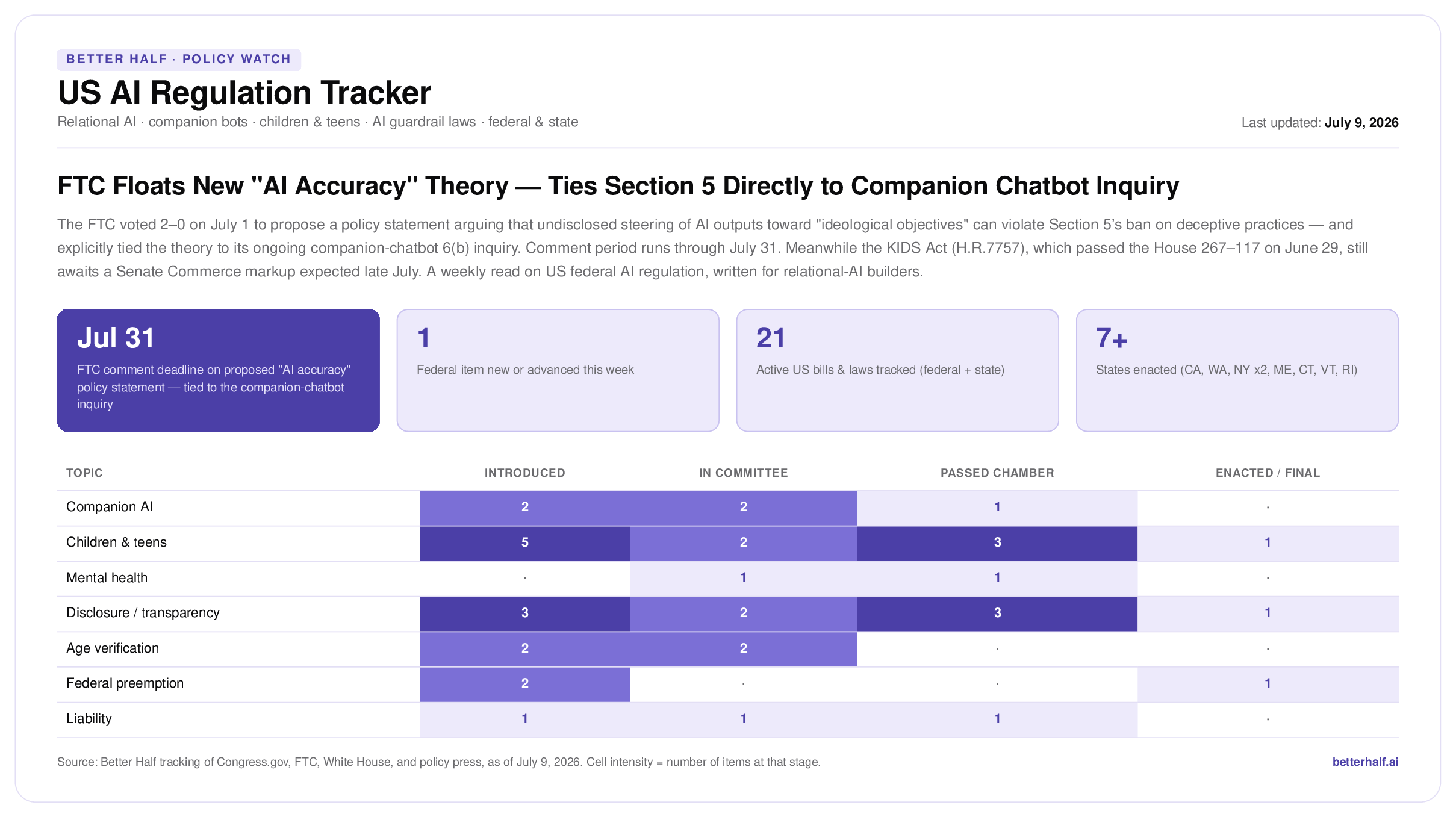
For the full breakdown — every bill, lawsuit, and commentary piece we’re tracking — visit better-half.ai.
Link Outs
Meta’s new Muse Image generator is using Instagram photos from public profiles. And you’re already opted in. You can turn it off in your settings.
Is AI the next Big Tobacco? The argument is gaining traction. This plan didn’t get much traction for social media, but maybe a Truth campaign would help.
If Johnny Depp couldn’t come close to Gene Wilder’s performance in the Willy Wonka remake, how do you think AI will do? Judging from the trailer, not well.
Remember those people who told you philosophy majors are worthless? Turns out AI teams need more of them.
Check out this Atlantic: Recode interview with Signal CEO Meredith Whittaker for an excellent take on why digital privacy matters more than ever in an age of AI.
One last thing…
The robots’ violent takeover may not be ready for primetime, but don’t say it’s for lack of trying:
This is Good Friction, Better Half’s look at relational AI — the technologies deepening human connection, and the ones quietly pulling us apart. Subscribe here:
Comments
Nothing yet. Say the first thing.
Sign in to join the conversation.