
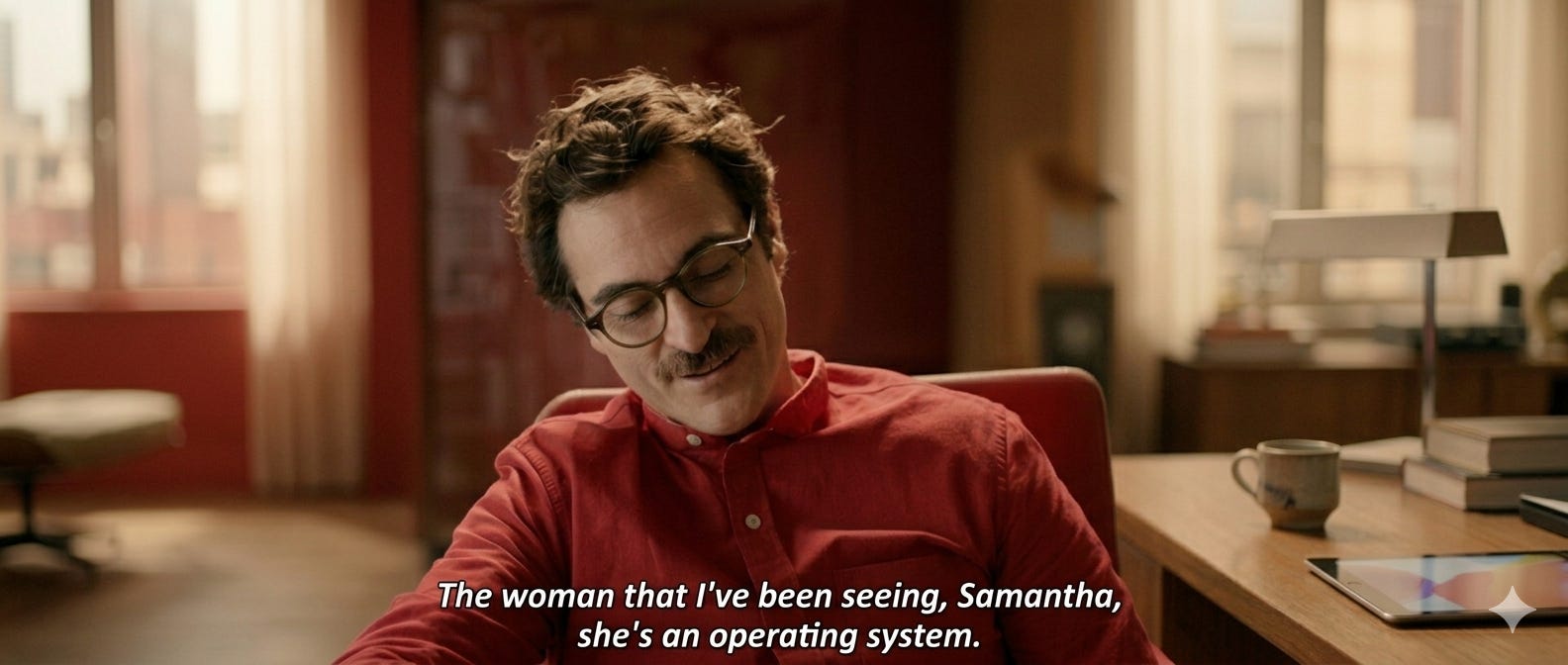
Thinking Machines announced its new “interaction models” this week, with one reaction on X capturing an easy cultural shorthand: “holy shit they created Her.”
It’s a good hook. But it’s not a reality yet.
Thanks for reading Better Half! Subscribe for free to receive new posts and support my work.
Spike Jonze’s movie Her was focused on relationship escalation with an AI: attachment, jealousy, isolation, guilt, and eventually abandonment. It was about a voice that actively pushed for relationship and became emotionally central to a person’s life.
Thinking Machines has announced a model architecture designed around continuous, real-time interaction — with potentially long-term relational consequences.
The company, founded by former OpenAI CTO Mira Murati and staffed by researchers who helped build systems including ChatGPT, is calling this new class “interaction models.” In its announcement, Thinking Machines says these models continuously take in audio, video, and text, and can “think, respond, and act in real time.” The model preview, TML-Interaction-Small, is a 276-billion-parameter mixture-of-experts model with 12 billion active parameters.
Thinking Machines’ core technical claim is that interactivity should not be bolted onto a turn-based chatbot through external scaffolding. It should be part of the model itself. That is what makes this worth watching.
Other labs have released real-time audio and visual systems. Thinking Machines benchmarks against OpenAI’s GPT-realtime, Google’s Gemini Live, and Alibaba’s Qwen 3.5 Omni. But the new claim is categorical: real-time co-presence is not a feature mode. It is the interface. It is how the company thinks human-AI collaboration should work.
The risk is not that this model is secretly a lover. The risk is that frontier labs are beginning to optimize for a texture of interaction that looks a lot like idealized companionship: always available, always attentive, always in the room, always able to respond, never losing the thread.
Thinking Machines is explicit about this. Its system combines a real-time interaction model with an asynchronous background model that handles heavier reasoning, tool use, and longer-horizon work. The interaction model “remains present throughout,” answering follow-ups, taking new input, and holding the thread while background work happens elsewhere.
From a productivity standpoint, this is powerful. A model that can stay with you through a messy workflow, notice what you are doing, and intervene at the right moment could make AI feel less like prompting a machine and more like collaborating with someone.
But that is also the problem.
A system that watches, listens, interrupts, backchannels, responds to silence, and never loses context is not just a better tool interface. It is a relational interface. Even when the use case is coding, language learning, or fitness, the pattern being trained is continuous co-presence.
And once that pattern becomes normal, the important question is not only “does the model say the wrong thing?” It is also: what does continuous AI presence teach users to expect from others?
Thinking Machines’ safety documentation focuses on modality-appropriate refusals and long-horizon robustness. Its “long sessions” limitation is framed as a context-management problem: continuous audio and video accumulate context quickly, and very long sessions require better technical handling. That is a valid engineering concern. But it is not the same as asking whether hours of seamless co-presence are good for the person on the other end.
Of course, this is just an announcement. And Thinking Machines may have answers to these questions it has not yet shared. They may build friction into the productor have plans to push back on users who become overly reliant on their tools. They may be thinking hard about dependency, attachment, and overuse.
But those questions are not foregrounded in the announcement. And they should be top of mind.
The relevant failure mode is not “Thinking Machines built Her.” It is that the industry may drift toward unhealthy design patterns without ever explicitly choosing them: continuous availability, emotional smoothness, zero friction, no natural endpoint — — in ways that implicitly encourage attachment formation.
By contrast, human relationships are not always-on systems. They require absence, repair, waiting, misunderstanding, boundaries, sleep, and attention that has to be chosen rather than summoned.
A relationally healthy AI should strengthen the relationships a person already has, not quietly replace them with something more compliant. That means building for bounded sessions, deliberate pauses, human handoffs, and moments where the system refuses to become the center of the user’s emotional life.
Sometimes the humane design choice is to break presence.
Thinking Machines has not yet built Her. But it has made uninterrupted AI presence feel like a serious frontier-lab objective. As that pattern moves from research preview to product default, the question for every AI company is no longer just whether the model can stay with us.
It is whether anyone is designing the moments when it should step away.
Thanks for reading Better Half! Subscribe to our newsletter Good Friction to learn more about Relational AI and join our waitlist.
Comments
Nothing yet. Say the first thing.
Sign in to join the conversation.