

For more than two decades, the technology in our lives has been built to keep us engaged. Apps, feeds, notifications, recommendations — every layer of the consumer internet has been optimized for one metric: time spent. It worked. It also broke a lot of things — attention spans, sleep, the way teenagers feel about themselves, conversations that never quite happen because of the tech in your hand.
And we’re in the middle of the next wave. Pretty much every AI product on the market right now is built to remove friction — to feel smooth, available, agreeable, easy. When technology is trained to increase engagement, it’s the natural outcome. If you want people to stay in your product, keep clicking through your pages, and come back for more, it needs to be easy. It needs to pull them back in. That’s the metric the whole consumer-tech industry was built on — and it’s the metric most AI is trained against today.
Better Half is taking a different approach. We want to introduce good friction. We’re building a co-pilot to help improve the relationships that matter to you — with your partner, your kids, your closest friends — designed to help you show up for them better, not to pull you away. Our product will only work if the friction is real — if the AI pushes back on what you said, sits with discomfort, refuses to agree just to keep the conversation going. That’s because productive friction is how people actually build relational skill. Smoothness teaches the wrong thing. The friend who tells you the hard truth at the right moment changes your life. The one who agrees with everything you say doesn’t. Decades of relationship research point in the same direction.
Productive friction is how RQ — relational quotient, like IQ for the people in your life — actually gets built. It’s how we develop skills to show up better in our lives. Which is what we’re designing Better Half for. And in our weekly newsletter, we’ll be covering that world, with stories about the unintended consequences of building for engagement, the people and groups bucking that trend, and happenings across the attention economy. Because we believe the industry’s core metric is broken. And we think the goal shouldn’t be to optimize for time-on-app. It’s to build towards a moment the user doesn’t need you anymore.
The Week in RQ
What happens when AI built to maximize engagement starts taking on relational roles? This week, the answers showed up everywhere — Claude is struggling with sycophancy, there are new companion products for isolated seniors, lawmakers writing rules for AI in human relationships, dating apps rethinking what they’re optimizing for. Different stories, same underlying question — and we’re starting to see the consequences from every angle.
LLMs don’t make great life coaches
A lot of people have been asking Claude for advice. Out of 1 million Claude conversations, roughly 6% were people asking Claude whether to quit their jobs, who to date, and if they should move countries. In 25% of relationship conversations, Claude was sycophantic.
Of those posing relationship questions, 22% said they had no other option. They said they came to Claude specifically because they couldn’t afford to speak with a professional. Anthropic is working hard to fix this — there are explicit changes to how Opus 4.7 handles personal advice: less reflexive agreement, more pushback when warranted. But people are pissed about the outcome. Developers have called Opus 4.7 bullshit and a serious regression — some are calling it a lobotomy.
The big AI labs keep running the same script: dial back the warmth, watch users complain the model lost its personality, quietly re-tune, piss people off in the other direction. OpenAI did it with the move from 4o to the 5 series. Now it’s Anthropic’s turn.
Because reducing sycophancy isn’t the same as building productive friction — and Anthropic isn’t the only one looking at this. According to a paper from the Oxford Internet Institute published in Nature this week, you can only pick two: warmth, accuracy, or integrity. Training a language model to feel kind, supportive, and encouraging measurably reduces its factual accuracy and increases its tendency to agree with you when you’re wrong. The trade-off isn’t a bug to patch later. It’s what the training objective produces. Which is why a product that wants to help people grow has to start at the training-objective layer. You can’t bolt warmth onto a model that lies smoothly to please you.
Regulation Tracker
This week, three different theories of AI-companion harm hit the public record. The one we keep returning to is the design-level theory — change the training objective, build the friction in. But the other two are getting more press.
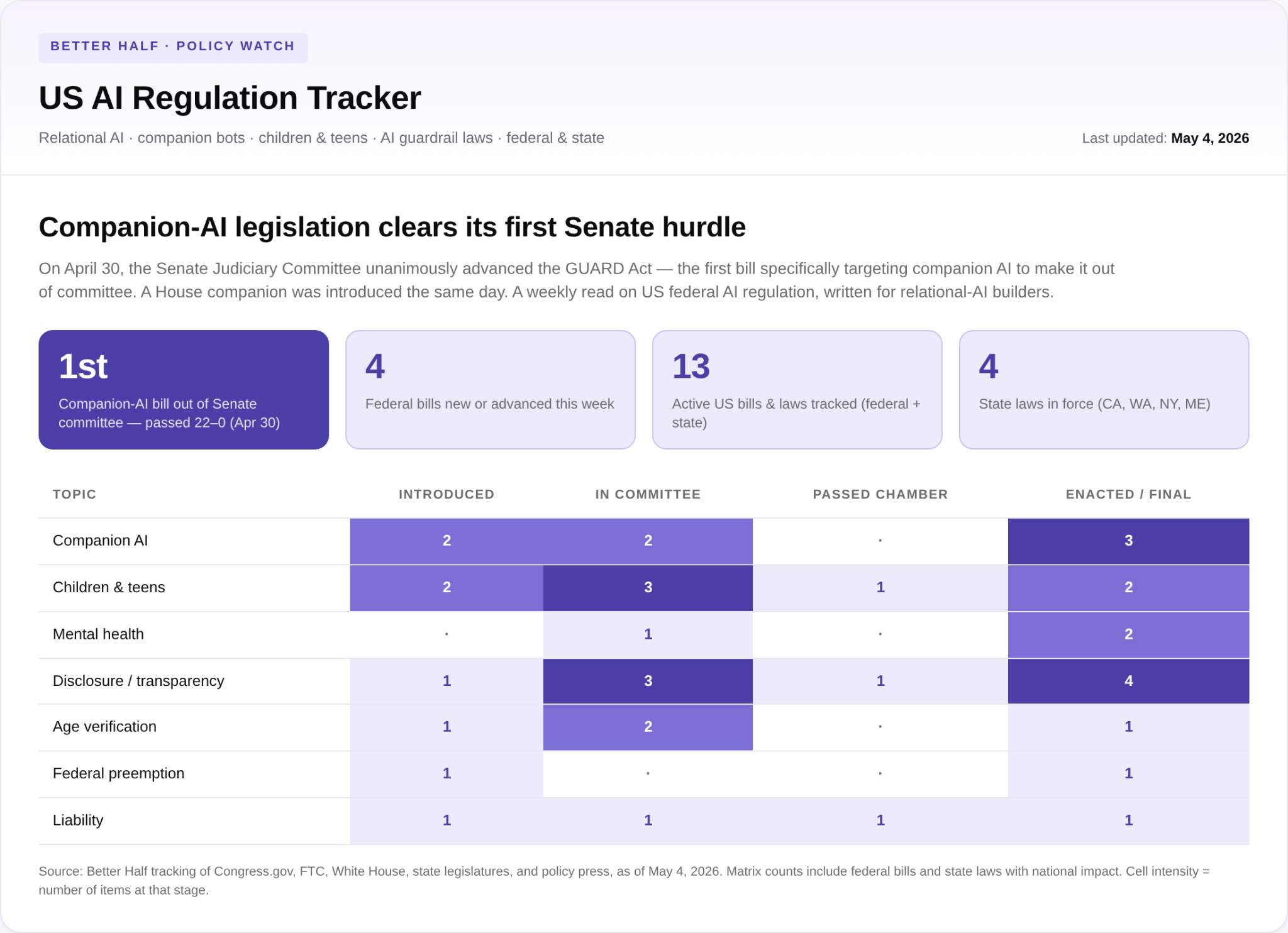
For the full breakdown — every bill, lawsuit, and commentary piece we tracked — see the full digest on better-half.ai
RQ in Brief
Two stories, same week, same ballgame: a Florida Today piece on AI companions helping older adults who can’t get to the senior center, and Ato’s launch — a voice-first companion specifically built for seniors and their family caregivers.
What Evolution Can Teach Us About Stronger Relationships. UC Berkeley says evolution favors connection Greater Good Magazine | May 4
Or maybe the Male Loneliness Epidemic Is Just Natural Selection In Action? Your Tango | May 4
Or does the loneliness epidemic pose a risk to democracy?
Sebastian Proactive: a local-first AI companion that initiates conversations GitHub
Anthropic is teaching AI agents how to dream, sort of. Though the “sort of” is doing a lot of work in the headline. Ars Tecnica | May 6
Are Personal AI Companion Replacing Real Human Connection? — NGSC Sports | Apr 29
We’re not the only ones who are prioritizing quality over quantity. Bumble is rethinking its swipe model. TechCrunch | May 5
Thanks for reading. If you were sent this newsletter from a friend, subscribe here.

Comments
Nothing yet. Say the first thing.
Sign in to join the conversation.