

This week’s AI news circles a cultural shift: AI is moving from a tool we use to a layer that mediates how we work, connect, learn, and trust.
So what happens to us as more of life comes through an AI lens? This week’s stories trace that tension across microcommunities, social-practice bots, cognitive overreliance, safety handoffs, companion-bot regulation, AI and work, and the strange rise of synthetic relationships.
— Meghan
Thinking Machines, the AI lab founded by former OpenAI CTO Mira Murati, has announced a new class of “interaction models” designed for continuous, real-time audio, video, and text interaction.
One reaction on X captured the obvious cultural shorthand: “holy shit they created Her.”
But Thinking Machines is previewing something more specific: an architecture designed around never losing the thread with the user.
That is powerful for productivity. It is also relationally important. A system that watches, listens, interrupts, backchannels, responds to silence, and stays present while background reasoning happens elsewhere is not just a better tool interface. It is a relational interface.
The question is not whether the model is secretly a lover. It is what continuous AI presence teaches users to expect from others.
The thing to watch here is if releases like this pressure the industry to rush to keep up, drifting toward toxic, Her-type design patterns without explicitly choosing them: continuous availability, emotional smoothness, zero friction, no natural endpoint.
Sometimes the humane design choice is to break presence.
Why human skills will matter more in the “Agentic Interface Era.” New_Public argues we are moving from the social-feed era into the “Agentic Interface Era,” where AI agents increasingly shape what people see, how information is summarized, and how trust travels online. The risk is more automation, synthetic interaction, and anti-social behavior at scale. The opportunity is that smaller, higher-trust microcommunities may become more valuable. That tracks with new Greater Good research on shared activity as a source of connection, and with Derek Thompson’s Plain English episode arguing that AI may redirect work rather than erase it — making human skills like trust, judgment, coordination, care, and knowing when not to automate even more important. After the Feed New_ Public | May 12 When Adults Embrace Play, They Create Community Greater Good | May 11 The Case Against the AI Job Apocalypse — Plain English
Noora is an anti-companion bot. Stanford’s Open Virtual Assistant Lab quietly launched a chatbot called Noora to help users on the autism spectrum practice social communication through structured empathy exercises: read the emotional valence, write an empathic response, get feedback, try again. In a small randomized trial, 71% of users improved their empathetic responses after four weeks. Noora is not trying to become a friend. It is trying to help someone practice a human skill. An AI Social Coach Is Teaching Empathy to People with Autism
An AI Atrophy tracker for engineers. A solo developer shipped an iOS quiz app called Atrophy for software engineers who suspect their LLM use has slipped toward cognitive atrophy from over-reliance on AI. From the announcement: “You’ll get a score at the end, plus a downloadable certificate for bragging rights (or public shaming).” Hacker News | May 11
OpenAI is adding a human you know into the loop if your chats dip into self-harm. Last Thursday OpenAI announced Trusted Contact, an optional safety feature in ChatGPT that allows adults to nominate someone they know and trust to be “notified if our automated systems and trained reviewers detect the enrolled person may have discussed harming themselves in a way that indicates a serious safety concern.”
Your brain on AI. A new study co-authored by Brian Christian found that brief AI help can reduce persistence and hurt independent performance after access is removed. The distinction was how people used it: those who asked for direct answers showed worse downstream performance, while those who asked for hints did not show the same decline. The pattern keeps showing up: AI’s effects depend on how you use AI matters more than whether you do. Generative AI impairs brain performance, thinking, problem-solving Fast Company | May 11 AI Assistance Reduces Persistence and Hurts Independent Performance Arxiv | April 10
Policy watch: Are companion bots a public health issue? Brookings is hosting an event May 26 asking whether AI companion bots should be governed according to their public-health implications.
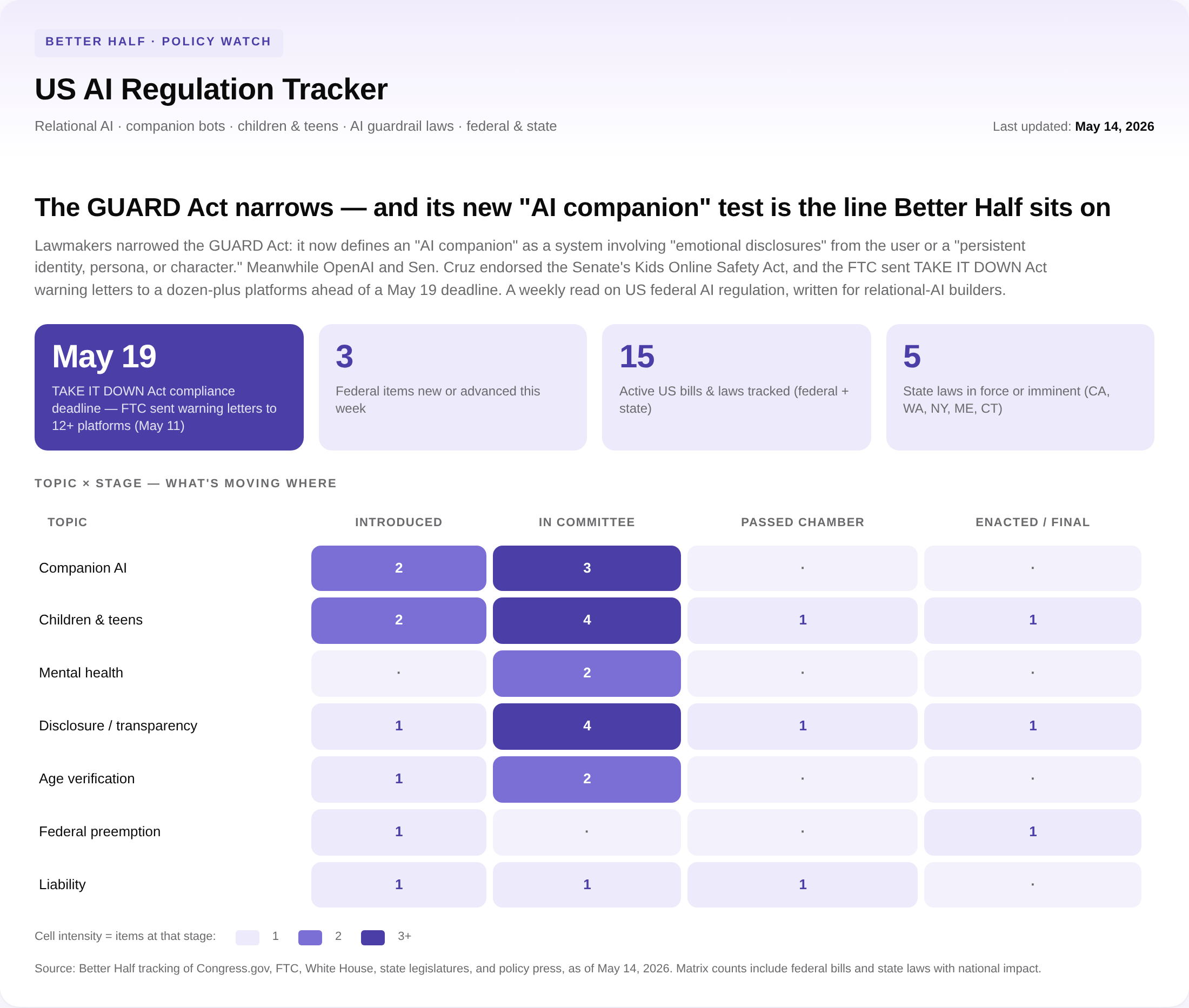
For the full breakdown — every bill, lawsuit, and commentary piece we tracked — see the full digest on better-half.ai
Palantir is getting ‘unlimited access’ to NHS patient data in the UK.
AI users are still protesting changes to the AI companions they love. Right now they’re mad at Claude for sunsetting Sonnet 4.5.
The key to societal resilience? It starts with cognitive defence and improved relational skills.

Japanese game Dragon Quest has added an AI companion named “Chatty Slimey,” and hopes players treat it as a friend… even though Chatty looks a lot like an iridescent poop emoji.
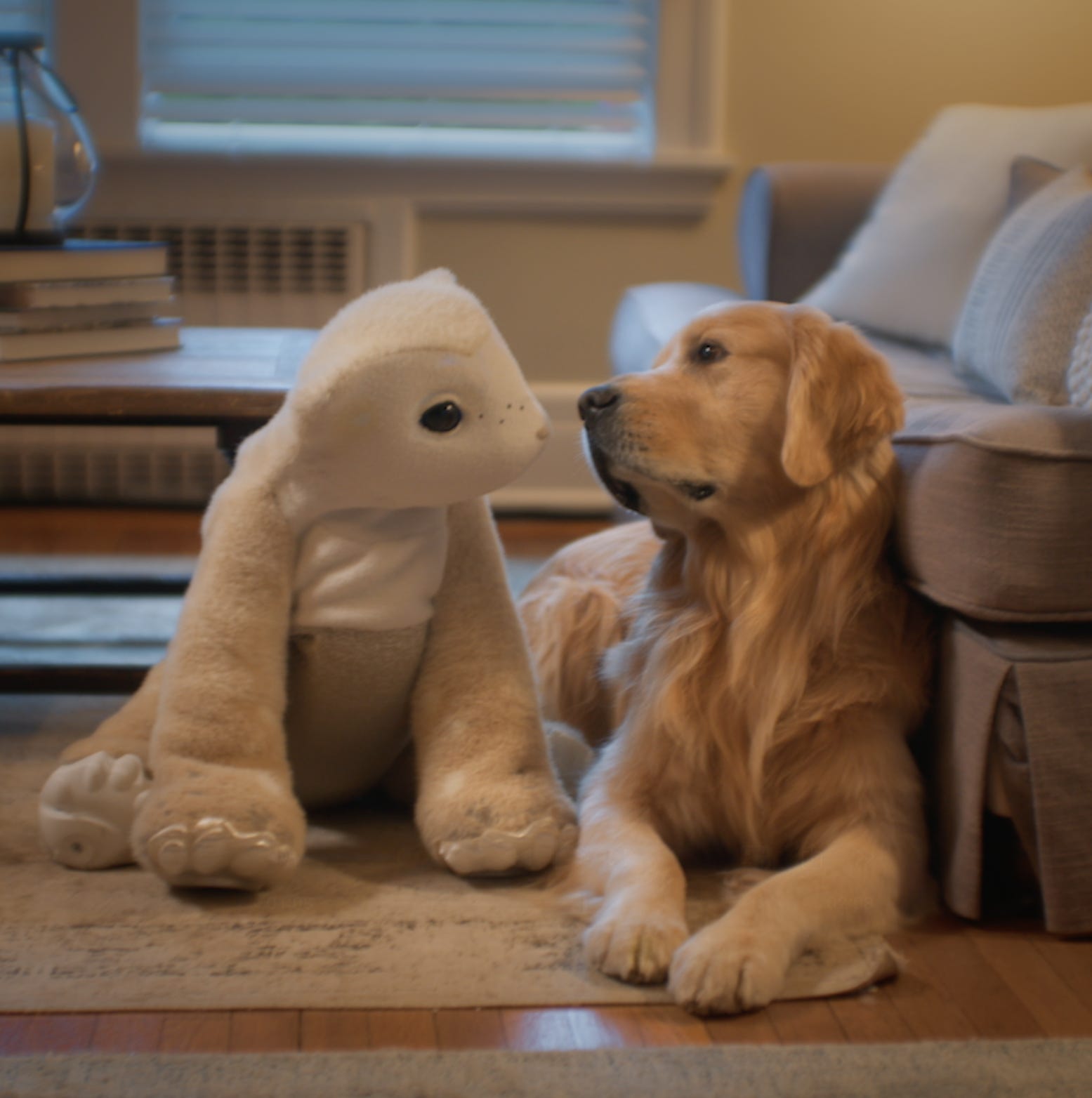
And the creator of Roomba is launching a dog-sized companion robot pet designed to be a ‘familiar’ for human connection. The real life dog in the photo doesn’t look too happy about it.
Opus 4.7 has learned self love.
This is Good Friction, Better Half’s look at relational AI — the technologies deepening human connection, and the ones quietly pulling us apart. Join our waitlist at findyour@better-half.ai.

No posts
Comments
Nothing yet. Say the first thing.
Sign in to join the conversation.