

It is an established fact that Europeans care deeply about their financial health. They are among the world’s first in savings. However, when it comes to investing, are they in a good position?
The BETTER FINANCE and EFPA Financial Health Study — drawing on responses from 14,318 individuals across 10 European countries — showed that Europeans are good at managing their personal finances and, to some degree (varying by country), at saving.
However, the question is, are Europeans structurally and behaviourally equipped to participate in capital markets?
The data suggests they are not. And the reasons go well beyond a simple knowledge gap.
The data offers genuine cause for optimism. The preconditions for a retail investment culture are present in Europe. With capacities in place, the main challenge is conversion.
86% of Europeans consider financial health important. They link it explicitly to quality of life, mental well-being, and the ability to plan for the future. This reflects a mindset that is, at least in principle, aligned with long-term financial planning.
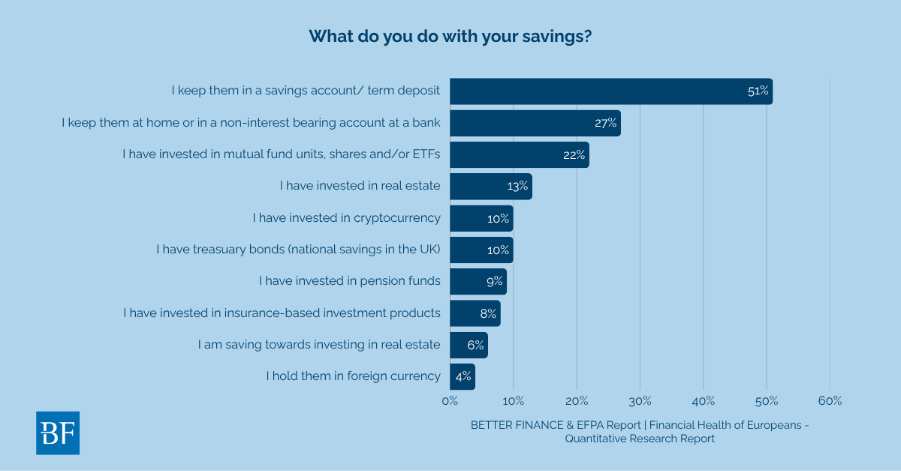
This mindset is supported by behaviour. Europe is a savings economy, with 78% of Europeans reporting to save at least occasionally. 62% reported having a financial buffer covering at least three months of expenses. This shows that Europe is a misallocated saver economy, with much of the savings parked in low-yield deposits or cash.
At the same time, there is a clear appetite to do more. Nearly 3 in 4 Europeans want to improve their financial knowledge and skills. This willingness to improve signals an openness to engage with more sophisticated financial decisions. For retail investment, this represents a significant onboarding opportunity, one that remains largely untapped by both policymakers and the financial industry.
Taken together, these findings pave the way for the EU’s ambitions with its Savings and Investment Union and Retail Investment Strategy. It shows that Europeans are willing, able, and increasingly motivated to engage with financial markets. With the right tools and financial products (such as PEPP and Savings and Investments Accounts), Europeans have the capacity to turn the low-yield savings into capital market investments.
Savings exist. The motivation is there. Yet systemic friction and behavioural barriers consistently stop Europeans from taking the next step into investing.
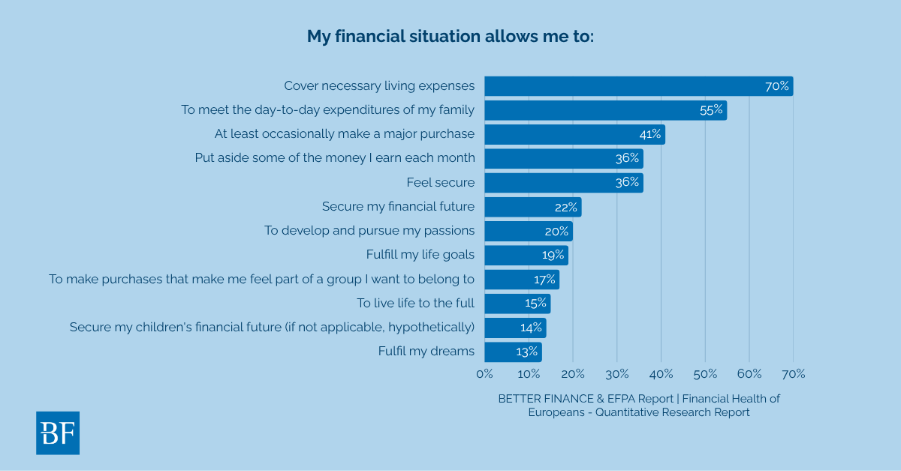
First, income limitations remain a key barrier. Though Europeans regard financial health as an important factor in their overall well-being, 83% report that they can meet at most half of their financial needs. Only 15% feel financially free to enjoy life. This significantly reduces risk appetite. For many households, investing is perceived as a luxury, something to consider only once financial comfort is achieved.
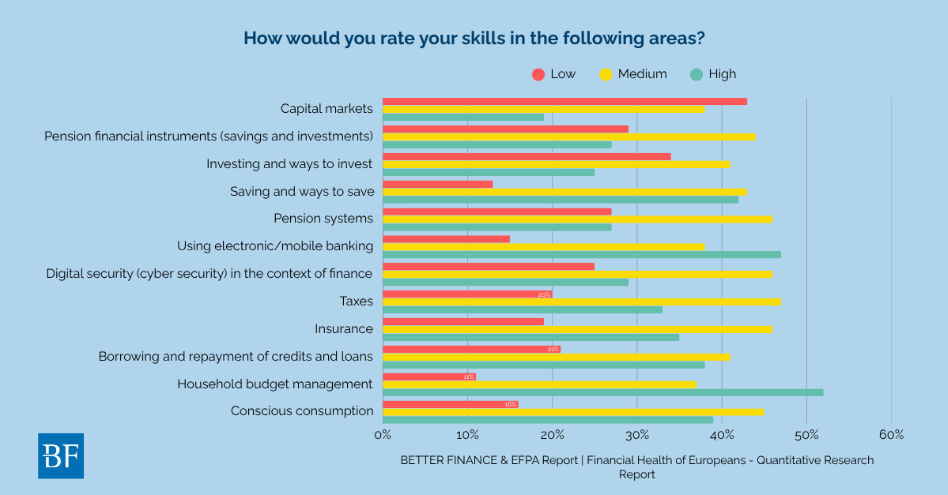
Second, there is a clear gap in investment knowledge. Only 1 in 3 Europeans feel confident about investing and pension planning, with the lowest confidence consistently observed in capital markets and long-term financial planning. Europeans can budget, however, they struggle to make the transition into investment decisions.
That transition requires a confidence threshold (in products, in markets, in one’s own financial competence) that most have not yet crossed. Without it, savings remain where they are: in cash deposits, generating weak returns and contributing nothing to the deepening of European capital markets.
Third, the data highlights a persistent intention–action gap. While 65% of Europeans set long-term financial goals, only 15% consistently pursue them. Behavioural factors such as present bias, complexity aversion, and inertia play a decisive role, delaying or preventing engagement with financial markets. The distance between intention and behaviour is where retail investment participation is lost.
The inability to harvest long-term returns is a lost opportunity for Europeans, especially considering that the projections that supplementary pension products will not provide a steady income in the future, as reported by BETTER FINANCE’s annual pension report. Overall, this misallocation represents a structural inefficiency that the EU’s Savings and Investments Union and Retail Investment Strategy aim to address.
The barriers identified above are significant. Yet the data reveals a deeper layer of dysfunction, one that points to a system that is structurally failing to produce retail investors.
First, basic financial awareness is alarmingly low. Only 11% of Europeans can accurately estimate their monthly income, and only 9% track their expenses precisely. Most households rely on rough estimates rather than a clear picture of their financial position. This matters enormously for retail investing. Without a reliable understanding of personal cash flow, assessing investable capacity is effectively impossible.
Second, investing is not part of how Europeans define financial health. Only 18% of Europeans associate financial health with investing, and just 14% associate it with having financial knowledge. Europeans define financial health in defensive terms: security, stability, and the absence of financial stress. Wealth creation, capital growth, and long-term market participation do not feature. This cultural disconnect is consequential. If investing is not perceived as a normal component of financial well-being, it will remain an exceptional behaviour rather than a mainstream one.
Third, capital markets are widely perceived as inaccessible. Approximately 1 in 3 Europeans believe that financial health is achievable only for the wealthy or those with strong financial expertise. This perception of exclusion is self-reinforcing. It suppresses participation amongst precisely those households that would benefit most from long-term investing. It also exposes the limits of information-based interventions: if people believe markets are not designed for them, no amount of communication will shift behaviour at scale.
Taken together, these findings point to a system design problem. Products are too complex. Accessible investment pathways are too few. Trust in financial markets and institutions remains fragile. The result is a continent where the structural conditions for retail investing are weak.
Thanks for reading Inside EU Finance: The Individual Investor Brief! This post is public so feel free to share it.
The data points to a clear structural failure: lots of savers, few investors. Closing this gap requires an honest assessment of why well-intentioned policy has not delivered.
The EU has not been idle. The Retail Investment Strategy sought to improve fairness and transparency for retail investors. PEPP was designed as a simple, portable long-term savings vehicle accessible to all Europeans. The Savings and Investments Union is now the framework within which these ambitions are being pursued. Yet retail participation remains weak.
Why? Because good policy frameworks have repeatedly met poor execution at Member State level. PEPP is the clearest example. Negligible uptake reflects insufficient tax incentivisation, limited distribution, and a product that never achieved the simplicity it promised.
For Europe’s capital markets to flourish, four things need to change. Products must be simpler and cheaper. Distribution must be reoriented away from intermediary incentives and towards genuine suitability for retail clients. Simple, standardised investment vehicles such as PEPP and Savings and Investment Accounts must be made genuinely accessible and attractive at the household level. Finally, as BETTER FINANCE has consistently argued, the inducement model creates a structural conflict of interest that undermines trust in financial markets. An inducement ban, combined with fee-based independent advice as the standard precondition for rebuilding the trust that retail participation requires.
Europeans are ready to be investors. The system needs to meet them halfway.
No posts
Comments
Nothing yet. Say the first thing.
Sign in to join the conversation.