
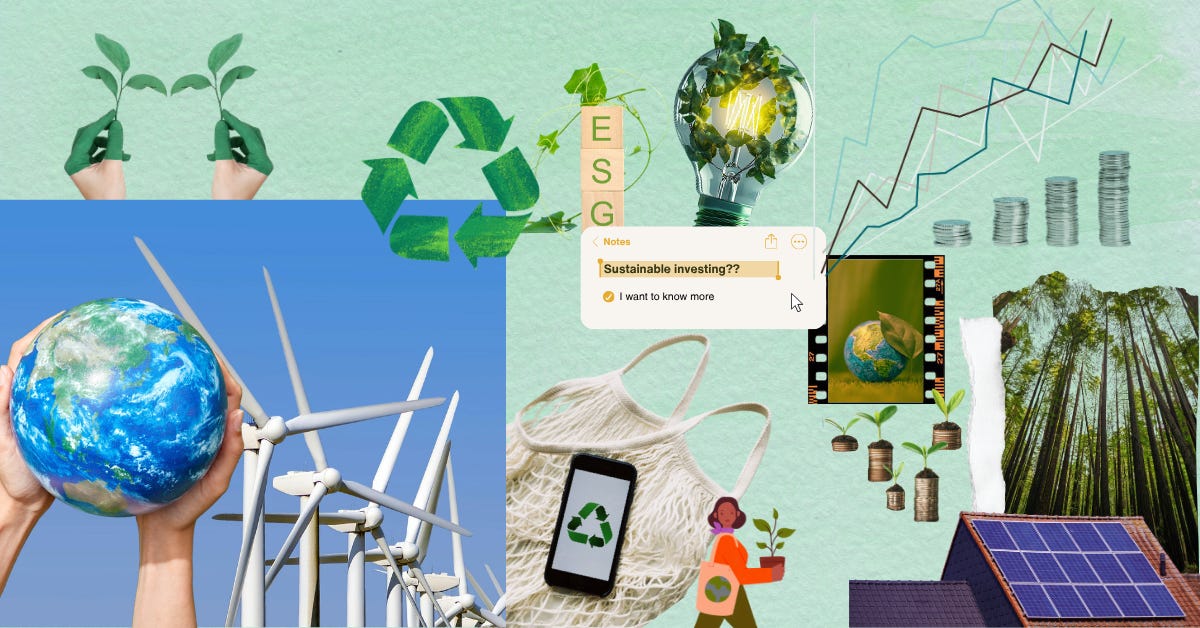
Sustainable (or “responsible”) investing has gone mainstream, and for good reason.
Across Europe, more and more people want their savings and pensions to do more than just grow. They want their money to mean something. To support the climate transition. To promote better corporate behaviour. To contribute, however modestly, to a better future.
And yet, scratch the surface, and things quickly become complicated.
Let’s start with the obvious: most people do not want to choose between doing good and doing well.
European investors consistently show that they care about sustainability, but not at the cost of significantly lower returns. The expectation is clear: align values and performance.
That is not unreasonable. In fact, it is the very premise on which sustainable investing has been built.
But delivering on that promise is harder than it looks.
If you have ever tried to understand how “green” an investment really is, you have probably run into a wall.
· Information is inconsistent
· Methodologies vary widely
· Labels can be misleading
· And the jargon is often impenetrable
Even worse, there is the persistent issue of greenwashing, where companies or funds appear far more sustainable than they truly are.
One of the most confusing aspects is how companies are rated. A fossil fuel company might receive a relatively strong ESG score simply because it performs “better” than other fossil fuel companies. Meanwhile, a renewable energy firm might rank lower due to different metrics or risks.
So yes, an oil major can look “greener” than a wind turbine manufacturer. Not because it is, but because of how the system works.
Here is where things get truly interesting.
Intuitively, you might think the most responsible approach is to avoid “bad” companies altogether. But that is not always the case.
There is a growing recognition that:
· Engagement can be more effective than exclusion, at least in some cases
· Investors can push companies to improve if they remain invested
· Selling shares may simply transfer ownership to less responsible actors
In other words, staying invested in a polluting company, and using your influence, might ultimately have more impact than walking away.
Uncomfortable? Yes. But important.
For a deep dive, read the annual BETTER FINANCE report on transition investing, its evolution, challenges and opportunities
Read the Transition Investing Report
One of the most overlooked aspects of investing is also one of the most powerful: shareholder rights.
When you invest, you do not just own a financial asset. You often gain:
· Voting rights
· The ability to support or oppose company decisions
· A say in governance, climate strategy, executive pay, and more
But here is the catch: many individual investors either do not realise this, or cannot easily exercise these rights, especially when investing through funds or pension schemes.
That is a problem.
Because without active ownership, sustainable investing risks becoming little more than a branding exercise.
The EU has taken major steps to bring order to the chaos.
Frameworks such as the EU Taxonomy aim to define what is genuinely sustainable. Disclosure rules are designed to improve transparency and comparability.
These are crucial developments, but they are not a silver bullet.
· The rules are complex
· Implementation is uneven
· Debates continue over what should, or should not, qualify as “green”
In short, regulation helps, but it does not eliminate ambiguity.
Thanks for reading Inside EU Finance: The Individual Investor Brief! This post is public so feel free to share it.
If there is one takeaway, it is this: sustainable investing is worth pursuing, but it requires critical thinking.
Keep in mind:
· Labels do not tell the whole story
· “Best in class” does not mean “good in absolute terms”
· Engagement can sometimes be more powerful than divestment
· Your shareholder voice matters, so use it if you can
· Transparency is improving, but still far from perfect
Sustainable investing is not a passing trend. It is a fundamental shift in how we think about capital, responsibility and the future.
But it is also messy, full of trade-offs, grey areas and contradictions.
And that is okay.
Because the goal is not perfection. It is progress.
The more informed, engaged and demanding investors become, the harder it will be for the system to hide behind complexity or empty claims.
So, ask questions. Look deeper. And remember: where your money goes still matters.
Perhaps now more than ever.
No posts
Comments
Nothing yet. Say the first thing.
Sign in to join the conversation.