
Across Europe, people are being asked to take more responsibility for their financial future.
Longer life expectancy, pressure on public pension systems, and persistently low interest rates mean households are increasingly expected to invest, not just save. European policy discussions now encourage citizens to put more of their money to work in capital markets.
Yet for many people, investing still feels distant, complex, and risky. Trust in financial markets remains fragile, and participation uneven. This gap between ambition and reality is where investor education enters the conversation.
If you want to explore practical lessons from previous initiatives, part 2 of this series explores in more detail what experience shows works, what does not, and why investor education remains important despite its limits and provides a detailed overview of what BETTER FINANCE and its members have learned.
European households hold a large share of their wealth in cash and bank deposits. While historically, conditions such as positive real interest rates, relatively secure public pensions, and limited access to retail investment made saving a common choice, investing has always offered the potential for higher long-term returns. Today, households face low interest rates and inflation, highlighting the importance of putting some savings to work in capital markets.
Inflation erodes purchasing power. Low-yield savings struggle to support long-term goals such as retirement. At the same time, European companies need stable, long-term capital to finance innovation and growth.
Moving from saving to investing is, therefore, not simply a personal choice. It has broader economic implications. But participation cannot be mandated. It depends on confidence, which is where investor education plays a critical role.
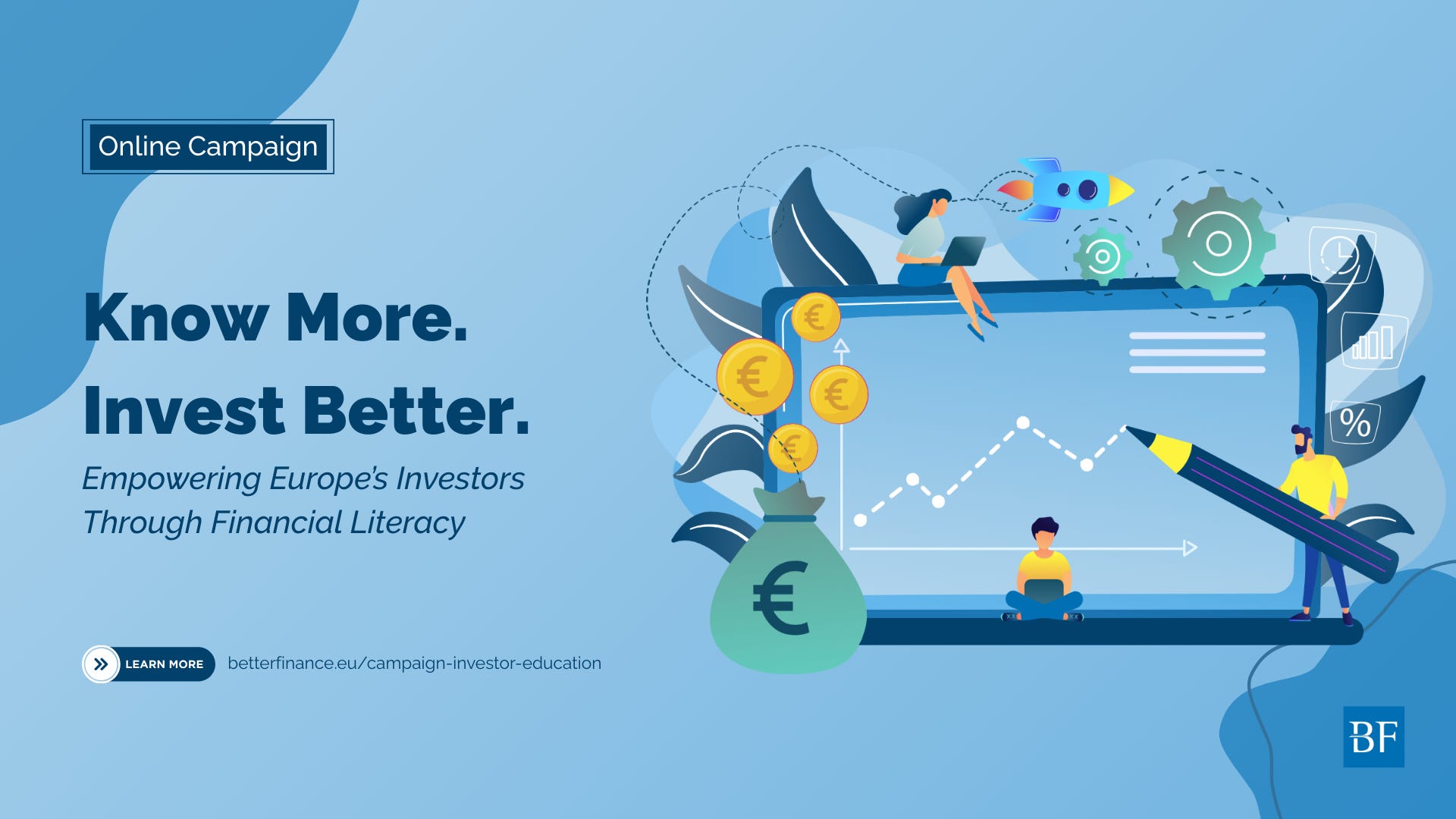
BETTER FINANCE and its members have developed concrete tools and campaigns to help households bridge this gap, including various educational materials and initiatives. For examples of our initiatives rooted in everyday life experiences, see our Investor Education YouTube playlist and Know More, Invest Better campaign.
Thanks for reading Inside EU Finance: The Individual Investor Brief! This post is public so feel free to share it.
Investor education is not about teaching people how to beat the markets or select products. Its real value lies in helping individuals understand risk, set realistic expectations, and feel confident enough to engage with investing rather than avoid it altogether.
Without this foundation, fear of loss dominates, distrust in financial markets grows, and savings remain idle.
Effective investor education enables individuals to make informed decisions aligned with their own long-term goals. It is about confidence and trust, not sales. For further discussion of how education works in practice, see our flagship article Investor education in Europe: necessary, limited, and still essential.
Across the European Union, investor education initiatives exist in many forms. Some Member States have national strategies or school-based programmes. Others rely on initiatives led by regulators, consumer organisations, or private actors. [RZ1]
The result is a fragmented landscape. Access, quality, and continuity vary widely. Outcomes are rarely evaluated in a consistent way, and cross-border coordination remains limited.
The European Commission’s Financial Literacy Strategy seeks to address this. By improving coordination, sharing best practices, and raising overall literacy, the strategy provides a framework for EU-level action. BETTER FINANCE welcomes this effort, while emphasising that strategy alone cannot guarantee impact.
Experience shows that investor education works best when it is independent from commercial interests.
When financial education is delivered by banks or product providers, it can become promotional, even unintentionally. This undermines trust and weakens the credibility of the message.
BETTER FINANCE and its members operate independently. They work directly with households, often at moments of uncertainty or when people seek guidance. This proximity allows education to respond to real-life needs, rather than generic assumptions.
Investor education should start early, ideally in schools. Introducing basic concepts such as saving, risk, diversification, and long-term planning helps build confidence before habits are formed.
But education cannot stop there. Financial decisions evolve throughout life. Investor education is most effective when linked to real decisions, such as choosing a pension or making a first investment. Learning by doing often leaves a stronger impression than abstract instruction alone.
Investor education is increasingly central to European policy debates. It is not a cure-all, but it is necessary. Combined with strong consumer protection, fair markets, and well-designed products, it can help bridge the gap between ambition and outcomes.
BETTER FINANCE is organising an upcoming event on investor education in the EU, bringing together policymakers, supervisors, investor representatives, and educators to share lessons, discuss challenges, and explore what works in practice. More information about the event and registration can be found here.
At a time when citizens are expected to take growing responsibility for their financial future, independent, experience-based, and continuous investor education is no longer optional. It is central to trust, participation, and the resilience of Europe’s capital markets.
No posts
Comments
Nothing yet. Say the first thing.
Sign in to join the conversation.