

Europe’s policymakers want households to put more of their savings to work. Through the newly released Savings and Investments Union agenda, the EU aims to channel idle cash into capital markets and strengthen long-term growth. But for many Europeans, investing still feels opaque, risky and untrustworthy. Thus, European savings continue to be concentrated in low-yield bank accounts, leaving households exposed to inflation and markets starved of patient capital.
In this context, financial advice is meant to play a critical role: helping investors navigate complexity, understand risks, and make informed long-term decisions that build their financial freedom. But as BETTER FINANCE’s new report on financial advice warns, seeking financial advice does not guarantee receiving good advice. Conflicts of interest, uneven adviser standards across Member States, and new digital advisory models continue to test whether EU rules truly protect retail investors.
For ordinary Europeans, investing has become harder, despite technological advances and new investment platforms. Financial products are increasingly complex, spanning structured instruments, insurance-based investments, pensions, and digital investment platforms, making them difficult to assess without professional support.
At the same time, financial literacy in the EU remains low: on average, only about half of Europeans can correctly answer basic financial knowledge questions. This is a missed opportunity. It prevents retail investors from achieving meaningful returns on their savings, leaving them exposed to inflation, and limits the growth of companies that need diverse, long-term funding.
Not everything that a bank, broker or platform tells a client counts as financial advice. Under EU law, a crucial distinction exists between information, sales, and advice. That line determines the level of investor protection that applies.
Information is factual and neutral: prices, product features, market news or general comparisons. On its own, it does not trigger legal obligations. Sales involve promoting or distributing products, often driven by commercial incentives. Financial advice, by contrast, arises when a firm makes a personal recommendation presented as suitable for a specific client or based on that client’s circumstances.
This distinction matters because once a service qualifies as advice, strict legal duties apply, including suitability assessments, disclosure requirements and conflict-of-interest rules.
EU law defines advice separately under MiFID II (for investment products) and the Insurance Distribution Directive (IDD) (for insurance-based investments). While aligned in purpose, the two regimes are not identical, particularly on inducements and adviser status.
To support consistent supervision, ESMA has developed five practical tests to assess whether a service amounts to investment advice in practice.
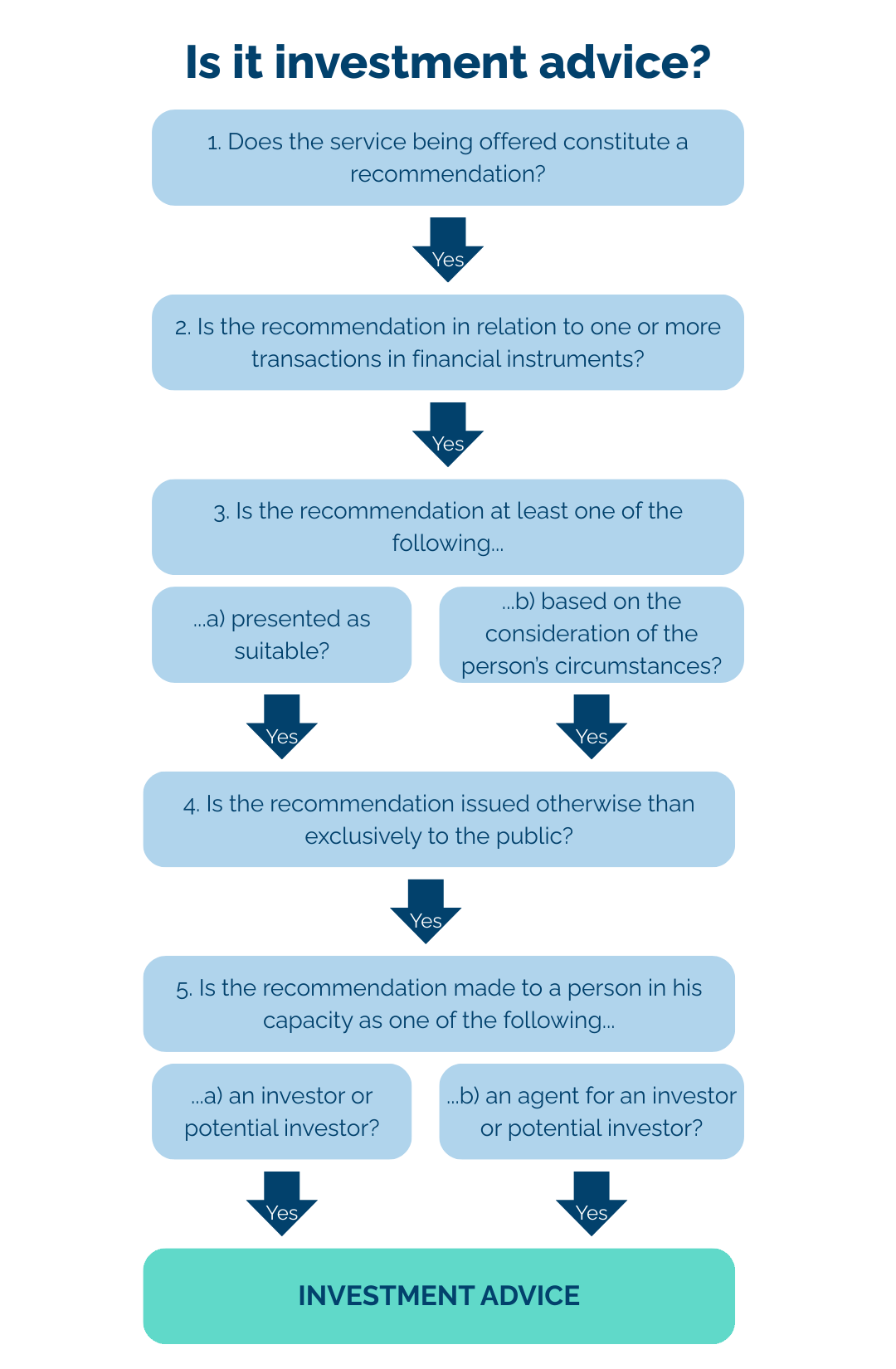
At the same time, when defining financial advice, we must establish who may provide it. Under the EU law, financial advice may be provided by investment firms authorised under MiFID II and by insurance distributors regulated under the IDD, depending on the product concerned. In addition, MiFID II allows Member States to create national regimes for so-called “local advisers” who can give limited advice on non-complex products outside the full EU framework. This means that while EU rules require advisers to have adequate knowledge and competence, qualification standards and certification remain largely determined at the national level, resulting in significant divergence across Member States.
One major weakness of the EU framework lies in the uneven application of rules across Member States, particularly when it comes to adviser qualifications. While MiFID II sets general competence requirements, national authorities retain wide discretion in how these are implemented, resulting in a patchwork of standards that leaves retail investors exposed to differing levels of protection depending on where they seek advice.
Conflicts of interest present a second, more structural problem. Inducements continue to shape advice, incentivising the distribution of higher-paying products rather than those best suited to clients’ needs. Although MiFID II requires firms to identify, manage, and disclose conflicts, these payments are typically invisible to clients and economically disconnected from the provision of advice. In other words, inducements reward product sales rather than advice, steering intermediaries towards higher-paying products and undermining the notion that recommendations are based solely on clients’ best interests.
The rise of robo-advisers and digital investment platforms adds another layer of complexity to the EU framework. Though these tools are often presented as low-cost, impartial alternatives to traditional advice, they largely rely on fee-based models and avoid commission-driven incentives. Yet their growing use also exposes new risks.
Robo-advisers typically rely on simplified questionnaires and standardised algorithms, limiting their ability to capture clients’ full financial circumstances and resulting in recommendations that may lack sufficient personalisation. Although MiFID II applies on a technology-neutral basis and formally covers automated advice, regulatory safeguards have not always kept pace with digital business models. This raises concerns about the suitability of assessments, the oversight of algorithms, and the quality of advice delivered online.
While both MiFID II and IDD are detailed, they fall short of defining what constitutes good advice. As a result, compliance with rules does not necessarily translate into advice that genuinely serves investors’ interests.
BETTER FINANCE recommends that high-quality advice starts with independence from remuneration incentives. Recommendations should not be shaped by commissions or inducements, and adviser status and fees should be disclosed clearly and upfront.
Following that, advice must also be demonstrably in the client’s best interest, based on a sufficiently broad product range, prioritising cost-efficient solutions and avoiding unnecessary complexity. Equally crucial is who delivers it: advisers should meet high, harmonised qualification and competence standards, combining technical knowledge with an understanding of client behaviour and long-term needs. Finally, quality advice should empower clients to understand risks, costs and how recommendations fit their financial goals over time.
BETTER FINANCE sees initiatives such as the Retail Investment Strategy as steps in this direction, but warns that without EU-wide harmonisation, advice quality will continue to vary by country. The UK’s Retail Distribution Review, which clearly separated independent from restricted advice and raised professional standards, illustrates how clearer rules can strengthen trust and participation.
No posts
Comments
Nothing yet. Say the first thing.
Sign in to join the conversation.