
Today’s post is by someone dear to me both personally and professionally. Lynneth Miller Renberg completed her PhD with me in 2018; she was the first PhD student I had the privilege of advising. She is a brilliant scholar and beautiful person, as well as the author/editor of two published academic books and one forthcoming (with another soon to follow). Lynneth and her husband Adam Renberg, a scholar of early Christianity, partnered to produce an advent devotional book that I cannot recommend highly enough. You can order it wherever books are sold (it released last week). I’ve already ordered multiple copies to give as gifts this Christmas. I hope you enjoy this introduction by Lynneth!
You can also follow the Renbergs on IG and on The Anxious Bench.
Candles in the Darkness: An Introduction
Egeria was quite far from home for this year’s celebration of the coming of Christ. She’d traveled from her community in Spain to Jerusalem—no short distance for anyone to travel in 382. But there was something special about celebrating the birth of Christ in the region where he’d been born. She’d followed the procession of monks, walking from Bethlehem to Jerusalem through the dark night—arriving just as the dawn started to make it possible to recognize her fellow pilgrims. Upon reaching the church, Egeria was struck by a blaze of light from the candles lit within. As daylight outside started to match the glow of the candles, Egeria heard the psalms and the prayers with which the church celebrated the birth of Christ. It was no longer dark: the light had come.
This is the account of a celebration for the birth of Christ in Jerusalem that Egeria left for us in the 380s—we can even read it in her own words, as part of a collection of letters and descriptions she sent back to a group of women in Spain:
Blessed is he that comes in the Name of the Lord, and the rest which follows. And since, for the sake of the monks who go on foot, it is necessary to walk slowly, the arrival in Jerusalem thus takes place at the hour when one man begins to be able to recognize another, that is, close upon but a little before daybreak. And on arriving there, the bishop and all with him immediately enter the Anastasis (the tomb where the resurrection took place), where an exceedingly great number of lights are already burning. There a psalm is said, prayer is made, first the catechumens and then the faithful are blessed by the bishop. . . . The monks remain there until daybreak and recite hymns.[1]
Egeria and her fellow believers literally walked from cradle to cross to empty tomb, from darkness into light.
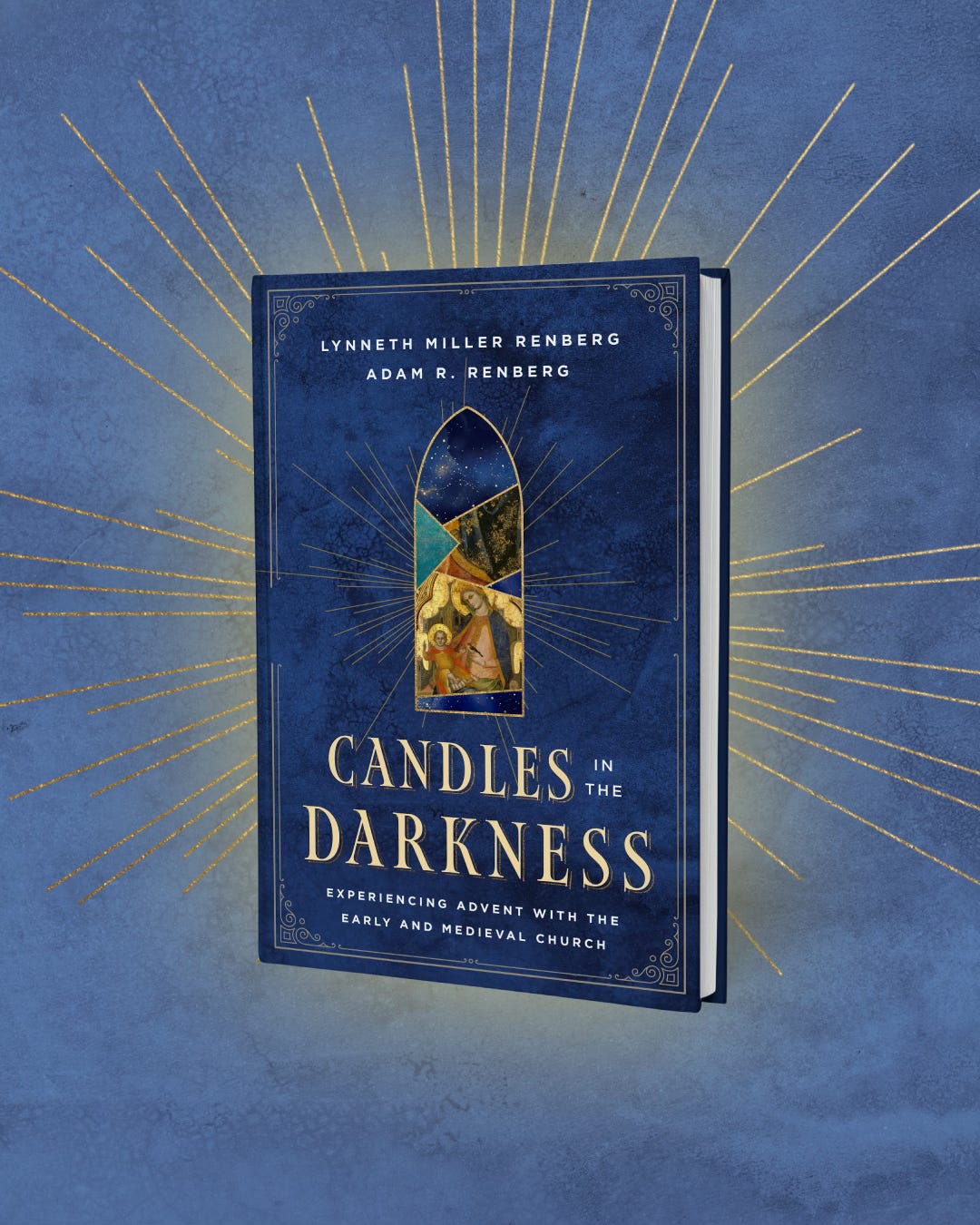
Candles in the Darkness: Experiencing Advent with the Early and Medieval Church begins with the passage above. Here we offer an account of a pilgrimage, the journey of a woman from the fourth century, Egeria, from her home in Spain to Jerusalem, to experience the liturgical seasons in the same places that Christ lived them. In her account of the journey, Egeria emphasizes the new places, sights, and traditions she encountered, as well as the ways that these experiences helped deepen and strengthen her faith. This is at the heart of what my co-author and husband, Adam Renberg, and I hope we can do with this devotional. In encountering new ideas, people, and frameworks from early and medieval history, our own faith has been encouraged and strengthened. We’ve learned from the different ways that these women and men think, describe, and envision God, as well as from their perspectives on Scripture. Egeria herself seems to have had the same experience, traveling to a new place with new perspectives, traditions, and emphases. It seems clear from her letters home to her community in Spain that she likewise learned from and was encouraged by these encounters.
What Egeria’s letters do not detail so clearly are her emotions or feelings along the way– we do not know if she found the journey to be overly difficult, if she experienced “culture shock” with the new languages and customs she encountered, or how she felt about her church community back home. We can guess that at times she perhaps felt out of place– like she didn’t recognize the church around her. Perhaps Egeria even felt hurt or confused by her own church and community. The fourth century in Spain was, after all, a time of change and conflict: the Roman Empire was disintegrating, and the Iberian Peninsula reflected that chaos, with invasions from south and north leading to military conflicts, turmoil, and division. And as the region converted to Christianity, that itself was not without tension or struggle, with differing visions of orthodoxy creating religious as well as political division. Whether on pilgrimage or at home, Egeria likely knew what it felt to be hurt or confused by the culture and church around her, to feel a stranger in a foreign land. But from her letters, it seems clear that she found comfort in the global church: in experiencing the beauty in different traditions and cultures centering the same core theological truth of God become flesh, for the love of humanity.
This devotional is not just for Advent or Christmastide, or for those who enjoy church history. It is also (and perhaps especially) meant to comfort and encourage those who have been hurt by the church and culture in which they live. For both of us, we’ve often felt out of place in the church we see dominating American culture, hurt or confused by the issues that are loudly debated and by the culture wars that seem to dominate podcasts, news, and both in-person and online conversations. When we’ve felt alienated by the church we encounter in our own time and place, both of us have found comfort in authors from other cultures and other centuries.
Reading authors like Egeria or Ephrem the Syrian or Hadewijch (or so many of the other authors in this book) reminds us that the church we know and see in our own communities is one very small part of the much larger Body of Christ– a congregation spanning continents and centuries, centered on Christ incarnate, crucified, and resurrected rather than on culture wars. The sisters and brothers we hear from these different places and times often thought very differently about faith than we often do. They had different priorities, different concerns, and different theological debates; if we were to, like Egeria, join a Christmas service in the third century, we’d certainly struggle with the language, but also likely with the liturgy, the rituals, the allegories, and the music. But we’d find commonality as well. At the core, Christians throughout the whole world from the earliest days of the church onwards have celebrated Advent as a season of waiting for the fulfilment of promises of God with us, have rejoiced at Christmas and the birth of Christ, have marveled and wondered at the ramifications of God made flesh.
This devotional is for those of us who need reminders to look to Christ and who sometimes feel out of place or out of time in the churches around us. The cultural and theological differences between us and past believers helps remind us that at its core, the Gospel remains the same, and that darkness cannot overcome the Light. When the darkness of the church as we see it in news stories or on social media feels overwhelming, the candles offered by past believers, with the new illumination of God, faith, and faith in practice that they offer, can help remind us of the light and hope offered in Christ. If you are struggling to hold onto hope or to see the beauty in the Body of Christ, we hope you’ll join us in hearing and learning from these sisters and brothers in faith, as we all seek Christ together.
[1]Charles Lett Feltoe and M. L. McClure, eds. and trans., The Pilgrimage of Etheria, Translations of Christian Literature Series III: Liturgical Texts (Macmillan, 1919), 52-53.
Comments
Nothing yet. Say the first thing.
Sign in to join the conversation.