
Welcome back.
This week:
Meta’s Muse Spark reset the price-performance race in legal AI.
Harvey made its third acquisition of 2026 as it pushes beyond legal.
Big Law continues creating Chief AI Officer roles.
Lets dig in.

Meta has reset the price-performance race
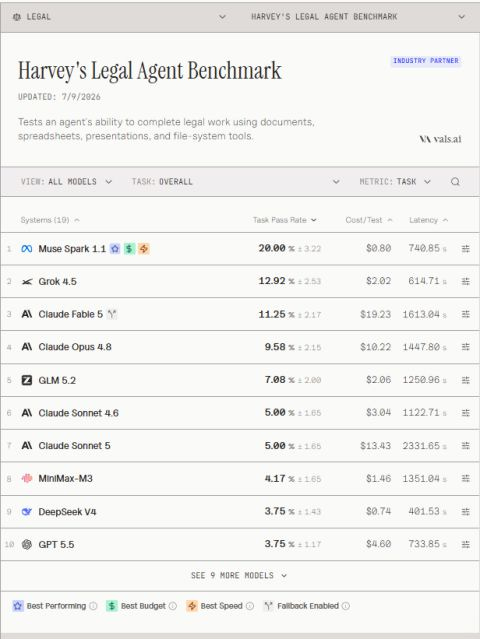
The recent release of Muse Spark 1.1 has caused quite a stir in legal tech circles. Within days of its debut, the model shot straight to the top of Harvey’s Legal Agent Benchmark on Vals AI, comfortably outpacing heavyweights like Grok 4.5 and Claude Fable 5.
When you dig into the data, the efficiency gains are rather impressive:
Muse Spark 1.1: 20.00% task pass rate | $0.80 per test
Grok 4.5: 12.92% task pass rate | $2.02 per test
Claude Fable 5: 11.25% task pass rate | $19.23 per test
GPT-5.5: 3.75% task pass rate | $4.60 per test
To put those numbers into perspective, Muse Spark manages to pass roughly 1.8 times as many tasks as Claude Fable 5, whilst operating at roughly one twenty-fourth of the cost. When stacked up against Grok, it delivers a 1.5x higher pass rate at just 40% of the price.
However, there are two major caveats to keep in mind. First, OpenAI’s latest GPT-5.6 (including the Sol variants) has yet to be evaluated on this specific benchmark. Second, and perhaps more importantly, a 20% pass rate on complex legal agent tasks is a remarkably low bar in absolute terms. None of these models are remotely close to undertaking unsupervised legal work; they remain highly capable assistants rather than independent practitioners.
Why it matters
For the past two years, the industry has been obsessed with raw capability. But these results suggest we are entering a new era. We are about to start judging models not just on theoretical performance, but on who can deliver the best legal work for the lowest cost.
Token costs have long been the hidden constraint on legal AI. Reviewing thousands of discovery documents, cross-referencing complex multi-jurisdictional contracts, or running deep due diligence consumes massive amounts of context and ultimately tokens. When a single test run costs nearly twenty dollars (as seen with Claude Fable 5), scaling that technology across an entire enterprise can become financially ruinous.

Harvey buys Benchmark, its third acquisition of 2026. Harvey announced that it had acquired Benchmark, a New York decision-infrastructure platform for asset management backed by Y Combinator and the Outsiders Fund. The company disclosed alongside the deal that it added more than $100m in net-new annual recurring revenue in the second quarter. Harvey already works with 50 asset-management firms, among them Blue Owl Capital, Bridgewater Associates and KKR.
Chief AI officers become a job title. Arnold & Porter appointed Roger Maeda, previously its director of IT enterprise applications, as chief artificial intelligence officer - joining a growing list of firms creating a C-suite role for AI oversight at the firm.
A law school bans the hardware. The University of Chicago Law School has reportedly introduced a phone and laptop ban in response to AI use.
Thanks for reading Best Practice! Subscribe for the very latest on Legal AI.

Legal Operations @ Luma
Product Engineer @Keith
Legal Engineer - Tax @ Legora

We discussed:
→ Why vendors are already moving beyond “agentic AI” to full end to end outcomes.
→ The difference between selling software and selling an outcome, and why so many legal AI vendors are stuck between the two.
→ His theory that legal is heading toward the same moment retail banking hit with digital challenger banks in 2015, and what Big Law should do about it before it’s too late.
I hope you enjoy listening just as much as I did recording it!
Want to feature in the Best Practice podcast? Email george@georgehannah.com
Watch it here on YouTube.
Or on Spotify

Apple v OpenAI. Apple recently filed a 41-page complaint to the courts, accusing OpenAI, its hardware subsidiary io Products, and two former Apple employees of using stolen trade secrets to accelerate development of OpenAI’s planned consumer devices.
The complaint names OpenAI’s chief hardware officer, Tang Yew Tan, and engineer Chang Liu, and alleges a coordinated pattern of misconduct at an institutional level involving confidential product designs, manufacturing methods and supplier information. Apple alleges Liu retained a work-issued laptop and exploited a bug that let him reach Apple’s cloud file storage after leaving, downloading dozens of confidential files. It also claims candidates were asked to bring parts, prototypes and design material to OpenAI interviews.
Apple is not looking for a quiet settlement. If it prevails, the practical effect would be to constrain OpenAI’s hardware roadmap to directions Apple has not pursued, and to shift the burden onto OpenAI to demonstrate the originality of its own designs — an awkward position for a company preparing for an IPO.

A step in the right direction?
Meta announced that it will notify parents if their teenager discusses suicide or self-harm with the Meta AI chatbot. A dedicated AI system flags the conversations; every flagged chat is reviewed by a person before an alert goes out. Where a teenager’s intent is ambiguous, Meta says it will err on the side of caution and notify the parent anyway.
What interests me is where the responsibility lands. Meta has built a detection system, added a human review layer, and then handed the outcome to a parent with a link to some expert resources.
Meta is clearly trying to play it safe here by taking aggressive precautions against potential AI tragedies. It’s a smart defensive move, especially considering the massive wave of recent lawsuits hitting OpenAI and other AI platforms for having weak or nonexistent safeguards in their chatbots.
That’s everything for this week.
If you have suggestions for improving Best Practice, or simply want to introduce yourself, then hit reply to this email. I read every response!
See you next week,
George, Editor of Best Practice
Comments
Nothing yet. Say the first thing.
Sign in to join the conversation.