
Welcome back.
This week, we dive into:
Pangram’s AI detector is dividing Substack writers, and might law firms quite like their AI detection?
Willkie Farr and Clifford Chance take different paths to building their own AI infrastructure.
Why “AI slop” is slowly corrupting the data behind wildlife science.
Sponsor Best Practice and get your brand seen by thousands of legal professionals

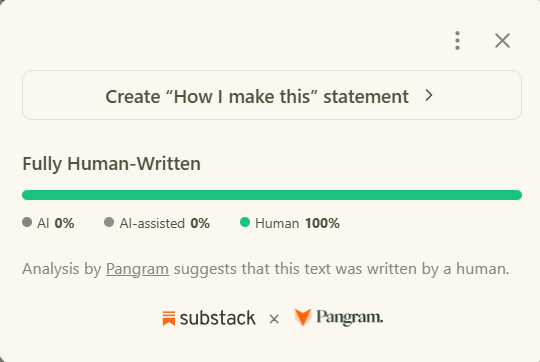
Substack (the platform which you read this newsletter) recently announced an in-house AI text detection feature, brought to you by a little-known start-up called Pangram. Alongside this feature, Substack announced an optional “How I made this” disclosure for writers who want to describe the role of AI in their work.
As intended, the announcement has sparked immediate pushback from many fellow Substacker’s, with some arguing that the feature violates articles 21 and 22 of the GDPR act on the right to an automated decision-making process. Some voices have even pointed out that statistical classifiers like Pangram’s can be significantly more harsh on neurodiverse writers and non-native English speakers, as the rigid formulaic nature of their writing can be incorrectly flagged as “AI-generated.”
However, the more interesting twist to this story comes with Pangram’s plans to sell the same detection technology to law firms. On their website, Pangram claims that that their technology could provide “protection for your firm’s reputation while mitigating liability” and detect the use of ChatGPT, as well as ensuring “authentic human authorship of your work product.”
Why It Matters
I think recent shift to embrace AI text detection tools reflects the larger three-year pendulum swing in the attitudes of people towards AI in general.
In the first wave, many organizations and individuals were embarrassed to admit using AI for legal work. Then, the pendulum swung to the other side, with many firms and individuals proudly proclaiming their ability to use any form of generative AI. Now, as we see the first signs of disillusionment with the “AI slop” approach, many organizations are are moving back towards premium human writing.
Could we see third-party text scanners starting to be used by law firms? Say that your in-house document management system or email gateway is scanning work-product emails for authenticity and providing a score on every email before it goes out to a client.
I’m curious though, if you were to view my work as being “fully AI generated”, would you be less likely to read it?

Spellbook has announced the launch of its contracts tool for Google Docs. Available in beta, the tool debuted alongside a wider effort by Spellbook to attract more in-house legal and corporate counsel clients, as well as enter the Google Workspace ecosystem.
Willkie Farr has announced a significant AI partnership with OpenAI, with the goal of accelerating the firm’s “legal and business innovation engine”, Willkie Works. The collaboration marks one of the few attempts by major law firms to develop their own large-scale infrastructure, as opposed to relying on third-party vendors.
Magic Circle firm Clifford Chance has launched a custom AI-powered knowledge bank created in collaboration with Microsoft and Epiq Advisory for Law Firms. Clifford Chance appears to favor building custom AI infrastructure within familiar enterprise software.

Perplexity is going deep into the legal vertical:
Product Counsel @ SpaceXAI
Legal Engineer @ Ivo
AI Engineer @ Orbital
Subscribe to Best Practice to receive updates like this every Sunday.

We discussed:
→ Why vendors are already moving beyond “agentic AI” to full end to end outcomes.
→ The difference between selling software and selling an outcome, and why so many legal AI vendors are stuck between the two.
→ His theory that legal is heading toward the same moment retail banking hit with digital challenger banks in 2015, and what Big Law should do about it before it’s too late.
I hope you enjoy listening just as much as I did recording it!
Want to feature in the Best Practice podcast? Email george@georgehannah.com


Beyond Substack, The Guardian reports there has been a lot of “AI slop” in science. According to an article published in the Guardian this week, generative AI photo editing tools are causing issues for birdwatchers and other amateur scientists who attempt to enhance their photographs of wildlife, birds, and plants.
Because many people use AI photo enhancements to improve their low-resolution or badly framed photos, generative AI incorrectly alters the appearance of birds and other wildlife, introducing characteristics of other species in the process. This creates challenges for scientists and amateur “ornithologists” hoping to catalog the migration patterns of wildlife birds, as some AI-enhanced images depict species in locations where they are not likely to appear, such as North American red-winged blackbirds in Brazil.
According to the article, while actual fakes are relatively rare, many experts think AI-enhanced “real images” pose a threat to biodiversity science. Crazy!
That’s everything for this week.
If you have suggestions for improving Best Practice, or simply want to introduce yourself, then hit reply to this email. I read every response!
See you next week,
George, Editor of Best Practice
Comments
Nothing yet. Say the first thing.
Sign in to join the conversation.