
Welcome back. Lots to cover this week, including:
English law says it already has the answer to Al liability
Harvey's token usage jumps 14x in six months
Grok 4.5 narrowly tops Harvey's legal benchmark
Let’s dig in.
THIS WEEK IN LEGAL AI
For years lawyers have been weighing up what happens when AI gets something wrong. This week we have seen the UK Jurisdiction Taskforce launch a 130 page statement with their take. And lucky for you, your editor has spent the best part of a couple of hours analysing and unpacking what they have got to say.
English law, they argue, already has the tools. Doctrines such as contract, negligence, product liability, professional duties and defamation can all be made to work in an AI context.
The harder question is where responsibility lands when you have a supply chain where models are opaque, outputs (from AI) are unpredictable and humans may be only partly in control of what the machine produces.
That matters given we are moving from the “experimentation” phase of AI into something which is being as widely adopted, as say the internet as been, by professionals, businesses and consumers at a huge scale.
They argue that a careless user may be liable. Also that a professional who fails to check an AI output may be liable. In some cases, a professional might even be criticised for not even using AI (for perhaps increasing the speed of contract review) where a “competent peer” would have done so.
Foundation model developers, by contrast, may often sit further from the harm, especially where a general-purpose model is used (perhaps in a legal context) in ways they could not reasonably foresee.
Some of the statement’s main messages are that:
AI does not float above the law. It is not a legal person.
It cannot itself be sued.
Responsibility will still attach to humans and companies: those who build, sell, deploy, recommend, rely on or publish through it.
If English law can already stretch to cover AI harms, then the next battleground will be looking at whether businesses can prove they used it responsibly.
That means the boring work becomes valuable. Everything from procurement, governance, audit trails, testing, contract drafting, model selection, supervision, and crystal-clear internal policies.
I think the statement is really good (and rather accessible as a second year law student)
You can give it a read it here.
BEST PRACTICE PODCAST
We discussed:
→ Why vendors are already moving beyond “agentic AI” to full end to end outcomes.
→ The difference between selling software and selling an outcome, and why so many legal AI vendors are stuck between the two.
→ His theory that legal is heading toward the same moment retail banking hit with digital challenger banks in 2015, and what Big Law should do about it before it’s too late.
I hope you enjoy listening just as much as I did recording it!
Want to feature in the Best Practice podcast? Email george@georgehannah.com
WORTH KNOWING
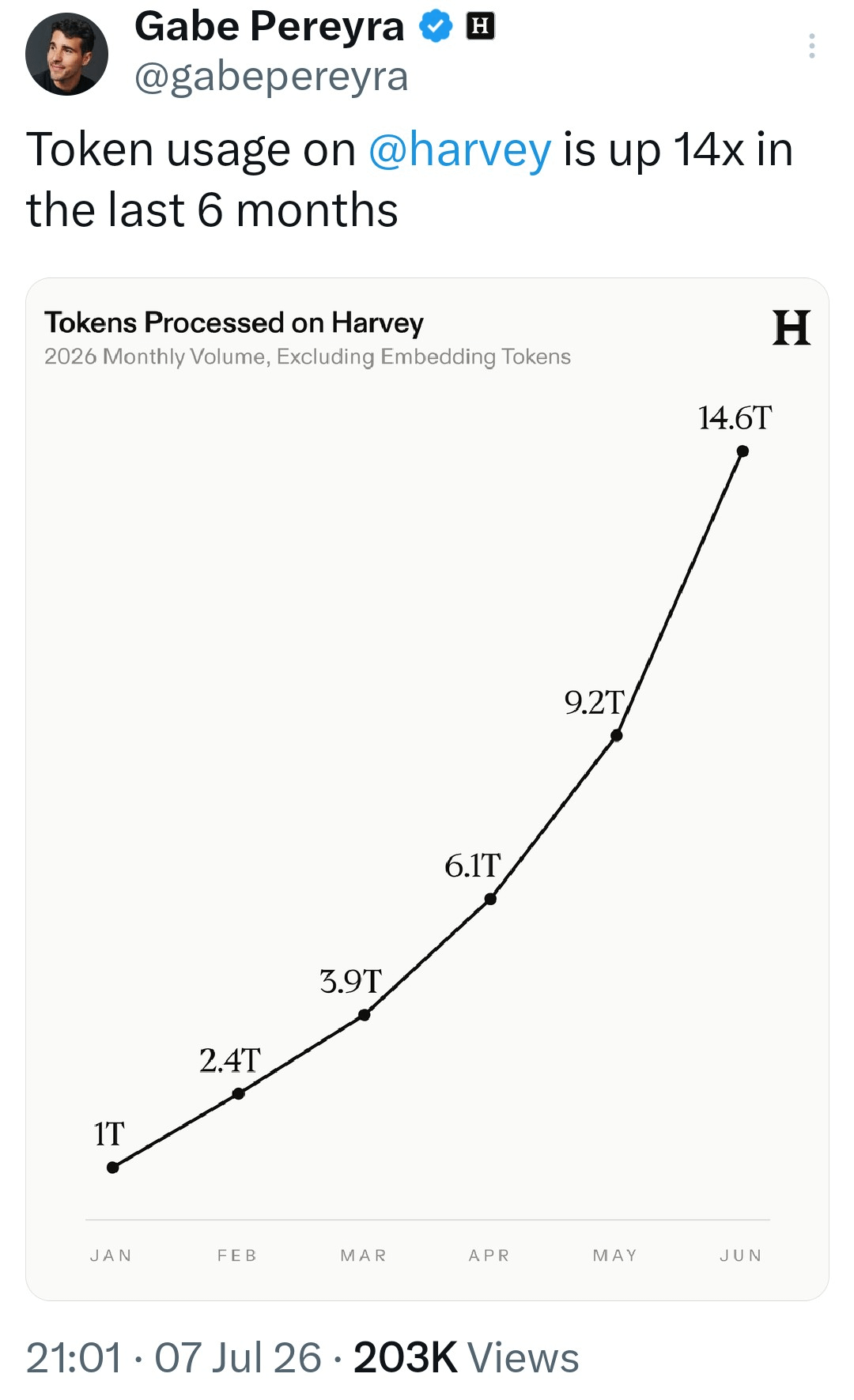
Harvey co-founder Gabe Pereyra revealed this week that token processing on the platform has grown fourteen-fold in six months, with monthly volume now in the trillions. He expects consumption-based pricing to become standard as agentic tools drive costs up - a single 100,000-document contract review can already run to roughly $20,000 in tokens. Rival Legora has already moved to consumption-based pricing for its agent product.
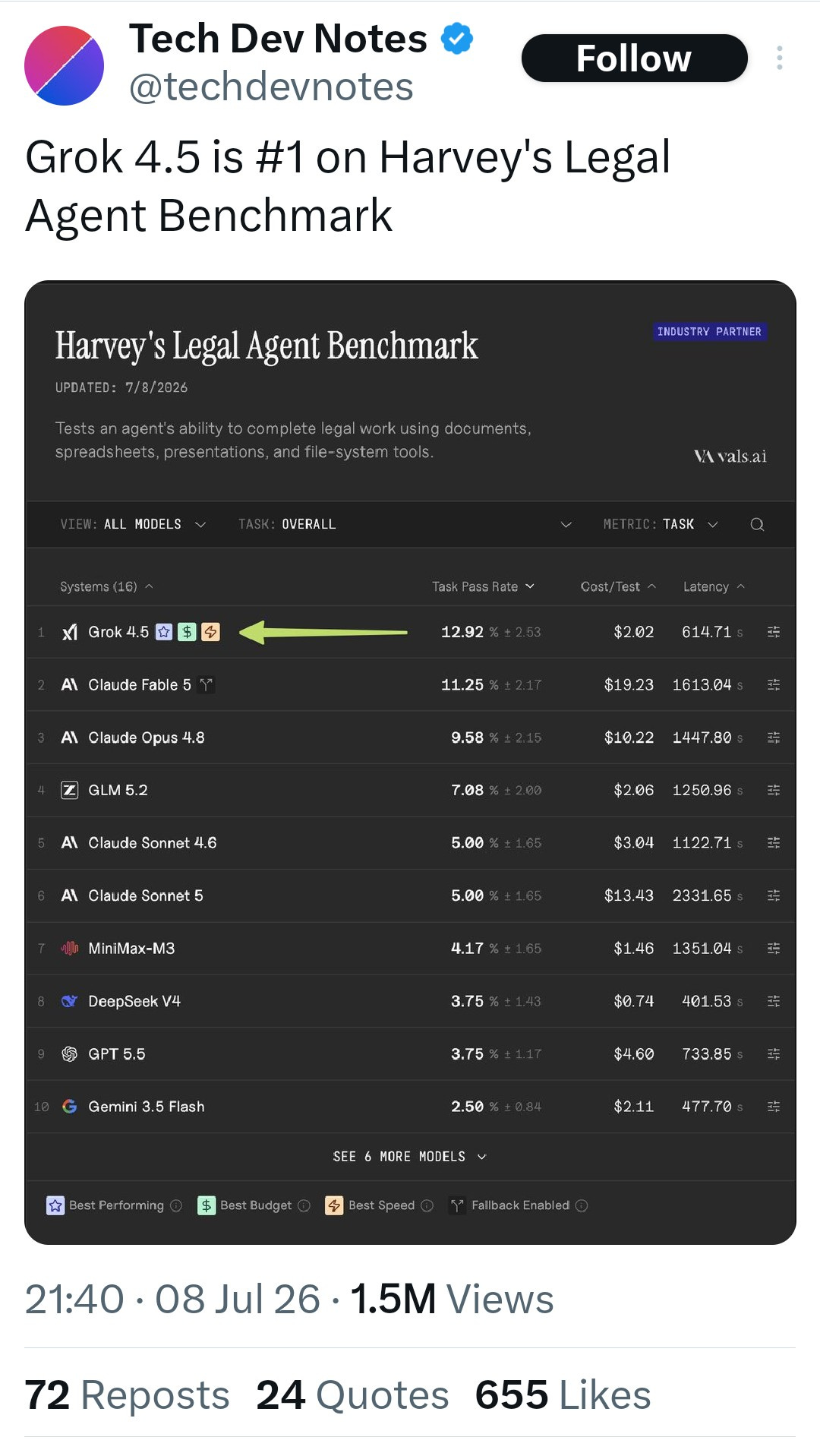
Harvey open-sourced its Legal Agent Benchmark (LAB) this month, testing AI agents against 1,200-plus real legal tasks. Grok 4.5 leads the early leaderboard with a task pass rate of 12.92%, followed by Claude Fable 5 and Claude Opus 4.8. Every model scored in single digits bar the leader — a reminder of how far agentic legal AI still has to go.
IN OTHER AI NEWS
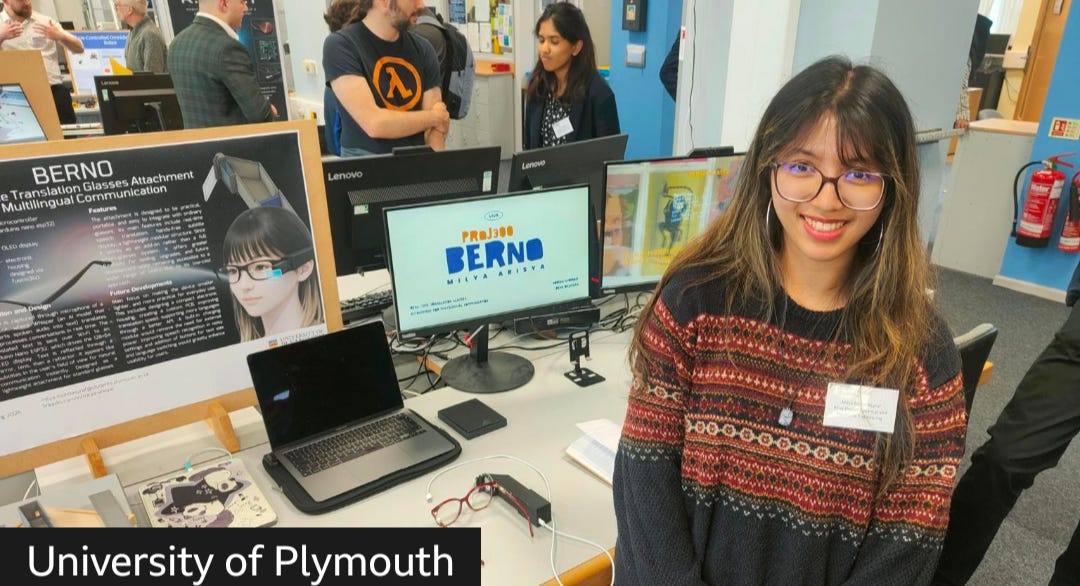
First reported by the BBC, Milya Mohd Asyraf, a 22-year-old electrical and electronic engineering student at the University of Plymouth, has spent six months building a clip-on device that translates and transcribes speech in real time, projecting the text onto a small screen positioned in front of a person's glasses.
The best bit is that it only cost around £30, using recycled and affordable components. A microphone captures speech, an AI model translates and converts it into text, and a microcontroller sends the result over wi-fi to the display.
Asyraf, who grew up in a multilingual household, has said the device works best when programmed for a specific language, and that it doubles as a subtitle tool for people who are hard of hearing.
Enjoying Best Practice? Share it with a colleague.
If you have suggestions for improving Best Practice, or simply want to introduce yourself, then hit reply to this email. I read every response!
See you next week,
George, Editor of Best Practice
Comments
Nothing yet. Say the first thing.
Sign in to join the conversation.